
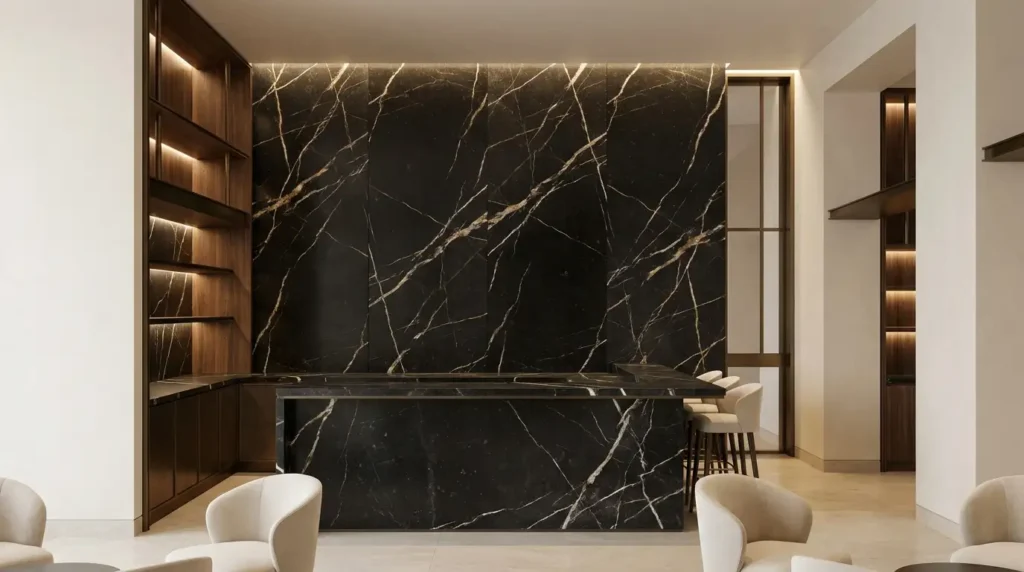
Few natural stones create visual contrast as immediately as Sahara Noir marble.
Its deep black to charcoal background is crossed by distinctive white, cream, gold and warm mineral veins that often form unusually straight or intersecting lines.
The result is very different from the flowing movement typically associated with white marble.
Sahara Noir can appear:
- graphic
- architectural
- dramatic
- luxurious
- geometric
- contemporary
without relying on an artificial printed pattern.
The material originates from Tunisia and is commercially recognized for its dark background with white and gold-colored veining.
This makes it particularly effective for applications such as:
- feature walls
- hotel receptions
- bathrooms
- vanity tops
- fireplaces
- kitchen islands
- bar counters
- flooring
- staircases
- restaurant interiors
- custom furniture
- luxury residential interiors
However, Sahara Noir is not a stone that should simply be ordered by name and installed randomly.
Its strongest characteristic is its pattern.
That means the success of a project depends heavily on:
- actual slab selection
- vein position
- panel dimensions
- cutting layout
- finish
- joint positioning
- slab sequence
- lighting
- surrounding materials
- maintenance
What Is Sahara Noir Marble?
Sahara Noir is a dark natural stone originating from Tunisia.
In the dimension-stone market, it is widely sold and specified as Sahara Noir marble.
However, geological and commercial terminology do not always align perfectly. Some technical descriptions identify the material more specifically as a very fine-grained compact black limestone, while it remains commercially categorized and sold as marble.
For architectural specification, this distinction matters because the project should understand both:
the commercial stone name
and
the actual mineral and technical characteristics of the selected material.
Visually, Sahara Noir typically combines:
- deep black
- charcoal black
- dark brown-black
- white calcitic veins
- warm gold-colored veins
- cream lines
- occasional warm brown mineral movement
One of its most recognizable characteristics is the geometry of its veins.
Rather than creating broad clouds, the lines may appear:
- relatively straight
- sharply angled
- intersecting
- fragmented
- almost architectural
This gives Sahara Noir a highly distinctive appearance.
Where Does Sahara Noir Come From?
Sahara Noir is a natural stone from Tunisia. Current stone references associate it with Tunisian quarrying areas and consistently identify Tunisia as its country of origin.
This origin should not be confused with the style or naming of other black marbles found in Europe or elsewhere.
For projects where origin is commercially or contractually important, documentation should always refer to the actual material being supplied.
The trade name alone should not replace:
- origin documentation
- slab approval
- project specifications
- technical data where required
What Makes Sahara Noir Visually Distinctive?
The strongest visual feature is contrast.
The dark background creates an almost graphic canvas.
Across this background, lighter mineral veins can appear in:
- white
- ivory
- cream
- golden beige
- ochre-gold
This combination creates an effect that can feel more structured than many other marbles.
A large Sahara Noir slab may resemble an abstract architectural drawing.
That makes it particularly suitable for spaces where stone needs to become part of the visual identity.
Not Every Sahara Noir Slab Looks the Same
Natural stone should never be expected to behave like a repeating manufactured surface.
One Sahara Noir slab may contain:
- several strong white lines
- very little gold
- large uninterrupted black areas
Another may contain:
- stronger gold-colored veins
- denser intersections
- more fragmented black areas
A third may be significantly calmer.
For this reason, a small sample is not enough for important applications.
The entire slab composition matters.
Sahara Noir for Feature Walls
Feature walls are among the strongest applications for Sahara Noir.
The reason is simple.
A large wall allows the complete natural pattern to remain visible.
Large panels can reveal:
- long white veins
- intersecting mineral lines
- dark uninterrupted areas
- gold-colored details
- natural relationships between slabs
This can work especially well in:
- hotel lobbies
- luxury residences
- restaurants
- entrance halls
- executive offices
- private clubs
- high-end commercial interiors
The surrounding architecture should usually remain relatively restrained.
Sahara Noir already provides a strong graphic element.
Large Panels vs Small Tiles
For a highly patterned stone, panel size makes a major difference.
Small tiles repeatedly interrupt the veins.
Large-format panels preserve more of the natural geological composition.
For an important wall, large pieces can provide:
- fewer joints
- stronger visual continuity
- clearer vein patterns
- a greater sense of natural stone scale
However, panel dimensions should respond to:
- available slab dimensions
- wall geometry
- handling requirements
- fabrication
- installation
- technical requirements
The largest possible panel is not automatically the best panel.
Planning a Sahara Noir Feature Wall
Start with the final wall dimensions.
Then establish:
- total width
- total height
- doors
- openings
- electrical outlets
- lighting locations
- furniture
- joints
After this, the wall panels can be positioned over photographs of the actual slabs.
This allows the design team to control exactly where important veins will appear.
Without this step, a dramatic white or gold line may end up:
- hidden behind furniture
- cut through an opening
- lost at the edge
- divided across unrelated panels
The stone may still be beautiful.
The design opportunity has simply been wasted.
Can Sahara Noir Be Bookmatched?
Suitable consecutive slabs can sometimes be arranged into mirrored compositions.
This can create a highly dramatic feature wall.
Because Sahara Noir often contains relatively straight or intersecting veins, symmetrical matching can create strong graphic forms.
Possible applications include:
- reception walls
- fireplaces
- luxury bathrooms
- restaurant walls
- large residential feature walls
However, symmetrical matching should not be treated as compulsory.
Some slabs look better with natural directional flow.
Bookmatch or Natural Vein Flow?
These approaches create very different effects.
Symmetrical Matching
Creates:
- strong central symmetry
- greater drama
- a decorative focal point
- more formal composition
Natural Vein Flow
Creates:
- more organic movement
- less obvious symmetry
- greater architectural continuity
- a more natural composition
The correct choice depends on the actual slabs.
Do not decide before reviewing them.
Sahara Noir for Hotel Reception Areas
Sahara Noir works particularly well in hotel reception environments.
A reception area needs a clear visual anchor.
The stone can be used on:
- reception desk fronts
- reception countertops
- background walls
- side panels
- nearby decorative surfaces
For example:
Sahara Noir reception desk
warm beige flooring
walnut wall panels
warm white plaster
can create a strong identity without covering the entire lobby in dark stone.
This is usually more effective than using a statement marble on every surface.
Sahara Noir for Bathrooms
Dark stone can create extremely sophisticated bathrooms when used with restraint.
Sahara Noir can be considered for:
- shower walls
- vanity tops
- vanity walls
- bathroom floors
- bathtub surrounds
- shelves
- niches
- custom basins
A balanced contemporary bathroom might combine:
Sahara Noir wall
dark walnut vanity
warm white surfaces
brushed bronze fixtures
The white and gold-colored veins then become visible without the entire bathroom becoming overwhelmingly dark.
Sahara Noir Shower Walls
A full-height shower wall can be one of the strongest applications.
Large-format panels preserve the natural pattern.
Before fabrication, plan:
- panel joints
- shower controls
- niches
- shelves
- corners
- fittings
One of the most common mistakes with expensive patterned marble is placing a large niche directly through the most attractive part of the slab.
The opening should be considered during the layout stage.
Sahara Noir Vanity Tops
A vanity requires relatively little material, allowing a particularly attractive section of a slab to be selected.
The design should consider:
- basin opening
- faucet location
- backsplash
- front edge
- visible side returns
The main vein should be positioned deliberately.
For example, a strong gold-colored line running along the length of a vanity can become part of the design.
Sahara Noir for Flooring
Sahara Noir can also be used for interior flooring.
Commercial references list flooring among its architectural applications.
However, a dark patterned floor creates a very different atmosphere from beige or white marble.
It can make a space feel:
- more dramatic
- more formal
- visually deeper
- more intimate
Potential applications include:
- entrance halls
- selected lobby areas
- powder rooms
- restaurants
- private dining areas
- luxury residential spaces
For very large floors, careful selection becomes especially important.
Large Sahara Noir Floors
Imagine several hundred square meters of black marble.
If every piece contains dense white and gold veins, the floor may become extremely busy.
A calmer slab group may therefore be more suitable for large floor areas than the most dramatic material.
Selection should consider:
- background continuity
- vein density
- direction
- joint layout
- tile size
- lighting
Highly dramatic slabs can then be reserved for walls or other focal surfaces.
Pre-Installation Arrangement
Pre-arranging flooring or wall pieces can help control the overall pattern.
The project team can review:
- dark areas
- stronger veins
- quieter pieces
- neighboring elements
- pattern direction
Pieces can then be numbered according to their intended installation position.
This can be especially useful for Sahara Noir because the bright veins remain highly visible against the black background.
Sahara Noir for Fireplaces
A fireplace is naturally a focal point.
Sahara Noir can intensify that role.
Possible approaches include:
- full-height fireplace wall
- simple surround
- stone mantel
- large central slab
- side returns
A minimal composition may use:
Sahara Noir fireplace wall
warm oak flooring
off-white walls
simple furniture
The black stone becomes the main visual anchor.
Technical requirements around the fireplace must be coordinated with the specific system being used.
Sahara Noir for Kitchen Islands
A large island allows the stone pattern to be seen from several angles.
Sahara Noir may be used for:
- island countertop
- side panels
- waterfall-style ends
- backsplash
- bar surfaces
A strong vein can potentially continue from the horizontal surface to a vertical side when the cutting layout is carefully planned.
This type of continuity should be designed before fabrication.
Marble in Kitchens Requires Realistic Expectations
Sahara Noir is a calcium-carbonate-based natural stone and should be maintained accordingly.
Calcareous stones are sensitive to acidic substances.
Products containing lemon, vinegar or other acids can dull or etch these surfaces.
In kitchen environments, particular attention should be given to:
- lemon juice
- vinegar
- wine
- acidic foods
- acidic cleaning products
Spills should be addressed promptly.
Natural stone should be selected with an understanding of how it will age and be maintained.
Sahara Noir for Bar Counters
Dark stone is particularly effective in bar environments.
Warm directional lighting can highlight:
- gold-colored veins
- white mineral lines
- polished depth
- black background
Possible applications include:
- bar tops
- bar fronts
- wall panels
- shelving backgrounds
However, bars also expose the stone to:
- citrus
- wine
- alcohol
- cleaning chemicals
Care expectations should therefore be considered during specification.
Sahara Noir for Restaurants
Restaurants are well suited to dramatic stone because lighting can be carefully controlled.
Sahara Noir can be used for:
- host desks
- bar areas
- dining-room feature walls
- fireplace surrounds
- bathroom vanities
- selected floors
- custom tables
The best result often comes from concentrating the stone in one or two important locations.
Sahara Noir for Staircases
The stone can also be considered for:
- treads
- risers
- landings
- side cladding
- surrounding walls
Pattern planning is important.
A staircase containing random bright veins on every step can become visually fragmented.
A controlled sequence can produce a much stronger result.
Sahara Noir for Custom Furniture
Natural stone furniture is another effective use.
Possible pieces include:
- coffee tables
- dining tables
- side tables
- console tables
- display plinths
- reception furniture
- stone benches
For furniture, evaluate:
- slab dimensions
- thickness
- structural support
- edge details
- vein placement
- fabrication requirements
The most visually interesting part of the slab should normally remain on the most visible face.
Polished Sahara Noir
Polishing can intensify the appearance of dark natural stone.
A polished Sahara Noir surface can show:
- deeper black
- stronger contrast
- brighter white veins
- more visible gold-colored details
- higher reflection
This finish can be particularly effective for:
- wall panels
- reception desks
- bathroom vanities
- decorative furniture
- fireplaces
- bar counters
Current commercial descriptions commonly present polished Sahara Noir as a key finish.
Honed Sahara Noir
A honed finish produces lower reflection.
This can make Sahara Noir feel:
- softer
- more architectural
- more contemporary
- less formal
The background may also appear slightly lighter than a highly polished surface.
A honed finish can be particularly attractive with:
- walnut
- natural oak
- warm plaster
- matte metal
- linen
- cream fabrics
If the natural vein pattern is already very strong, reducing reflection can create better visual balance.
Polished or Honed Sahara Noir?
Consider polished when you want:
- maximum black depth
- strong vein contrast
- reflection
- a formal luxury character
Consider honed when you want:
- softer black tones
- reduced glare
- contemporary architecture
- a quieter surface
Whenever possible, compare actual samples made from the same material.
Photographs can exaggerate or reduce the difference between finishes.
Finish Can Change the Apparent Color
Dark stones respond strongly to surface finish.
Polishing may make Sahara Noir appear:
- darker
- richer
- more contrasted
Honing may make it appear:
- softer
- slightly greyer
- more subdued
Lighting changes the perception even further.
This is why final material approval should ideally consider both:
finish + lighting
together.
Sahara Noir + Walnut
Walnut is one of the strongest supporting materials.
Both are dark, but their textures are completely different.
Sahara Noir provides:
- mineral geometry
- sharp veins
- black depth
Walnut provides:
- warm brown color
- natural grain
- softer organic movement
The combination can feel rich without requiring excessive ornament.
Sahara Noir + Warm White
Warm white provides the visual breathing room that dark marble needs.
It can be used for:
- walls
- ceilings
- cabinetry
- furniture
- plaster surfaces
This prevents the room from becoming too dark.
A strong combination can be:
one Sahara Noir wall
warm white architecture
walnut
rather than covering every surface with black marble.
Sahara Noir + Beige Stone
This is an excellent strategy for larger projects.
A warm beige stone can cover the primary surfaces.
Sahara Noir can then become the accent.
For example:
light beige floor
Sahara Noir reception desk
or:
cream bathroom
Sahara Noir vanity wall
The dark stone becomes much more visible when surrounded by restrained light materials.
Sahara Noir + Ivory Travertine
The contrast can be particularly architectural.
Ivory Travertine provides:
- warm cream color
- natural pores
- sedimentary texture
Sahara Noir provides:
- dark contrast
- graphic lines
- a denser appearance
This can work well when one stone clearly has the primary role and the other is used as an accent.
Sahara Noir + Bronze
Brushed bronze can connect naturally with the warm gold-colored veins.
Use it sparingly for:
- lighting
- handles
- bathroom fixtures
- thin architectural profiles
- furniture details
Too much bright metallic finish can make the interior feel overly decorative.
A muted brushed surface is usually more restrained.
Sahara Noir + Black Metal
Black metal can create an almost monochromatic material palette.
This works particularly well in:
- restaurants
- bars
- contemporary offices
- minimalist residences
However, the design should include enough contrast through:
- warm lighting
- wood
- cream fabrics
- pale plaster
otherwise the space may become too dark.
Sahara Noir + Light Oak
Light oak creates a stronger contrast than walnut.
It can make Sahara Noir feel more contemporary and less formal.
For example:
Sahara Noir fireplace
light oak floor
warm white walls
can create a highly modern residential interior.
Sahara Noir + Afyon White
A black-and-white stone palette can create strong architectural contrast.
Afyon White provides:
- brightness
- neutral white stone
- greater reflected light
Sahara Noir provides:
- depth
- graphic movement
- dark focal surfaces
The combination should generally avoid excessive pattern density.
If Sahara Noir is highly veined, a relatively calm white stone is easier to balance.
Sahara Noir + Rosso Levanto
These are both strong statement stones.
Using them together requires much more restraint.
Sahara Noir offers:
- black background
- white and gold-colored lines
Rosso Levanto offers:
- burgundy background
- light contrasting veins
If both are used in the same interior, one should normally remain clearly secondary.
Otherwise the materials may compete for attention.
How Lighting Changes Sahara Noir
Lighting has an enormous impact on dark natural stone.
Strong Daylight
Can reveal:
- charcoal areas
- subtle brown-black tones
- fine mineral details
- differences in finish
Warm Artificial Lighting
Can emphasize:
- gold-colored veins
- warm brown details
- deeper black surfaces
Cool Artificial Lighting
Can emphasize:
- white veins
- grey tones
- sharper contrast
The same slab can appear dramatically different under different lighting temperatures.
Grazing Light
Light directed across the surface from the side can emphasize:
- surface texture
- fine veins
- joint lines
- changes in finish
This can be particularly effective on honed stone.
However, it can also reveal fabrication and installation irregularities.
Lighting and stone installation should therefore be coordinated.
How to Select Sahara Noir Slabs
The slab-selection process should follow the project design.
1. Define the Desired Background
Do you want:
- very deep black
- black-charcoal
- slightly warmer dark tones?
2. Define Vein Density
Do you want:
- very calm material
- medium veining
- highly graphic veins?
3. Define the Gold-to-White Balance
Some slabs may show more white.
Others may contain more warm gold-colored movement.
4. Review Full Slabs
Never approve a major statement wall from a small sample alone.
5. Review Multiple Slabs Together
Several attractive slabs may not necessarily create a compatible group.
6. Confirm Dimensions
Especially for large wall panels and furniture.
7. Select the Finish
Polished and honed can create dramatically different effects.
Why Full-Slab Photography Is Important
Sahara Noir is highly graphic.
A small sample might contain:
- only black
- one white line
- one gold-colored area
It tells you very little about the complete composition.
A full-slab photograph shows:
- vein direction
- line intersections
- large uninterrupted black zones
- distribution of warm veins
- overall pattern density
This is essential for pattern planning.
Cutting Layout
For strongly patterned stone, cutting should not begin before the layout is reviewed.
A structured process can be:
- Finalize the dimensions.
- Photograph the actual slabs.
- Position required pieces digitally.
- Review the main veins.
- Review openings.
- Review joints.
- Review corners.
- Approve the arrangement.
- Begin fabrication.
This process is especially important for:
- reception desks
- walls
- kitchen islands
- vanities
- fireplaces
- custom furniture
Planning Corners
If the design includes visible side returns, the stone relationship around the corner should be considered.
A strong white vein suddenly ending at a corner can look accidental.
Depending on the slabs and fabrication method, the design may attempt to create greater visual continuity between the front and side faces.
The objective is not artificial perfection.
It is intentional composition.
Slab Yield Matters
The most beautiful slab is not necessarily the most efficient slab for a project.
Suppose a large wall requires four tall panels.
A dramatic slab may contain beautiful veins but have dimensions that create excessive waste.
Another slab may allow the required pieces to be cut much more efficiently.
A good project balances:
visual quality
with
material yield.
Numbering Custom Pieces
For complex projects, individual fabricated pieces should be clearly organized.
A system may connect:
drawing
→
piece number
→
crate
→
installation position
This reduces confusion on site.
It becomes particularly useful when neighboring panels were selected to create a specific vein relationship.
Natural Variation Is Not a Defect
Sahara Noir is genuine natural stone.
Variation can occur in:
- background darkness
- gold-colored veining
- white veins
- pattern density
- mineral details
The objective should not be to force every slab to look identical.
The objective is to establish an acceptable project range.
How to Clean Sahara Noir
Proper care begins with understanding that this is a calcium-carbonate-rich natural stone.
For routine maintenance:
- Remove loose dust and grit.
- Clean spills promptly.
- Use soft cleaning materials.
- Use a pH-neutral cleaner suitable for natural stone.
- Avoid acidic cleaners.
- Avoid aggressive abrasive products.
- Rinse surfaces appropriately after cleaning.
Natural stone care guidance states that products containing lemon, vinegar and other acids can dull or etch calcareous stone.
Can You Use Vinegar on Sahara Noir?
No.
Vinegar is acidic.
Acid can chemically affect the surface of calcium-carbonate-based stone.
On dark polished stone, etching can be particularly noticeable.
A damaged area may appear:
- dull
- grey
- cloudy
- lighter than the surrounding polished surface
This may be much more visible on black marble than on some lighter stones.
What Is Etching?
Etching is different from ordinary dirt.
An acid reacts with the stone and alters the surface finish.
On polished Sahara Noir, this may appear as a dull patch where the surrounding stone remains reflective.
Natural stone care guidance identifies acids as a cause of etch marks.
Cleaning alone may not restore the original finish.
Professional restoration may be required.
Fingerprints and Water Marks on Dark Stone
Dark polished surfaces can visually show:
- fingerprints
- water marks
- dust
- cleaning residue
more easily than some lighter stone surfaces.
This should be considered for:
- bar tops
- vanity tops
- reception counters
- high-touch furniture
Proper cleaning methods and realistic maintenance expectations are important.
Should Sahara Noir Be Sealed?
There is no universal rule that every natural stone surface requires the same treatment.
An appropriate impregnating treatment can increase resistance to certain everyday dirt and spills, but sealing does not make natural stone stain-proof.
The decision should consider:
- actual stone
- finish
- application
- exposure
- maintenance requirements
Does Sealer Prevent Acid Etching?
No.
This distinction is essential.
A sealer may improve resistance to certain staining agents.
It does not make calcium-carbonate stone chemically resistant to acids.
Therefore:
sealed Sahara Noir is not acid-proof Sahara Noir.
Acidic cleaners should still be avoided.
Sahara Noir for High-Traffic Floors
A decorative bathroom floor and a hotel entrance do not experience the same conditions.
For high-traffic flooring, evaluate:
- actual material properties
- finish
- installation system
- entrance protection
- cleaning program
- maintenance
- replacement material
Sand, dirt and grit can act as abrasives on stone floors, making regular removal and entrance mats important.
Exterior Use Requires Technical Evaluation
Because Sahara Noir is a dark calcium-carbonate-based stone, exterior specification should be approached carefully.
General marble guidance notes that weathering and acid rain can affect marble, and exterior applications are more commonly associated with white marbles, subject to exceptions and project-specific evaluation.
Therefore, do not assume that Sahara Noir is universally suitable for:
- every facade
- every climate
- every exterior paving application
Exterior use should be evaluated according to:
- actual material
- technical test data
- climate
- exposure
- finish
- fixing system
- panel dimensions
- local requirements
For many design projects, Sahara Noir is most naturally treated as a premium interior material.
Sahara Noir for Luxury Residential Interiors
In residential architecture, Sahara Noir can be especially effective for:
- master bathrooms
- fireplaces
- kitchen islands
- dining tables
- entrance consoles
- feature walls
- powder rooms
The strongest strategy is usually not to use it everywhere.
One carefully selected stone element may define the entire room.
Sahara Noir for Hotels
Hospitality projects can use the material strategically for:
- reception walls
- reception desks
- bars
- premium bathrooms
- restaurant features
- fireplaces
- lift lobbies
- decorative furniture
A limited quantity can create a memorable identity.
This can also make material selection more controlled because the most dramatic slabs can be reserved for the most visible surfaces.
Sahara Noir for Restaurants and Bars
Dark marble naturally complements lower, warmer lighting levels.
The white and gold-colored veins can become visually stronger under controlled illumination.
A restrained restaurant palette might use:
Sahara Noir
dark walnut
warm plaster
brushed bronze
soft lighting
The stone becomes decorative without requiring additional busy patterns.
Sahara Noir vs Rosso Levanto
These materials create dramatically different moods.
Sahara Noir
Offers:
- black background
- white and gold-colored veins
- geometric movement
- sharper graphic contrast
Rosso Levanto
Offers:
- burgundy background
- white mineral veining
- warmer dramatic color
- richer red depth
Choose Sahara Noir when the design needs a black architectural focal point.
Choose Rosso Levanto when a dark warm-colored focal point is preferred.
Sahara Noir vs Tundra Grey
These stones have very different roles.
Sahara Noir
Is:
- dark
- dramatic
- graphic
- visually dominant
Tundra Grey
Is:
- medium grey
- calmer
- more neutral
- easier to use over large areas
A project may even use a calm grey stone as the background and Sahara Noir as a strategic accent.
Sahara Noir vs Afyon White
This is a strong contrast.
Afyon White provides:
- brightness
- lightness
- neutral white marble
Sahara Noir provides:
- darkness
- graphic lines
- strong focal character
Used together carefully, the palette can create a highly architectural black-and-white interior.
Sahara Noir vs Silver Travertine
Although both can work in dark contemporary interiors, their geological appearance is very different.
Sahara Noir
Provides:
- dense dark background
- sharp white and gold-colored veins
- more graphic contrast
Silver Travertine
Provides:
- grey sedimentary layers
- natural pores
- horizontal direction when vein cut
- softer mineral variation
Choose according to whether the design requires:
graphic veins
or
layered texture.
Common Mistakes with Sahara Noir
1. Selecting from a Small Sample
A small sample cannot communicate the full vein composition.
2. Ordering Without Reviewing Slabs
Actual slab patterns matter enormously.
3. Cutting Before Planning
Major veins may be lost in openings.
4. Using the Stone on Every Surface
The interior can become visually too dark and busy.
5. Ignoring Slab Sequence
Important wall compositions may lose continuity.
6. Choosing Finish from Photographs Alone
Polished and honed dark stone can look significantly different.
7. Using Acidic Cleaners
Acids can etch calcareous stone.
8. Assuming Sealer Makes the Stone Acid-Proof
It does not.
9. Assuming Every Sahara Noir Slab Is Identical
Natural variation is expected.
10. Specifying Exterior Use Without Technical Review
Exterior performance should be verified for the actual project conditions.
How to Plan a Sahara Noir Project
A practical process is:
1. Define the Application
Wall, vanity, floor, fireplace, island, reception or furniture?
2. Finalize the Dimensions
Know approximately what must be produced.
3. Define the Desired Vein Character
Calm or dramatic?
More white or more gold-colored movement?
4. Review Actual Slabs
Prefer full photographs and complete project quantities.
5. Select the Finish
Polished or honed.
6. Prepare the Cutting Layout
Position important pieces on the real slab photographs.
7. Review Vein Positions
Check openings and edges.
8. Review Panel Relationships
Natural flow or symmetrical matching?
9. Number the Pieces
For complex projects.
10. Perform Quality Control Before Packing
Verify:
- dimensions
- finish
- visible condition
- piece numbers
- pattern sequence
Is Sahara Noir a Good Choice for Large Projects?
It can be highly effective when used strategically.
Potential project types include:
- luxury hotels
- villas
- restaurants
- private clubs
- high-end residences
- offices
- commercial interiors
For large projects, Sahara Noir often works best as a signature material rather than as a universal background stone.
For example, a hotel may use a light neutral natural stone across thousands of square meters while using Sahara Noir only for:
- reception
- bar
- selected bathrooms
- fireplaces
Those smaller areas may become the most visually memorable surfaces in the project.
Why Sahara Noir Works in Contemporary Design
Sahara Noir already contains its own graphic composition.
That makes it particularly compatible with simple architecture.
A contemporary interior may need only:
Sahara Noir
walnut
warm white plaster
bronze
glass
The veins provide the decoration.
The architecture can remain restrained.
This is one of the reasons the stone can look equally appropriate in:
- minimal residences
- dark restaurants
- luxury hotels
- modern commercial interiors
Final Thoughts
Sahara Noir marble is one of the strongest choices for designers who want a dark natural stone with a highly recognizable graphic character.
Its deep black-to-charcoal background creates visual depth.
Its white and gold-colored natural veins introduce contrast.
And its often linear or intersecting pattern gives the material a distinctly architectural quality.
It can be used for:
- feature walls
- bathrooms
- vanity tops
- hotel receptions
- fireplaces
- floors
- kitchen islands
- bars
- stairs
- custom furniture
But the best results are created before installation begins.
A successful project considers:
actual slabs
vein position
finish
cutting layout
panel sequence
lighting
surrounding materials
maintenance.
Review the full slabs.
Decide where the strongest veins should appear.
Do not hide the best parts of the material inside openings.
Use dark stone strategically.
Avoid acidic cleaners.
And do not expect an impregnating treatment to make marble completely stain-proof or acid-proof.
When Sahara Noir is treated as a natural architectural composition rather than simply a black surface, even a relatively small amount of stone can become one of the defining elements of an interior.
Frequently Asked Questions
What is Sahara Noir marble?
Sahara Noir is a dark natural stone from Tunisia with a deep black-to-charcoal background and characteristic white and gold-colored veins. It is widely marketed as marble, although some technical descriptions classify the material more specifically as a compact fine-grained limestone.
Where does Sahara Noir come from?
Sahara Noir originates from Tunisia.
What color is Sahara Noir?
It generally has a deep black or charcoal background crossed by white, cream and gold-colored natural veins.
Can Sahara Noir be used for walls?
Yes. Large interior wall panels are one of its strongest decorative applications.
Can Sahara Noir be used for flooring?
Yes, it is commercially used for interior flooring, subject to appropriate material selection, finish, installation and maintenance for the project.
Can Sahara Noir be used in bathrooms?
Yes. It can be considered for walls, vanity tops, floors, bathtub surrounds and custom stone elements with appropriate specification and care.
Is polished or honed Sahara Noir better?
Neither is universally better. Polishing creates deeper black tones and stronger reflection, while honing creates a softer and more contemporary appearance.
Can Sahara Noir be bookmatched?
Suitable consecutive slabs may be arranged into mirrored compositions when the natural pattern supports the design.
Can Sahara Noir be used for kitchen countertops?
It can be used for kitchen surfaces, but users should understand that calcium-carbonate-based natural stone can be etched by acidic substances such as lemon and vinegar.
Can vinegar damage Sahara Noir?
Yes. Acidic products can dull or etch calcareous natural stone surfaces.
Does sealing make Sahara Noir stain-proof?
No. An appropriate impregnating treatment may increase resistance to certain everyday spills, but it does not make natural stone completely stain-proof.
Does sealing prevent acid etching?
No. Sealing and acid resistance are different. Marble can still react with acidic substances after an impregnating treatment has been applied.
Looking for Sahara Noir Marble for Your Project?
VeraMarbles can support residential, hospitality and commercial projects requiring Sahara Noir marble.
Send us your:
- required quantity
- application
- dimensions
- thickness
- preferred finish
- desired vein character
- architectural drawings
- project location
We can support your project with:
- slab selection
- color and vein control
- slabs
- tiles
- custom cutting
- cutting-layout planning
- vein arrangement
- symmetrical slab matching
- pre-installation arrangement
- piece numbering
- packing coordination
- quality control before shipment
Request a Quote from VeraMarbles