
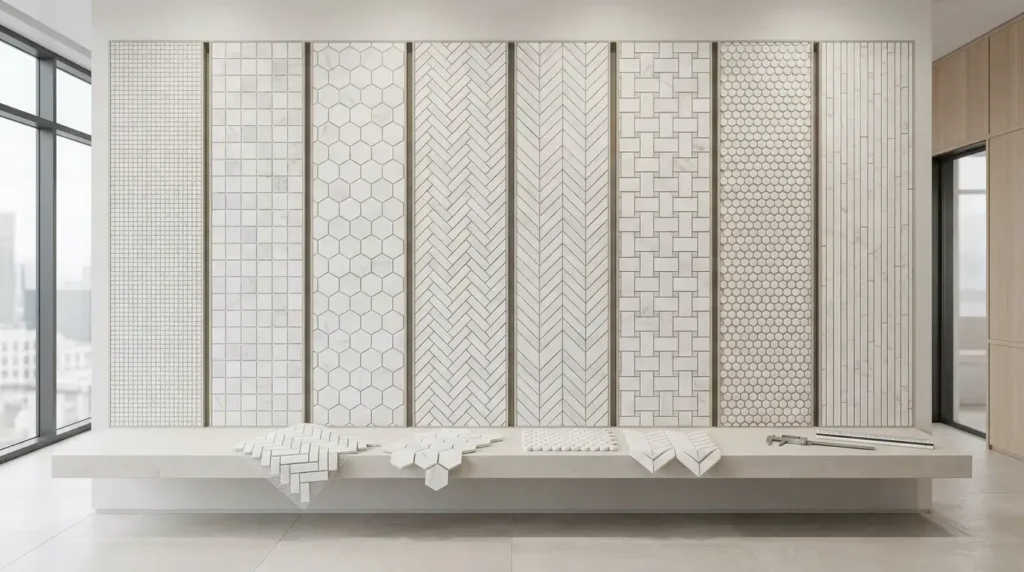
Marble mosaic size is not a minor product-detail decision.
It changes the architecture.
A mosaic made from:
10 × 10 mm chips
can read almost like a continuous textured surface.
The same marble cut into:
50 mm hexagons
becomes a much more legible geometric pattern.
Use elongated strips and the surface becomes directional.
Use penny rounds and grout becomes a much larger part of the visual composition.
Use herringbone and the wall begins to express movement.
For architects, the important question is therefore not only:
“Which mosaic pattern do we like?”
It is:
“What scale should this pattern have in this particular architectural space?”
That decision affects:
- visual density
- stone visibility
- grout proportion
- sheet geometry
- cutting
- transitions
- corners
- drainage
- installation
- material yield
This guide explains the main marble mosaic sizes and formats from an architectural rather than purely decorative perspective.
Mosaic Size Has Three Different Meanings
When specifying mosaic, architects should distinguish between:
chip size
sheet size
and
pattern repeat.
These are not the same thing.
Chip Size
The chip is the individual stone element.
Examples include:
- 10 × 10 mm square
- 15 × 15 mm square
- 25 × 25 mm square
- 15 × 76 mm herringbone strip
- 50 mm hexagon
Chip dimensions control the visual scale.
Sheet Size
Multiple chips are commonly assembled into one installable sheet.
The sheet may measure approximately:
- 250 × 300 mm
- 300 × 300 mm
- 330 × 250 mm
or another size depending on pattern geometry.
The sheet exists primarily for:
- handling
- installation
- packing
It is not necessarily the visual module of the finished surface.
Pattern Repeat
Some patterns repeat across several chips or extend beyond the rectangular sheet boundary.
This is particularly important for:
- herringbone
- chevron
- basketweave
- interlocking patterns
- custom geometric mosaics
The architect should understand all three dimensions.
Do Not Write Only “30 × 30 cm Mosaic”
A specification such as:
“300 × 300 mm marble mosaic”
may describe only the sheet.
It tells the installer almost nothing about the actual visible pattern.
The specification should identify:
- individual chip geometry
- nominal sheet dimensions
- thickness
- finish
- mounting
where appropriate.
Why Mosaic Scale Matters
Imagine one 2400 mm-high shower wall.
A 10 mm mosaic may create hundreds of small visual repetitions.
A large hexagon may create only several dozen.
The stone is the same.
The architectural expression is completely different.
Small Mosaic Reads as Texture
As individual stone pieces become smaller, the eye increasingly reads:
- collective tone
- grout network
- texture
rather than individual marble pieces.
This can be useful when the design needs:
- softness
- tactile character
- fine visual rhythm
Large Mosaic Reads as Geometry
As the chips become larger, the viewer can more easily see:
- each individual stone
- each vein
- each polygon
- the boundaries of the pattern
The mosaic becomes more graphic.
Viewing Distance Changes the Result
A mosaic selected from a desk sample at:
50 cm
may look completely different when installed on a wall viewed from:
5 meters.
Architects should evaluate patterns at representative viewing distance.
10 × 10 mm Square Marble Mosaic
The 10 × 10 mm square is among the finest conventional architectural mosaic scales.
It creates:
- very high joint density
- fine texture
- relatively low visual importance of each individual chip
- strong ability to follow small changes in surface geometry
The surface can begin to read almost like:
stone textile.
Where 10 × 10 Works Well
Potential applications can include:
- detailed shower floors
- small bathroom zones
- curved features
- spa surfaces
- decorative fields
- custom gradients
subject to the suitability of the actual stone and complete installation system.
Visual Character of 10 × 10
On a white marble:
- grey veins become fragmented
- background variation becomes distributed
- grout contributes strongly to the final color
The natural geology becomes less slab-like and more granular.
10 × 10 and Strongly Veined Stone
Highly dramatic marble cut into tiny pieces can produce:
- isolated dark chips
- fragmented veins
- unexpected color concentration
Always review the actual stone in mosaic form.
Do not assume the slab appearance will survive at miniature scale.
15 × 15 mm Square Marble Mosaic
The 15 × 15 mm format provides a middle ground between:
- ultra-fine mosaic texture
- more legible natural stone.
Compared with 10 × 10 mm, it can show slightly more of:
- marble color
- crystal character
- local veining
without becoming a large geometric module.
Architectural Character
15 × 15 mm can work when the designer wants the wall or floor to feel:
- refined
- detailed
- clearly mosaic
without the extremely dense appearance of smaller tesserae.
Staggered Small Squares
Small squares can also be arranged in staggered configurations rather than a strict aligned grid.
This changes the visual rhythm while maintaining the same general chip scale.
The specification should clarify whether the intended layout is:
- straight
- staggered
- custom
rather than identifying only the size.
20–25 mm Square Marble Mosaic
Around the 20–25 mm range, individual pieces become much more legible.
The viewer begins to see:
- natural marble variation
- isolated veins
- each individual square
more clearly.
This is an extremely useful architectural scale.
25 × 25 mm Square
A 25 × 25 mm square can balance:
stone visibility
and
mosaic texture.
Compared with 10 × 10 mm, it creates:
- fewer joints
- more visible marble
- stronger geometry
while remaining small enough for many detailed applications.
23 × 23 mm and Similar Production Formats
Real factory production does not always use exact round metric dimensions.
A nominal small-square mosaic may use dimensions such as:
- approximately 23 × 23 mm
- approximately 25 × 25 mm
depending on product design and production system.
Architectural drawings should therefore use actual approved product data rather than assuming nominal dimensions.
Square Mosaic and Grout Color
Because the geometry is simple, grout becomes one of the main design controls.
For example:
white marble + warm-white grout
can create a softer continuous field.
white marble + medium-grey grout
can turn the same product into a visible grid.
The architect should decide whether the design emphasizes:
stone
or
geometry.
50 × 50 mm Square Mosaic
A 50 × 50 mm square begins to feel closer to small-format stone tile than fine mosaic.
It provides:
- much more visible geology
- lower joint density
- stronger modular grid
This can be useful where the designer wants:
natural stone first
and
mosaic second.
Large Squares and Shower Slopes
Larger chips may not follow complex multi-directional slopes as easily as smaller mosaic.
That does not make them automatically inappropriate.
But drain geometry and slope configuration should be reviewed.
Never choose wet-area mosaic size from aesthetics alone.
Hexagon Marble Mosaic
Hexagon is one of the most versatile natural-stone mosaic geometries.
It can range from:
- very fine honeycomb texture
to:
- large individual stone modules.
Therefore:
“hexagon mosaic”
is not a sufficient specification.
Small Hexagon
Small hexagons create:
- high geometric density
- soft honeycomb effect
- strong grout participation
At distance they can read as a continuous textured field.
50 mm Hexagon
A larger approximately 50 mm hexagon allows:
- individual marble pieces
- local veins
- tonal variation
to become much more visible.
It creates a more graphic architectural surface.
Real Hexagon Sheet Geometry
A 50 mm hexagon does not necessarily sit on a perfect 300 × 300 mm sheet.
The interlocking geometry may create sheet dimensions such as approximately:
263 × 305 mm
depending on the product.
This illustrates why architects should request actual sheet data.
Hexagon on Walls
Large hexagons work particularly well when the design intends the geometry to remain visible.
Applications can include:
- feature walls
- shower walls
- vanity walls
- kitchen surfaces
depending on project conditions.
Hexagon on Floors
For floors, consider:
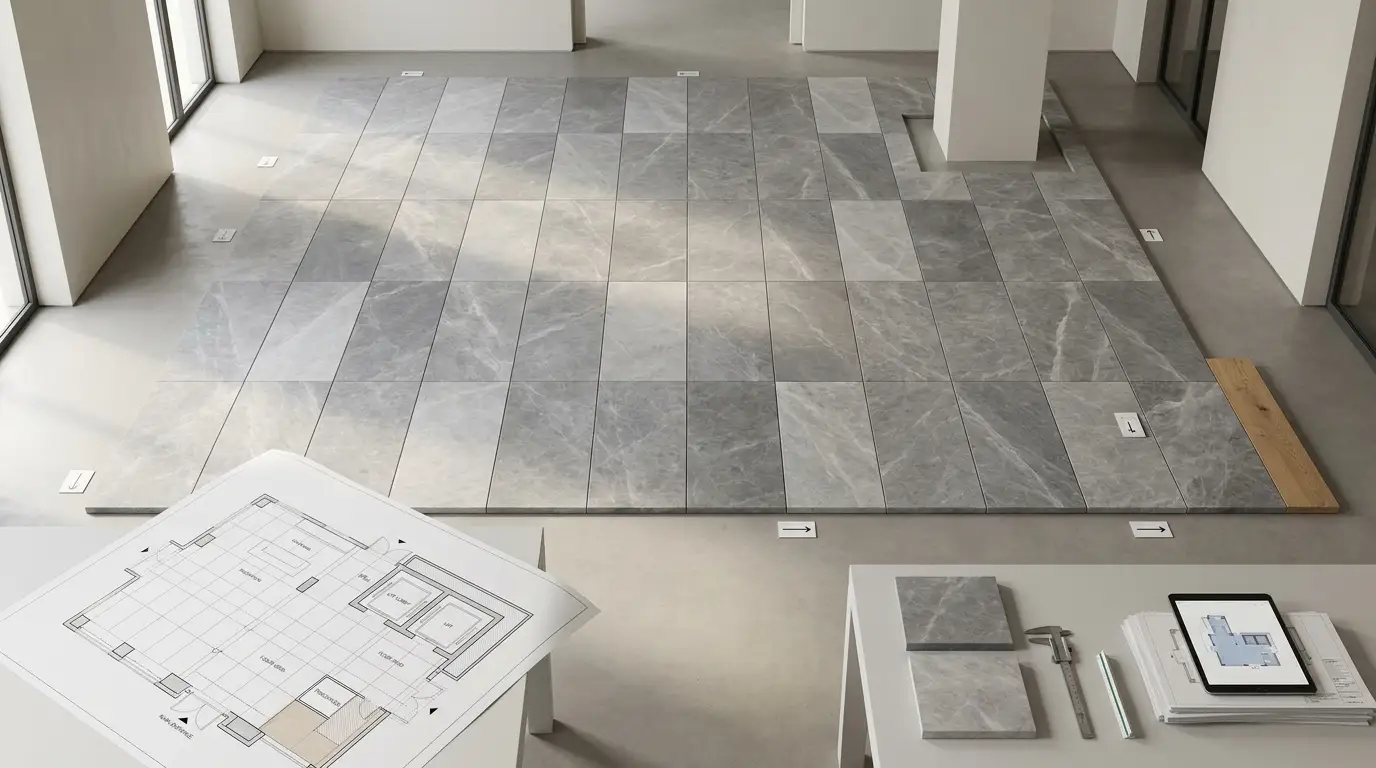
- chip scale
- joint density
- finish
- installation system
- expected use
rather than assuming all hexagon mosaics behave identically.
Herringbone Marble Mosaic
Herringbone is created from rectangular pieces arranged in an interlocking zigzag.
Its defining characteristic is direction.
The pattern has a clear visual axis.
Herringbone Piece Size Matters
Compare:
15 × 76 mm
with:
25 × 50 mm.
Both can be called:
herringbone marble mosaic.
But they produce radically different architectural expressions.
Thin Herringbone
Long narrow pieces create:
- finer direction
- more lines
- greater pattern density
This can feel:
- elegant
- detailed
- textile-like
especially on vertical surfaces.
Broader Herringbone
Shorter or broader rectangular pieces create:
- more stone visibility
- larger zigzag
- more graphic appearance
This may work better on:
- larger walls
- broader floor areas
where a tiny pattern could disappear.
Real Herringbone Sheet Size
Because pieces project beyond one another, herringbone sheets are often irregular.
A real product using approximately:
15 × 76 mm pieces
may have a sheet around:
263 × 329.5 mm
rather than 300 × 300 mm.
Another herringbone using approximately:
25 × 50 mm pieces
may be configured around a more conventional sheet size.
Therefore:
piece size and sheet size must be specified separately.
Herringbone Orientation
Herringbone can be oriented:
- vertically
- horizontally
- toward a focal point
Rotation changes the perceived proportions of the wall.
Vertical Herringbone
Can emphasize:
- height
- upward movement
Horizontal Herringbone
Can emphasize:
- width
- lateral movement
The architect should show orientation on elevations.
Chevron Marble Mosaic
Chevron is often confused with herringbone.
They are not the same pattern.
Herringbone
Uses rectangular pieces.
They overlap visually to create a broken zigzag.
Chevron
Uses pieces cut at an angle.
Their ends meet to create continuous V-shaped lines.
The result is usually:
- cleaner
- sharper
- more directional
than herringbone.
Thin Chevron
A thin chevron may create:
- elegant linear movement
- relatively fine scale
- strong vertical or horizontal rhythm
A real natural-stone production sheet may measure approximately:
330 × 254 mm
rather than exactly 300 × 300 mm.
Again, actual geometry matters.
Chevron Needs Accurate Alignment
Small installation deviations are especially visible in chevron because the V lines should continue coherently across neighboring sheets.
Sheet boundaries must disappear visually.
Chevron for Feature Walls
Chevron can work particularly well on:
- vanity walls
- reception details
- shower features
- decorative lobby surfaces
where directional movement contributes to the architecture.
Herringbone vs Chevron
Choose herringbone when you want:
- more traditional interlock
- broken directional rhythm
- softer zigzag
Choose chevron when you want:
- sharper V geometry
- continuous direction
- stronger graphic movement
Neither is universally more contemporary.
Scale, marble and architecture determine the result.
Basketweave Marble Mosaic
Basketweave creates a repeated woven effect from:
- elongated rectangular pieces
- smaller square inserts
or related geometries.
It introduces more information than simple squares.
Typical Basketweave Character
A common configuration may use:
- approximately 25 × 50 mm rectangles
with smaller contrasting components.
Sheet dimensions may be around:
305 × 305 mm
for certain designs.
But this should not be treated as universal.
Basketweave and Stone Contrast
Basketweave can use:
- one marble
- two marbles
- marble plus contrasting natural stone
The visual intensity changes significantly.
Low Contrast Basketweave
Using similar stones creates:
- subtle geometry
- quiet luxury
- softer pattern
High Contrast Basketweave
Using:
- white
- black
or another strong contrast makes the pattern much more visible.
For large architectural areas, test the contrast at full scale.
Basketweave and Architectural Style
Basketweave is often associated with classic interiors.
But material and scale can make it feel highly contemporary.
For example:
monochromatic honed marble basketweave
can read very differently from a traditional black-and-white version.
Penny Round Marble Mosaic
Penny round is built from small circular stone pieces.
Because circles do not tessellate without space between them, grout occupies a significant part of the visible surface.
This makes grout particularly important.
Visual Character
Penny round creates:
- softer geometry
- high joint density
- fine repetitive rhythm
It works especially well where the designer wants a surface to feel:
- tactile
- continuous
- less linear.
Real Penny Round Sheet Size
A penny-round sheet may be close to:
285 × 298 mm
or another irregular dimension depending on the circle size and production arrangement.
It should not be assumed to be exactly 300 × 300 mm.
Penny Round and Grout
With square mosaic, grout appears primarily as intersecting straight lines.
With penny round, grout wraps around every circular piece.
Therefore, changing grout color can dramatically change the final surface.
Light Grout
May soften the field and allow the marble to dominate.
Contrasting Grout
May create a pronounced dotted pattern.
Review physically before specifying.
Penny Round in Wet Areas
The many joints and small pieces can allow the mosaic to conform to certain sloped surfaces more readily than large stone tile.
But the designer still must evaluate:
- actual finish
- stone
- drain
- slope
- waterproofing
- setting system
- required slip performance.
Pattern alone does not determine suitability.
Kitkat Marble Mosaic
Kitkat formats use long narrow stone strips.
They may also be described using terms such as:
- finger mosaic
- thin strip mosaic
depending on market terminology.
Why Kitkat Is Architecturally Different
The pattern is strongly linear.
When installed vertically, it can visually stretch the wall upward.
When installed horizontally, it can make a surface feel wider.
Vertical Kitkat
Potentially useful for:
- vanity feature walls
- bar fronts
- reception details
- niches
- fluted-look surfaces
when appropriate to the installation.
Horizontal Kitkat
Can emphasize:
- width
- horizontal architecture
- long counters
- elongated rooms
Strip Width Matters
Very narrow strips create:
- greater joint density
- finer texture
Wider strips show:
- more stone
- more natural variation
Specify actual piece dimensions.
Kitkat vs Fluted Stone
These are completely different products.
Kitkat Mosaic
Uses many separate narrow stone pieces with joints.
Fluted Stone
Uses grooves or sculptural relief cut into larger stone pieces.
They may create similar vertical rhythm from a distance but behave very differently in:
- fabrication
- installation
- cleaning
- joints
Do not confuse them in specifications.
Rhomboid Marble Mosaic
Rhomboid or diamond-like geometric pieces can produce:
- dimensional optical effects
- directional patterns
- more decorative compositions.
Their visual complexity is greater than simple square or hexagon formats.
Rhomboid Sheet Geometry
Because the outer edges are irregular, actual sheet dimensions may differ significantly from a nominal square.
Request:
- full geometry
- repeat dimensions
- CAD outline
when integrating the pattern with fixed architectural edges.
Pinwheel Marble Mosaic
Pinwheel patterns combine:
- larger geometric pieces
- smaller accent pieces
to create repeated rotating compositions.
They are particularly sensitive to:
- contrast
- grout
- pattern scale
because several design elements repeat simultaneously.
Low-Contrast Pinwheel
Can create subtle movement.
High-Contrast Pinwheel
Can become a dominant decorative floor or wall pattern.
Use high contrast carefully in large areas.
Windmill and Related Geometric Patterns
Windmill patterns create rotational visual movement using:
- rectangular
- square
- sometimes contrasting components.
They can work well in:
- floors
- bathrooms
- decorative feature areas
depending on scale and stone selection.
Pattern Names Are Not Universal Specifications
Names such as:
- windmill
- pinwheel
- basketweave
may be used differently by different producers.
For a construction specification, include:
- drawing
- actual product reference
- chip dimensions
rather than relying solely on the pattern name.
Octagon and Dot
Octagonal natural-stone tile with small contrasting inserts creates another classic modular system.
Although some versions use larger components than conventional mesh mosaics, the same principles apply:
- module size
- contrast
- joint
- thickness
- orientation.
Large Decorative Mosaic Sheets
Not every mosaic sheet is approximately 300 × 300 mm.
Complex decorative formats may have:
- larger bounding dimensions
- smaller coverage
- irregular edges
because their geometry is optimized around the repeat.
The architect should use:
actual effective coverage
for quantity calculations.
Sheet Size Does Not Equal Installed Visual Grid
This concept is critical.
Imagine a herringbone mosaic delivered on:
263 × 329.5 mm sheets.
The finished wall should not show:
263 × 329.5 mm rectangles.
The sheet exists only to organize installation.
The finished surface should show:
continuous herringbone.
Why Sheet Boundaries Become Visible
Common causes include:
- incorrect sheet spacing
- rigid placement without adjustment
- inconsistent internal chip spacing
- substrate irregularity
- poor interlocking geometry
- tonal variation concentrated by sheet
The Installer May Need to Adjust Individual Pieces
High-quality mosaic installation sometimes requires small local adjustments.
Mesh mounting is an installation aid.
It does not mean every sheet should be placed mechanically without visual review.
Mosaic Thickness
Architectural natural-stone mosaics commonly require the thickness to be coordinated with adjacent materials.
Real products may use dimensions such as approximately:
- 10 mm
- 12 mm
depending on pattern and stone.
Do not assume every mosaic from one collection has identical thickness.
Thickness Becomes Critical at Transitions
Typical transitions include:
- mosaic to marble tile
- mosaic to slab
- mosaic to porcelain
- mosaic to plaster
- mosaic to metal trim
- mosaic to drain
If the finish levels differ, the substrate or setting assembly may need coordination.
Marble Mosaic + Large-Format Marble
This is one of the most effective architectural combinations.
For example:
large marble wall panels
small mosaic shower floor.
The same material family can appear completely different because scale changes.
Same Stone, Different Scale
A large marble slab preserves:
- long veins
- geological movement
The mosaic converts the same stone into:
- texture
- rhythm
- modular geometry.
This creates material continuity without visual repetition.
Mosaic Scale and Natural Veining
Stone selection becomes increasingly important as the chip gets smaller.
Large Chips
Preserve more of:
- veins
- crystal structures
- local color.
Small Chips
Fragment geological movement.
The overall field becomes more:
- tonal
- granular
- abstract.
Choose stone accordingly.
Highly Veined Lilac or Violet Marble
In large slab format, purple veins may form dramatic long movements.
Cut into fine mosaic, the same stone may produce:
- white chips
- lilac chips
- vein fragments
- occasional dark pieces.
The visual result can become much more varied.
White Marble
White marble is highly flexible because:
- simple formats remain calm
- geometric patterns remain readable
- contrasting grout can strengthen the pattern
- matching grout can soften it.
But the actual natural variation should still be approved.
Dark Marble
Dark marble mosaics can create:
- highly graphic surfaces
- dramatic bathrooms
- hotel feature areas.
Joint color becomes especially visible.
A light grout can create a strong network across dark stone.
Multicolor Mosaic
Combining several natural stones increases design complexity.
The architect should define:
- exact stone for every component
- finish
- acceptable variation
- pattern map
rather than simply writing:
“multicolor marble mosaic.”
Pattern Density
Pattern density is the number of visible geometric changes within a given area.
It is affected by:
- chip size
- shape
- joint width
- color contrast.
Fine Pattern Density
Examples:
- 10 × 10 squares
- thin herringbone
- penny round
- narrow kitkat
These may feel:
- detailed
- textured
- active
at close range.
Coarser Pattern Density
Examples:
- 50 mm hexagon
- larger square
- broad basketweave
These allow:
- individual stone
- geometry
to be understood more easily.
Pattern Density and Room Size
Fine pattern can work beautifully in:
- small bathrooms
- niches
- detail zones.
Across a massive lobby wall, the same pattern may visually merge into texture.
This may be desirable.
Or it may make the expensive geometry irrelevant.
Use Full-Scale Printouts
One of the easiest ways to evaluate mosaic scale is to print the pattern:
1:1
or create a full-scale physical mock-up.
This can immediately reveal whether:
- chips are too small
- pattern is too busy
- joints dominate
- geometry disappears
at intended viewing distance.
Pattern Scale in Elevations
Place the real pattern repeat into the elevation.
Do not use a generic hatch.
A correct elevation can reveal how the mosaic terminates at:
- ceiling
- floor
- niche
- vanity
- mirror
- door.
Shower Floors
Small formats are often chosen for shower floors because they can accommodate changes in slope more easily than very large rigid pieces.
But architects should still evaluate:
- chip size
- finish
- joint system
- drain
- slope
- waterproofing
- installation method.
Central Drain
A central point drain often requires multiple slope directions.
Fine mosaics may adapt more naturally around this geometry.
Still, the drain should be integrated into the pattern.
Linear Drain
A linear drain can sometimes allow:
- simpler planar slope
- more continuous mosaic geometry.
But its location should be coordinated with the pattern and surrounding stone.
Avoid Tiny Cut Pieces Around Drains
If a drain interrupts a large hexagon or strong geometric pattern, the installer may be forced to create:
- tiny fragments
- broken shapes.
Move either:
- the drain
- pattern centerline
where design flexibility allows.
Mosaic on Shower Walls
Walls do not have the same slope requirements as floors.
This allows more freedom with:
- larger chips
- stronger patterns
- directional geometry.
But corners, niches and fixtures become more important.
Niche Scale
A small niche may not accommodate a large repeating pattern cleanly.
For example, a broad herringbone repeat may leave only:
- half a pattern
- awkward clipped ends.
Check the actual niche dimensions.
Use Different Scales Within One Bathroom
A sophisticated bathroom does not need one mosaic everywhere.
For example:
25 × 25 mm floor
thin herringbone niche
large-format marble walls
can create hierarchy while maintaining one stone family.
Do Not Use Every Pattern at Once
Natural stone already contains geological variation.
A bathroom containing:
- herringbone
- hexagon
- penny round
- checkerboard
simultaneously can become visually overloaded.
Choose a hierarchy.
Mosaic as Field vs Mosaic as Accent
Decide whether the mosaic is:
Field Material
Covering a major architectural surface.
Accent Material
Used in:
- niche
- border
- backsplash
- inset.
Fine, complex patterns can often be more effective as accents.
Hotels Need Repeatable Formats
For repeated bathrooms, the chosen mosaic should be practical across:
- many identical rooms
- repeated drains
- repeated niches
- standardized details.
A pattern that works beautifully in one custom bathroom may create unnecessary complexity across 200 rooms.
Hotel Bathroom Prototype
Before bulk production, use the prototype room to validate:
- pattern size
- sheet dimensions
- drain alignment
- grout
- transitions
- corner details
- installation time.
This can save significant problems later.
Mosaic Sheet Area
For procurement, do not calculate only by the external bounding rectangle of an irregular sheet.
Use the manufacturer’s or fabricator’s stated:
effective coverage per sheet
where available.
This is particularly important for:
- herringbone
- chevron
- irregular decorative shapes.
Real Production Examples
Actual marble mosaic production demonstrates why nominal assumptions are risky.
For example, different products may use:
- 50 mm hexagon on approximately 263 × 305 mm sheets
- 15 × 76 mm herringbone on approximately 263 × 329.5 mm sheets
- thin chevron on approximately 330 × 254 mm sheets
- penny round on approximately 285 × 298 mm sheets
- 25 × 50 mm basketweave on approximately 305 × 305 mm sheets
- 23 × 23 mm squares on approximately 305 × 305 mm sheets
The important lesson is not the specific dimensions.
It is:
pattern geometry determines real sheet geometry.
Always specify the actual product.
Do Not Build the Architectural Drawing from Assumed Sheet Sizes
If a pattern must:
- center on a wall
- align with a niche
- fit inside a border
request exact geometry before issuing final drawings.
A 20–30 mm discrepancy repeated across many sheets can shift the pattern considerably.
Sheet Layout and Wall Centerline
For symmetrical feature walls, consider whether:
- a chip
- grout line
- pattern axis
should align with the wall centerline.
This should be drawn intentionally.
Herringbone Centering
A herringbone wall can be centered on:
- V-axis
- joint
- piece
depending on desired result.
Different starting points produce different edge cuts.
Hexagon Centering
Hexagon geometry also creates multiple possible axes.
Test the pattern across the complete wall rather than centering only one sheet.
Penny Round Centering
Penny round usually reads more continuously, so exact geometric center may be less visually critical.
Perimeter cuts still deserve review.
Kitkat Alignment
For vertical kitkat, the architect may want:
- a central strip
- central joint
- symmetrical number of strips.
At highly visible vanity walls, these differences matter.
Corners
Different patterns behave differently at corners.
Square Mosaic Corners
Simple grid geometry makes continuation relatively straightforward.
Herringbone Corners
The directional pattern may not continue naturally around a 90-degree turn.
The architect should decide whether to:
- continue
- mirror
- reset
- terminate.
Chevron Corners
Chevron alignment is especially sensitive because the V geometry can become visibly broken.
Hexagon Corners
Wrapping a hexagon around an external corner may require:
- special cuts
- trim
- solid-stone return.
Study the condition.
Penny Round Corners
Small circular modules can tolerate some geometric irregularity visually, but edge detailing is still required.
Solid Stone Borders
One effective way to resolve complicated mosaic edges is using:
- solid marble strip
- pencil liner
- stone trim.
This can create a clean architectural frame.
Mosaic and Moldings
Natural-stone mosaics can be coordinated with:
- liners
- base moldings
- fluted tiles
- solid trims
to resolve transitions.
The profile should be treated as part of the complete system.
Grout Proportion Changes with Chip Size
Smaller pieces create more grout per square meter.
That means chip size affects:
- color balance
- visual texture
- maintenance.
Small Chip + Contrasting Grout
Creates a very strong grid or texture.
Small Chip + Matching Grout
Can visually blend the pieces into a softer surface.
Large Chip + Matching Grout
Allows the marble itself to dominate.
This relationship should be part of design development.
Joint Width and Chip Size
Joint width should not be chosen independently of:
- chip size
- fabrication tolerance
- edge condition
- pattern.
A small difference in joint width has much greater visual impact on:
10 mm chips
than on:
50 mm chips.
Mesh Backing
Many repetitive stone mosaics are delivered on mesh.
The mesh helps maintain:
- pattern
- spacing
- handling.
It does not guarantee that the complete installed surface will automatically align.
Check Mesh Flexibility
For curved surfaces, determine whether the:
- chip dimensions
- mesh
- spacing
can follow the required radius.
Large chips on flexible mesh may still not conform to a tight curve.
Sheet Boundary Detection
The larger and more rigid the sheet, the easier it can become to install sheets as visible blocks if spacing is not adjusted.
The installer should review the whole field continuously.
Custom Sheet Development
For large projects, standard catalog patterns can sometimes be adapted through:
- different stone combinations
- adjusted chip dimensions
- custom sheet geometry.
If creating a new product, prototype the sheet before mass production.
Sample Approval
An architect should ideally review the exact combination of:
- stone
- chip size
- pattern
- finish
- joint character
rather than approving these items separately.
One Stone, Three Samples
Consider requesting the same marble as:
- square
- herringbone
- hexagon
if the design team is uncertain.
The difference can be more dramatic than comparing three different marbles in the same format.
Mosaic Sample Board
A useful sample board may identify:
- stone
- chip dimension
- pattern
- sheet dimensions
- thickness
- finish.
This becomes a better architectural reference than a loose unlabeled piece.
Installed Mock-Up
For major projects, an installed mock-up adds information that a loose sample cannot provide:
- grout
- sheet boundaries
- real joint color
- substrate effect
- corner behavior.
Architectural Scale Mock-Up
A 300 × 300 mm sheet may not reveal a repeating installation problem.
Where possible, mock up several sheets together.
This allows the team to see whether:
- sheet outlines appear
- pattern drifts
- tone distribution is balanced.
Custom Waterjet Mosaic
Custom waterjet work moves beyond standard chip formats.
Here, the architect controls:
- individual geometry
- color map
- repeat
- borders
- composition.
The same scale principles still apply.
Avoid Extremely Small Waterjet Pieces
A CAD drawing can contain infinitely small geometry.
Natural stone cannot.
Very narrow pieces may become:
- fragile
- difficult to cut
- difficult to mount
- difficult to install.
Fabrication review should happen before design is frozen.
Brass and Stone Combinations
Decorative mosaics may combine:
- marble
- metal inserts
where appropriate.
This creates additional interfaces related to:
- thickness
- finish
- cleaning
- movement
- installation.
Treat the combination as a complete product.
Production Tolerances
The smaller the mosaic pieces, the more repeated dimensions the surface contains.
Small dimensional deviations can affect:
- pattern alignment
- sheet-to-sheet spacing.
Quality control should therefore evaluate the assembled sheet rather than only individual chips.
Check a Full Sheet
Inspection should include:
- overall dimensions
- chip geometry
- spacing
- stone range
- missing pieces
- mesh bond
- finish
- thickness.
Check Several Adjacent Sheets
One sheet may look perfect.
The actual architectural concern is:
how several sheets join.
For major projects, place multiple sheets together during quality review.
Packing
Mosaic sheets should be protected from:
- distortion
- detached pieces
- excessive bending
- moisture where relevant
- edge damage.
Boxes should maintain the geometry established during production.
Orientation Labels
Directional products can benefit from clear orientation indicators on packaging.
Especially:
- herringbone
- chevron
- kitkat
- custom patterns.
This reduces accidental rotation on site.
Quantity Planning
Mosaic quantity depends on more than floor or wall area.
Consider:
- effective sheet coverage
- pattern direction
- perimeter cuts
- niches
- corners
- spare material.
Directional Patterns May Increase Waste
Herringbone and chevron can create more edge cutting than simple square mosaics.
Actual waste should be evaluated from the drawing.
Irregular Sheet Coverage
A sheet’s external width × height may not equal actual coverage because:
- edges interlock
- pieces project beyond the nominal rectangle.
Use product coverage information.
Spare Material
Retain spare sheets for significant projects.
Later production may differ in:
- stone tone
- veining
- chip dimensions
- finish.
Original spares can make future repair much easier.
Choosing the Right Format
The right marble mosaic format depends on what the architecture needs.
Choose Small Squares When You Want:
- fine texture
- flexible geometry
- understated pattern
- high joint density.
Choose 25 mm Squares When You Want:
- balance between stone and mosaic
- simple geometry
- stronger marble visibility.
Choose Hexagon When You Want:
- clear geometry
- contemporary or classic flexibility
- greater individual stone presence.
Choose Herringbone When You Want:
- directional movement
- sophisticated repetitive rhythm
- visual energy.
Choose Chevron When You Want:
- sharper geometry
- continuous V lines
- stronger direction.
Choose Basketweave When You Want:
- woven structure
- decorative hierarchy
- potential stone contrast.
Choose Penny Round When You Want:
- soft geometry
- tactile field
- high grout participation.
Choose Kitkat When You Want:
- linear rhythm
- vertical or horizontal emphasis
- fine architectural texture.
Architect’s Mosaic Format Selection Checklist
Before specifying a format, confirm:
Architectural Scale
- room dimensions
- viewing distance
- surface area
- focal importance.
Stone
- exact marble
- natural variation
- vein intensity
- finish.
Geometry
- chip dimensions
- actual shape
- pattern repeat
- orientation.
Sheet
- actual sheet dimensions
- effective coverage
- edge geometry
- mounting.
Thickness
- mosaic thickness
- adjacent material level
- transition detail.
Joints
- internal spacing
- grout intent
- sheet-to-sheet continuity.
Application
- wall or floor
- wet or dry
- slope
- drain
- curve radius.
Details
- niches
- corners
- borders
- transitions
- trims.
Approval
- physical sheet
- multiple-sheet sample
- grout test
- installed mock-up.
Production
- dimensional tolerance
- stone distribution
- sheet consistency
- orientation marking.
Procurement
- effective sheet area
- quantity
- waste
- spare material.
If those items are defined, the architect is specifying a real mosaic product rather than only choosing a pattern name.
Questions Architects Should Ask Before Choosing Mosaic Size
- What is the exact chip size?
- What are the actual sheet dimensions?
- What is the effective coverage per sheet?
- What is the nominal thickness?
- How is the mosaic mounted?
- Is the sheet edge straight or interlocking?
- What is the internal chip spacing?
- What natural variation should we expect?
- Is the pattern directional?
- Is CAD geometry available?
- Can the pattern be centered on the architectural elevation?
- Can the mosaic follow the required slope?
- Can it follow the required curve?
- How does it meet adjacent materials?
- What grout character is intended?
- Can several sheets be reviewed together?
- Is an installed mock-up recommended?
- What waste should be expected from the actual layout?
- Can spare material be retained?
- Can a custom chip size be produced if required?
Common Mosaic Size and Format Mistakes
Specifying Only the Pattern Name
“Herringbone” does not define the product.
Assuming Every Sheet Is 300 × 300 mm
Complex patterns often use irregular sheet sizes.
Confusing Chip Size with Sheet Size
These are different dimensions.
Choosing Scale from a Small Online Image
Pattern density changes dramatically at architectural scale.
Using Highly Veined Marble in a Tiny Mosaic Without Sampling
The slab pattern may become visually fragmented.
Ignoring Grout Proportion
Small chips create much more visible grout.
Confusing Chevron with Herringbone
They have different geometry.
Ignoring Pattern Direction
Directional mosaics can alter room proportions.
Ignoring Niche Dimensions
A beautiful pattern may terminate badly inside a small niche.
Ignoring Drain Position
Strong geometry can be damaged by poorly coordinated drain cuts.
Assuming Mesh Makes Installation Automatic
Sheets still require alignment and adjustment.
Drawing with Generic 300 mm Modules
Actual pattern geometry may drift from the architectural drawing.
Ignoring Adjacent Finish Thickness
Poor transitions become visible immediately.
Using Too Many Mosaic Formats in One Room
Pattern hierarchy can disappear.
Approving One Sheet Only
Sheet-to-sheet behavior remains unknown.
Ordering Only the Net Surface Area
Directional and irregular patterns require layout-based quantity review.
A Practical Mosaic Format Selection Workflow
1. Define the Surface
Wall, floor, niche, shower or feature.
2. Define Viewing Distance
Close-detail or architectural-scale surface?
3. Select Stone Character
Calm or strongly veined?
4. Choose Pattern Family
Square, hexagon, herringbone, chevron, basketweave, penny round or kitkat.
5. Test Two or Three Scales
Do not select the first available format.
6. Obtain Actual Product Data
Chip, sheet, thickness and coverage.
7. Place the Real Pattern in the Drawing
At true scale.
8. Resolve Orientation
Especially directional formats.
9. Coordinate Drains and Niches
Before specification.
10. Resolve Material Transitions
Including thickness.
11. Review Physical Samples
Preferably several sheets.
12. Select Grout Direction
Color and visual contrast.
13. Create an Installed Mock-Up
For important projects.
14. Confirm Production Geometry
Before bulk order.
15. Calculate Quantity from Real Sheet Coverage
Not assumptions.
16. Order Spare Material
For future replacement.
This process connects:
pattern
to
real architecture.
Final Thoughts
Marble mosaic formats should not be selected like decorative icons in a catalogue.
Every change in:
chip size
shape
sheet geometry
and
orientation
changes the architecture.
A 10 × 10 mm square is not simply a smaller version of a 25 × 25 mm square.
It creates:
- more grout
- finer texture
- different stone expression.
Herringbone is not interchangeable with chevron.
Penny round makes grout a major visual material.
Kitkat creates directional lines.
Hexagon can shift from fine texture to bold geometry depending on size.
Basketweave introduces a second level of pattern hierarchy.
And actual sheet sizes often differ substantially from the convenient assumption of:
300 × 300 mm.
For architects, the best process is simple:
specify the real chip.
specify the real sheet.
draw the real repeat.
review the real stone.
coordinate the grout.
resolve the edges.
test the architecture at full scale.
Then choose the format.
The goal is not to find the most interesting mosaic pattern.
It is to find the pattern whose:
scale
stone
geometry
and
installation
belong naturally to the project.
Frequently Asked Questions
What is the most common marble mosaic sheet size?
Many products are supplied around a nominal 300 × 300 mm format, but actual dimensions vary widely by geometry. Herringbone, chevron, penny round and hexagon sheets may all have different real dimensions.
What is the difference between mosaic chip size and sheet size?
Chip size is the dimension of each individual stone piece. Sheet size is the overall mounted assembly containing multiple chips.
Is 10 × 10 mm marble mosaic too small?
Not necessarily. It creates a fine textured appearance with high joint density and can be useful for detailed or geometrically demanding areas.
Is 25 × 25 mm marble mosaic better than 10 × 10 mm?
Neither is universally better. 25 mm pieces show more marble and create fewer joints, while smaller chips create finer texture and can adapt more readily to certain surface geometries.
What size marble mosaic is best for shower floors?
There is no single universal size. Chip size should be coordinated with slope, drain geometry, stone finish, joint system and relevant wet-floor requirements.
What is a 50 mm hexagon mosaic?
It is a hexagonal stone piece with approximately 50 mm nominal geometry, typically assembled into an interlocking sheet. Exact sheet dimensions vary by production design.
What is the difference between herringbone and chevron?
Herringbone uses rectangular pieces arranged in an interlocking zigzag. Chevron uses angled pieces that meet to form continuous V-shaped lines.
Does herringbone come in different sizes?
Yes. Thin elongated herringbone and broader herringbone formats create very different visual scales.
What is penny round mosaic?
Penny round uses small circular stone pieces arranged on mounted sheets, creating high joint density and a soft repetitive pattern.
Why does grout matter so much with penny round?
Circular pieces leave significant visible joint area around each chip, so grout color strongly influences the overall surface.
What is kitkat marble mosaic?
Kitkat is a linear mosaic made from long narrow stone strips. It creates a strong directional texture and may be installed vertically or horizontally.
Is kitkat the same as fluted marble?
No. Kitkat is composed of separate stone strips with joints. Fluted marble is generally a larger stone surface sculpted with grooves.
What is basketweave marble mosaic?
Basketweave combines rectangular and smaller geometric components into a repeating woven pattern.
Are all mosaic sheets 300 × 300 mm?
No. Actual sheet dimensions depend on chip geometry and pattern. Some sheets are irregular or interlocking.
Why should architects request CAD geometry for mosaics?
Exact CAD geometry allows the real pattern repeat to be coordinated with walls, niches, drains, borders and architectural centerlines.
Can the same marble look different in different mosaic sizes?
Yes. Small chips fragment natural veins and create a more textured field, while larger chips preserve more of the stone’s geological character.
Should architects review more than one mosaic sheet?
For important projects, yes. Several sheets together reveal sheet-to-sheet spacing, tonal distribution and whether the sheet boundaries remain visible.
Can marble mosaic chip sizes be customized?
Custom production may allow alternative chip dimensions and patterns depending on the stone, quantity and fabrication requirements.
Selecting Marble Mosaic for an Architectural Project?
VeraMarbles supports architects and interior designers developing standard and custom natural-stone mosaics.
Send us your:
- architectural elevation or floor plan
- intended application
- preferred marble
- preferred pattern
- target chip scale
- finish
- estimated quantity
- reference image
- project location
- project schedule
We can support your project with:
- marble selection
- square mosaics
- small-format mosaics
- hexagon mosaics
- herringbone
- chevron
- basketweave
- penny round
- kitkat
- geometric mosaics
- multi-stone patterns
- custom chip dimensions
- custom sheet development
- pattern-scale studies
- sample production
- CAD coordination
- waterjet fabrication
- finish coordination
- quality control
- export packing
Request Mosaic Selection Support from VeraMarbles