
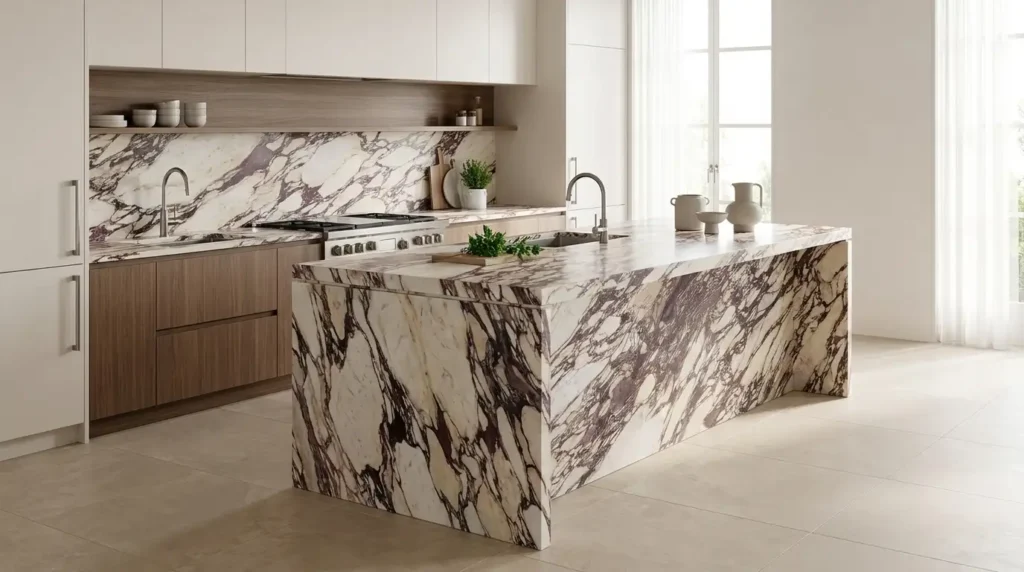
Some marbles are selected to quietly complement a kitchen. Calacatta Viola is usually chosen to become the kitchen.
With a creamy white background cut by dramatic burgundy, violet and wine-colored veining, Calacatta Viola creates the kind of natural pattern that immediately draws the eye. Authentic Calacatta Viola is associated with the Carrara and Apuan Alps stone-producing region of Italy, and its bold coloration distinguishes it from more restrained white Calacatta varieties.
That combination has made Calacatta Viola marble kitchen countertops, islands and backsplashes particularly attractive for interiors where natural stone is intended to act as an architectural feature rather than simply a neutral work surface.
But appearance is only half of the decision.
Before selecting Calacatta Viola for a kitchen, it is important to understand how marble behaves, how individual slabs should be selected and what level of maintenance comes with using a natural calcium-based stone in one of the busiest areas of a home.
Is Calacatta Viola Marble Good for Kitchen Countertops?
Yes — Calacatta Viola can be used successfully for kitchen countertops, islands and worktops, provided the owner understands the characteristics of natural marble.
The material is already commercially supplied specifically for kitchen worktops and countertop applications, while designers also use it for islands, splashbacks and full-height wall treatments.
Its biggest advantage is obvious: visual impact.
Unlike a relatively uniform engineered surface, every Calacatta Viola slab contains its own distribution of veins, colors and movement. Two kitchens using the same stone can therefore look completely different.
Its biggest consideration is equally important: it is real marble.
Marble requires more care than many engineered countertop surfaces. Acidic substances can etch its finish, while liquids and oils may stain the material if spills are left unattended or the stone is not appropriately protected. The Natural Stone Institute specifically notes that acids can cause etch marks on stone surfaces.
For clients who expect a completely unchanged surface after years of heavy use, another countertop material may be more appropriate.
For clients who value natural variation, character and architectural impact, Calacatta Viola can be exceptional.
What Does Calacatta Viola Look Like?
The defining feature of Calacatta Viola is its contrast.
The typical visual palette combines:
- creamy or warm white areas
- burgundy veining
- violet and purple tones
- wine-red movement
- occasional grey coloration
- irregular natural formations
Suppliers of Italian Calacatta Viola describe the stone as having a white or creamy background crossed by distinctive violet, purple and burgundy veins.
This is important when designing a kitchen because the stone is rarely visually passive.
A large Calacatta Viola island can become the dominant element of the room before cabinetry, lighting or furniture are even considered.
That is precisely why slab selection matters so much.
Why Calacatta Viola Works So Well on Kitchen Islands
A kitchen island gives dramatic natural stone enough surface area to display its pattern.
On a small countertop section, only a limited portion of the slab may be visible. On a large island, the relationship between the white areas and violet-burgundy veins can be seen much more clearly.
This makes Calacatta Viola particularly suitable for:
- statement kitchen islands
- waterfall islands
- large preparation surfaces
- breakfast bars
- feature countertops
- stone-clad island sides
The stone is currently being used by designers not only as a worktop but also across islands and backsplashes, allowing its veining to become a defining visual feature of the kitchen.
Waterfall Edges
A waterfall configuration continues the stone vertically from the countertop toward the floor.
With Calacatta Viola, this can be extremely effective — but only when the slab layout is planned correctly.
The important question is not simply:
“Do we want a waterfall edge?”
It is:
“How will the vein continue from the horizontal surface to the vertical surface?”
Poor vein placement can make even an expensive slab installation look disconnected.
For heavily patterned natural stones, the fabrication layout should ideally be reviewed before cutting begins.
Calacatta Viola Countertops with a Matching Backsplash
One of the strongest ways to use Calacatta Viola is to continue the countertop material onto the backsplash.
Instead of introducing another tile or surface, the same marble creates visual continuity between the horizontal and vertical planes.
This works especially well behind:
- cooktops
- sinks
- preparation areas
- open shelving
- minimalist cabinetry
A full-height marble backsplash also provides more space for the veining to become part of the architecture.
For very expressive slabs, however, more stone is not automatically better.
A highly active island combined with highly active countertops, splashbacks, flooring and walls can make a kitchen visually overwhelming.
The surrounding material palette should therefore be comparatively controlled.
Which Cabinet Colors Work with Calacatta Viola?
Calacatta Viola gives designers several directions because its veining contains both warm and dramatic tones.
Warm Wood
Walnut, dark oak and other warm woods can complement the burgundy and violet movement while preventing the kitchen from becoming overly formal.
Cream and Warm White
Warm neutral cabinetry allows the marble to remain the main visual feature.
Rather than competing with the stone, the cabinetry creates a quiet background.
Deep Burgundy or Aubergine
A more expressive approach is to pick up one of the darker colors within the marble.
Deep wine, aubergine and burgundy cabinetry can emphasize the violet-red movement.
Black or Charcoal
Dark cabinetry creates strong contrast with the lighter areas of the marble and can produce a more contemporary result.
Design commentary around Calacatta Viola has similarly highlighted darker woods, warm neutrals and softer metallic finishes as effective companions to its dramatic coloration.
Polished or Honed Calacatta Viola?
Both finishes create very different impressions.
Polished Calacatta Viola
A polished finish emphasizes:
- color depth
- contrast
- veining
- reflection
- dramatic visual movement
It is often selected when the objective is a highly luxurious, jewel-like stone surface.
Honed Calacatta Viola
A honed finish provides a softer, less reflective appearance.
It may suit interiors with:
- matte cabinetry
- natural timber
- minimalist architecture
- softer contemporary finishes
The correct choice depends less on which finish is universally “better” and more on the desired architectural character of the project.
Always inspect an actual finished sample rather than making the decision from a digital photograph.
Every Calacatta Viola Slab Is Different
This sounds obvious, but it is one of the most important aspects of buying natural stone.
You are not purchasing a printed pattern.
You are selecting an individual geological surface.
That means the exact appearance can vary significantly from slab to slab.
Before fabrication, review the actual slabs intended for your project and consider:
- Where are the strongest veins?
- Which section should become the island?
- Where will the sink opening be positioned?
- Where will the cooktop be positioned?
- Are seams required?
- How will veins meet across those seams?
- Will any edges continue vertically?
- Is bookmatching part of the design?
Selecting marble based only on a small sample can hide the most important characteristic of the material: its full-scale movement.
Guidance on selecting marble countertops also recommends reviewing actual slabs, considering the amount and pattern of veining, checking available dimensions and planning bookmatching where appropriate.
Bookmatching Calacatta Viola Marble
For some projects, consecutive slabs can be opened like pages of a book so that their vein patterns reflect one another.
This is known as bookmatching.
With a strongly patterned stone such as Calacatta Viola, bookmatching can create an exceptionally dramatic feature.
Potential locations include:
- full-height backsplashes
- feature walls
- oversized islands
- bar areas
- dining walls
- fireplace surrounds connected visually to the kitchen
It is not necessary for every project.
Sometimes a more natural, uninterrupted slab layout is more suitable.
The decision should be made while viewing the actual slabs rather than after fabrication.
Does Calacatta Viola Marble Stain?
Like other natural marbles, Calacatta Viola should not be treated as stain-proof.
Depending on the individual stone and installation, an appropriate impregnating sealer may help improve resistance to staining. The Natural Stone Institute notes that sealing makes stone more stain-resistant rather than stain-proof and recommends discussing whether sealing is appropriate with the stone supplier or fabricator.
In a kitchen, quickly address substances such as:
- cooking oils
- wine
- coffee
- sauces
- strongly colored liquids
The objective is simple: do not give spills unnecessary time to penetrate the stone.
What About Lemon and Other Acidic Foods?
This is where marble differs fundamentally from many engineered countertop materials.
Acidic substances can react with calcium-based stones and affect the surface finish.
Potential sources include:
- lemon juice
- vinegar
- citrus
- some wines
- acidic cleaning products
The Natural Stone Institute identifies acids as a cause of etching on stone surfaces.
A sealer should therefore not be viewed as a magical shield against every type of damage.
Sealing can help with staining resistance, but it does not change the underlying chemical behavior of marble.
How to Clean a Calacatta Viola Marble Countertop
Daily care does not need to be complicated.
For routine cleaning, use products suitable for natural stone.
The Natural Stone Institute recommends a neutral cleaner, stone soap or mild liquid dishwashing detergent with warm water, followed by rinsing and drying with a soft cloth.
A practical routine is:
- Blot spills quickly.
- Use a soft cloth.
- Clean with a pH-neutral stone cleaner or suitable mild cleaner.
- Rinse away cleaner residue where necessary.
- Dry the surface.
- Avoid aggressive acidic cleaning products.
For a significant stain or damaged finish, consult a natural-stone professional rather than repeatedly experimenting with household chemicals.
Should Calacatta Viola Be Sealed?
Potentially, yes — but the answer should depend on the specific slab and installation rather than a generic timetable.
The Natural Stone Institute states that many marble and granite countertops can benefit from an appropriate quality sealer, while also emphasizing that not every stone necessarily requires sealing.
Ask your stone supplier or fabricator to evaluate the actual material.
More importantly, remember:
Sealed does not mean maintenance-free.
Is Calacatta Viola Practical for a Busy Kitchen?
That depends on what you expect from the surface.
Choose Calacatta Viola if you prioritize:
- authentic natural stone
- unique slab variation
- dramatic veining
- statement design
- premium architectural character
- a material that can develop a natural patina over time
Think carefully before choosing it if you require:
- virtually zero maintenance
- complete resistance to acids
- complete stain resistance
- perfectly uniform patterns
- every countertop to remain visually unchanged
Neither expectation is wrong.
Problems occur when a material is selected for its appearance without understanding its behavior.
How to Choose the Right Calacatta Viola Slab
For a kitchen project, we recommend evaluating the full slab rather than selecting from a small sample.
1. Look at the Entire Slab
Step back.
The most important veins may only make sense when the complete slab is visible.
2. Consider Your Island Dimensions
A beautiful section of stone is useless if critical veins disappear into sink or cooktop cut-outs.
3. Plan the Cuts
Think about countertops, islands, splashbacks and vertical returns as one composition.
4. Check Slab Compatibility
If your project needs multiple slabs, review them together.
5. Discuss Vein Direction
The fabricator should understand which movements you want to preserve.
6. Photograph the Layout
Before cutting, document the approved slab layout.
This eliminates misunderstandings later in the fabrication process.
Calacatta Viola Kitchen Design Ideas
A few combinations work particularly well with this marble.
Minimal Warm Kitchen
Calacatta Viola island
- warm white cabinets
- natural oak
- brushed metal details
Dark Contemporary Kitchen
Calacatta Viola countertops
- charcoal cabinetry
- dark timber
- minimal lighting
Burgundy Statement Kitchen
Calacatta Viola island
- deep burgundy cabinetry
- warm white walls
- subtle metallic accents
Natural Architectural Kitchen
Honed Calacatta Viola
- walnut cabinetry
- limestone or timber flooring
- restrained accessories
In each case, allow the marble to do the visual work.
Final Thoughts
A Calacatta Viola marble kitchen countertop is not the quiet option.
Its creamy field, burgundy-violet veining and natural variation can transform an ordinary work surface into one of the main architectural elements of the kitchen.
The trade-off is that it must be treated as natural marble rather than an indestructible engineered surface.
Select the actual slab carefully. Plan the vein layout before cutting. Understand sealing and maintenance. Clean it correctly. And design the surrounding kitchen to complement rather than compete with the stone.
Done properly, Calacatta Viola does not simply cover a countertop.
It defines the room.
Frequently Asked Questions
Is Calacatta Viola marble suitable for kitchen countertops?
Yes. Calacatta Viola is used for kitchen countertops, worktops, islands and backsplashes. As a natural marble, however, it requires appropriate care and can be affected by staining and acidic substances.
Where does Calacatta Viola marble come from?
Authentic Calacatta Viola is associated with Italy’s Carrara/Apuan Alps marble-producing region.
Does Calacatta Viola need sealing?
Depending on the slab and installation, an impregnating sealer may be recommended. Sealing improves stain resistance but does not make marble completely stain-proof.
Can lemon damage Calacatta Viola?
Acidic substances can etch marble surfaces. Lemon, vinegar and acidic cleaners should therefore not be allowed to remain on the countertop.
Can Calacatta Viola be used for a kitchen island?
Yes. Large islands are particularly effective applications because they provide enough uninterrupted surface area to display the marble’s distinctive veining.