
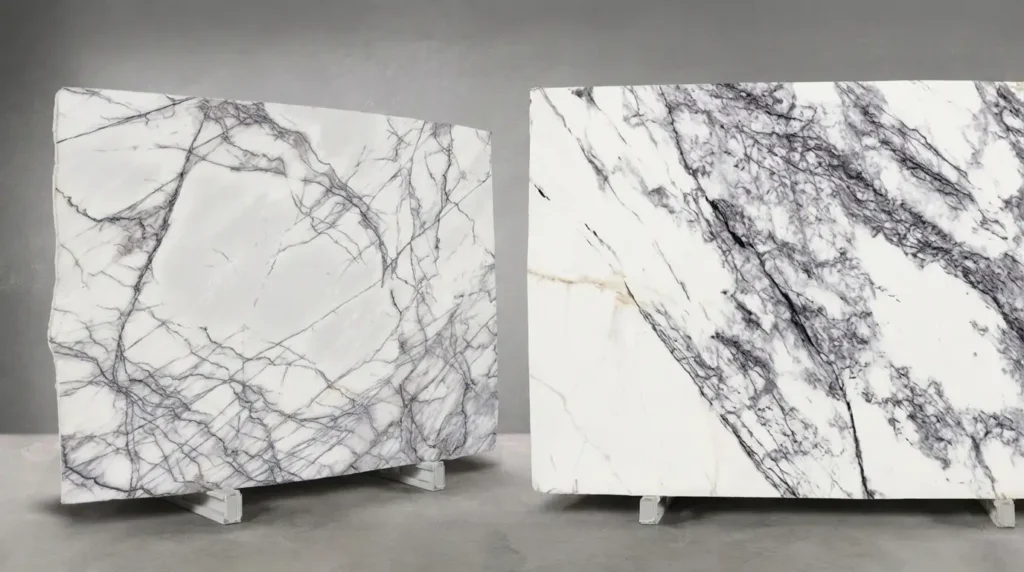
At first glance, New York Marble and Milas Lilac can look extremely similar.
Both may feature:
- a predominantly white background
- grey movement
- violet or lilac veins
- dramatic natural variation
- a clean luxury appearance
There is another reason for the confusion.
The natural stone industry does not use these two commercial names in a completely standardized way.
Some market references use Milas New York and Milas Lilac almost interchangeably, while others distinguish New York and Lilac as different visual selections within the broader group of white and purple-veined marbles from the Milas region of Türkiye.
That means choosing between them should not begin with the name printed on a quotation.
It should begin with the actual slabs.
For architects, interior designers, fabricators and project buyers, the important questions are:
- What does the actual material look like?
- How white is the background?
- How strong are the purple veins?
- How consistent is the available quantity?
- What slab dimensions are available?
- Is the project looking for subtle movement or dramatic veining?
- Can the required panels be produced from the available slabs?
- Does the selected material work with the overall design?
This guide explains how to compare New York Marble and Milas Lilac correctly.
What Is New York Marble?
In the international natural stone market, the name New York Marble is commonly used for Turkish white marble with grey, violet, purple or blue-purple natural veining.
Despite the commercial name, commonly marketed Milas New York Marble is quarried in Türkiye rather than New York. Market references associate Milas New York with the Milas area in southwestern Türkiye.
Its typical visual characteristics may include:
- white to warm-white background
- grey veining
- dark violet lines
- purple-blue movement
- relatively fine cross-veining
- areas of quieter white stone
However, the exact appearance varies considerably between blocks and commercial selections.
This variation is important.
One New York Marble selection may appear almost white and grey.
Another may contain enough violet movement to look very close to Milas Lilac.
What Is Milas Lilac Marble?
Milas Lilac is a Turkish natural marble associated with the Milas area of Muğla in southwestern Türkiye.
It is generally recognized for its light background and distinctive purple, lilac and grey natural veining.
A typical Milas Lilac slab may feature:
- bright white background
- cool white background
- lilac veins
- violet veins
- grey mineral lines
- fractured natural patterns
- branching vein structures
Some selections are extremely dramatic.
Others are considerably quieter.
This is why the material should not be evaluated from a small sample alone.
A small sample might contain only white marble.
Another sample from the same slab could contain an intense purple vein.
The complete slab tells a much more useful story.
Are New York Marble and Milas Lilac the Same Stone?
Sometimes the names overlap.
This is the most important point in the comparison.
Certain international market references describe Milas New York Marble as also being known as Milas Lilac Marble.
Other commercial classifications distinguish them as related selections, describing Lilac as generally cooler and more strongly purple-veined, while New York may have warmer white tones and less intense veining.
Therefore, it would be misleading to create a universal rule saying:
New York Marble always looks like this.
and:
Milas Lilac always looks like that.
Natural stone trade names are not the same as internationally standardized product codes.
Different quarry areas, selections, exporters and markets may use names differently.
For a real project, specify the material using:
commercial name + actual slab approval + visual range + finish + dimensions
rather than relying only on the commercial name.
The Simplest Visual Difference
When New York and Milas Lilac are sold as separate selections, a useful general distinction is often the intensity and character of the purple veining.
New York Marble
May generally be selected for:
- quieter movement
- more white space
- grey or finer violet veins
- softer contrast
- a cleaner overall appearance
Milas Lilac
May generally be selected for:
- stronger purple movement
- more visible lilac veining
- greater contrast
- more expressive slab patterns
- stronger decorative impact
But these are selection tendencies, not universal geological rules.
Always compare the actual slabs available for the project.
Background Color
The white background has a major influence on how these materials are perceived.
New York Marble Background
Some New York selections may have:
- warm white
- soft white
- slightly creamy white
- light grey-white
Milas Lilac Background
Milas Lilac is frequently selected with:
- cool white
- bright white
- pale grey-white
When strong purple veins cross a very white background, the contrast becomes much more dramatic.
This is one reason Milas Lilac is often chosen as a statement material.
Vein Color
Both materials can contain complex natural mineral movement.
Possible colors include:
- grey
- violet
- lilac
- dark purple
- blue-purple
- plum
- occasional darker mineral lines
Milas New York is described in market references as having a consistent white background with black and dark purple-blue veins.
Milas Lilac is commonly characterized by a white background with purple, lilac and grey veining.
The difference can therefore become subtle when the two selections are viewed side by side.
Vein Density
This may be more useful than focusing only on vein color.
Imagine two slabs.
Slab A
Approximately 70–80% of the visual field appears calm and white, with fine grey-purple lines crossing the surface.
Slab B
Large violet veins branch across most of the slab, creating a much stronger graphic pattern.
Even if both come from a closely related stone family, they will behave completely differently in an interior.
Slab A may be easier to use across a larger surface.
Slab B may be far more effective as a statement wall.
Which One Is More Dramatic?
A strongly selected Milas Lilac is usually the more visually dramatic option.
The combination of:
white background
strong violet veining
can create a very high-contrast surface.
This makes it particularly effective for:
- feature walls
- bathroom walls
- reception areas
- fireplaces
- kitchen islands
- custom furniture
A quieter New York selection may provide the same white-and-violet character with less visual intensity.
That can make it easier to use across larger surfaces.
Which One Looks More Minimal?
For a highly restrained interior, a quieter New York selection may be easier to integrate.
For example:
New York Marble
light oak
warm white walls
minimal black details
can create a clean contemporary space.
Milas Lilac can also work in minimalist interiors, but the stone often becomes the dominant visual element.
In that case, the surrounding materials should usually remain restrained.
Which Is Better for a Feature Wall?
If the purpose of the wall is to attract attention, a strongly veined Milas Lilac selection can be extremely effective.
Large slabs allow the natural pattern to be appreciated at full scale.
A dramatic wall may work well in:
- hotel lobbies
- luxury residences
- restaurants
- reception areas
- bathrooms
- private offices
New York Marble can also be used for an accent wall, especially when a softer and more controlled pattern is preferred.
The decision should ultimately be based on the actual slab composition.
Which Is Better for Flooring?
For large floors, excessive vein movement can become visually busy.
This does not mean Milas Lilac cannot be used for flooring.
It means the selection and layout become more important.
For a large floor, a quieter group of slabs may make it easier to create:
- consistent visual flow
- balanced vein distribution
- controlled tonal variation
- a calm overall surface
If a New York Marble selection contains more white space and finer veins, it may therefore be easier to use across a large floor.
For either material, laying out the pieces before final installation can help control visual variation.
Which Is Better for Bathrooms?
Both can work beautifully.
The real question is what type of bathroom you want.
For a Calm Bathroom
Consider:
- quieter New York Marble
- light oak
- warm white walls
- restrained metal details
For a Statement Bathroom
Consider:
- strongly veined Milas Lilac
- one large marble wall
- walnut cabinetry
- neutral flooring
- restrained fixtures
A common mistake is using highly dramatic marble on every surface.
Sometimes one carefully selected wall has more impact than covering the entire bathroom.
Which Is Better for a Shower Wall?
Both materials can create impressive full-height shower walls.
The key is panel planning.
Before fabrication, determine:
- wall dimensions
- panel dimensions
- niche location
- shower control locations
- joints
- vein direction
- desired sequence
If the strongest vein disappears into a large niche opening, much of the visual value of the slab can be lost.
For a luxury project, the stone should be composed before it is cut.
Which Is Better for a Vanity?
Both work well visually.
A vanity requires relatively little material, which means a particularly attractive section of a slab can be selected.
For Milas Lilac, a dramatic purple vein can be deliberately positioned across the visible countertop.
For a quieter New York selection, the vanity can maintain a cleaner appearance while still showing natural violet movement.
The cutout for the basin should be included in the cutting plan.
Do not position the most attractive part of the pattern exactly where it will be removed.
Which Is Better for a Kitchen Island?
This depends almost entirely on the desired character of the kitchen.
New York Marble Island
Can create:
- a light appearance
- softer natural movement
- a cleaner visual composition
- easier integration with cabinetry
Milas Lilac Island
Can create:
- a strong focal point
- dramatic purple movement
- higher visual contrast
- a more expressive design
For a large Milas Lilac island, the marble may become the central design element of the entire kitchen.
The cabinetry can then remain relatively simple.
Marble in Kitchens Requires Appropriate Expectations
Both New York and Milas Lilac are marble.
Marble is a calcareous natural stone, and acidic substances can react with its surface.
Natural stone care guidance warns that products containing lemon, vinegar or other acids may dull or etch calcareous stones.
In kitchens, attention should therefore be given to:
- lemon juice
- vinegar
- wine
- acidic foods
- acidic cleaners
Spills should be cleaned promptly.
This does not prevent marble from being used in kitchens.
It simply means that owners should understand the characteristics of genuine natural marble.
Polished New York Marble
A polished surface can:
- increase reflection
- deepen the visual contrast
- make veins more visible
- give the surface a more formal character
This can work particularly well for:
- wall cladding
- countertops
- bathroom vanities
- decorative panels
Honed New York Marble
A honed surface reduces reflection and can make the material appear more understated.
It may be preferred for contemporary interiors where the goal is:
- softer light
- less reflection
- a quieter stone surface
- a more architectural appearance
Polished Milas Lilac
Polishing can strongly emphasize the relationship between the white background and purple veins.
For highly dramatic slabs, this may create a very luxurious appearance.
It can be particularly effective on:
- statement walls
- vanities
- kitchen islands
- reception counters
- fireplaces
Honed Milas Lilac
Honing can soften the same dramatic pattern.
The veins remain visible, but the reduced surface reflection creates a quieter visual effect.
This can be an excellent choice when the slab itself already has enough movement and additional gloss is unnecessary.
Which Finish Should You Choose?
Do not decide from photographs alone.
The same slab can look surprisingly different in polished and honed finishes.
Compare actual samples under lighting similar to the final project.
Look at:
- background color
- vein contrast
- reflection
- surface texture
- interaction with surrounding materials
The finish should support the design rather than compete with it.
Can New York Marble Be Bookmatched?
When suitable consecutive slabs are available, symmetrical compositions can be created.
The natural pattern of the stone determines how successful the result will be.
A symmetrical composition is especially useful for:
- large feature walls
- hotel receptions
- fireplaces
- bathroom walls
- large kitchen backsplashes
But not every slab needs to be mirrored.
Sometimes a natural continuous flow creates a more sophisticated result.
Can Milas Lilac Be Bookmatched?
Yes, suitable consecutive Milas Lilac slabs can produce especially dramatic symmetrical compositions.
Strong purple veins can create:
- branching patterns
- central mirrored forms
- butterfly-like compositions
- large graphic natural shapes
Before fabrication, the complete slab sequence should be reviewed.
The design should establish where the central joint will be located.
Bookmatching vs Natural Vein Flow
These are different design approaches.
Symmetrical Matching
Creates:
- symmetry
- a central focal point
- a decorative composition
- stronger visual impact
Natural Vein Flow
Creates:
- more organic movement
- less formal composition
- greater visual continuity
- a more natural appearance
Neither method is automatically better.
The right choice depends on the architecture.
Why Full-Slab Photos Matter
A small stone sample can be misleading.
Imagine receiving a 10 × 10 cm sample cut from a white area of Milas Lilac.
You may conclude that the marble is almost completely white.
But the full slab may contain a huge purple vein covering one-third of the surface.
The opposite can happen as well.
A sample taken directly from a strong vein can make the complete slab appear more dramatic than it actually is.
For strongly patterned marble, review:
- complete slab photographs
- multiple slabs
- slab dimensions
- slab sequence
before final approval.
Why Multiple Slabs Should Be Reviewed Together
A project rarely uses only one slab.
Imagine a large bathroom requiring six slabs.
Individually, all six slabs may be attractive.
But if:
- two are bright white
- two are grey-white
- one is heavily purple
- one is very quiet
they may not form a coherent group.
This is why selection should consider the complete project quantity.
Selection Matters More Than the Name
This is especially true when comparing New York Marble and Milas Lilac.
The label may tell you the general stone family.
It does not tell you exactly what your finished project will look like.
For an architectural specification, consider defining:
- approved background range
- acceptable vein density
- acceptable vein colors
- required finish
- required dimensions
- reference slab photographs
- approved sample
This gives the buyer and producer a much clearer target.
What If a Supplier Calls the Same Material New York and Another Calls It Lilac?
Do not assume that one is necessarily wrong.
Commercial stone naming can vary between markets.
Available references demonstrate this inconsistency: some list Milas New York and Milas Lilac as alternative names, while others separate them according to visual characteristics.
Instead of debating the label, ask for:
- full slab photographs
- current stock
- quarry information when relevant
- dimensions
- thickness
- finish
- visual selection
- physical test data when required by the application
The project should approve a real material, not just a name.
Is New York Marble Actually from New York?
The Turkish stone marketed as Milas New York Marble is associated with Türkiye, particularly the Milas region.
Therefore, the commercial name should not be interpreted as proof that the stone originates in New York in the United States.
This is an important distinction for:
- specifications
- certificates of origin
- customs documents
- project documentation
When origin matters, confirm it separately.
Are New York Marble and Mugla White the Same?
Commercial naming becomes even more complicated within Turkish white marble.
Names involving:
- Milas
- Muğla
- New York
- Lilac
- White
may sometimes be used differently across markets.
This is precisely why a project should avoid choosing marble entirely by trade name.
A proper material approval should combine:
name + origin + actual visual selection + physical requirements.
Color Comparison
A practical visual comparison may look like this:
| Characteristic | New York Marble | Milas Lilac |
|---|---|---|
| Background | White to warm white | White to cool white |
| Typical vein character | Grey, fine violet or purple movement | Stronger lilac and violet movement |
| Visual intensity | Often quieter | Often more expressive |
| White space | Often greater | Depends strongly on selection |
| Statement effect | Moderate to strong | Moderate to very strong |
| Natural variation | Yes | Yes |
This table should be treated as a selection guide rather than a geological standard because commercial naming varies.
Which One Works Better with Walnut?
Both.
Walnut introduces warmth and depth.
With New York Marble, the combination can feel:
- restrained
- sophisticated
- balanced
With Milas Lilac, walnut can soften the stronger violet pattern.
For example:
Milas Lilac wall
walnut cabinetry
warm white surfaces
can create a very balanced luxury interior.
Which One Works Better with Light Oak?
New York Marble can work particularly well with light oak when the objective is a calm Scandinavian or contemporary European atmosphere.
Milas Lilac can also be combined with light oak, but the purple veins will naturally become more prominent against the restrained wood.
Which One Works Better with Black?
Both can work with black details.
Use black selectively on:
- frames
- lighting
- handles
- furniture structures
- fixtures
Too much black combined with highly contrasted purple marble can make the space visually heavy.
Which One Works Better with Bronze?
Brushed bronze is particularly effective with Milas Lilac because it introduces warmth against cooler white and violet tones.
It can also work well with New York Marble.
Use it in controlled areas such as:
- lighting
- handles
- fixtures
- thin profiles
The objective should be balance rather than covering the interior with metallic finishes.
Which One Is Better for Hotels?
It depends on the role of the stone.
For Large Repetitive Areas
A quieter New York selection may be easier to control across:
- multiple bathrooms
- corridors
- floors
- repetitive wall areas
For Signature Areas
Milas Lilac can be particularly effective for:
- reception walls
- premium suites
- lobby features
- restaurant walls
- statement bathrooms
One strongly veined marble surface can create a recognizable visual identity without using the material throughout the entire building.
Which One Is Better for Residential Projects?
For a residence, ask whether the client wants the marble to be:
a background
or
a focal point.
If the goal is a light natural stone with restrained movement, consider a quieter New York selection.
If the goal is a memorable natural pattern, consider a stronger Milas Lilac selection.
Actual slab selection matters more than the trade name.
Which One Is More Expensive?
There is no universal rule.
Price can vary according to:
- current availability
- visual selection
- background whiteness
- vein character
- slab dimensions
- usable yield
- thickness
- finish
- quantity
- fabrication
- packing
- transportation
A premium New York selection may cost more than a lower-grade Lilac selection.
A premium Milas Lilac selection may cost more than a standard New York selection.
The names alone do not determine the final price.
How Should You Compare Quotations?
Make sure both quotations describe equivalent products.
Compare:
| Specification | New York Marble | Milas Lilac |
| Actual selection | Confirm | Confirm |
| Origin | Confirm | Confirm |
| Slab dimensions | Confirm | Confirm |
| Thickness | Confirm | Confirm |
| Finish | Confirm | Confirm |
| Quantity | Confirm | Confirm |
| Vein range | Confirm | Confirm |
| Fabrication | Confirm | Confirm |
| Packing | Confirm | Confirm |
| Delivery terms | Confirm | Confirm |
Without this information, comparing only the price per square meter may be misleading.
What Should Architects Specify?
Instead of writing only:
Milas Lilac Marble
consider including additional visual and technical requirements.
For example:
- natural Turkish marble
- approved reference sample
- approved slab photographs
- white background range
- medium lilac veining
- controlled tonal variation
- required finish
- required dimensions
- slab approval before fabrication
For highly visible applications, a mock-up may also be useful.
What Should Buyers Request Before Ordering?
Before confirming a significant order, request information appropriate to the project such as:
- Current full-slab photographs
- Available quantity
- Slab dimensions
- Thickness
- Finish
- Overall color range
- Vein variation
- Sequential slab availability where pattern matching is required
- Fabrication possibilities
- Packing method
- Production schedule
- Shipping details
For custom projects, provide architectural drawings early.
How Should the Slabs Be Selected?
A good selection process begins with the finished design.
Do not begin by asking:
Which slabs look the most dramatic?
Instead ask:
Which slabs best suit this project?
For a large floor, that may mean:
- more consistent background
- moderate veins
- easier tonal distribution
For a reception wall, it may mean:
- dramatic veins
- strong symmetry
- high visual impact
For a vanity, it may mean selecting one particularly attractive section of a slab.
The correct selection depends on where the stone will be used.
How Should Strong Veins Be Planned?
Before cutting, mark the location of:
- openings
- joints
- corners
- sinks
- faucets
- electrical points
- niches
- edges
Then position the required pieces over the slab image.
This allows the designer to decide where the major veins should appear.
Without this step, a beautiful natural pattern can easily be lost during fabrication.
Should the Pieces Be Pre-Arranged?
For important flooring and wall projects, pre-arranging pieces can be extremely useful.
This allows review of:
- tonal distribution
- vein direction
- neighboring pieces
- strong and quiet areas
- complete composition
Individual pieces can then be numbered according to the approved installation sequence.
For a strongly patterned material, this adds far more control than random installation.
How Should New York and Milas Lilac Be Cleaned?
Both are marble and should be maintained using products appropriate for calcareous natural stone.
For routine care:
- remove dust and abrasive particles
- clean spills promptly
- use suitable pH-neutral stone cleaners
- avoid acidic cleaners
- avoid unnecessary abrasive products
Natural stone care guidance specifically warns that lemon, vinegar and other acids may dull or etch calcareous stones.
Does Sealing Prevent Etching?
No.
Stain resistance and acid resistance are different.
An appropriate impregnating treatment may improve resistance to certain liquids, but marble can still chemically react with acidic substances.
Therefore:
sealed marble does not mean acid-proof marble.
Proper cleaning and realistic maintenance expectations remain necessary.
Common Mistakes When Comparing New York and Milas Lilac
1. Assuming the Trade Names Are Universally Standardized
They are not consistently used across the entire market.
2. Choosing from a Small Sample
A small sample cannot show the complete slab pattern.
3. Comparing Names Instead of Slabs
Actual slab appearance matters more.
4. Assuming New York Marble Comes from New York
Milas New York is a Turkish marble.
5. Assuming Milas Lilac Is Always Heavily Veined
Natural variation means quieter selections can also exist.
6. Choosing the Most Dramatic Slab for Every Application
Strong veining may work beautifully on a wall but become too busy across a very large floor.
7. Cutting Before Planning the Pattern
Important veins can end up in openings or hidden areas.
8. Ignoring Slab Dimensions
A beautiful slab may not produce the required pieces efficiently.
9. Comparing Prices Without Matching Specifications
Different selections and fabrication requirements can create very different quotations.
10. Expecting Natural Stone to Be Perfectly Uniform
Variation is part of genuine marble.
New York Marble or Milas Lilac: Which Should You Choose?
Choose based on the actual design objective.
Consider New York Marble When You Want:
- a predominantly white surface
- finer or quieter natural movement
- controlled violet or grey veining
- a softer statement
- easier use across larger areas
Consider Milas Lilac When You Want:
- stronger purple veining
- a more expressive natural pattern
- high visual contrast
- an accent wall
- a dramatic bathroom
- a statement island or reception area
But remember:
A dramatic New York slab can be stronger than a quiet Lilac slab.
Natural stone does not always follow neat category boundaries.
That is why slab approval is essential.
Final Verdict
The most useful answer to New York Marble vs Milas Lilac is not that one stone is automatically better than the other.
They can belong to closely related Turkish white marble families, and commercial naming can overlap depending on how material is classified in the market.
The practical difference is often found in the actual selection.
New York Marble may be chosen for a quieter white appearance with more restrained grey-violet movement.
Milas Lilac may be chosen for stronger lilac and purple veining and greater visual impact.
For a real architectural project, do not approve either material solely from its commercial name.
Compare:
actual slabs
background color
vein intensity
available quantity
dimensions
finish
cutting requirements
final application.
Natural marble should be selected as a real geological material, not as a digital color code.
The best choice is the slab group that works with the architecture.
Frequently Asked Questions
Are New York Marble and Milas Lilac the same?
The commercial terminology is not completely consistent. Some market references use Milas New York and Milas Lilac as alternative names, while others distinguish them as different visual selections within a related Turkish marble group.
Where does New York Marble come from?
The material commonly marketed as Milas New York Marble is quarried in Türkiye and associated with the Milas region.
Where does Milas Lilac come from?
Milas Lilac is associated with the Milas area of southwestern Türkiye and is known for its white background with lilac and purple natural veining.
Which has more purple veins?
When the two names are used for separate visual selections, Milas Lilac is often associated with stronger purple veining. However, natural variation and inconsistent trade naming mean actual slabs should always be compared.
Which is better for a large floor?
A quieter and more consistent slab group may be easier to use across a large floor. The best choice depends on the actual New York or Milas Lilac selection available.
Which is better for a feature wall?
A strongly veined Milas Lilac selection can create a powerful statement wall, although dramatic New York Marble slabs can also work very well.
Can New York Marble be used in a bathroom?
Yes, subject to appropriate material selection, finish, installation and maintenance for the specific application.
Can Milas Lilac be used in a kitchen?
Yes, but as marble it requires appropriate care around acidic substances such as lemon and vinegar.
Can these marbles be symmetrically matched?
Suitable sequential slabs can be arranged to create mirrored compositions when the natural pattern supports the design.
Which one is more expensive?
Neither is universally more expensive. Price depends on selection, slab dimensions, quantity, finish, fabrication, availability and logistics.
Comparing New York Marble and Milas Lilac for a Project?
VeraMarbles can help you compare actual marble selections according to the requirements of your residential, hospitality or commercial project.
Send us your:
- required quantity
- application
- dimensions
- thickness
- preferred finish
- desired vein character
- architectural drawings
- project location
We can support the project with:
- slab selection
- comparison of available material
- color and vein control
- custom cutting
- pattern planning
- symmetrical slab matching
- pre-installation arrangement
- piece numbering
- quality control before shipment
Request a Quote from VeraMarbles