
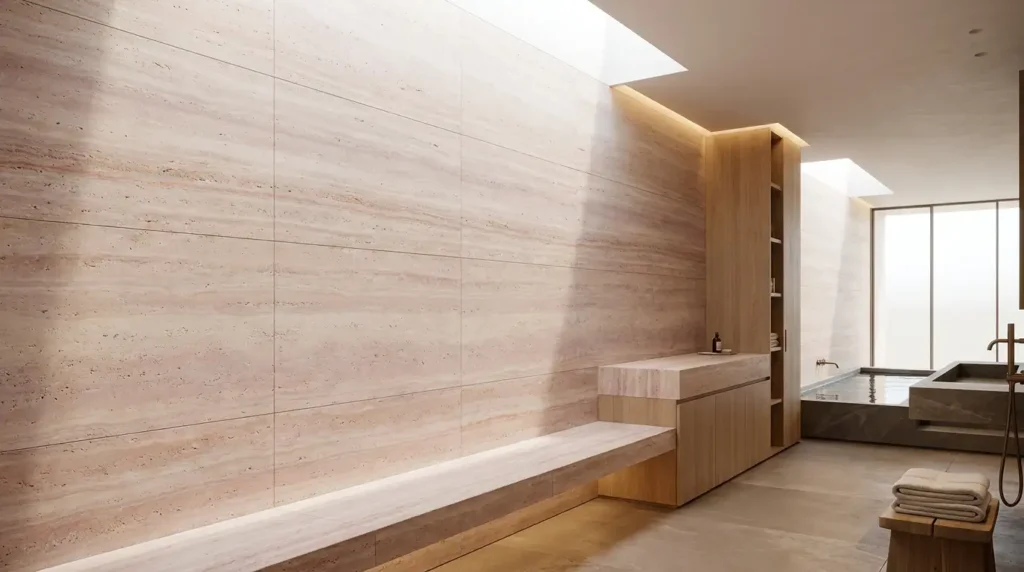
Neutral natural stone does not always have to mean beige, white or grey.
Pink Travertine introduces another possibility.
Its palette can move through:
- pale blush
- dusty pink
- salmon
- muted rose
- warm terracotta
- cream
- rust
- soft red-brown
while maintaining the porous, layered geological character that makes travertine immediately recognizable.
The result can feel surprisingly contemporary.
Instead of creating an overly decorative pink interior, a carefully selected Pink Travertine can provide a warm mineral surface that works naturally with:
- walnut
- light oak
- warm white plaster
- bronze
- dark metal
- cream textiles
- muted green
- concrete
- glass
Pink Travertine can be considered for applications including:
- feature walls
- bathrooms
- flooring
- fireplaces
- staircases
- reception areas
- vanity tops
- furniture
- selected exterior cladding
- terraces and paving where technically appropriate
But the commercial name alone is not enough to specify the material correctly.
A successful project should also define:
- actual color range
- cut direction
- vein intensity
- pore structure
- filled or unfilled treatment
- finish
- dimensions
- slab or tile selection
- application
- technical requirements
- installation
- maintenance
What Is Pink Travertine?
Pink Travertine is a color-based commercial description for naturally pink-toned travertine.
Travertine itself is a form of terrestrial limestone formed through the precipitation of calcium carbonate from mineral-rich freshwater systems. It is therefore geologically a limestone, not marble.
Its characteristic structure may include:
- visible pores
- cavities
- sedimentary bands
- tonal layers
- mineral deposits
- irregular natural voids
Pink selections introduce additional coloration that may range from subtle blush to much stronger reddish tones.
The exact appearance varies according to the quarry, layer and mineral chemistry.
This means Pink Travertine should be treated as a visual stone family rather than one globally identical product.
Is Pink Travertine a Marble?
No, not geologically.
Travertine is a type of limestone.
The natural stone industry has historically used broad commercial groupings that do not always align perfectly with scientific rock classification, but travertine is fundamentally a calcium-carbonate sedimentary stone.
This distinction matters because it influences:
- acid sensitivity
- porosity
- finishing
- pore treatment
- maintenance
- technical specification
Pink Travertine should therefore not be treated as if it behaves exactly like a crystalline marble simply because both are natural calcium-carbonate stones.
Where Does Pink Travertine Come From?
Pink-toned travertines are not limited to one single quarry or country.
Türkiye has substantial natural travertine resources, and Turkish geological and natural-stone studies document colored travertines including pink material.
Research on Turkish travertines specifically identifies Kütahya Pink Travertine, with material ranging from lighter pink toward darker pink and red tones.
Other pink-toned travertines can occur in different quarry regions internationally.
For this reason, a project should not use the words Pink Travertine as a substitute for origin documentation.
When origin matters, confirm:
- quarry region
- country of origin
- current production
- actual slabs
- certificates where required
Why Is Some Travertine Pink?
Travertine coloration can be influenced by mineral impurities and the chemistry of the water from which the calcium carbonate originally precipitated.
Iron-bearing minerals are particularly important in many reddish and brown travertines.
A recent study of Turkish colored travertines found that the reddish color of Kütahya material was associated with iron oxide content, while mineralogical analysis showed calcite as the dominant mineral.
This does not mean every Pink Travertine has exactly the same chemical composition.
But it helps explain why natural travertines can move through:
- cream
- yellow
- pink
- rust
- red
- brown
depending on geological conditions.
What Does Pink Travertine Look Like?
There is no single correct shade.
A Pink Travertine selection may be predominantly:
Pale Blush
With:
- light cream
- pale pink
- subtle salmon bands
This can create a very soft contemporary appearance.
Dusty Rose
With:
- muted pink
- rose-grey
- warm beige
- deeper mineral lines
This works particularly well in architectural interiors.
Salmon Pink
With:
- warm pink
- peach
- terracotta movement
- cream layering
This creates a stronger color statement.
Deep Pink to Red-Pink
With:
- rust
- dark rose
- red-brown
- stronger iron-rich coloration
These selections can be extremely dramatic.
The correct choice depends on whether the stone should act as:
background material
or
statement material.
Pink Travertine Is Not Always Uniformly Pink
One of the most attractive characteristics of real Pink Travertine is variation.
A slab may contain:
- pale pink areas
- cream bands
- darker rose lines
- rust-toned layers
- natural pores
all within the same surface.
This is very different from a manufactured material produced in one uniform pink color.
Natural variation provides depth.
However, that variation must be controlled across larger projects.
Calm vs Dramatic Selections
For architectural planning, it can be useful to divide available material visually.
Calm Pink Travertine
May have:
- pale pink background
- limited contrast
- soft cream movement
- relatively uniform tone
Good for:
- large floors
- multiple bathrooms
- larger wall areas
Medium Selection
May combine:
- blush
- dusty rose
- cream bands
- moderate natural movement
Good for:
- bathrooms
- hospitality interiors
- stairs
- furniture
Dramatic Selection
May contain:
- stronger red-pink layers
- rust
- darker veins
- greater tonal contrast
Good for:
- feature walls
- fireplaces
- reception areas
- statement furniture
The most dramatic slab is not automatically the highest-quality choice.
The correct material is the one that suits the architecture.
Vein-Cut Pink Travertine
Cut direction can completely transform the appearance of travertine.
Vein cutting exposes the natural sedimentary bedding as directional lines.
With Pink Travertine, vein cut can create:
- horizontal pink bands
- cream lines
- salmon layers
- red-brown mineral stripes
- strong geological direction
This makes it especially suitable for architecture with long horizontal proportions.
Why Vein Cut Works So Well with Pink Travertine
Color and direction reinforce each other.
Imagine a wall composed of long horizontal layers of:
pale pink
cream
dusty rose
rust.
The result can appear almost like a geological watercolor.
Because the pattern is naturally linear, it can complement:
- long walls
- low furniture
- horizontal windows
- fireplace openings
- contemporary facades
Where to Use Vein-Cut Pink Travertine
Strong applications include:
- feature walls
- bathroom walls
- fireplace walls
- reception backgrounds
- facades
- custom furniture
- stair walls
- long corridors
The vein orientation should be clearly defined on fabrication drawings.
Randomly rotating individual panels can weaken the intended composition.
Cross-Cut Pink Travertine
Cross cutting reveals the stone differently.
Instead of strong horizontal layers, the surface becomes:
- cloud-like
- circular
- irregular
- softer
- less directional
You may also see natural pore structures more clearly distributed across the face.
Cross cut can be particularly attractive for:
- flooring
- bathrooms
- entrance halls
- tables
- more organic interior concepts
Vein Cut vs Cross Cut
This decision can transform the same general stone family.
Vein Cut
Choose it when you want:
- direction
- horizontal movement
- geological layering
- stronger architectural lines
Cross Cut
Choose it when you want:
- softer movement
- less obvious direction
- more organic surfaces
- calmer flooring
For an important project, review actual full-size samples of both cuts.
Do not make the decision from a small online image.
Pink Travertine for Feature Walls
A full-height Pink Travertine wall can be one of its strongest applications.
The material introduces color without requiring paint or another applied decorative finish.
Possible locations include:
- hotel lobbies
- villa entrances
- living rooms
- restaurants
- reception areas
- spa interiors
- retail environments
For contemporary architecture, the surrounding palette can remain extremely restrained.
For example:
Pink Travertine wall
walnut
warm white plaster
cream furniture
may already be enough.
Large Panels
Larger panels allow:
- more visible geological layering
- fewer joints
- stronger material continuity
- more natural stone scale
Before fabrication, coordinate panel dimensions with:
- ceiling height
- doors
- electrical outlets
- furniture
- lighting
- corners
The wall should be planned as an architectural composition rather than treated simply as a square-meter quantity.
Horizontal Vein Continuity
For vein-cut wall panels, exact continuity across every joint may not always be possible.
The objective should instead be:
- compatible colors
- consistent vein direction
- similar band scale
- controlled darker areas
Natural stone should look coordinated, not digitally duplicated.
Pink Travertine for Bathrooms
Pink Travertine is particularly effective in bathrooms because the color naturally creates warmth.
Possible applications include:
- shower walls
- floors
- vanity tops
- vanity walls
- bathtub surrounds
- niches
- shelves
- custom stone basins
A well-designed Pink Travertine bathroom does not need to feel feminine or decorative.
The result depends on the supporting palette.
Contemporary Pink Travertine Bathroom
Consider:
vein-cut Pink Travertine shower wall
dark walnut vanity
warm off-white plaster
brushed bronze fixtures
light neutral floor.
This creates a sophisticated mineral palette.
The pink becomes architectural rather than ornamental.
Minimal Pink Bathroom
For a lighter interpretation:
pale Pink Travertine
light oak
warm white
brushed stainless metal
can create a very calm contemporary environment.
The key is controlling saturation.
Muted pink natural stone usually integrates more easily than intense artificial pink surfaces.
Shower Walls
Large shower slabs are particularly effective.
Before fabrication, plan:
- shower controls
- niche position
- shelving
- joints
- corners
- panel orientation
With vein-cut material, make sure neighboring panels maintain the intended direction.
Pink Travertine Bathroom Flooring
For bathroom floors, finish selection should consider technical performance as well as appearance.
Wet areas can require attention to:
- surface texture
- slip requirements
- drainage
- water exposure
- maintenance
- installation system
A highly polished surface may not be appropriate for every wet floor.
The final specification must follow the actual project requirements.
Pink Travertine Vanity Tops
A vanity provides an opportunity to use a distinctive section of the stone.
Possible approaches include:
- calm pale pink top
- highly layered vein-cut top
- cross-cut top with more organic pores
Before cutting, plan:
- basin opening
- faucet holes
- backsplash
- edge profile
- side returns
The most attractive natural area should not disappear inside the basin cutout.
Pink Travertine for Flooring
Pink Travertine can create an unusually warm floor.
Possible spaces include:
- residences
- hotels
- restaurants
- boutique retail
- entrance halls
- spa interiors
- selected commercial areas
For larger surfaces, the selection should usually be calmer than the material chosen for a feature wall.
Large Pink Travertine Floors
Across a large floor, the eye reads the complete material distribution.
The project should therefore control:
- lighter pieces
- darker rose areas
- cream sections
- red-brown movement
- pores
- tile dimensions
Without planning, the floor may accidentally form dark or strongly pink zones.
Dry Layout
A dry layout can be extremely useful.
The stone pieces are arranged before final installation so the project team can review:
- color balance
- strong pieces
- quiet pieces
- vein direction
- neighboring tiles
Once approved, pieces can be numbered.
This provides much more control than random installation.
Pink Travertine for Hotel Interiors
Hospitality projects offer excellent opportunities because Pink Travertine can create a memorable identity without requiring aggressive pattern.
Applications include:
- reception wall
- reception desk
- lobby flooring
- premium bathrooms
- restaurant interiors
- spa areas
- fireplace walls
- furniture
A hotel does not need to use pink stone everywhere.
One strategically selected application can be enough.
Pink Travertine for Spa Interiors
Pink Travertine is especially compatible with spa architecture.
The material combines:
- mineral texture
- warm color
- natural pores
- low-contrast tonal movement
Possible pairings include:
Pink Travertine
light oak
warm plaster
linen
soft indirect lighting.
The result can feel natural rather than decorative.
Pink Travertine for Restaurants
Restaurants can use stronger pink selections because controlled evening lighting can soften the material.
Possible applications include:
- bar fronts
- bar counters
- host desks
- feature walls
- bathroom vanities
- selected floors
- custom tables
Warm lighting may emphasize:
- rose
- rust
- salmon
- cream
tones in the stone.
Pink Travertine for Fireplaces
A vein-cut fireplace wall can be particularly strong.
The geological layers give the surface direction without requiring highly contrasted marble veins.
A contemporary palette might be:
Pink Travertine fireplace
light oak flooring
cream furniture
dark metal fireplace opening.
The stone introduces warmth while the black fireplace creates definition.
Technical requirements around heat must be designed according to the specific fireplace system.
Pink Travertine for Staircases
Pink Travertine can be fabricated for:
- treads
- risers
- landings
- side cladding
- surrounding walls
Vein orientation should be coordinated.
For vein-cut material, the repeated horizontal layers can work naturally with stair geometry.
Random orientation may create a fragmented appearance.
Pink Travertine for Reception Desks
A simple reception desk can become highly distinctive when clad in vein-cut Pink Travertine.
Possible components include:
- front face
- countertop
- side returns
- background wall
For a refined contemporary result, the desk itself can remain geometrically simple.
The stone provides enough visual complexity.
Pink Travertine for Custom Furniture
Possible pieces include:
- coffee tables
- dining tables
- console tables
- side tables
- plinths
- benches
The warm coloration makes Pink Travertine particularly suited to furniture because the material can act as both stone and color accent.
For furniture, consider:
- slab dimensions
- thickness
- support
- pores
- edge treatment
- vein direction
Pink Travertine Dining Tables
A large vein-cut table can display long colored bands across the surface.
A cross-cut table can look completely different, with more irregular clouds and pores.
For a custom table, choose the cut direction according to the desired visual effect.
Pink Travertine + Walnut
This is one of the strongest combinations.
Walnut introduces:
- dark brown
- warmth
- strong natural grain
Pink Travertine introduces:
- dusty rose
- cream
- mineral layers
Together, the materials create a sophisticated earthy palette.
This works particularly well in:
- hotel interiors
- bathrooms
- restaurants
- luxury residences
Pink Travertine + Light Oak
Light oak creates a softer result.
It can work particularly well with pale blush selections.
The combination feels:
- bright
- calm
- warm
- contemporary
Good applications include:
- bathrooms
- spa interiors
- bedrooms
- residential living spaces
Pink Travertine + Warm White
Warm white provides a neutral background.
It allows the stone to retain its natural pink coloration without creating excessive contrast.
Use warm white for:
- plaster
- cabinetry
- ceilings
- upholstery
The difference between white architecture and muted pink stone can feel very sophisticated.
Pink Travertine + Burgundy
For a richer palette, restrained burgundy accents can connect with deeper red mineral tones.
However, use them carefully.
The combination can become visually heavy if both materials or colors occupy large areas.
A better approach might be:
Pink Travertine wall
small burgundy furniture accent
rather than two equally dominant surfaces.
Pink Travertine + Muted Green
Pink and green create a natural complementary relationship.
Muted shades such as:
- olive
- sage
- grey-green
can work particularly well.
This combination should remain earthy rather than highly saturated.
For example:
pale Pink Travertine
olive upholstery
walnut
warm white plaster.
Pink Travertine + Bronze
Brushed bronze complements the warm mineral tones naturally.
It can be used for:
- bathroom fixtures
- lighting
- handles
- furniture details
- thin architectural profiles
Avoid excessive bright gold finishes.
The stone already provides warmth.
Pink Travertine + Dark Metal
Charcoal or black metal can make the material feel more architectural.
Use it for:
- window frames
- furniture bases
- fireplace openings
- lighting
- bathroom fixtures
The contrast helps prevent a pale pink interior from becoming visually soft everywhere.
Pink Travertine + Grey
Warm grey can provide a sophisticated counterbalance.
A cool blue-grey may make the pink look more saturated.
A warm taupe-grey can create a calmer relationship.
Always compare actual material samples together.
Pink Travertine + Concrete
Concrete creates an interesting contrast.
Concrete is:
- uniform
- grey
- industrial
Pink Travertine is:
- warm
- porous
- naturally layered
- variable
Used together, the materials can create very contemporary architecture.
Pink Travertine + White Marble
This combination should be handled carefully.
A calm white marble can provide contrast with Pink Travertine.
But a highly dramatic white marble with strong veining may compete visually.
It is generally easier to create hierarchy using:
one patterned stone
one quieter supporting stone.
Filled vs Unfilled Pink Travertine
Natural pores are one of travertine’s defining characteristics.
They may be:
- left open
- partially filled
- more completely filled
depending on the desired surface and application.
Filled Pink Travertine
Filling produces a smoother appearance.
It can be useful for:
- interior flooring
- bathrooms
- tabletops
- vanity surfaces
- refined wall cladding
The filling material should be compatible with the stone and desired finish.
Unfilled Pink Travertine
Open pores emphasize the geology.
The surface feels:
- more natural
- more textured
- more architectural
- less formal
This can work especially well on vertical walls.
However, maintenance requirements and the specific environment should be considered.
Do Not Automatically Fill Every Pore
Travertine’s cavities are not simply imperfections that must always disappear.
They are part of the stone’s formation and visual identity.
A contemporary architectural project may intentionally preserve some pore structure.
The decision should be made according to:
- application
- appearance
- maintenance
- finish
- technical requirements
Honed Pink Travertine
Honing is one of the most versatile finishes.
It can create:
- soft matte surfaces
- muted pink coloration
- lower reflection
- contemporary appearance
A honed finish is particularly effective with:
- walnut
- oak
- warm plaster
- bronze
It allows the color and sedimentary structure to remain visible without strong gloss.
Brushed Pink Travertine
Brushing introduces greater texture.
It can emphasize:
- pores
- sedimentary layers
- natural irregularity
- shadows under side lighting
This can work particularly well for:
- feature walls
- rustic-modern interiors
- selected exterior applications subject to technical approval
Tumbled Pink Travertine
Tumbling softens edges and creates a more aged surface character.
It can be used in:
- smaller-format flooring
- traditional patterns
- selected outdoor or transitional spaces
- more relaxed interiors
However, tumbled Pink Travertine creates a very different aesthetic from large honed slabs.
The finish should fit the architectural language.
Polished Pink Travertine
Travertine can sometimes be polished, producing:
- stronger color depth
- greater reflection
- more visible layering
However, polished Pink Travertine feels considerably more formal.
For many contemporary projects, honed or lightly textured surfaces may be easier to integrate.
Functional requirements must also be considered before selecting a polished surface for flooring.
Sandblasted or Textured Finishes
More textured finishes may be appropriate for selected architectural applications.
They can:
- reduce reflection
- lighten the apparent color
- increase tactile character
- emphasize stone texture
Exterior and wet-area applications require project-specific performance evaluation.
Finish should never be selected only from aesthetic preference.
How Finish Changes Pink Travertine Color
The same stone can look surprisingly different after finishing.
Polished
May appear:
- darker
- richer
- more saturated
Honed
May appear:
- softer
- more muted
- slightly lighter
Strongly Textured
May appear:
- lighter
- drier
- more mineral
This is why the actual production finish should be approved before large quantities are processed.
How Lighting Changes Pink Travertine
Lighting can transform the perceived color.
Natural Daylight
May reveal:
- pale pink
- mineral variation
- true cream layers
- subtle grey undertones
Warm Lighting
May emphasize:
- peach
- salmon
- terracotta
- rust
Cool Lighting
May make the stone appear:
- paler
- greyer
- more mauve
For an important project, review a representative sample under the planned lighting temperature.
Avoid Overly Warm Lighting
There is a limit.
If already warm Pink Travertine is illuminated with excessively yellow light, the stone may become:
- orange
- overly salmon
- visually saturated
The objective should be to support the stone’s real color rather than artificially alter it.
Pink Travertine for Exterior Cladding
Travertine and limestone have a long architectural history in exterior vertical applications.
However, suitability must be verified for the actual stone and project conditions, not assumed from the commercial name.
Possible uses may include:
- villa facades
- entrance walls
- landscape walls
- selected commercial facades
A vein-cut pink facade can create a very distinctive contemporary building.
Pink Travertine Facade Design
Pink stone does not require classical architecture.
A highly modern facade could combine:
vein-cut Pink Travertine
large glass openings
dark bronze window frames
concrete
minimal landscaping.
The stone provides color while the building geometry remains simple.
Exterior Use Must Be Technically Verified
Do not assume every Pink Travertine is suitable for:
- every climate
- freeze-thaw exposure
- every panel thickness
- every fixing system
- exterior paving
Industry guidance notes that while many limestone and travertine varieties have successful histories in exterior vertical cladding, fewer varieties are proven for exterior paving in freeze-thaw environments.
Project evaluation may need to consider:
- absorption
- density
- strength
- freeze-thaw exposure
- panel size
- finish
- anchoring system
- local codes
Pink Travertine for Terraces
Terraces may be possible where the selected stone, finish and climate are appropriate.
Important considerations include:
- slip resistance
- drainage
- freeze-thaw exposure
- surface texture
- installation system
- maintenance
An interior honed sample should not automatically be used to approve an exterior terrace.
The service conditions are different.
Pink Travertine for Pool Areas
The color can work beautifully near water, but pool applications require detailed technical evaluation.
Consider:
- water chemistry
- slip resistance
- salts
- freeze-thaw conditions
- surface finish
- edge details
Do not specify a pool surround based only on appearance.
Selecting Pink Travertine Slabs
Selection should begin with the architecture.
1. Define the Pink Tone
Do you want:
- pale blush
- dusty rose
- salmon
- deeper red-pink?
2. Define the Cream Content
Some slabs may be predominantly pink.
Others may contain extensive cream layers.
3. Define the Darker Mineral Range
Are rust or brown areas acceptable?
4. Choose the Cut Direction
Vein cut or cross cut?
5. Define Pore Treatment
Filled or intentionally open?
6. Select the Finish
Honed, brushed, polished or another approved treatment?
7. Review Full-Size Material
Never approve a major project from only one small sample.
Full-Slab Photography
Full slab photographs help reveal:
- overall pink percentage
- cream areas
- darker layers
- pore distribution
- vein scale
- slab dimensions
This information is especially important when producing:
- feature walls
- large bathroom panels
- reception desks
- furniture
Small Samples Can Be Misleading
A sample taken from a cream band may make the stone appear almost beige.
A sample taken from the strongest rose layer may make the material appear far more saturated than the complete slab.
The larger the natural pattern, the more important full-slab review becomes.
Large Project Selection
Suppose a hotel requires 1,000 m².
The selection should not be defined simply as:
Pink Travertine.
A more useful visual requirement might define:
- pale-to-medium dusty pink
- controlled cream layering
- limited deep red areas
- vein-cut orientation
- honed finish
This creates a much more precise sourcing target.
Natural Variation Is Normal
Real Pink Travertine can vary in:
- pink intensity
- cream content
- pore distribution
- layering
- rust coloration
- slab-to-slab movement
This is not automatically a quality problem.
The important question is whether the material remains within the approved visual range.
Dry Layout for Large Projects
Before final packing or installation, tiles and panels may be arranged to review:
- tonal distribution
- darker areas
- cream pieces
- vein direction
- overall balance
Pieces can then be numbered.
This is particularly useful for hotel flooring and feature walls.
Panel Numbering
For cut-to-size projects, a clear system can link:
architectural drawing
→
piece number
→
crate number
→
installation position.
This reduces installation errors.
For directional Pink Travertine, it also prevents panels from being accidentally rotated.
Cutting Layout
A planned cutting layout can improve both aesthetics and material yield.
The process may include:
- Finalize project dimensions.
- Photograph actual slabs.
- Position components digitally.
- Review pink and cream areas.
- Review vein direction.
- Mark openings.
- Review corners.
- Approve.
- Fabricate.
This becomes especially useful for:
- vanities
- reception desks
- wall panels
- fireplaces
- furniture
Corners and Returns
Vein-cut Pink Travertine may contain obvious horizontal layers.
When a wall or reception desk turns a corner, the relationship between these layers should be considered.
An unrelated side panel may interrupt the visual movement.
Planning the visible faces together can create a much more intentional result.
Material Yield
A visually spectacular slab may not provide the most efficient cuts.
A quieter slab with better dimensions may allow:
- fewer joints
- larger panels
- less waste
The project should balance:
visual quality
usable yield
rather than evaluating the stone only by slab price.
How to Clean Pink Travertine
Pink Travertine remains a calcium-carbonate stone.
That means routine maintenance should follow care principles suitable for limestone and travertine.
Industry guidance recommends cleaning natural stone using suitable neutral products and warns that acidic solutions can affect calcareous stone.
For routine care:
- Remove dust and loose grit.
- Clean spills promptly.
- Use soft cleaning materials.
- Use an appropriate pH-neutral cleaner.
- Avoid acidic cleaning products.
- Avoid unnecessary abrasive products.
- Rinse and dry as appropriate.
Can You Use Vinegar on Pink Travertine?
No.
Vinegar is acidic.
Travertine is calcium-carbonate based and therefore vulnerable to acids.
Acid exposure can lead to:
- dull areas
- altered texture
- loss of polish
- lighter marks
The effect can be especially noticeable on more refined finishes.
Can Lemon Damage Pink Travertine?
Yes.
The issue is the same chemistry.
Lemon juice contains acid.
Routine natural-stone guidance specifically warns against acidic substances on calcareous stones.
This should be considered particularly for:
- vanity tops
- dining tables
- kitchen-related surfaces
- bars
What Is Etching?
Etching is not ordinary dirt.
It occurs when acid chemically reacts with calcium carbonate.
The surface finish itself changes.
On a refined surface, an etched area may appear:
- dull
- lighter
- less reflective
- cloudy
Cleaning alone may not restore the original finish.
Is Pink Travertine Suitable for Countertops?
It may be used in some countertop or furniture applications, but users should understand its:
- porosity
- acid sensitivity
- potential for staining
- natural pores
- maintenance requirements
Industry guidance notes that absorption varies significantly across limestone and travertine varieties and that calcium-carbonate chemistry limits the suitability of some varieties for countertop applications.
The actual stone should therefore be evaluated rather than assuming all travertines perform identically.
Should Pink Travertine Be Sealed?
There is no universal schedule suitable for every Pink Travertine project.
An impregnating treatment may be appropriate depending on:
- actual material
- porosity
- finish
- pore treatment
- location
- exposure
- maintenance expectations
A sealer may improve resistance to some staining agents.
It does not make the stone completely stain-proof.
Does Sealer Make Pink Travertine Acid-Proof?
No.
Stain resistance and acid resistance are different.
An impregnating treatment does not change the fundamental calcium-carbonate chemistry of the stone.
Pink Travertine can still react with:
- vinegar
- lemon
- acidic drinks
- acidic cleaners
even after treatment.
Dust and Grit on Travertine Floors
Sand and grit can act as abrasive material on natural stone floors.
For high-traffic interiors:
- use entrance mats
- remove grit regularly
- establish an appropriate cleaning program
Preventing abrasive dirt from entering the building can significantly reduce wear.
Pink Travertine for High-Traffic Projects
For hotels, restaurants and commercial interiors, the specification should consider more than color.
Evaluate:
- actual stone characteristics
- finish
- pore treatment
- expected traffic
- installation
- maintenance
- replacement stock
A feature wall and a hotel entrance floor do not require the same performance.
Keep Spare Material
For important projects, retain some additional material from the approved production lot.
Future Pink Travertine sourced years later may differ in:
- color
- layering
- pore structure
- mineral movement
Spare pieces can be valuable for:
- repairs
- future alterations
- replacement
This is particularly important for hotels and commercial projects.
Pink Travertine vs Ivory Travertine
Both can create warm natural interiors, but their color identities are different.
Pink Travertine
Provides:
- blush
- rose
- salmon
- warmer mineral coloration
Ivory Travertine
Provides:
- cream
- beige
- neutral warmth
Choose Pink Travertine when the stone itself should introduce color.
Choose Ivory Travertine when the architecture needs a quieter neutral base.
Pink Travertine vs Silver Travertine
These materials create almost opposite atmospheres.
Pink Travertine
Feels:
- warm
- earthy
- soft
- colorful
Silver Travertine
Feels:
- cooler
- grey
- restrained
- more industrial
Both can be extremely contemporary.
The difference is primarily the material palette.
Pink Travertine vs Red Travertine
The boundary can sometimes be gradual.
A particular quarry may produce layers ranging from:
- pale pink
- dark pink
- rust
- red
rather than one perfectly uniform category.
Turkish studies document colored Kütahya travertine ranging from lighter pink to deeper red tones.
Therefore, actual material approval matters more than the color name alone.
Pink Travertine vs Pink Marble
They may share a color family but have different geological structures.
Pink Travertine
Typically offers:
- natural pores
- sedimentary layering
- vein-cut and cross-cut visual options
- limestone structure
Pink Marble
Typically offers:
- crystalline structure
- different vein character
- generally different pore structure
- different visual depth when polished
The choice depends on whether the project needs:
layered texture
or
crystalline marble character.
Common Mistakes with Pink Travertine
1. Treating Pink Travertine as One Standardized Product
Different quarries and selections can vary significantly.
2. Calling Travertine Marble
Geologically, travertine is limestone.
3. Ignoring Cut Direction
Vein cut and cross cut can look completely different.
4. Approving from One Small Sample
The sample may not represent the full slab.
5. Ignoring Pores
Filled and unfilled surfaces create different results.
6. Choosing Exterior Use Only by Appearance
Technical suitability must be evaluated for the actual project.
7. Using Acidic Cleaners
Acids can damage calcium-carbonate stone.
8. Assuming Sealing Makes It Acid-Proof
It does not.
9. Expecting Perfect Pink Uniformity
Natural variation is normal.
10. Using Too Many Warm Materials Together
Pink stone, red wood, gold metal and yellow lighting can become overly warm.
Balance the palette carefully.
How to Plan a Pink Travertine Project
A useful workflow is:
1. Define the Application
Wall, floor, bathroom, facade, staircase or furniture?
2. Define the Desired Pink Range
Blush, dusty rose, salmon or deeper pink?
3. Choose the Cut
Vein cut or cross cut?
4. Define Pore Treatment
Filled or intentionally open?
5. Choose the Finish
Honed, brushed, polished, tumbled or textured?
6. Define Dimensions
Standard tiles or custom cut-to-size?
7. Review Actual Material
Prefer full slabs and representative production material.
8. Prepare the Layout
Especially for directional vein-cut projects.
9. Arrange Important Pieces
Control tonal variation.
10. Number Custom Elements
For complicated projects.
11. Perform Quality Control
Check:
- dimensions
- color
- finish
- vein direction
- pore treatment
- numbering
- packing
before shipment.
Is Pink Travertine a Good Choice for Large Projects?
It can be extremely effective when the desired visual range can be sourced consistently.
Potential projects include:
- luxury hotels
- resorts
- villas
- restaurants
- spas
- retail interiors
- residential developments
- selected commercial architecture
For large quantities, the specification should define more than the stone name.
Consider establishing:
- approved color range
- cream percentage
- darker pink tolerance
- cut direction
- finish
- pore treatment
- dimensions
This creates clearer expectations for production.
Why Pink Travertine Works in Contemporary Architecture
Pink stone may sound highly decorative.
It does not need to be.
Travertine already has a strong architectural history because of its:
- layering
- texture
- pores
- natural repetition
Using a muted pink version of the same geological language can create architecture that feels both natural and unexpected.
A contemporary palette could be as simple as:
Pink Travertine
walnut
warm white
dark bronze
clear glass.
No additional patterned material may be necessary.
Pink Does Not Have to Mean Feminine
Color interpretation depends strongly on context.
Combine Pink Travertine with:
- floral decoration
- saturated pink paint
- soft gold
- highly decorative furniture
and the space may feel more overtly decorative.
Combine the same stone with:
- concrete
- dark metal
- walnut
- minimal furniture
- architectural lighting
and the result can feel highly contemporary and neutral.
The material itself does not determine the design language.
The complete architecture does.
Use the Stone Strategically
Pink Travertine can be more powerful when used selectively.
A hotel may need:
one Pink Travertine reception wall
rather than pink stone everywhere.
A bathroom may need:
one full-height shower wall.
A living room may need:
one fireplace surface.
Natural color becomes more memorable when it has enough visual space around it.
Final Thoughts
Pink Travertine offers a distinctive alternative to conventional beige, ivory and silver travertines.
It retains the geological characteristics that define travertine:
- calcium-carbonate composition
- sedimentary layering
- natural pores
- vein-cut and cross-cut patterns
while introducing a palette that can move from:
pale blush
to
dusty rose
to
salmon
to
deeper rust-red tones.
Travertine is geologically a terrestrial limestone, and Türkiye has substantial travertine resources that include documented pink and colored varieties.
Pink Travertine can be considered for:
- feature walls
- bathrooms
- flooring
- fireplaces
- staircases
- reception areas
- hospitality interiors
- furniture
- selected exterior applications
But the best results depend on more than choosing a color.
The project should define:
actual material
color range
vein cut or cross cut
pore treatment
finish
dimensions
layout
technical requirements
maintenance.
Review full slabs.
Compare the actual pink range.
Decide whether the architecture needs linear vein-cut material or softer cross-cut movement.
Approve the pore treatment.
Plan panel orientation before fabrication.
Evaluate exterior applications technically.
Avoid acidic cleaning products.
And remember that an impregnating treatment does not make travertine completely stain-proof or acid-proof.
When these decisions are coordinated properly, Pink Travertine can create architecture that feels warm and distinctive without becoming overly decorative.
Frequently Asked Questions
What is Pink Travertine?
Pink Travertine is a commercial description for naturally pink-toned travertine, a terrestrial form of limestone created through calcium-carbonate precipitation.
Is Pink Travertine marble?
No. Travertine is geologically a type of limestone rather than true marble.
Does Pink Travertine come from Türkiye?
Türkiye produces pink and other colored travertines, and geological research documents Pink Travertine from areas including Kütahya.
Why is Pink Travertine pink?
The color can be influenced by mineral chemistry and impurities present during stone formation. Iron-bearing phases contribute to reddish coloration in documented Turkish colored travertines.
What is vein-cut Pink Travertine?
Vein cutting exposes the sedimentary bedding as directional bands, creating a more linear pink, cream and rust pattern.
What is cross-cut Pink Travertine?
Cross cutting creates a less directional, more cloud-like appearance with natural pores distributed across the surface.
Can Pink Travertine be used in bathrooms?
Yes, it can be considered for walls, vanities and flooring when the finish, installation system and wet-area requirements are appropriate.
Can Pink Travertine be used for flooring?
Yes. The specific selection, surface finish and installation should be chosen according to the intended traffic and environment.
Can Pink Travertine be used outdoors?
Some travertines have successful exterior applications, but the actual stone, climate, finish and installation system should be technically evaluated. Exterior paving in freeze-thaw environments requires particular caution.
Can Pink Travertine be polished?
Travertine can be produced in several finishes, including honed and in suitable material polished surfaces. Final appearance depends on the actual selection and processing.
Should Pink Travertine be filled?
It may be filled, partially filled or intentionally left with visible pores depending on the application and desired architectural appearance.
Can vinegar damage Pink Travertine?
Yes. Travertine is calcium-carbonate based and acidic substances can alter or etch its surface.
Does sealing make Pink Travertine acid-proof?
No. An impregnating treatment may improve resistance to certain staining agents but does not eliminate the stone’s sensitivity to acids.
Looking for Pink Travertine for Your Project?
VeraMarbles can support residential, hospitality and commercial projects requiring Pink Travertine.
Send us your:
- required quantity
- application
- dimensions
- thickness
- preferred pink range
- vein-cut or cross-cut preference
- desired finish
- pore-treatment preference
- architectural drawings
- project location
We can support your project with:
- material selection
- color-range control
- vein-direction control
- slabs
- tiles
- custom cutting
- wall and floor layout planning
- dry layout
- piece numbering
- packing coordination
- quality control before shipment
Request a Quote from VeraMarbles