
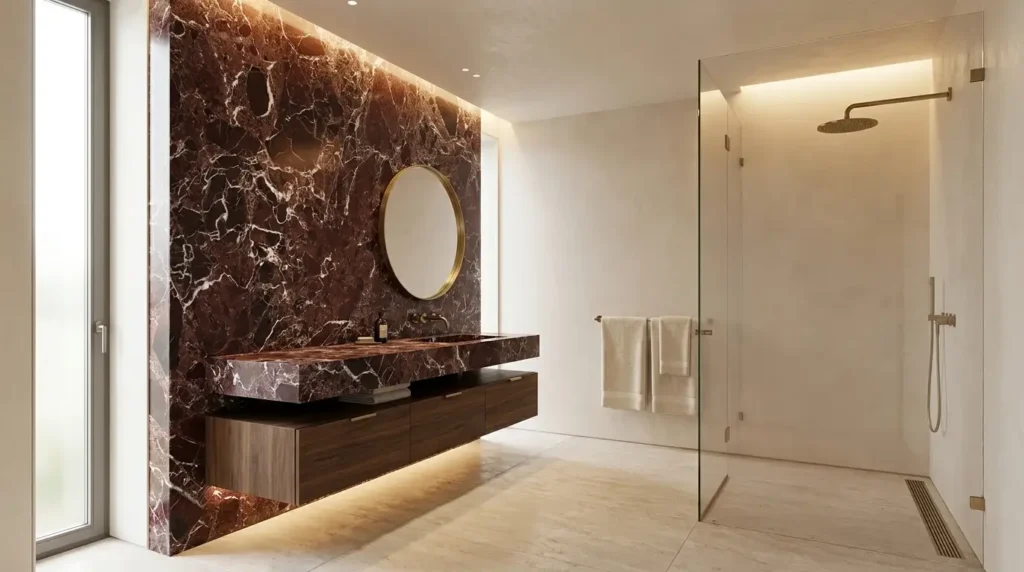
Rosso Levanto marble is not designed to disappear into an interior.
With its deep burgundy, wine-red and plum-toned background crossed by contrasting white veining, it is a natural stone typically selected when the material itself is intended to become an important part of the architecture.
That strong visual identity makes Rosso Levanto marble particularly effective for statement bathrooms, feature walls, vanity tops, staircases, flooring and bespoke architectural elements. Current suppliers offer it for applications including floors, wall cladding, bathrooms, stairs, vanity tops and other interior surfaces.
But choosing Rosso Levanto involves more than selecting a dark red marble.
The exact slab, finish, vein distribution, fabrication layout and maintenance expectations can dramatically influence the final result.
This guide explains what to consider before specifying Rosso Levanto for a residential or commercial natural-stone project.
What Is Rosso Levanto Marble?
Rosso Levanto is known for its dark red-to-burgundy appearance and contrasting white veining.
Some selections lean toward rich cherry red, while others can appear darker, closer to burgundy or plum. Italian Rosso Levanto supplied from Liguria is described as having deep burgundy-plum coloration and bold white veining. Turkish suppliers also market a cherry-red, white-veined marble under the Rosso Levanto trade name.
This distinction matters when sourcing material.
The name alone should not be treated as proof of a specific quarry origin. If origin is important for your specification, certification or architectural documentation, confirm the actual quarry and country of origin with your supplier before purchase.
Why Is Rosso Levanto So Distinctive?
Most commonly specified marbles fall into relatively neutral palettes:
- white
- beige
- grey
- cream
- black
Rosso Levanto occupies a very different visual category.
Its burgundy-red base means it immediately introduces colour into an interior, while the white natural veining prevents the stone from appearing flat or uniform.
That makes it especially useful when an architect or designer wants to create a deliberate focal point.
Rather than functioning simply as a background finish, Rosso Levanto can act almost like a piece of architectural artwork.
Rosso Levanto Marble Applications
1. Feature Walls
One of the strongest applications for Rosso Levanto is a feature wall.
Large-format slabs allow the stone’s natural movement to be seen without the visual interruption created by numerous smaller tiles.
Potential applications include:
- hotel reception walls
- residential entrance walls
- restaurant interiors
- luxury retail spaces
- fireplace surrounds
- elevator lobbies
- bathroom feature walls
- bar backgrounds
Rosso Levanto is commercially specified for wall cladding and feature-wall applications.
For large walls, slab layout should be planned before cutting.
The relationship between adjoining slabs can be just as important as the individual slab itself.
2. Rosso Levanto Bathrooms
Bathrooms provide an excellent environment for expressive natural stone because the material can be repeated across several architectural surfaces.
Rosso Levanto can potentially be used for:
- vanity tops
- vanity splashbacks
- shower walls
- bath surrounds
- feature walls
- selected flooring
- custom basins
- shelves and niches
Current suppliers specifically offer Rosso Levanto for bathroom surfaces and vanity applications.
The important design principle is balance.
If Rosso Levanto covers every visible surface, a small bathroom can become visually heavy.
A more controlled approach might use Rosso Levanto for the vanity and one feature wall, while surrounding surfaces remain neutral.
3. Vanity Tops
A bathroom vanity is one of the simplest ways to introduce Rosso Levanto into an interior without allowing the material to dominate the entire space.
It pairs particularly well with:
- warm white walls
- walnut cabinetry
- dark timber
- brushed brass
- bronze
- black metal
- cream limestone
Because the countertop is relatively compact, designers can select a particularly attractive part of the slab for the visible surface.
4. Flooring
Rosso Levanto can also be used as marble flooring and is marketed for floor applications by suppliers.
However, flooring requires more than visual approval.
The project team should consider:
- traffic level
- surface finish
- maintenance expectations
- slip characteristics
- tile dimensions
- joint layout
- installation system
- wet versus dry conditions
A large expanse of dark burgundy marble can create an exceptionally luxurious effect, but it is usually more visually dominant than grey or beige flooring.
For that reason, Rosso Levanto flooring often works best when the rest of the architectural palette is restrained.
5. Staircases
Stairs can turn Rosso Levanto from a finish into an architectural element.
Possible applications include:
- treads
- risers
- landings
- staircase walls
- skirting
- adjacent wall cladding
Rosso Levanto is commercially offered for staircase applications.
Using the same material on both treads and risers can create a monolithic appearance.
Alternatively, Rosso Levanto treads can be combined with simpler risers or surrounding materials for a lighter visual effect.
6. Kitchen Countertops and Islands
Rosso Levanto is also sold for worktops and countertops.
Visually, it can create a spectacular kitchen.
A Rosso Levanto island paired with restrained cabinetry can become the central feature of the entire room.
Strong combinations include:
Rosso Levanto + walnut
Rosso Levanto + warm white cabinetry
Rosso Levanto + black cabinetry
Rosso Levanto + brushed brass
But marble used in a kitchen should be chosen with realistic maintenance expectations.
Spills should be addressed quickly and cleaning products should be appropriate for natural stone. Current care guidance for Rosso Levanto recommends mild or pH-neutral cleaning rather than harsh or abrasive products.
7. Fireplaces
A fireplace is another application where a highly expressive marble can work extremely well.
Rosso Levanto can be used around:
- contemporary fireplaces
- traditional fireplace surrounds
- full-height chimney walls
- integrated media walls
Because the material already contains significant visual movement, the surrounding design can remain relatively simple.
Some current stone suppliers specifically market Rosso Levanto slabs for fireplace applications.
Rosso Levanto Marble Finishes
Finish selection dramatically changes how Rosso Levanto appears.
Polished Rosso Levanto
A polished finish emphasizes:
- colour depth
- contrast
- white veining
- reflection
- richness of the burgundy background
For clients who want the marble to feel dramatic and luxurious, polished Rosso Levanto is often the obvious direction.
Polished slabs are widely offered commercially.
The reflective surface can make darker areas appear deeper while increasing the contrast between the base colour and white veining.
Honed Rosso Levanto
A honed finish creates a softer and more matte appearance.
Instead of emphasizing reflection, it allows the colour and natural structure of the material to feel more architectural.
Honed Rosso Levanto can work particularly well in contemporary interiors combined with:
- matte timber
- textured plaster
- bronze
- brushed metal
- neutral fabrics
- cream natural stone
Suppliers currently offer honed processing alongside polished finishes.
Brushed Rosso Levanto
A brushed finish can introduce additional tactile character and reduce the formality associated with a highly polished dark marble.
Rosso Levanto is also offered commercially with brushed processing.
This can be particularly interesting for architectural applications where the designer wants the stone to feel more natural and textured.
Always review a physical sample in the proposed finish before approving the final material.
Digital photographs cannot reliably communicate reflectivity, texture or tactile character.
What Colors Work with Rosso Levanto?
Because Rosso Levanto already has a strong colour identity, surrounding materials should be chosen carefully.
Rosso Levanto + Warm White
This is one of the safest combinations.
Warm white allows the burgundy stone to remain the visual focus while preventing the interior from becoming too dark.
Rosso Levanto + Walnut
Walnut works exceptionally well with dark red marble.
Both materials contain visual warmth, but their textures are different enough to create contrast.
Consider:
- walnut vanity
- Rosso Levanto countertop
- neutral wall
- brushed brass tapware
This can create a sophisticated hospitality-style bathroom.
Rosso Levanto + Black
Black introduces a more contemporary and dramatic character.
Use it selectively through:
- cabinetry
- metal frames
- lighting
- taps
- furniture
Too much black combined with Rosso Levanto can make a smaller interior visually heavy.
Rosso Levanto + Brass or Bronze
Warm metallic finishes naturally complement burgundy and wine-red tones.
Brushed rather than highly polished metal often creates a more restrained result.
Rosso Levanto + Cream Limestone
This is one of the most useful combinations for larger projects.
The cream limestone provides the quiet architectural background.
Rosso Levanto provides the accent.
For example:
Cream limestone flooring + Rosso Levanto reception desk
or
Neutral bathroom walls + Rosso Levanto vanity
This gives the red marble space to make an impact without overwhelming the interior.
How to Select Rosso Levanto Slabs
Selecting the actual slabs is particularly important with a highly veined dark marble.
Look at the Entire Slab
Do not evaluate the material from a 10 × 10 cm sample alone.
A sample can tell you:
- general colour
- finish
- texture
but it cannot show the full composition.
Compare the Base Colour
Place several slabs next to each other.
Check whether the overall colour is:
- deep burgundy
- cherry red
- plum
- red-brown
For large projects, major shade differences may become visible after installation.
Examine the White Veining
Some slabs may contain larger white movements.
Others may contain finer, more fragmented veining.
Neither is automatically better.
The right choice depends on the design.
Plan Important Cuts
Before fabrication, consider where:
- sink cut-outs
- cooktops
- joints
- edges
- corners
- wall transitions
will intersect with the strongest areas of the pattern.
A beautiful vein can easily disappear into a cut-out if fabrication is not planned visually.
Review Multiple Slabs Together
If the project needs several slabs, they should ideally be reviewed as a group.
This is especially important for:
- feature walls
- large islands
- long counters
- bookmatching
- hotel projects
- large bathrooms
Can Rosso Levanto Be Bookmatched?
Potentially, yes, where consecutive slabs and processing allow it.
Bookmatching opens adjoining slabs in mirrored orientation, creating a symmetrical pattern.
With Rosso Levanto, the contrast between the burgundy background and white veins can produce a highly expressive composition.
Potential applications include:
- hotel reception walls
- luxury bathrooms
- restaurant feature walls
- fireplace walls
- oversized kitchen splashbacks
- private residence entrance halls
But bookmatching should never be assumed from a small material sample.
The actual slab sequence should be reviewed.
What Determines Rosso Levanto Marble Price?
There is no single permanent price for Rosso Levanto marble.
Current retail listings already demonstrate substantial market-specific pricing differences, meaning a fixed number in an evergreen guide would quickly become unreliable.
Instead, price is better understood through the factors that influence a quotation.
1. Slab Selection
More visually desirable or consistent selections may be priced differently from commercial selections.
2. Slab Dimensions
Larger usable slabs may be more valuable for projects requiring uninterrupted surfaces.
3. Thickness
Current suppliers commonly offer Rosso Levanto slabs in thicknesses such as 20 mm and 30 mm, although availability should always be verified for the actual lot.
4. Finish
Polishing, honing, brushing and other processing requirements can influence final project cost.
5. Fabrication
A raw slab and a finished kitchen island are completely different products.
Fabrication may include:
- cutting
- edge profiling
- CNC work
- sink cut-outs
- mitred edges
- reinforcement
- bookmatching
- dry laying
6. Quantity
Commercial project quantities and one-slab residential orders may have different commercial structures.
7. Logistics
Freight, packaging, destination, insurance and local delivery all influence landed cost.
For that reason, the most useful way to determine Rosso Levanto pricing is to provide the supplier with:
- required quantity
- dimensions
- thickness
- finish
- application
- delivery destination
and request a project-specific quotation.
How to Clean Rosso Levanto Marble
Routine maintenance should remain simple.
Current Rosso Levanto care recommendations emphasize soft cleaning materials and mild or pH-neutral cleaners rather than harsh chemicals or abrasive products.
A practical routine is:
- Remove loose dust and particles.
- Wipe spills promptly.
- Use a soft cloth.
- Use a suitable pH-neutral natural-stone cleaner.
- Avoid aggressive abrasives.
- Dry the surface when appropriate.
Do not assume that a strong household cleaner is suitable simply because it cleans other kitchen or bathroom surfaces.
Natural stone requires compatible chemistry.
Does Rosso Levanto Need Sealing?
Depending on the specific stone, finish and application, an appropriate impregnating treatment may be recommended.
Current care guidance from Rosso Levanto suppliers commonly recommends sealing to improve resistance against moisture and staining.
But sealing should not be interpreted as making the material indestructible.
The correct treatment should be selected according to:
- the actual slab
- finish
- application
- installation environment
- manufacturer’s instructions
Your fabricator or natural-stone supplier should advise on the appropriate product and application schedule.
Rosso Levanto in Modern vs Classic Interiors
One of the interesting characteristics of Rosso Levanto is that it can work in very different design styles.
Classic Luxury
Combine:
- polished Rosso Levanto
- brass
- dark timber
- traditional detailing
- warm lighting
The result can feel rich and formal.
Contemporary Architecture
Combine:
- honed Rosso Levanto
- warm white plaster
- walnut
- minimalist lighting
- simple geometric forms
The same stone suddenly feels much more modern.
Minimal Statement Interior
Use very little Rosso Levanto.
For example:
- neutral interior
- cream flooring
- white walls
- one Rosso Levanto table or vanity
The smaller amount of stone can actually make its impact stronger.
Is Rosso Levanto Right for Your Project?
Rosso Levanto is particularly suitable when the project needs:
- a strong natural-stone identity
- burgundy or wine-red coloration
- high visual contrast
- distinctive feature surfaces
- a premium architectural focal point
- natural slab variation
It may be less appropriate when the design requires:
- highly uniform surfaces
- very subtle neutral materials
- minimal visual movement
- a surface expected to behave like engineered material
The question is not whether Rosso Levanto is universally better than another marble.
It is whether its character supports the architecture.
Final Thoughts
Rosso Levanto marble is a material with presence.
Its deep burgundy-red background and contrasting white veining make it fundamentally different from the white, beige and grey stones commonly used throughout contemporary interiors.
That makes it especially powerful for feature walls, bathrooms, vanity tops, staircases, flooring, fireplaces, kitchen islands and bespoke architectural details.
But the material should be specified thoughtfully.
Review the actual slabs. Confirm the origin if it matters to the project. Choose the finish based on both aesthetics and application. Plan important cuts before fabrication. Understand the maintenance requirements. And avoid covering every surface simply because the stone is beautiful.
When used with restraint, Rosso Levanto can transform a relatively simple interior into something memorable.
Frequently Asked Questions
What color is Rosso Levanto marble?
Rosso Levanto is typically characterized by a dark burgundy, wine-red or plum-toned background with contrasting white veining. Exact appearance varies between slabs and material sources.
Where does Rosso Levanto marble come from?
The trade name is used in the market for material associated with Liguria in Italy as well as red marble supplied from Türkiye. For projects where origin is important, confirm the exact quarry and country of origin for the slabs being purchased.
Where can Rosso Levanto marble be used?
Commercial suppliers list applications including wall cladding, flooring, bathrooms, staircases, vanity tops, feature walls and countertops.
Is Rosso Levanto available in polished and honed finishes?
Yes. Current suppliers offer polished, honed and, in some cases, brushed finishes.
How should Rosso Levanto marble be cleaned?
Use a soft cloth and an appropriate mild or pH-neutral cleaner. Avoid harsh chemicals and abrasive cleaning materials that may damage the finish.
How much does Rosso Levanto marble cost?
There is no universal price. Cost depends on slab selection, dimensions, thickness, finish, fabrication, quantity, supplier and delivery destination. Current retail listings also vary substantially by market.