
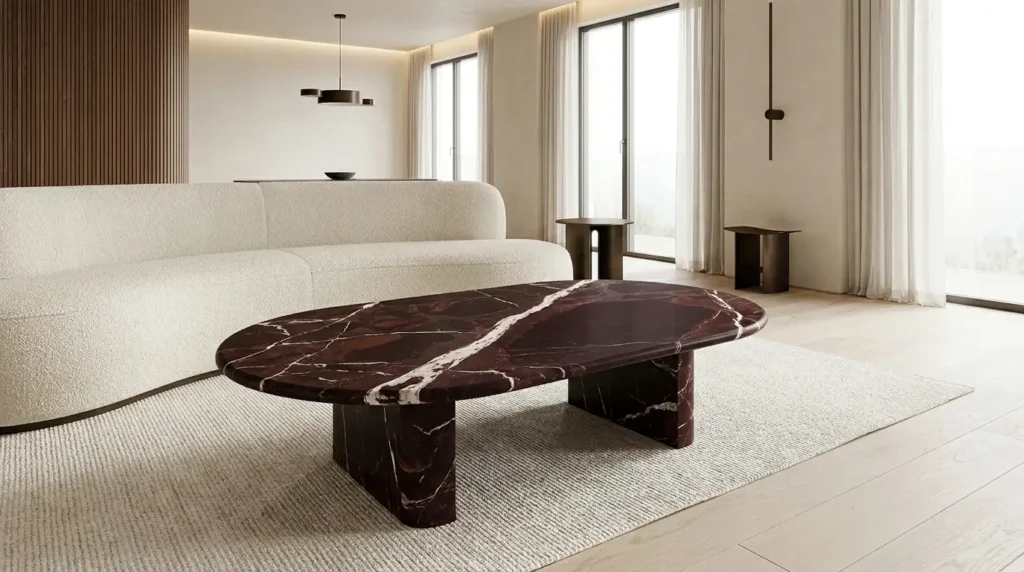
A marble coffee table may use far less natural stone than a floor or feature wall, but it can have just as much visual impact.
The reason is simple.
A coffee table normally occupies the center of the seating area.
It sits directly within the visual field of:
- sofas
- lounge chairs
- rugs
- lighting
- fireplaces
- architectural stone
- artwork
and people see its surface from a relatively close distance.
This makes natural stone particularly effective.
A marble coffee table can display:
- dramatic veins
- subtle mineral clouds
- crystalline structures
- brecciated formations
- unusual natural colors
- geological movement
without requiring a large quantity of material.
It is therefore one of the most practical ways to introduce an expressive natural stone into an interior.
But successful marble furniture requires more than cutting a small rectangle from a leftover slab.
The best coffee tables coordinate:
stone
shape
proportion
pattern placement
edge profile
base
surface finish
structural support
as one complete design.
Why Choose a Marble Coffee Table?
A natural stone coffee table can function as both:
furniture
and
material statement.
Unlike manufactured surfaces with repeated printed patterns, every genuine natural-stone piece can have a unique geological composition.
This makes marble particularly effective for custom furniture.
One table may contain:
- one dramatic vein
- a large clean mineral field
- a concentrated burgundy formation
- branching green movement
- subtle crystalline variation
while another table produced from the same stone family can look completely different.
The furniture becomes individual.
Coffee Tables Are Ideal for Statement Stone
Using an expressive marble across an entire room can sometimes become visually overwhelming.
A coffee table provides another strategy.
Instead of installing:
- 50 m² of colorful marble
- a complete stone wall
- dramatic flooring
the designer may use only one carefully selected stone furniture piece.
For example:
warm neutral room
one Rosso Levanto coffee table
can introduce enough burgundy color to change the entire atmosphere.
Likewise:
minimal cream interior
one Rainforest Green coffee table
can provide a strong natural focal point without covering the architecture in green stone.
Marble Coffee Table vs Marble Dining Table
A coffee table gives the designer different freedoms.
Compared with a dining table, it can generally be:
- lower
- smaller
- more sculptural
- more irregular
- more visually experimental
The furniture does not need to provide seating around its entire perimeter.
This allows greater freedom with:
- bases
- asymmetrical forms
- solid stone volumes
- nesting compositions
- organic shapes
The coffee table is therefore one of the best categories for exploring sculptural natural-stone furniture.
Best Marble Types for Coffee Tables
There is no single best stone.
Different marbles create completely different furniture identities.
The right choice depends on whether the table should be:
- neutral
- colorful
- dramatic
- minimal
- warm
- monochromatic
- sculptural
Calacatta Viola Coffee Table
Calacatta Viola is particularly suited to smaller furniture because an expressive area of one slab can become the complete visual composition.
Its natural palette can include:
- white
- ivory
- burgundy
- wine red
- violet
- purple-red movement
A coffee table allows the most attractive part of the slab to be deliberately selected.
This can produce an almost artwork-like object.
Why Calacatta Viola Works on Small Furniture
Imagine a large slab containing one spectacular burgundy formation.
Using that area in flooring may cause it to become only one part of a much larger composition.
Using it for a coffee table concentrates the pattern.
The table becomes:
one selected geological moment.
This makes dramatic slabs especially valuable for furniture production.
Statuario Coffee Table
Statuario provides a different visual language.
Its typical combination of:
- white background
- grey veins
- clean mineral areas
makes it suitable for:
- minimalist interiors
- contemporary apartments
- luxury villas
- hotel suites
A simple round or oval table can allow the natural grey vein to become the main decoration.
Afyon White Coffee Table
Afyon White works particularly well when the design needs natural marble without dramatic veining.
The table can rely on:
- clean white background
- crystalline texture
- subtle mineral movement
- precise furniture proportions
This makes Afyon White useful for very minimal interiors.
A sculptural base can become more prominent because the stone surface itself remains relatively calm.
Rosso Levanto Coffee Table
Rosso Levanto can create an exceptionally strong furniture piece.
Its deep burgundy coloration can transform a neutral living room immediately.
Possible combinations include:
Rosso Levanto
cream sofa
light oak
warm white plaster.
Because the stone has strong color and natural movement, the coffee-table shape usually benefits from restraint.
A simple:
- circle
- oval
- rounded rectangle
may be stronger than a complicated sculptural outline.
Alexander Black Coffee Table
A black coffee table creates strong visual weight.
Alexander Black can offer:
- black background
- white veins
- pale-grey movement
which makes it especially suitable for:
- light-colored living rooms
- cream upholstery
- pale rugs
- oak flooring
- contemporary architecture
The result can be highly graphic.
Rainforest Green Coffee Table
Rainforest Green is particularly effective for statement furniture.
Its branching natural pattern may resemble:
- tree roots
- rivers
- forest branches
- geological maps
A relatively small tabletop can capture an exceptionally interesting section of one slab.
Because the stone is visually complex, the geometry should generally remain simple.
Narcisse Coffee Table
Narcisse can create a warmer furniture object.
Its natural appearance may combine:
- mocha
- brown
- taupe
- grey-brown
- lighter mineral clouds
This works particularly well with:
- cream sofas
- oak
- walnut
- bronze
- warm plaster
A honed finish can make the material feel especially contemporary.
Pink Travertine Coffee Table
Travertine furniture deserves special attention because it creates a softer and more textural appearance than conventional marble.
Pink Travertine can produce coffee tables with:
- blush
- dusty rose
- cream
- subtle rust
- natural pores
This can work extremely well in:
- contemporary residential interiors
- boutique hotels
- lounge areas
- spa-inspired spaces
Silver Travertine Coffee Table
Silver Travertine can create more architectural furniture.
A vein-cut top may contain:
- linear grey layers
- silver bands
- taupe movement
while a cross-cut surface may appear:
- cloudier
- less directional
- more organic.
Travertine can also be used to create substantial pedestal bases.
Ivory Travertine Coffee Table
Ivory Travertine is one of the strongest choices for sculptural stone furniture.
Its neutral cream palette allows:
- thick volumes
- fluted bases
- cylinders
- monolithic forms
without making the furniture visually excessive.
This makes it ideal for minimalist interiors where the furniture shape is more important than dramatic color.
Marble Coffee Table Shapes
Shape is one of the most important design decisions.
Popular options include:
- round
- oval
- rectangular
- square
- rounded rectangle
- racetrack
- organic
- asymmetrical
- nesting
- monolithic sculptural forms
Each shape interacts with natural stone differently.
Round Marble Coffee Table
The round coffee table is one of the most versatile configurations.
It works particularly well with:
- sectional sofas
- curved sofas
- lounge-chair groups
- compact living rooms
The absence of corners also improves circulation around the furniture.
Common Round Marble Coffee Table Sizes
Useful starting dimensions include approximately:
- Ø60 cm
- Ø70 cm
- Ø80 cm
- Ø90 cm
- Ø100 cm
- Ø110 cm
- Ø120 cm
The correct size depends on:
- sofa dimensions
- number of seats
- available circulation
- whether additional side tables are used
A 60–70 cm table may work as a compact accent.
A 100–120 cm table becomes a major central furniture object.
Round Table Pattern Placement
Circular cutting creates a unique relationship with the slab.
A strong vein can be placed:
- through the center
- slightly off-center
- diagonally across the circle
- along one edge
Each position creates a different visual balance.
The circle should be positioned digitally on the actual slab before cutting.
Why Circular Tables Can Create More Waste
A circle is cut from a rectangular slab.
This naturally leaves material around:
- four corners
- outside the circumference
However, those remnants can often be used for:
- side tables
- small consoles
- shelves
- sample pieces
A furniture set can therefore be planned together to improve material utilization.
Oval Marble Coffee Table
Oval coffee tables are particularly effective in elongated seating areas.
They combine:
- soft edges
- good circulation
- more usable length than a circle
They work especially well in front of:
- long sofas
- large sectionals
- hotel lounge seating
Typical Oval Coffee Table Dimensions
Useful starting ranges include approximately:
- 100 × 60 cm
- 110 × 65 cm
- 120 × 70 cm
- 130 × 75 cm
- 140 × 80 cm
- 150 × 85 cm
These are design references rather than fixed standards.
The correct proportions depend on the furniture arrangement.
Oval Tables and Dramatic Veins
An oval shape works beautifully with diagonal geological movement.
For example, one strong grey or burgundy vein can cross:
- one curved corner
- the table center
- the opposite side
creating a more dynamic composition.
Rectangular Marble Coffee Table
Rectangular tables provide a more architectural appearance.
They work especially well in:
- formal living rooms
- large villas
- hotel lounges
- long seating configurations
The geometry allows strong slab movement to remain clearly visible.
Common Rectangular Coffee Table Dimensions
Possible planning ranges include:
- 80 × 50 cm
- 90 × 60 cm
- 100 × 60 cm
- 110 × 60 cm
- 120 × 70 cm
- 130 × 70 cm
- 140 × 80 cm
Large luxury interiors may use even larger pieces.
The table should still remain proportionate to the surrounding seating.
Square Marble Coffee Table
Square tables work particularly well with:
- large sectional sofas
- square seating arrangements
- symmetrical interiors
Typical starting sizes may include:
- 70 × 70 cm
- 80 × 80 cm
- 90 × 90 cm
- 100 × 100 cm
- 110 × 110 cm
- 120 × 120 cm
A large square stone table can become visually substantial.
The base design therefore becomes important.
Rounded Rectangle Coffee Table
A rounded rectangle is one of the strongest contemporary forms.
It combines:
- architectural geometry
- softer circulation
- modern furniture language
The corner radius can vary from:
- very subtle
- medium
- strongly rounded
The radius should relate to:
- table dimensions
- stone thickness
- surrounding furniture
Racetrack Coffee Table
The racetrack form uses:
- parallel straight sides
- fully curved ends
It is particularly effective with:
- contemporary sofas
- long seating groups
- minimalist interiors
The shape feels more sculptural than a simple rectangle while remaining geometrically controlled.
Organic Marble Coffee Tables
Organic furniture removes strict geometric symmetry.
Possible shapes include:
- irregular pebble forms
- asymmetrical ovals
- softened triangular forms
- free-form contours
This can create highly sculptural furniture.
However, there is an important rule:
the more complicated the stone, the simpler the shape may need to be.
A wildly veined stone combined with a highly irregular shape can create too much visual information.
Organic Shape + Calm Stone
One effective strategy is:
sculptural shape
calm natural stone.
For example:
Afyon White
or
Ivory Travertine
can work beautifully with an organic outline because the surface remains visually restrained.
Dramatic Stone + Simple Shape
The opposite strategy works equally well:
dramatic stone
simple geometry.
For example:
Calacatta Viola
simple oval
allows the geological pattern to become the primary design element.
Nesting Marble Coffee Tables
Nesting tables use two or more pieces at different heights or dimensions.
They can provide:
- flexibility
- layered furniture composition
- additional surface area
- stronger visual rhythm
A set may include:
- one large oval
- one smaller circle
or:
- two overlapping rounded rectangles.
Same Stone Nesting Tables
Using the same slab creates a strong relationship between pieces.
The patterns may appear related without being identical.
For example:
large Calacatta Viola table
small Calacatta Viola side table
can be produced from neighboring slab areas.
Contrasting Stone Nesting Tables
Another strategy is combining two stones.
For example:
Afyon White
Rosso Levanto
or:
Ivory Travertine
Alexander Black.
This creates stronger contrast.
But the stones should have clearly defined hierarchy.
Do Not Combine Too Many Stone Types
A three-table set using:
- white marble
- red marble
- green marble
may become visually chaotic.
A more controlled approach is usually:
- same stone, different sizes
or:
- one neutral stone
- one statement stone.
Coffee Table Height
Coffee tables are much lower than dining tables.
A useful starting range is approximately:
30–45 cm overall height.
Many contemporary low tables fall around:
32–38 cm.
More conventional coffee tables may sit around:
38–45 cm.
The correct height depends on the sofa.
Relationship Between Sofa and Coffee Table Height
A coffee table is often designed:
- approximately level with the sofa seat
- or slightly lower
rather than substantially higher.
A very high coffee table can interfere visually with the seating area.
A very low table can become uncomfortable for everyday use.
Always review the actual sofa dimensions.
Sofa Distance
A useful planning range between the sofa and coffee table is often approximately:
35–50 cm.
The space should allow:
- comfortable access
- leg movement
- circulation
while keeping the table reachable.
The correct distance depends on the seating design and room proportions.
Coffee Table Width Relative to Sofa
Rather than using one fixed formula, visually compare the table with the sofa.
A very small coffee table in front of a long sectional can appear disconnected.
An oversized table can restrict circulation.
The table should feel intentionally related to the seating group.
Coffee Table Thickness
There is no universal correct stone thickness.
The design must consider:
- table size
- stone type
- support
- span
- edge profile
- reinforcement
- base configuration
- transport
Visual thickness and structural thickness are also not necessarily the same.
20 mm Stone Top
Approximately 20 mm stone can create:
- visually light furniture
- refined modern edges
- elegant proportions
but thin natural stone generally requires appropriate support.
A large 20 mm top should not simply be expected to span widely unsupported.
30 mm Stone Top
Approximately 30 mm stone provides:
- greater visual substance
- a stronger edge
- increased section depth
It is common for furniture that should feel clearly stone-based without appearing extremely heavy.
Support is still important.
Thick-Looking Coffee Tables
Coffee tables frequently use exaggerated visual thickness as part of the design.
A top may appear:
- 50 mm
- 70 mm
- 100 mm
or more.
This effect can be achieved through built-up stone edge construction rather than one extremely thick solid slab.
Built-Up Edge
A built-up edge can create:
- stronger visual mass
- reduced use of solid thick material
- controlled furniture proportions
However, the mitred joints must be fabricated precisely.
On highly veined stone, the relationship between top and edge pattern is especially visible.
Monolithic Solid-Stone Coffee Tables
Some coffee tables are intentionally designed as massive stone objects.
These may use:
- thick blocks
- laminated stone structures
- stone-clad structural cores
- multiple fabricated components
The final construction should be selected according to:
- material
- weight
- stability
- handling
- fabrication
The appearance alone should not determine the assembly method.
Marble Coffee Table Edge Profiles
Common edge options include:
- straight
- micro-bevel
- eased
- rounded
- bullnose
- chamfered
- reverse chamfer
- mitred thick edge
Straight Edge
A simple straight edge creates:
- clean architecture
- strong geometry
- minimal visual distraction
It is particularly effective with dramatic stone.
Soft Rounded Edge
Rounded edges can make marble furniture feel more tactile.
They work especially well for:
- oval tables
- organic shapes
- family living areas
- contemporary interiors
The radius can be subtle or visually pronounced.
Chamfered Edge
A chamfer can make a thick stone top appear lighter.
The angled cut creates a shadow line beneath the visible top surface.
This is particularly effective on:
- rectangular tables
- square tables
- dark marble
Reverse Chamfer
A reverse chamfer reduces visible edge mass from below.
From above, the tabletop still appears substantial.
From normal seated viewing height, it may look significantly lighter.
This can work extremely well with modern furniture.
Marble Coffee Table Bases
Coffee tables allow much more freedom in base design than dining tables because knee clearance around the entire perimeter is less important.
Possible bases include:
- stone pedestal
- twin pedestal
- cylinder
- sphere-inspired supports
- rectangular blocks
- metal frames
- wood structures
- sculptural stone volumes
Stone Pedestal Base
A stone pedestal can create a monolithic appearance.
Examples include:
- central cylinder
- rectangular block
- oval pedestal
- fluted cylinder
The base can use:
- the same stone
- or a contrasting stone.
Same-Stone Pedestal
Using the same stone creates a highly sculptural object.
For example:
Rosso Levanto top
Rosso Levanto pedestal
produces a strong visual statement.
This works best when the complete room remains relatively restrained.
Contrasting Pedestal
A contrasting base can reduce visual intensity.
For example:
Calacatta Viola top
warm white limestone pedestal.
The dramatic tabletop remains dominant while the base provides quieter support.
Cylindrical Stone Bases
Cylinders are particularly compatible with:
- round tables
- oval tables
- organic furniture
They can be produced with:
- smooth surfaces
- vertical fluting
- ribbed texture
depending on the stone and design.
Fluted Marble Coffee Table Base
Fluting can transform a relatively simple pedestal.
Vertical grooves create:
- shadows
- rhythm
- texture
- stronger craftsmanship
This works especially well with calmer materials such as:
- Afyon White
- beige marble
- Ivory Travertine
because the geometry remains visible.
Should Highly Veined Stone Be Fluted?
It can be, but consider what will be lost.
Fluting breaks the natural surface into many narrow ridges.
A dramatic vein may become visually fragmented.
For highly expressive stone, a smooth pedestal often preserves the pattern more effectively.
Metal Coffee Table Bases
Metal provides a lighter alternative.
Possible materials and appearances include:
- black metal
- dark bronze
- brushed bronze
- stainless steel
A thin structural frame allows more of the marble top to remain visually dominant.
Black Metal Base
Black works with almost every natural stone.
It is particularly effective with:
- white marble
- burgundy marble
- green marble
- beige stone
because the support remains visually quiet.
Bronze Base
Bronze introduces additional warmth.
It works especially well with:
- Rosso Levanto
- Narcisse
- cream stone
- green stone
but should be used carefully with highly decorative marble.
Stainless Steel Base
Stainless steel creates a cooler contemporary character.
Strong combinations include:
- Statuario
- Afyon White
- Tundra Grey
- Alexander Black
especially in minimalist interiors.
Wood Coffee Table Bases
Wood can visually soften a stone top.
Strong combinations include:
Walnut + White Marble
Classic contrast.
Walnut + Green Marble
Natural, earthy richness.
Light Oak + Black Marble
Strong contemporary contrast.
Dark Oak + Beige Stone
Warm and understated.
Coffee Table Slab Selection
This is where custom furniture can differ dramatically from mass-produced stone furniture.
Do not simply choose:
Calacatta Viola
and expect every table to look like the reference image.
Choose the actual slab section.
Selecting the Exact Table Position
Once the slab has been photographed, create a scaled outline of the coffee table.
Move it around the slab.
Evaluate:
- central composition
- vein position
- color distribution
- quiet areas
- natural discontinuities
Then rotate the outline.
A 90-degree rotation can completely change the furniture.
Centering a Feature
Some tables benefit from a strong central geological feature.
Examples include:
- a burgundy Calacatta Viola formation
- a branching Rainforest Green pattern
- one strong Alexander Black white vein
The table then becomes intentionally symmetrical around the selected feature.
Off-Center Pattern
Perfect centering is not always best.
An off-center vein can create:
- movement
- tension
- contemporary asymmetry
This works particularly well on:
- oval tables
- organic tables
- rounded rectangles
Avoid Unintentional Pattern Placement
A strong vein ending exactly at a corner can sometimes appear accidental.
Likewise, one half of a round table may contain all the dramatic pattern while the other half is completely empty.
This may be beautiful.
Or it may appear unbalanced.
The key is that the result should be reviewed intentionally before cutting.
Using Slab Offcuts
Coffee tables are one of the best applications for high-quality slab remnants.
A large project may leave stone pieces after producing:
- kitchen islands
- bathroom vanities
- wall panels
- dining tables
Some remnants may contain spectacular natural patterns.
Instead of treating them as waste, they can become:
- coffee tables
- side tables
- console tops
- shelves
- decorative objects
Offcut Does Not Mean Lower Quality
A remnant may contain one of the most beautiful areas of the original slab.
Its limitation is usually only:
dimension.
Furniture transforms that dimensional limitation into an opportunity.
Designing Furniture Around Available Stone
Suppose an exceptional remnant measures:
105 × 75 cm.
Instead of insisting on a predetermined:
120 × 80 cm coffee table,
the designer may adapt the table to:
100 × 70 cm
and preserve the unique material.
This is one of the advantages of bespoke furniture.
Creating a Furniture Collection from One Slab
One full slab may produce:
- dining table
- coffee table
- two side tables
depending on dimensions.
This creates a naturally coordinated collection.
The pieces share:
- color
- mineral character
- stone origin
without repeating the exact same texture.
Coffee Table + Side Tables
A strong furniture set might use:
one large oval coffee table
two small round side tables.
They may all use the same stone but different slab areas.
This creates consistency without monotony.
Coffee Table + Console
Another option is:
coffee table
console table
produced from related slab areas.
The furniture can then visually connect:
- living room center
- wall furniture
without covering permanent architecture in the same stone.
Polished Marble Coffee Tables
Polishing increases:
- reflection
- apparent color depth
- vein contrast
- visual richness
It works especially well with:
- black marble
- red marble
- green marble
- dramatic white marble
A polished coffee table can act almost like a reflective object within the room.
Honed Marble Coffee Tables
Honing creates:
- softer color
- lower reflection
- more contemporary appearance
- tactile surface character
This can work particularly well for:
- neutral stones
- brown stones
- minimalist interiors
It can also make a highly dramatic marble feel more architectural.
Polished vs Honed for Dark Marble
This difference can be especially noticeable.
Polished Alexander Black
May appear:
- deeper black
- strongly contrasted
- reflective
Honed Alexander Black
May appear:
- charcoal
- softer
- more matte
The same general principle applies to many dark natural stones.
Polished vs Honed for Colorful Marble
Polishing generally strengthens:
- burgundy
- green
- brown
- violet
while honing can mute them slightly.
Always approve the actual finish.
Coffee Table Lighting
Because coffee tables sit horizontally, they receive light differently from wall panels.
Ceiling lighting may reflect directly from polished stone.
Window light may create:
- broad reflections
- stronger crystal visibility
- changing vein contrast
This means finish selection should consider the actual room lighting.
Highly Polished Table Under Pendant Light
A polished table directly beneath bright lighting can produce significant reflection.
This may be desirable in a formal luxury interior.
For a softer residential atmosphere, a honed finish may feel more comfortable.
Marble Coffee Table Weight
Even relatively small stone furniture can be heavy.
Weight increases quickly with:
- larger diameter
- greater thickness
- solid stone bases
This affects:
- floor handling
- delivery
- installation
- relocation
A sculptural stone table should therefore be designed with real logistics in mind.
A 100 cm Round Table Is Not a Small Object Logistically
A 100 cm round natural-stone top combined with a solid stone pedestal can become a substantial furniture piece.
Before production, consider:
- doorway width
- elevator
- stairs
- final room
- assembly method
If possible, design the top and base as separately manageable components.
Modular Construction
Some coffee tables can be assembled from:
- separate top
- pedestal
- hidden fixing system
This can simplify:
- packing
- transportation
- installation
The structural connection still needs to be appropriate for the table design.
Stability Is Critical
A visually attractive coffee table must also be stable.
The relationship between:
- top size
- top weight
- base width
- center of gravity
must be considered.
An extremely small pedestal beneath a very large stone top may look elegant in a render while being inappropriate in reality.
Do Not Copy Impossible AI Furniture
This is becoming increasingly important.
AI-generated furniture concepts frequently show:
- massive stone tops
- tiny unsupported pedestals
- impossible cantilevers
- extremely thin marble necks
- floating stone
without structural logic.
A render can be inspiration.
It should not replace fabrication engineering.
Sculptural Marble Bases
Stone can still create very unusual furniture when geometry remains physically realistic.
Possible concepts include:
- twin oval pedestals
- offset cylinders
- interlocking blocks
- fluted monoliths
- curved stone-clad forms
Each should maintain credible:
- stability
- support
- fabrication
- assembly
Marble Coffee Tables for Luxury Hotels
Hospitality interiors can use stone coffee tables to reinforce the material identity of the architecture.
Possible locations include:
- lobby lounges
- suites
- executive lounges
- reception seating
- restaurant waiting areas
Furniture can use the same stone family as selected architectural details.
Hotel Furniture Does Not Need to Match Exactly
Suppose a lobby contains:
Ivory Travertine flooring.
The coffee tables do not necessarily need to be Ivory Travertine.
They might use:
Rosso Levanto
to create contrast.
The goal is material coordination, not repetition.
Marble Coffee Tables for Hotel Suites
A suite can use a smaller statement stone that would be too expensive or visually intense for large-scale architectural surfaces.
For example:
Calacatta Viola coffee table
can provide a luxury material signature without requiring a Calacatta Viola bathroom or floor.
Marble Coffee Tables for Residential Interiors
Coffee tables can also be the most practical entry point for expressive natural stone in a residence.
A homeowner may want:
- burgundy marble
- green marble
- black marble
but not want to commit to permanent architecture.
Furniture provides a more concentrated way to use the material.
Neutral Room + Statement Table
This is one of the most reliable formulas.
For example:
cream sofa
warm white plaster
light oak floor
Rainforest Green coffee table.
The stone immediately becomes the visual center.
Dramatic Room + Quiet Table
The opposite also works.
If the room already contains:
- expressive artwork
- dramatic wall stone
- colorful furniture
use a quiet table such as:
- Afyon White
- Ivory Travertine
- restrained Tundra Grey
to prevent material competition.
Marble Coffee Table Care
Natural stone furniture should be maintained according to the actual stone.
For calcium-carbonate-based marble, conservative routine care includes:
- pH-neutral natural-stone cleaner
- soft cloth
- prompt spill removal
- coasters
- avoiding abrasive products
- avoiding acidic cleaning agents
Coffee tables may encounter fewer food-related spills than dining tables, but they are still exposed to:
- coffee
- wine
- cocktails
- citrus drinks
- decorative objects
- candle wax
- cosmetics
Care expectations should be understood before selecting the stone.
Can Coffee Stain Marble?
Potentially.
The risk depends on:
- stone absorption
- surface treatment
- contact time
- finish
Promptly blotting spills is a sensible maintenance practice.
Do not allow dark liquids to remain unnecessarily on porous or absorbent natural stone.
Can Wine Damage Marble?
Wine may create more than one concern.
It contains:
- pigments
- liquid
- acidity
Depending on the marble, it may contribute to:
- staining
- surface etching
Clean spills promptly and use coasters.
Can Lemon Damage a Marble Coffee Table?
Acid-sensitive marble can be etched by lemon or other citrus liquids.
The resulting mark may appear:
- matte
- pale
- dull
even when no visible colored stain remains.
This is why citrus drinks should not sit directly on marble without protection.
Can Vinegar Be Used to Clean Marble Furniture?
No for conventional calcareous marble.
Vinegar is acidic and can chemically affect calcium-carbonate surfaces.
Use an appropriate non-acidic natural-stone cleaning product instead.
Etching vs Staining
These are different problems.
Staining
A substance penetrates into the material.
Etching
A chemical reaction alters the surface.
A polished marble coffee table can therefore have:
- no stain
but still show:
- a dull etched ring.
Understanding the difference is important when evaluating maintenance.
Coasters Are Particularly Useful
Coffee tables regularly hold:
- drinks
- cocktails
- glasses
- cups
Coasters provide a simple barrier between the stone and liquid.
They are particularly useful with:
- citrus drinks
- wine
- alcohol
on calcium-carbonate stone.
Decorative Objects Can Scratch
Coffee tables may hold:
- ceramic objects
- metal trays
- sculptures
- lamps
Sliding rough objects across polished stone can create surface marks.
Felt pads beneath decorative pieces can reduce unnecessary abrasion.
Should Marble Coffee Tables Be Sealed?
Possibly, depending on the stone.
An appropriate impregnating treatment may increase resistance to certain stains.
But it does not make natural stone completely stain-proof.
The correct treatment depends on:
- stone
- finish
- absorption
- factory processing
- intended use
Sealing Does Not Prevent Acid Etching
This distinction is important.
An impregnator can reduce penetration.
It does not fundamentally change the mineral chemistry of marble.
Therefore:
sealed marble can still etch.
Do not market sealing as universal protection from:
- lemon
- vinegar
- acidic drinks
on conventional calcitic marble.
Travertine Coffee Table Care
Travertine is also calcium-carbonate based.
The same general acid caution applies.
Additionally, depending on whether the table is:
- filled
- partially filled
- unfilled
its surface texture may require slightly different maintenance.
Open pores can collect:
- dust
- crumbs
- liquid
more easily than a fully filled smooth surface.
Filled Travertine for Furniture
A filled and honed travertine may be practical for furniture where a smoother tabletop is desired.
It preserves much of the:
- color
- sedimentary character
while reducing some open cavities.
Unfilled Travertine Furniture
An intentionally more open surface can look extremely architectural.
But clients should understand the tactile and cleaning characteristics.
It may be better suited to:
- side tables
- decorative furniture
than surfaces expected to remain completely smooth.
Marble Coffee Table vs Travertine Coffee Table
Choose marble when you want:
- crystalline stone
- veins
- greater graphic movement
- polished luxury
Choose travertine when you want:
- pores
- sedimentary character
- earthier texture
- sculptural architectural forms
Neither is universally better.
Marble Coffee Table vs Wood Coffee Table
Marble
Provides:
- visual weight
- mineral depth
- unique geology
- stronger statement
Wood
Provides:
- warmth
- organic grain
- softer tactile appearance
- lower visual weight
Combining the two can create a balanced interior.
Marble Coffee Table vs Glass Coffee Table
Glass almost disappears visually.
Marble does the opposite.
It creates:
- mass
- color
- material presence
Choose glass when the room needs visual lightness.
Choose marble when the coffee table should become a defined object within the space.
Marble Coffee Table vs Porcelain
Porcelain can imitate stone patterns with high consistency.
Natural marble provides:
- non-repeating geology
- genuine mineral structure
- unique slab composition
The choice depends partly on whether the client values:
consistency
or
natural uniqueness.
Custom Marble Coffee Table vs Ready-Made
A ready-made stone table typically provides predefined:
- dimensions
- shape
- stone
- pattern
- base
A custom marble table allows control over:
- exact stone slab
- exact table dimensions
- pattern placement
- edge profile
- finish
- base material
- height
This is particularly valuable for high-character natural stone.
Custom Production Workflow
A professional process can follow:
1. Define the Room
Review sofa and seating arrangement.
2. Determine Table Size
Based on circulation and proportion.
3. Choose Shape
Round, oval, rectangular, square or organic?
4. Choose Stone
White, beige, grey, black, burgundy, green or another color?
5. Review Actual Material
Use full slabs or suitable remnants.
6. Select Exact Slab Area
Position the table digitally.
7. Select Thickness
According to design and structural requirements.
8. Choose Edge
Straight, rounded, chamfered or another approved detail.
9. Choose Finish
Polished or honed?
10. Design Base
Stone, metal or timber?
11. Review Stability
Confirm realistic structural proportions.
12. Produce Shop Drawings
Define all components.
13. Fabricate
According to approved layout.
14. Quality Control
Check:
- stone
- dimensions
- shape
- edges
- finish
- pattern
- base
- assembly
15. Pack
Protect edges and surfaces.
16. Install
Where professional handling is required.
Packing Marble Coffee Tables
Natural-stone furniture requires more protection than ordinary lightweight furniture.
Packing should consider:
- stone surface
- edges
- corners
- base
- movement
- vibration
Depending on design, the top and base may be packed separately.
Rounded Tables Still Need Edge Protection
A circular table does not have sharp rectangular corners, but the perimeter remains vulnerable.
The outer stone edge should be protected from impact throughout:
- factory handling
- loading
- transport
- site delivery
Quality Control Before Shipment
Before packing, inspect:
- overall dimensions
- height
- stone selection
- pattern position
- finish consistency
- edge quality
- visible repairs where relevant
- base finish
- connection points
Furniture problems are easier to correct in production than after international shipment.
Photograph the Finished Table
For custom projects, finished-product photography provides another verification step.
Useful views include:
- complete table
- top view
- edge detail
- base
- underside connection
- stone close-up
- dimensions where necessary
This creates a clearer record before packing.
Coffee Table Furniture Sets
Instead of producing one isolated table, a project can define a coordinated set.
For example:
Set A
- 110 cm oval coffee table
- two 45 cm side tables
Set B
- 100 cm round coffee table
- one 60 cm nesting table
Set C
- 130 × 70 cm rectangular table
- matching console
A coordinated family can strengthen the interior design.
Same Shape, Different Heights
Nesting compositions may use:
- identical geometry
- different scale
- different height
This creates a visually coherent group.
Same Stone, Different Shapes
Another approach uses:
- round coffee table
- rectangular console
- cylindrical side table
all in the same material.
The stone creates the family identity rather than the furniture shape.
Same Shape, Contrasting Stones
For stronger interiors:
- one large neutral table
- one small statement table
can create controlled contrast.
For example:
Ivory Travertine large table
Rosso Levanto small table.
Choosing Stone by Interior Style
Minimal Contemporary
Consider:
- Afyon White
- Statuario with controlled veins
- Ivory Travertine
- Tundra Grey
Warm Contemporary
Consider:
- Narcisse
- Pink Travertine
- beige marble
- Ivory Travertine
Dramatic Luxury
Consider:
- Calacatta Viola
- Rosso Levanto
- Alexander Black
Organic Luxury
Consider:
- Rainforest Green
- Silver Travertine
- warm travertine
The actual slab is still more important than the category.
Choosing Shape by Interior Style
Minimalist
- circle
- clean rectangle
- rounded rectangle
Organic
- pebble shape
- irregular oval
- asymmetric form
Architectural
- square
- rectangle
- monolithic pedestal
Soft Contemporary
- oval
- racetrack
- large-radius rounded rectangle
Choosing the Base by Stone Pattern
Dramatic Stone
Use:
- simple pedestal
- minimal metal
- quiet geometry
Calm Stone
You can introduce:
- fluting
- sculptural base
- unusual geometry
This keeps the furniture composition balanced.
Common Mistakes with Marble Coffee Tables
1. Choosing the Stone from a Tiny Sample
A small sample cannot define the complete table.
2. Ignoring the Actual Slab Pattern
The table should be positioned before cutting.
3. Making the Table Too Small for the Sofa
The furniture becomes visually disconnected.
4. Making the Table Too Large
Circulation becomes uncomfortable.
5. Copying Unrealistic Render Proportions
Stone furniture must remain physically credible.
6. Using a Tiny Base Under a Large Heavy Top
Stability and support are essential.
7. Making Both Shape and Stone Extremely Dramatic
Too many visual features can compete.
8. Ignoring Edge Design
The edge is visible from almost every seated position.
9. Ignoring Weight Before Delivery
The table still needs to reach the room.
10. Using Acidic Marble Cleaners
Conventional marble requires appropriate non-acidic care.
11. Assuming Sealing Makes Marble Acid-Proof
It does not.
12. Treating Remnant Stone as Waste
High-quality offcuts can be ideal furniture material.
How to Choose a Marble Coffee Table
Use this process:
1. Measure the Seating Area
Not only the entire room.
2. Measure the Sofa
Understand the table-to-sofa proportion.
3. Determine Circulation
Leave practical access around the table.
4. Choose the Shape
Round, oval, rectangle or organic?
5. Define Height
Coordinate with the sofa seat.
6. Select the Stone Character
Calm or dramatic?
7. Review Actual Slabs or Remnants
Do not rely only on sample pieces.
8. Position the Table on the Stone
Approve the pattern.
9. Select the Edge
Match the design language.
10. Select the Finish
Polished or honed?
11. Design the Base
Stone, metal or wood?
12. Verify Support and Stability
Before fabrication.
13. Confirm Delivery Access
Especially for monolithic furniture.
14. Approve Shop Drawings
Before cutting.
Final Thoughts
A marble coffee table is one of the most effective ways to turn a small quantity of natural stone into a strong architectural element.
Because the furniture sits close to the user, every detail becomes visible:
- natural pattern
- finish
- edge
- proportions
- fabrication
- base
This creates an opportunity to use spectacular areas of slabs that might otherwise disappear within a much larger architectural project.
The strongest coffee tables begin with:
the actual stone
rather than only the stone name.
Review the slab.
Find the most interesting area.
Select the shape according to both the room and the geology.
Position the tabletop digitally before cutting.
Keep complicated stone patterns paired with relatively simple furniture forms.
Use calmer stones when the furniture geometry itself should become sculptural.
Plan realistic support.
Consider weight and delivery access.
Choose polished or honed finishes according to the lighting and interior style.
And maintain the natural stone according to its actual mineral composition.
A custom marble coffee table should not look like an arbitrary piece of stone placed on a pedestal.
The strongest designs make it difficult to separate:
the stone
from
the furniture.
They feel as though the table could only have been made from that particular slab.
Frequently Asked Questions
Is marble good for a coffee table?
Yes. Marble is commonly used for table tops and can create highly distinctive furniture because each natural stone piece has unique geological variation.
What is the best marble for a coffee table?
There is no universal best option. Calacatta Viola, Statuario, Afyon White, Rosso Levanto, Alexander Black, Rainforest Green and other stones create completely different furniture styles.
What is a standard marble coffee table size?
There is no single standard. Round tables commonly range roughly from 60 to 120 cm in diameter, while rectangular tables often begin around 80 × 50 cm and can extend well beyond 140 × 80 cm in large interiors.
How high should a marble coffee table be?
Approximately 30–45 cm is a useful planning range for many coffee tables. The final height should be coordinated with the actual sofa seat height.
Should a coffee table be lower than the sofa?
Many contemporary coffee tables sit approximately level with or slightly below the sofa seat. The exact relationship depends on comfort and design.
Is a round or rectangular marble coffee table better?
Round tables generally improve circulation and work well with curved or compact seating arrangements. Rectangular tables work particularly well with long sofas and more architectural interiors.
What size round marble coffee table should I choose?
Approximately 80–100 cm in diameter is versatile for many living rooms, while larger 110–120 cm tables can work in more generous seating areas. Room and sofa dimensions should determine the final size.
Is 20 mm marble enough for a coffee table?
It can be used in appropriately supported furniture. Suitability depends on the stone, table size, span, reinforcement and base configuration.
Is 30 mm marble better?
It creates a more substantial section and may offer greater stiffness, but support requirements still depend on the complete furniture design.
Can marble coffee tables have thick edges?
Yes. Mitred or built-up edges can create the appearance of a much thicker tabletop without using a solid block of equivalent thickness.
Can a coffee table be made entirely from marble?
Yes. Monolithic and pedestal-style stone furniture can be produced, provided weight, structural support, fabrication, handling and stability are properly considered.
Can marble coffee tables be made from leftover slabs?
Yes. High-quality remnants are often ideal for coffee tables, side tables and console tops because these products require smaller dimensions than major architectural elements.
Is polished or honed marble better for a coffee table?
Polished marble offers stronger reflection and color depth. Honed marble produces a softer and more contemporary surface. Neither is universally better.
Can coffee stain a marble table?
Potentially. Staining risk varies with the actual stone, porosity, finish, treatment and contact time. Spills should be removed promptly.
Can wine damage marble?
Wine may contribute to staining and, on acid-sensitive marble, etching. Prompt cleaning and the use of coasters are sensible precautions.
Can lemon or vinegar damage a marble coffee table?
Acid-sensitive marble can be etched by lemon, vinegar and other acidic substances. Appropriate non-acidic stone cleaners should be used instead.
Does sealing make a marble coffee table stain-proof?
No. An appropriate impregnating treatment can improve stain resistance but does not make natural stone completely stain-proof.
Does sealing prevent marble from etching?
No. Impregnation does not remove the chemical sensitivity of conventional calcium-carbonate marble to acids.
Can I order a marble coffee table made from an exact slab?
Yes. In custom natural-stone furniture production, the slab can be photographed and the exact tabletop position can be approved before fabrication.
Looking for a Custom Marble Coffee Table?
VeraMarbles can support bespoke natural stone furniture for residential, hospitality and commercial projects.
Send us your:
- preferred stone
- table dimensions
- preferred shape
- desired height
- finish
- edge profile
- base concept
- reference image or drawing
- project location
We can support your project with:
- full-slab selection
- suitable remnant selection
- tabletop pattern positioning
- round, oval and custom shapes
- custom dimensions
- polished and honed finishes
- mitred and sculptural edges
- stone pedestal production
- matching side tables
- matching console tables
- production drawings
- fabrication
- quality control
- export packing
- project coordination
Request a Custom Marble Coffee Table Quote from VeraMarbles