
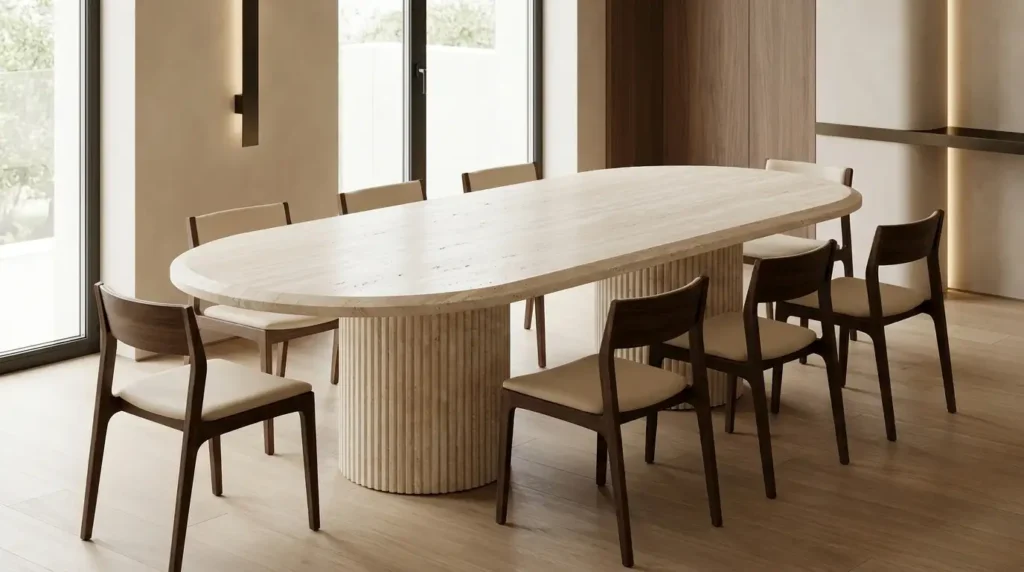
A travertine dining table creates a different type of natural-stone furniture from a conventional marble table.
Marble often attracts attention through:
- veins
- crystalline depth
- dramatic color contrast
Travertine works differently.
Its character comes from:
- natural pores
- sedimentary layers
- tonal bands
- mineral variation
- tactile texture
- geological direction
This makes travertine particularly suitable for the current architectural language of:
- sculptural furniture
- monolithic forms
- soft minimalism
- warm contemporary interiors
- organic architecture
A well-designed travertine dining table can feel substantial without looking excessively decorative.
It can become one of the largest stone elements in the room while still maintaining a calm architectural presence.
But travertine furniture should not be designed simply by replacing the marble top of an existing table with travertine.
The material has its own design logic.
A successful table should consider:
stone selection
cut direction
pore treatment
finish
table geometry
edge profile
pedestal design
structural support
fabrication
as one complete system.
What Is Travertine?
Travertine is a natural sedimentary stone belonging geologically to the limestone family.
It forms through the precipitation of calcium carbonate, commonly associated with mineral-rich spring systems.
This geological formation creates many of the features that make travertine visually distinctive:
- natural cavities
- pores
- sedimentary layers
- banding
- subtle mineral changes
Travertine is therefore not geologically marble, even though some historical commercial terminology may occasionally group polished travertines with marble.
For furniture design, this distinction matters because the stone’s:
- texture
- pore structure
- layering
- cut direction
are fundamental to its appearance.
Why Travertine Works So Well for Furniture
Travertine has several characteristics that make it particularly suited to contemporary furniture.
Its natural palette often includes:
- cream
- ivory
- beige
- taupe
- grey
- silver
- brown
- red
- pink
while its patterns are generally less graphic than strongly veined marble.
This means the designer can create more expressive furniture geometry without the stone itself becoming visually excessive.
Travertine works particularly well for:
- cylindrical pedestals
- thick-looking tabletops
- fluted bases
- oval tables
- racetrack tables
- monolithic forms
- sculptural consoles
- coffee tables
The geometry can become part of the furniture identity.
Travertine Furniture Is About Mass and Texture
A marble dining table can often look elegant with:
- a thin slab
- a minimal metal frame
Travertine is particularly powerful when it is allowed to feel more architectural.
For example:
thick-looking travertine top
two substantial stone pedestals
creates a furniture object that almost feels like a small piece of architecture.
The stone does not need dramatic veins.
Its:
- mass
- texture
- proportions
create the visual strength.
Best Travertine Types for Dining Tables
Different travertines produce completely different furniture.
Among the most useful design directions are:
Each provides a different architectural character.
Ivory Travertine Dining Table
Ivory Travertine is one of the strongest choices for minimalist furniture.
Its typical palette may include:
- warm ivory
- cream
- pale beige
- soft sand
- subtle tan layers
The relatively calm color makes it particularly suitable for sculptural forms.
For example:
Ivory Travertine racetrack table
two fluted cylindrical pedestals
can remain visually sophisticated because the material itself is restrained.
Why Ivory Travertine Is So Versatile
Ivory tones pair naturally with:
- walnut
- light oak
- dark oak
- cream upholstery
- warm white plaster
- bronze
- black metal
This allows the table to move between:
- Mediterranean contemporary
- warm minimalism
- luxury hospitality
- modern residential design
without depending on a highly specific color palette.
Vein-Cut Ivory Travertine Table
When vein cut, Ivory Travertine can show long horizontal or linear mineral layers.
On a rectangular dining table, these lines can be oriented:
along the table length
to reinforce the long proportion.
This can create an elegant visual rhythm.
Cross-Cut Ivory Travertine Table
Cross cutting creates a different character.
Instead of clear linear bands, the surface may appear:
- cloudier
- more irregular
- more organic
- less directional
This can work particularly well for:
- round tables
- oval tables
- organic furniture forms
where a strong straight geological direction may not be desired.
Silver Travertine Dining Table
Silver Travertine creates a cooler and more architectural furniture identity.
Its natural palette can include:
- silver-grey
- medium grey
- taupe-grey
- cream-grey
- charcoal-grey
- occasional warmer beige layers
The stone is especially effective in contemporary interiors that use:
- walnut
- dark bronze
- black metal
- warm white
- concrete
Vein-Cut Silver Travertine Table
Vein-cut Silver Travertine can produce extremely strong linear furniture.
A long table top may display parallel sedimentary bands that run almost continuously along the complete piece.
This works especially well for:
- 240 cm
- 260 cm
- 280 cm
- 300 cm
rectangular or racetrack dining tables.
The stone reinforces the furniture’s horizontal architecture.
Silver Travertine + Walnut
One of the strongest combinations.
Silver Travertine provides:
- cool mineral grey
- layered geology
- natural texture
Walnut provides:
- brown warmth
- visible grain
The result feels contemporary without becoming cold.
Pink Travertine Dining Table
Pink Travertine creates a softer and more distinctive furniture object.
Depending on selection, the stone may contain:
- pale blush
- dusty rose
- muted salmon
- cream
- rust
- warm red-brown
The key is selecting a restrained natural pink rather than an artificially saturated appearance.
Pink Travertine + Dark Wood
A particularly sophisticated combination is:
muted Pink Travertine
dark walnut
warm white plaster
dark bronze.
The darker surrounding materials prevent the pink stone from feeling overly delicate.
Pink Travertine + Cream
A lighter concept can combine:
Pink Travertine table
cream upholstered chairs
pale neutral flooring
warm plaster.
This creates a softer hospitality or residential aesthetic.
Travertine vs Marble Dining Table
These two materials create different furniture languages.
Marble Dining Table
Usually emphasizes:
- veins
- crystalline structure
- polished depth
- dramatic geological graphics
Travertine Dining Table
Usually emphasizes:
- pores
- sedimentary bands
- texture
- mass
- earthy natural color
Marble often behaves like:
natural artwork.
Travertine often behaves like:
architectural material.
Which Looks More Contemporary?
Both can be contemporary.
But travertine naturally supports the current preference for:
- rounded forms
- monolithic furniture
- textured stone
- soft neutral interiors
- substantial pedestals
particularly well.
Vein Cut vs Cross Cut Travertine
This is one of the most important decisions in travertine furniture.
The same block can produce dramatically different appearances depending on cutting orientation.
What Is Vein-Cut Travertine?
Vein cutting exposes the sedimentary bedding as visible directional bands.
The result can show:
- parallel lines
- elongated pores
- light-dark layers
- strong geological direction
This is particularly useful for long furniture.
What Is Cross-Cut Travertine?
Cross cutting reveals the stone across a different plane.
The resulting surface can show:
- cloud-like structures
- irregular pores
- circular mineral formations
- less obvious direction
Cross cut generally creates a softer visual composition.
Which Cut Is Better for a Dining Table?
Neither is universally better.
Choose Vein Cut If You Want:
- strong horizontal direction
- architectural lines
- long rectangular furniture
- more obvious travertine identity
Choose Cross Cut If You Want:
- softer pattern
- less direction
- round or oval furniture
- more organic appearance
The table shape should influence the cut choice.
Vein Direction on a Rectangular Table
Suppose a table measures:
260 × 110 cm.
Vein-cut bands can run:
Along the 260 cm Length
This emphasizes:
- length
- elegance
- horizontal movement
Across the 110 cm Width
This creates:
- stronger visual rhythm
- more frequent band transitions
For most long minimalist tables, longitudinal direction is often visually calmer.
But the actual slab should decide.
Vein Direction on an Oval Table
An oval table can use long veins effectively because the straight geological layers contrast with the curved perimeter.
This relationship between:
linear geology
and
soft geometry
can produce sophisticated furniture.
Vein Direction on a Round Table
A round table has no obvious long axis.
Possible strategies include:
- one dominant horizontal direction
- a slightly diagonal direction
- cross-cut material to avoid directional preference
Cross cut can be particularly useful when a round table should feel visually balanced from every seating position.
Natural Pores Are Part of Travertine
Travertine contains natural cavities.
These are not automatically defects.
They are part of the stone’s geological identity.
For furniture, however, the treatment of these pores becomes an important design and functional decision.
Filled Travertine Table
A filled surface uses compatible material to reduce or close natural cavities.
This can create:
- smoother surface
- easier everyday cleaning
- more controlled tactile experience
- more refined appearance
Filled travertine can be particularly suitable for dining tabletops.
Unfilled Travertine Table
An unfilled or more naturally open surface emphasizes:
- geological texture
- visible cavities
- tactile character
- shadow
This can look exceptional.
But for a dining table, open cavities may also collect:
- crumbs
- liquids
- dust
more easily.
The desired appearance should therefore be balanced against daily use.
Partially Filled Travertine
A middle approach can preserve some natural texture while reducing the deepest cavities.
This can create a furniture surface that still feels distinctly travertine without becoming excessively rough.
The actual finished sample should be approved.
Filled and Honed Travertine
For dining furniture, filled and honed is one of the most practical contemporary directions.
It combines:
- softer reflection
- visible natural layers
- smoother tabletop
- architectural character
without trying to make the stone look like highly polished marble.
Unfilled Vertical Pedestals
Another useful approach is combining different treatments within the same piece.
For example:
filled and honed tabletop
more open-textured travertine pedestal.
The tabletop remains practical.
The vertical base displays more geological texture.
Table Shapes for Travertine Furniture
Travertine is particularly compatible with:
- rectangular
- round
- oval
- racetrack
- organic
- monolithic sculptural forms
The stone’s relatively quiet color often allows furniture geometry to become more expressive.
Rectangular Travertine Dining Table
The rectangular table works especially well with vein-cut material.
It can emphasize:
- long sedimentary bands
- strong proportions
- architectural simplicity
Typical custom sizes may include:
- 180 × 90 cm
- 200 × 100 cm
- 220 × 100 cm
- 240 × 110 cm
- 260 × 110 cm
- 280 × 120 cm
- 300 × 120 cm
The final dimension should follow:
- seating
- room size
- slab dimensions
- structure
rather than a fixed catalogue standard.
Six-Person Travertine Dining Table
A useful starting range may be around:
180–220 × 90–100 cm.
A more generous six-person arrangement may use:
220 × 100 cm.
Eight-Person Travertine Dining Table
A common bespoke range can be around:
220–260 × 100–110 cm.
For more generous architecture:
260 × 110 cm
can provide a substantial furniture presence.
Ten-Person Travertine Dining Table
A larger table might begin around:
280 × 110 cm
and move toward:
300 × 120 cm or larger.
At this scale, engineering and logistics become increasingly important.
Round Travertine Dining Table
Travertine is particularly attractive in circular furniture because the natural stone can contrast with the soft geometry.
Useful diameter references include:
- Ø110 cm
- Ø120 cm
- Ø130 cm
- Ø140 cm
- Ø150 cm
- Ø160 cm
- Ø180 cm
The correct size depends on:
- seating
- chairs
- pedestal diameter
- desired comfort
Round Table + Cylindrical Pedestal
One of the cleanest travertine furniture designs is:
round tabletop
single cylindrical pedestal.
This can feel almost monolithic.
Ivory Travertine is particularly well suited to this design.
Pedestal Must Be Structurally Realistic
The central support should be sized according to:
- table diameter
- top weight
- stone thickness
- center of gravity
- structural system
A very narrow cylinder under a massive stone top may look elegant in a render but may not be appropriate in real furniture.
Oval Travertine Dining Table
Oval tables provide:
- soft circulation
- generous seating
- sculptural appearance
while still preserving significant tabletop area.
They work particularly well with:
- Ivory Travertine
- Pink Travertine
- Silver Travertine
depending on the desired color.
Racetrack Travertine Dining Table
The racetrack shape is especially strong for contemporary stone furniture.
It combines:
- straight long sides
- curved ends
creating a balance between:
- architecture
- softness
A vein-cut travertine top can reinforce the straight center while the rounded ends soften the object.
Organic Travertine Dining Table
Travertine can also be cut into:
- asymmetrical ovals
- pebble shapes
- softened free-form geometries
The calmer material allows these outlines to become more expressive.
However, organic geometry should still remain:
- structurally practical
- comfortable for seating
- compatible with chair placement
Do Not Sacrifice Function for Sculpture
A dining table is not only a sculpture.
It needs:
- usable seating
- knee clearance
- practical edge access
- stability
- comfortable chair positions
A spectacular shape that only allows four people to sit comfortably around a nominal eight-person table is unsuccessful furniture.
Travertine Table Height
A typical dining-table planning height is approximately:
74–76 cm overall.
This includes:
- stone top
- hidden support
- pedestal or base
A thick-looking tabletop should not accidentally push the total furniture height beyond comfortable dining proportions.
Thick Travertine Dining Tables
Travertine furniture is often designed to appear substantial.
A tabletop may visually appear:
- 50 mm
- 60 mm
- 80 mm
- 100 mm
or even thicker.
This does not necessarily mean the entire top uses a solid block of stone at that thickness.
Mitred Thick Edge
A common approach is using a thinner stone slab for the main top and fabricating vertical edge pieces around the perimeter.
This creates a thick architectural appearance while reducing:
- unnecessary weight
- material use
The corners and vein transitions need precise fabrication.
Travertine Is Especially Good for Thick-Looking Furniture
Because the stone generally has a quieter pattern, mitred construction can work extremely well.
The edge becomes part of the architectural mass.
With vein-cut material, the relationship between:
- top bands
- vertical edge bands
should be planned carefully.
Solid Thick Travertine
Another option is using thicker stone where appropriate.
This creates genuine material mass.
However, it increases:
- weight
- transport complexity
- installation difficulty
- structural demands
The choice should respond to the complete furniture design.
Travertine Table Edge Profiles
Possible edge designs include:
- straight
- micro-bevel
- eased
- softly rounded
- bullnose
- chamfer
- reverse chamfer
- thick mitred edge
Straight Edge
Works especially well with:
- rectangular vein-cut tables
- minimal architecture
- thick-looking tops
It reinforces the stone’s linear character.
Soft Rounded Edge
Works especially well with:
- oval
- racetrack
- round
- Pink Travertine
- Ivory Travertine
The furniture becomes softer and more tactile.
Reverse Chamfer
A reverse chamfer can make a substantial top appear visually lighter.
This can be useful when the table uses large stone pedestals and the upper section needs a little more refinement.
Bullnose
A fully rounded edge creates stronger softness.
It can work well with substantial round or oval furniture but generally feels less architectural than a simple straight or eased edge.
Travertine Pedestal Tables
Travertine is particularly suited to pedestal furniture.
Possible forms include:
- one cylinder
- two cylinders
- two oval pedestals
- rectangular blocks
- curved walls
- fluted columns
The base often becomes nearly as important as the top.
Twin Pedestal Dining Table
For long tables, two pedestals can provide a strong combination of:
- support
- stability
- seating clearance
- visual rhythm
Pedestals should be positioned far enough inward to allow comfortable end seating.
Oval Pedestals
Oval pedestal bases work especially well with:
- racetrack tables
- oval tables
because the geometry is repeated throughout the furniture.
They also provide a softer profile than rectangular block bases.
Cylindrical Pedestals
Cylindrical bases create a more sculptural appearance.
A long dining table may use:
- two large cylinders
rather than one continuous rectangular support.
This creates visual separation beneath the top.
Fluted Travertine Pedestal
Fluting can add detail without introducing another material.
Vertical grooves create:
- shadow
- rhythm
- craftsmanship
- visual texture
This is especially effective with Ivory Travertine.
Fluting and Vein Cut
Consider carefully how the geological layers interact with vertical fluting.
The surface will contain both:
- natural horizontal stone movement
- fabricated vertical geometry
This can produce an attractive grid-like contrast.
But overly strong natural layers combined with deep fluting may become visually busy.
Smooth Pedestal + Vein-Cut Top
One of the safest approaches is:
directional vein-cut tabletop
calmer smooth pedestal.
This lets the table surface carry the geological pattern.
Cross-Cut Pedestal + Vein-Cut Top
A more sophisticated approach can use the same travertine block in different orientations.
For example:
vein-cut top
cross-cut pedestal.
The colors remain related while the surface structures differ.
This can create subtle material contrast without introducing another stone.
Stone-Clad Hollow Pedestals
A large pedestal does not always need to be carved from one solid piece.
It may be fabricated from stone panels around a structural internal system.
This can reduce:
- weight
- stone consumption
while maintaining a monolithic appearance.
The joints should be planned carefully.
Solid Block Pedestals
Where appropriate, solid stone components may also be used.
They create exceptional material mass.
But the weight can become significant.
Before choosing this approach, consider:
- shipping
- floor loading
- lifting
- site access
Travertine + Metal Base
Travertine does not always require a stone pedestal.
Metal bases can create a lighter furniture appearance.
Strong choices include:
- dark bronze
- charcoal
- black
- brushed stainless steel
Ivory Travertine + Dark Bronze
This combination creates strong but warm contrast.
The stone remains light.
The bronze gives the furniture definition.
Silver Travertine + Black Metal
A cooler architectural combination.
Silver-grey layers sit naturally above a minimal black frame.
This can work particularly well in:
- contemporary villas
- executive dining areas
- restaurants
Pink Travertine + Dark Bronze
The darker metal provides enough weight to keep Pink Travertine visually sophisticated.
Avoid highly decorative bright-gold bases that can make the palette feel overly ornamental.
Travertine + Wood Base
Wood creates another natural material relationship.
Possible combinations include:
Ivory Travertine + Walnut
Warm and sophisticated.
Silver Travertine + Walnut
Strong cool-warm contrast.
Pink Travertine + Dark Walnut
Distinctive and contemporary.
Ivory Travertine + Light Oak
Soft minimalist palette.
Travertine Slab Selection
Travertine should be selected at full scale.
A small sample can show:
- color
- pore size
- finish
but cannot represent the complete table.
Full-slab or representative piece review can reveal:
- layer direction
- darker bands
- pore concentration
- color transitions
- usable dimensions
Selecting Vein-Cut Material
For vein-cut furniture, review:
- layer thickness
- direction
- darker mineral bands
- color consistency
- elongated pores
The strongest table usually uses compatible layers throughout the entire top.
Selecting Cross-Cut Material
For cross-cut material, focus on:
- cloud pattern
- pore distribution
- tonal variation
- circular mineral structures
Cross-cut pieces can be especially suitable for furniture where the top needs to look visually balanced from several directions.
Position the Table on the Actual Slab
Custom travertine furniture should still use a slab-layout process.
A workflow may include:
- Photograph the full slab.
- Record dimensions.
- Create the table outline to scale.
- Position the tabletop.
- Check vein direction.
- Review pores.
- Rotate the design if necessary.
- Approve.
- Cut.
Travertine may appear calmer than dramatic marble, but orientation remains extremely important.
Pattern Direction Is Part of the Furniture Design
With vein-cut material, the lines are effectively part of the table geometry.
If one piece runs:
left to right
while another visible component runs:
front to back
the difference will be obvious.
This may be intentional.
If not, it can make the furniture look poorly coordinated.
Tabletop and Edge Direction
For a thick mitred edge, decide how the edge should visually relate to the tabletop.
Possible strategies include:
Continuous Appearance
Try to create a compatible transition from horizontal top to vertical edge.
Controlled Contrast
Allow the edge direction to differ intentionally.
The first approach generally looks more monolithic.
Pedestal Direction
On stone pedestals, decide whether the layers should run:
- horizontally
- vertically
- in a cross-cut cloud pattern
before fabrication.
This is particularly important for vein-cut Silver Travertine.
Matching Does Not Mean Artificial Perfection
Natural travertine layers will not always align like printed stripes.
Do not attempt to make the stone look artificially manufactured.
The goal is:
- compatible movement
- deliberate orientation
- natural variation
rather than perfect digital repetition.
Material Yield
Cut orientation can affect material yield.
Suppose the ideal vein direction requires rotating a large tabletop across the slab.
This may create:
- more waste
- fewer secondary furniture pieces
The project needs to balance:
pattern quality
and
material efficiency.
Use Remaining Material for Coffee Tables
Travertine remnants can often be transformed into:
- coffee tables
- side tables
- console tops
- shelves
This can improve total slab utilization.
Furniture Family from One Travertine Selection
A project could produce:
dining table
coffee table
side tables
using the same block or production selection.
Because travertine contains natural variation, the pieces remain unique while still belonging visually to one family.
Same Travertine, Different Cuts
An especially interesting collection can use:
vein-cut dining table
cross-cut coffee table.
The material color remains consistent while the patterns change.
This creates a sophisticated furniture collection without introducing multiple stone colors.
Surface Finishes for Travertine Tables
Common design directions include:
- honed
- polished where appropriate
- brushed
- textured
- filled and honed
- unfilled and honed
The best treatment depends on:
- stone
- intended use
- required tactile quality
Honed Travertine Dining Table
Honing is particularly well suited to contemporary furniture.
It provides:
- low reflection
- soft natural color
- tactile surface
- restrained elegance
Ivory, Silver and Pink Travertine all work well visually in honed finishes.
Polished Travertine Dining Table
Some travertines can accept a polished surface.
Polishing can:
- deepen color
- increase reflection
- emphasize mineral bands
The result can feel more formal.
For the current sculptural furniture language, honed finishes are often particularly effective, but polished travertine remains a valid design option where the actual stone supports it.
Brushed Travertine Table
A brushed surface can provide stronger texture.
This may be attractive for:
- pedestal sides
- console tables
- decorative furniture
For a dining tabletop, the tactile practicality should be considered carefully.
Different Finish on Top and Base
The same table can combine:
honed smooth top
brushed pedestal.
This creates contrast without changing stone.
The top remains easier for daily dining use.
The base becomes more tactile.
Structural Considerations
Travertine is a natural stone with directional sedimentary structure.
Its properties can vary according to:
- stone source
- pore structure
- bedding orientation
- cutting direction
For large dining tables, structural decisions should therefore rely on the actual material and furniture design rather than generic assumptions.
Cutting Direction Can Matter Beyond Appearance
Travertine bedding creates anisotropy.
This means its properties may differ depending on direction.
For furniture, this reinforces the need to coordinate:
- visual orientation
- structural orientation
- span
- support
particularly in long tabletops.
Do Not Design Long Unsupported Stone Spans
A render may show a:
300 cm long table
supported only at its extreme ends.
That does not mean the same design should automatically be fabricated in natural travertine.
Long spans may require:
- closer pedestal positions
- hidden metal support
- internal structure
depending on the actual stone and thickness.
Hidden Metal Reinforcement
A properly designed hidden structure can provide support while maintaining the visual appearance of:
stone top + stone pedestals.
The structural system can be integrated beneath the tabletop where it is not visible during normal use.
Overhang
Pedestals are usually positioned inward from the ends to:
- improve seating
- create visual lightness
But excessive overhang should be avoided unless appropriate structural support is provided.
Seating Clearance
For dining tables, check:
- pedestal width
- pedestal spacing
- end-seat clearance
- knee room
- chair width
before approving the table.
A visually perfect pedestal can still make the furniture uncomfortable if positioned incorrectly.
Round Table Stability
For a single central pedestal, evaluate:
- pedestal diameter
- base weight
- top diameter
- center of gravity
- fixing system
The entire table should feel stable under normal use.
Travertine Dining Table Weight
Travertine furniture can become very heavy, particularly when it includes:
- large top
- thick edge
- multiple stone pedestals
This must be considered during:
- design
- packing
- shipping
- installation
One-Piece Tabletop Logistics
A 280 or 300 cm stone tabletop may be possible to fabricate.
But can it pass through:
- doors
- corridors
- elevators
- stairs?
Always check site access before production.
Separate Top and Pedestals
For many custom designs, producing:
- tabletop
- pedestal one
- pedestal two
as separate components makes handling easier.
Final assembly can occur on site.
Modular Large Travertine Tables
Exceptionally large tables may require more modular solutions.
The design should consider this before fabrication rather than discovering the problem during delivery.
Travertine Dining Table Care
Travertine is calcium-carbonate based and should be cared for accordingly.
For routine use:
- remove spills promptly
- use coasters
- use placemats where appropriate
- use soft cleaning cloths
- use pH-neutral natural-stone cleaner
- avoid abrasive products
- avoid acidic cleaners
Can Lemon Damage a Travertine Table?
Yes.
Travertine is acid-sensitive.
Lemon and citrus liquids can react with calcium-carbonate stone and alter the surface.
This may appear as:
- dulling
- lighter spots
- loss of finish
Can Vinegar Be Used on Travertine?
No.
Vinegar should not be used as a routine cleaner on travertine.
Use a suitable mild non-acidic natural-stone cleaner instead.
Wine on Travertine
Wine can create concerns related to:
- pigmentation
- liquid absorption
- acidity
The exact behavior depends on the stone and finish.
Spills should be removed promptly.
Coasters and placemats are useful for regular dining use.
Oil and Food
Food oils may also penetrate absorbent natural stone if left in contact for extended periods.
Filled and suitably treated surfaces may provide different behavior from more open travertine.
The actual furniture finish should be considered when establishing care instructions.
Should a Travertine Dining Table Be Sealed?
An appropriate impregnating treatment may be useful depending on:
- stone absorption
- pore treatment
- finish
- intended use
But sealing does not make travertine completely stain-proof.
Sealing Does Not Make Travertine Acid-Proof
This distinction is critical.
An impregnating treatment can reduce penetration of certain liquids.
It does not change the basic calcium-carbonate chemistry of travertine.
The table can therefore still be etched by acidic substances.
Filled Does Not Mean Sealed
Another important distinction:
filled
describes the treatment of the visible natural cavities.
sealed or impregnated
describes treatment intended to reduce liquid penetration.
A filled travertine table may or may not also have an impregnating treatment.
These are separate specifications.
Honed Does Not Mean Unprotected
Likewise:
honed
describes the surface finish.
It does not indicate whether the stone is:
- filled
- sealed
- unfilled
The complete specification should define each element.
A Complete Travertine Furniture Specification
Instead of writing only:
Ivory Travertine table
a better specification might include:
- Ivory Travertine
- vein cut
- filled
- honed
- 30 mm primary stone
- 70 mm visual mitred edge
- two oval stone pedestals
- approved full-slab selection
- custom dimensions
This greatly reduces ambiguity.
Travertine Dining Tables for Luxury Villas
Travertine furniture works especially well in residences with:
- natural plaster
- oak
- walnut
- linen
- warm neutral upholstery
A dining table can become a major architectural feature without requiring a strongly colorful stone.
Contemporary Villa Example
Consider:
260 × 110 cm Ivory Travertine racetrack dining table
two oval fluted pedestals
walnut chairs
warm-white plaster
light natural flooring.
The result can feel luxurious through:
- scale
- craftsmanship
- natural material
rather than ornament.
Travertine Dining Tables for Hotels
Hospitality projects can use custom dining tables in:
- restaurants
- private dining rooms
- suites
- executive lounges
- lobby dining areas
Travertine is particularly useful when the architecture already uses warm natural materials.
Restaurant Table Considerations
For restaurant use, evaluate:
- repeated cleaning
- food acids
- wine
- table turnover
- edge durability
- maintenance expectations
A surface specification suitable for a private residence may not necessarily be ideal for a high-use restaurant.
Multiple Restaurant Tables
For a restaurant requiring many tables, selection strategy becomes different.
The goal may be:
- compatible color
- repeatable dimensions
- efficient material yield
rather than selecting one dramatic area for every table.
This is where quarry and production consistency become particularly important.
Travertine Meeting Tables
Travertine can also create large meeting tables.
A long rectangular or racetrack top can provide:
- architectural presence
- subtle mineral texture
- quiet professional appearance
The design may require:
- cable access
- power outlets
- hidden metal frame
- multiple pedestals
These elements should be integrated into the shop drawing before fabrication.
Travertine Dining Table vs Marble Dining Table
Choose travertine when you want:
- warmer texture
- pores
- sedimentary layers
- sculptural mass
- more architectural furniture
Choose marble when you want:
- crystalline depth
- stronger veins
- graphic natural patterns
- polished drama
Both can be used for premium custom furniture.
Travertine Dining Table vs Wood Dining Table
Travertine provides:
- greater visual mass
- mineral texture
- stronger architectural presence
Wood provides:
- lighter perceived weight
- warmer tactile grain
- different everyday character
A stone top with a timber base can combine both.
Travertine Dining Table vs Porcelain Table
Porcelain can provide:
- highly consistent color
- controlled manufactured pattern
- different maintenance characteristics
Travertine provides:
- genuine pores
- geological layers
- natural variation
- unique pieces
The choice depends on whether natural variation is considered:
value
or
something to eliminate.
Why Natural Variation Matters
Travertine is not a uniform industrial material.
Expect variation in:
- background color
- layers
- pores
- mineral intensity
This should be managed through selection, not erased.
Large-Project Color Range
For multiple tables, define an acceptable range.
For example:
- light ivory to warm cream
- limited dark bands
- medium pore density
- vein-cut orientation
- filled and honed
This provides a clearer production target.
Full-Slab Photography
For one-off bespoke tables, full-slab photographs can be used to approve the exact furniture position.
For multiple tables, representative full-size material can help establish:
- color
- banding
- pore range
for production.
Dry Assembly
Before shipping a custom travertine dining table, test assembly is valuable where practical.
Check:
- pedestal position
- stability
- top alignment
- total height
- visual proportions
This reduces the chance of discovering problems at the project site.
Quality Control Checklist
Before packing, verify:
- overall size
- tabletop dimensions
- height
- stone selection
- cut direction
- pore treatment
- fill quality
- finish
- edge detail
- pedestal size
- fluting if applicable
- connection system
- visible condition
- stability
Check Fill Quality
For filled travertine, inspect:
- large cavities
- edge areas
- consistency
- visible surface finish
The goal should not necessarily be to make every pore completely invisible.
It should match the approved surface standard.
Check Vein Direction
For vein-cut furniture, confirm that the approved geological direction has been preserved.
This is especially important on:
- tabletop
- edges
- pedestals
when their relationship was intentionally designed.
Export Packing
Stone furniture requires robust packing.
The package should protect:
- top surface
- perimeter
- corners
- pedestal edges
- finished textures
against:
- impact
- vibration
- component movement
during transportation.
Pack Top and Bases Separately When Appropriate
This can:
- reduce handling risk
- simplify loading
- simplify installation
Components should be clearly identified for assembly.
Site Installation
At the project location:
- inspect the components
- position pedestals
- level the supports
- install the hidden structure if applicable
- position the tabletop
- secure according to the design
- inspect the completed table
Heavy stone furniture should be handled by an appropriately equipped installation team.
Common Mistakes with Travertine Dining Tables
1. Calling Travertine Marble
Travertine is geologically limestone.
2. Ignoring Cut Direction
Vein cut and cross cut can look completely different.
3. Choosing from a Small Sample
A sample does not show complete layer movement.
4. Not Specifying Filled or Unfilled
This can radically change the final surface.
5. Treating Every Natural Pore as a Defect
Pores are part of travertine geology.
6. Leaving Deep Open Cavities on a Dining Top Without Considering Maintenance
Visual preference and practical use should be balanced.
7. Using Unrealistic Tiny Pedestals
Natural-stone furniture must remain physically credible.
8. Designing Excessive Unsupported Spans
Support should reflect actual material characteristics.
9. Ignoring Bedding Orientation
Travertine is directionally structured.
10. Designing Only from a Render
The furniture still requires proper production drawings.
11. Ignoring Weight
Stone pedestals can make the complete piece extremely heavy.
12. Ignoring Delivery Access
The table must reach the room.
13. Using Vinegar or Acidic Cleaners
Travertine is acid-sensitive.
14. Assuming Sealing Makes Travertine Acid-Proof
It does not.
How to Choose a Travertine Dining Table
Use this process:
1. Define Seating
Six, eight, ten or more?
2. Measure the Room
Check circulation.
3. Choose Table Shape
Rectangular, round, oval, racetrack or organic?
4. Choose Travertine Color
Ivory, Silver, Pink or another selection?
5. Choose Cut Direction
Vein cut or cross cut?
6. Define Pore Treatment
Filled, partially filled or more natural/open?
7. Select Finish
Honed, polished, brushed or another approved treatment?
8. Review Full-Size Material
Do not rely on a small sample.
9. Position the Table on the Slab
For custom one-off furniture.
10. Define Edge Profile
Straight, rounded, chamfered or thick mitred?
11. Design Pedestal
Stone, metal or timber?
12. Review Structural Support
Particularly for long tables.
13. Confirm Seating Clearance
Before production.
14. Check Delivery Access
Especially for large tops.
15. Produce Shop Drawings
Define all components.
16. Fabricate
According to approved details.
17. Dry Assemble
Where practical.
18. Quality Control
Check stone and furniture.
19. Pack
Protect each component.
20. Install
At the final project location.
Which Travertine Should You Choose?
Choose Ivory Travertine When You Want:
- warm minimalism
- cream tones
- sculptural furniture
- compatibility with most timber
- calm architectural character
Choose Silver Travertine When You Want:
- grey
- stronger geological bands
- cooler contemporary interiors
- more visible direction
Choose Pink Travertine When You Want:
- subtle color
- dusty rose tones
- distinctive furniture
- warmer expressive architecture
The exact slab is still more important than the generic stone category.
Best Travertine for a Sculptural Dining Table
For heavily sculptural:
- pedestal
- fluting
- thick edges
- rounded geometry
a calmer selection such as Ivory Travertine is often particularly effective.
The furniture geometry remains clearly visible.
Best Travertine for a Minimal Linear Table
Vein-cut Silver Travertine can be exceptionally strong.
Use:
- long rectangular top
- narrow joints
- simple base
- strong horizontal layer orientation
and let the geology provide the design.
Best Travertine for a Statement Table
Pink Travertine can introduce more recognizable color without reaching the visual intensity of highly veined marble.
A simple oval or racetrack shape can allow the stone color to dominate.
Final Thoughts
A travertine dining table is not simply a beige stone table.
Travertine offers an unusually wide range of furniture possibilities through:
color
cut direction
natural pores
surface treatment
finish
geometry.
Ivory Travertine can create warm monolithic furniture.
Silver Travertine can create linear grey architectural tables.
Pink Travertine can introduce muted natural color.
Vein-cut material emphasizes geological layers.
Cross-cut material creates softer, cloud-like movement.
Filled surfaces provide a smoother furniture experience.
More open surfaces emphasize natural texture.
Honed finishes create restrained contemporary furniture.
Polished surfaces can deepen color where the specific travertine supports that treatment.
But appearance is only part of the design.
Travertine has a directional sedimentary structure, so large furniture should also consider:
- actual stone properties
- bedding direction
- thickness
- support
- pedestal spacing
- reinforcement
- weight
before fabrication.
Review full-size material.
Choose the cut direction intentionally.
Specify whether the stone should be filled or more open.
Position the table on the actual slab where appropriate.
Design realistic pedestals.
Check knee clearance.
Do not copy structurally impossible furniture renders.
Consider shipping and access before production.
Use suitable pH-neutral care products.
Avoid vinegar, lemon and other acids.
And do not assume an impregnating treatment makes travertine completely stain-proof or acid-proof.
The strongest travertine furniture uses the characteristics that differentiate the material from marble rather than trying to hide them.
Its:
pores
layers
texture
and
natural direction
should become part of the design.
Frequently Asked Questions
Is travertine good for a dining table?
Yes. Travertine can be used for custom dining furniture when the stone, support, finish and maintenance expectations are appropriate. Its natural pores and sedimentary structure create a distinctive architectural appearance.
Is travertine marble?
No. Travertine is geologically a type of limestone formed through calcium-carbonate precipitation.
What is the best travertine for a dining table?
There is no universal best option. Ivory Travertine works particularly well for warm minimalist furniture, Silver Travertine for grey architectural tables and Pink Travertine for more expressive designs.
What is vein-cut travertine?
Vein cutting exposes the sedimentary layers as directional bands across the stone surface.
What is cross-cut travertine?
Cross cutting creates a less linear, more cloud-like surface with differently distributed pores and mineral structures.
Is vein cut or cross cut better for a dining table?
Vein cut works particularly well for long rectangular or racetrack tables. Cross cut can work particularly well for round, oval or more organic furniture. The desired design should determine the choice.
Should a travertine dining table be filled?
A filled or partially filled surface can provide a smoother tabletop and may be more practical for dining use. More open surfaces create stronger natural texture but require different maintenance expectations.
What does filled and honed travertine mean?
Filled refers to reducing natural cavities with compatible filler. Honed refers to a smooth, low-reflection surface finish. They are separate specifications.
What size travertine table is suitable for six people?
Approximately 180–220 cm long and 90–100 cm wide is a useful planning range for many rectangular six-person tables.
What size travertine table is suitable for eight people?
Approximately 220–260 cm long and 100–110 cm wide is a common starting range, depending on chairs and desired spacing.
What height should a travertine dining table be?
Approximately 74–76 cm overall height is a common planning range for dining tables.
Can travertine tables have thick tops?
Yes. A mitred or built-up edge can create a thick architectural appearance without requiring a solid stone slab of the full visual thickness.
Can travertine table bases be fluted?
Yes. Fluted stone pedestals are particularly effective with relatively calm travertine selections.
Can the top and base use different travertine cuts?
Yes. For example, a table can combine a vein-cut tabletop with cross-cut pedestal surfaces to create subtle contrast using the same material family.
Can travertine dining tables use metal bases?
Yes. Dark bronze, black, charcoal and stainless-steel bases can all be considered depending on the stone and interior.
Can travertine be polished?
Some travertine varieties can accept polishing. Honed surfaces are also widely used and are particularly compatible with contemporary furniture.
Can vinegar be used on a travertine table?
No. Travertine is calcium-carbonate based and can be affected by acidic cleaners such as vinegar.
Can lemon damage a travertine table?
Yes. Citrus acids can chemically alter the stone surface and cause etching.
Should a travertine dining table be sealed?
An appropriate impregnating treatment may improve stain resistance depending on the stone and finish, but it does not make travertine completely stain-proof.
Does sealing make travertine acid-proof?
No. Impregnation does not remove the material’s basic sensitivity to acids.
Can travertine dining tables be custom made from an exact slab?
Yes. For bespoke furniture, full slabs can be reviewed and the exact tabletop location and vein direction can be approved before fabrication.
Looking for a Custom Travertine Dining Table?
VeraMarbles can support bespoke natural stone furniture for residential, hospitality and commercial projects.
Send us your:
- preferred travertine
- table dimensions
- number of seats
- preferred shape
- vein-cut or cross-cut preference
- filled or open-surface preference
- desired finish
- pedestal concept
- reference image or drawing
- quantity
- project destination
We can support your project with:
- Ivory Travertine selection
- Silver Travertine selection
- Pink Travertine selection
- full-slab review
- vein-direction planning
- tabletop positioning
- filled and unfilled surface options
- polished and honed finishes
- custom dimensions
- oval and racetrack fabrication
- thick mitred edges
- stone pedestal production
- fluted stone bases
- production drawings
- structural coordination
- dry assembly
- quality control
- export packing
- project coordination
Request a Custom Travertine Table Quote from VeraMarbles