
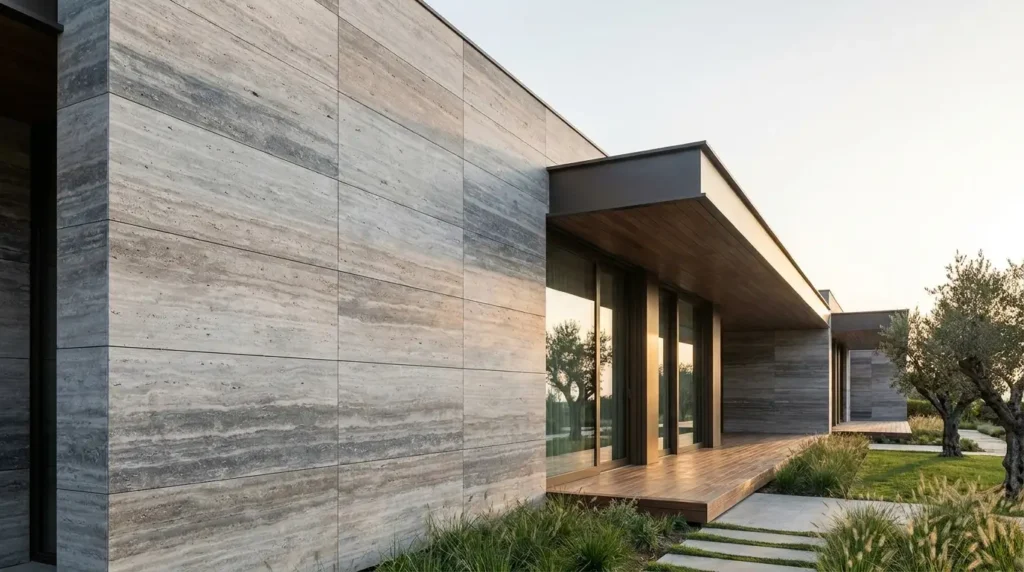
Travertine is usually associated with warm ivory, cream and beige architecture.
Silver Travertine offers a very different interpretation.
Its layered combination of silver, grey, charcoal, taupe and occasional warm mineral tones gives travertine a more contemporary architectural character.
Instead of creating a purely Mediterranean or traditional appearance, Silver Travertine can work naturally with:
- dark metal
- concrete
- walnut
- black details
- warm white plaster
- glass
- bronze
- minimalist architecture
Its geological structure also makes it visually different from grey marble.
Travertine is geologically a form of limestone rather than true marble. It is a terrestrial limestone formed through mineral precipitation, and its characteristic bedding can produce dramatically different appearances depending on how the block is cut.
This makes Silver Travertine particularly interesting for architecture.
The same block can produce either:
- strongly linear surfaces
- softer cloud-like surfaces
depending on whether it is vein cut or cross cut.
For a successful project, it is therefore not enough to specify only:
“Silver Travertine.”
The project should also consider:
- cut direction
- color range
- surface finish
- pore treatment
- dimensions
- slab selection
- panel orientation
- layout
- application
- technical performance
- installation
- maintenance
What Is Silver Travertine?
Silver Travertine is a commercial name generally used for travertine selections with a predominantly grey, silver or grey-brown visual character.
The exact appearance can vary considerably.
A particular selection may contain:
- pale silver-grey
- medium grey
- charcoal bands
- taupe
- brown-grey layers
- cream mineral lines
- occasional warmer beige areas
Some material may appear almost monochromatic.
Other selections can contain strong transitions between dark and light layers.
This variation is normal because commercial stone names primarily describe how a stone is recognized and traded rather than acting as a precise geological specification. Industry guidance distinguishes commercial stone naming from scientific geological classification.
For an architectural project, actual material approval is therefore more important than relying exclusively on the trade name.
Why Is Silver Travertine Different from Grey Marble?
At first glance, both materials may provide a grey natural stone surface.
Their visual structures, however, can be very different.
Grey Marble
May show:
- crystalline structure
- irregular veins
- cloud-like movement
- fine white mineral lines
- broad grey fields
Silver Travertine
Typically shows:
- sedimentary layering
- natural pores
- horizontal bands when vein cut
- more obvious geological direction
- alternating grey and taupe layers
This makes Silver Travertine particularly effective when the architecture benefits from visible direction.
A long wall clad in vein-cut Silver Travertine can appear even more horizontal because the stone itself reinforces the geometry.
Vein Cut Silver Travertine
Vein cut is one of the most recognizable ways to process travertine.
Industry terminology defines vein cutting as cutting across the natural bedding plane so that the layers become visible on the face of the stone.
The result can create:
- long horizontal bands
- grey and silver stripes
- strong direction
- continuous geological movement
- highly architectural surfaces
Silver Travertine can be particularly dramatic in vein cut because the darker and lighter mineral layers become clearly visible.
Where Does Vein Cut Work Best?
Vein cut can be especially effective for:
- feature walls
- facades
- fireplace walls
- reception areas
- large bathrooms
- long corridors
- custom stone furniture
- stair walls
It works particularly well in architecture with strong horizontal proportions.
For example:
long horizontal building volume
horizontal Silver Travertine veins
can create a powerful relationship between the stone and the building geometry.
Vein Direction Must Be Planned
When vein-cut travertine is used across multiple panels, orientation becomes extremely important.
Imagine three neighboring wall panels.
Panel one:
horizontal veins
Panel two:
horizontal veins
Panel three:
vertical veins
The interruption is immediately visible.
Therefore, drawings for large projects should clearly establish the required vein orientation before fabrication.
For important walls and facades, panel numbering can help preserve this direction from production through installation.
Cross Cut Silver Travertine
Cross cutting produces a very different appearance.
Instead of displaying the layered structure as long bands, the stone appears:
- more cloud-like
- less directional
- more organic
- softer
- visually scattered
Travertine blocks can produce significantly different appearances when cross cut versus vein cut.
This makes cross-cut Silver Travertine useful when the designer wants the grey travertine character without introducing strong horizontal lines.
Where Does Cross Cut Work Best?
Cross cut can work particularly well for:
- flooring
- bathrooms
- entrance halls
- selected wall areas
- commercial interiors
On a large floor, strong linear bands may sometimes create too much directional movement.
Cross cut can provide a calmer alternative.
Vein Cut or Cross Cut?
The choice should follow the architecture.
Consider Vein Cut When You Want:
- strong linear movement
- obvious geological layering
- horizontal architectural emphasis
- distinctive feature walls
- dramatic facades
Consider Cross Cut When You Want:
- softer patterning
- less direction
- calmer flooring
- more cloud-like natural variation
Neither cut is universally better.
They are two different visual expressions of travertine.
For important projects, review full-size samples of both before making the final decision.
Silver Travertine for Flooring
Silver Travertine can create a very sophisticated floor when the objective is a cooler, more contemporary natural stone palette.
It can work particularly well in:
- modern residences
- hotel lobbies
- restaurants
- retail interiors
- offices
- entrance halls
- corridors
The grey background creates a neutral foundation while the natural travertine structure prevents the floor from feeling industrial or artificial.
Cross Cut for Flooring
Cross cut can be particularly useful for large floors.
Its less directional pattern can make it easier to distribute material across an open space.
A successful floor may combine:
Silver Travertine
walnut
warm white walls
black metal details
The floor remains neutral but has more geological character than a uniform manufactured grey surface.
Vein Cut Flooring
Vein-cut flooring creates a stronger visual direction.
This can be intentional.
For example, the veins may run:
- along a corridor
- toward a view
- toward a reception desk
- through a long living area
The stone pattern can guide the eye through the architecture.
However, random rotation of strongly directional pieces should generally be avoided unless it is deliberately part of the design.
Silver Travertine for Wall Cladding
Wall cladding is one of the strongest applications for this material.
Large-format vein-cut panels allow the natural bedding to become part of the wall design.
Possible applications include:
- hotel lobby walls
- living room feature walls
- reception backgrounds
- corridor walls
- restaurant interiors
- elevator areas
- fireplace walls
- office reception spaces
The material can create visual interest without requiring highly contrasted marble veining.
Large Wall Panels
Large panels allow more of the geological structure to remain visible.
They also reduce the number of joints.
Before fabrication, the wall should be coordinated with:
- ceiling height
- doors
- electrical points
- furniture
- lighting
- niches
- corners
The panel grid should ideally respond to the architecture.
Horizontal Vein Continuity
For a premium vein-cut wall, neighboring panels can be selected to create a controlled visual flow.
Perfect geological continuity across an entire wall is not always realistic.
Natural stone should not be expected to behave like digitally printed wallpaper.
Instead, the goal can be:
- consistent direction
- compatible color
- balanced band thickness
- controlled tonal changes
This produces a natural but organized result.
Silver Travertine for Bathrooms
Grey travertine can create a very different bathroom atmosphere from beige travertine.
It feels:
- cooler
- more contemporary
- more architectural
- slightly more dramatic
Possible applications include:
- shower walls
- floors
- vanity tops
- bathtub surrounds
- wall panels
- niches
- shelves
A strong contemporary combination might be:
Silver Travertine
dark walnut
warm white plaster
brushed bronze fixtures
The walnut and bronze introduce warmth so the grey stone does not make the bathroom feel overly cold.
Silver Travertine Shower Walls
Large vein-cut panels can be particularly effective in a walk-in shower.
The horizontal stone movement can create a strong architectural backdrop.
Before fabrication, coordinate:
- shower controls
- niches
- shelves
- panel joints
- corners
- vein direction
Large openings should not be positioned without considering the stone pattern.
Silver Travertine Bathroom Flooring
For bathroom floors, the selected finish should meet the functional requirements of the specific wet area.
The decision should consider more than appearance.
Relevant factors may include:
- surface texture
- water exposure
- slip requirements
- drainage
- maintenance
- installation system
A visually attractive finish is not automatically the correct technical finish for every wet environment.
Silver Travertine for Facades
Travertine has a long history of exterior architectural use, and limestone and travertine are widely associated with both interior and exterior applications. However, the suitability of a particular stone for exterior use must be evaluated according to the exact material, climate and application.
Silver Travertine can create a particularly contemporary facade.
It works well with:
- glass
- dark bronze metal
- black aluminium
- concrete
- warm timber
- landscape architecture
Vein-Cut Silver Travertine Facades
Vein cut can make a facade appear wider and more horizontal.
This is especially effective for:
- contemporary villas
- boutique hotels
- commercial buildings
- low-rise offices
- resort architecture
The linear stone pattern can reinforce:
- roof lines
- terraces
- overhangs
- window bands
The architecture and geology begin to work in the same direction.
Exterior Suitability Is Project-Specific
It is important not to assume that every commercial Silver Travertine selection is automatically suitable for every exterior environment.
Exterior specification can depend on:
- the specific stone
- water absorption
- strength
- freeze-thaw exposure
- climate
- panel dimensions
- fixing system
- building height
- finish
- local regulations
Industry guidance notes that while many limestones and travertines have a successful history in exterior vertical applications, fewer limestone varieties have the same history in exterior paving under freeze-thaw conditions.
Technical approval should therefore be based on project requirements and relevant test data.
Silver Travertine for Fireplaces
A fireplace wall is an excellent place to use vein-cut Silver Travertine.
The stone creates natural direction without the visual intensity of highly veined marble.
A contemporary composition could include:
full-height Silver Travertine wall
minimal dark fireplace opening
light oak floor
warm white interior
The fireplace remains the focal point while the travertine provides texture and material depth.
Technical details around heat sources must be designed according to the specific fireplace system.
Silver Travertine for Staircases
The material can also be fabricated for:
- stair treads
- risers
- landings
- side cladding
- adjacent feature walls
For vein-cut pieces, orientation should be controlled.
For example, stair treads can maintain consistent horizontal geological movement from one step to the next.
A staircase using random vein directions may appear fragmented.
Silver Travertine for Reception Desks
A custom reception desk can use Silver Travertine on:
- front panels
- side returns
- worktop surfaces
- surrounding walls
The linear structure can make a simple rectangular desk appear much more architectural.
For a premium result, plan how the veins continue around visible corners.
Silver Travertine for Custom Furniture
Silver Travertine can also work for:
- coffee tables
- console tables
- dining tables
- side tables
- stone benches
- display plinths
For furniture, important considerations include:
- dimensions
- weight
- structural support
- edge design
- pore treatment
- vein direction
A table can look significantly different depending on whether the top is vein cut or cross cut.
Filled vs Unfilled Silver Travertine
Natural pores are a defining characteristic of travertine.
These cavities may remain visible or may be filled during processing.
The choice changes both the appearance and behavior of the surface.
Filled Silver Travertine
Filled surfaces generally appear:
- smoother
- cleaner
- more controlled
- more uniform
They can be appropriate for interiors requiring a refined surface.
Possible applications include:
- flooring
- bathrooms
- wall cladding
- countertops
- commercial interiors
Unfilled Silver Travertine
Unfilled material preserves more visible natural cavities.
This creates:
- stronger texture
- deeper shadows
- more geological character
- a more rustic or architectural appearance
It can be very effective on vertical surfaces.
However, the appropriateness of open pores depends on the actual application and environment.
Filled or Unfilled?
Choose according to:
- desired appearance
- application
- cleaning requirements
- exposure
- finish
- technical specification
A large physical sample is much more useful than deciding from a small photograph.
Honed Silver Travertine
Honed is one of the most versatile finishes.
It produces a relatively smooth surface with reduced reflection.
This can give Silver Travertine:
- a contemporary appearance
- softer grey tones
- lower glare
- strong architectural character
Honed surfaces work especially well with:
- walnut
- black metal
- warm white plaster
- concrete
- glass
Brushed Silver Travertine
Brushing creates more surface texture.
It can emphasize:
- pores
- natural layers
- tactile character
- side-light shadows
This finish can be effective in architecture where the stone should feel more natural and less formal.
The exact appearance of a brushed finish should always be approved from an actual production sample.
Sandblasted Silver Travertine
Textured finishes such as sandblasting may also be considered for certain applications.
A more textured surface can create:
- stronger shadow
- reduced reflection
- lighter apparent coloration
- greater visual roughness
Technical requirements should determine whether such a finish is appropriate for the specific project.
Polished Silver Travertine
Some travertine varieties can take a polish; commercial stone terminology historically recognizes polished travertines as well.
Polishing can:
- deepen grey tones
- increase reflection
- emphasize layered contrast
However, highly reflective Silver Travertine creates a very different architectural character from honed or brushed stone.
For contemporary projects, lower-reflection finishes are often easier to integrate into restrained material palettes.
How Finish Changes Color
Surface treatment can significantly change the apparent color of Silver Travertine.
A polished surface may appear:
- darker
- richer
- more contrasted
A honed surface may appear:
- softer
- more neutral
- slightly lighter
A strongly textured surface may appear:
- even lighter
- more matte
- more mineral
Therefore, finish approval should happen on the actual stone selection whenever possible.
Silver Travertine + Walnut
This is one of the strongest combinations.
Silver Travertine contributes:
- cool mineral grey
- horizontal geological movement
- natural texture
Walnut contributes:
- warmth
- deep brown color
- organic grain
The contrast creates balance.
It can work particularly well in:
- hotels
- bathrooms
- villas
- restaurants
- reception areas
Silver Travertine + Light Oak
For a lighter interior, combine the grey stone with light oak.
This creates a more relaxed contemporary atmosphere.
Possible applications include:
- residential bathrooms
- living rooms
- boutique hotels
- spa interiors
The light wood prevents the grey travertine from becoming too visually heavy.
Silver Travertine + Warm White
Warm white provides a clean background without emphasizing the cool grey tones too strongly.
It can be used on:
- walls
- ceilings
- cabinetry
- furniture
The combination can create a sophisticated neutral interior.
Silver Travertine + Black
Black works naturally with grey travertine.
Use it for:
- window profiles
- lighting
- fireplace openings
- furniture frames
- bathroom fixtures
However, too much black combined with dark Silver Travertine can create an unnecessarily heavy environment.
Warm wood or cream textiles can help balance the palette.
Silver Travertine + Bronze
Bronze introduces warmth.
This can be particularly effective in bathrooms and hospitality interiors.
Use brushed bronze for:
- fixtures
- lighting
- handles
- thin decorative profiles
The metal should support the stone rather than compete with it.
Silver Travertine + Concrete
This is a strong combination for contemporary architecture.
Both materials have a mineral character.
Concrete provides:
- visual uniformity
- monolithic surfaces
- industrial restraint
Silver Travertine adds:
- natural variation
- layering
- texture
- geological depth
The result can feel minimalist without being sterile.
Silver Travertine + Glass
For exterior architecture, Silver Travertine can provide mass and solidity while glass creates transparency.
The contrast between:
layered natural stone
and
clear architectural glazing
can be particularly effective on modern villas, hotels and commercial buildings.
Silver Travertine + White Marble
A white marble can be used selectively to introduce greater brightness.
For example:
Silver Travertine floor
white marble vanity
may work in a bathroom.
However, if the white marble has very dramatic veining, it should generally remain the focal stone while Silver Travertine acts as the quieter supporting material.
Silver Travertine + Dark Red Marble
A neutral grey travertine can create an effective background for a dark red statement stone.
For example:
Silver Travertine flooring
dark red marble reception desk
creates a clear hierarchy.
This allows a dramatic stone to be used strategically rather than throughout the entire project.
Silver Travertine in Minimalist Interiors
Silver Travertine fits naturally into minimalist architecture because the pattern is created by geology rather than decoration.
A simple palette can include:
Silver Travertine
walnut
warm white
black metal
No additional patterned surfaces may be necessary.
The natural stone already provides enough texture.
How to Select Silver Travertine Slabs
Do not approve a large project from one small sample.
Review:
- full slabs
- multiple slabs together
- overall grey tone
- dark band intensity
- warm brown areas
- pore distribution
- slab dimensions
- cut direction
Some selections may be highly uniform.
Others may contain significant dark-to-light movement.
The project should define an acceptable range.
Define the Desired Color Range
Before ordering, establish whether the project wants:
Light Silver
Predominantly:
- pale grey
- light silver
- subtle taupe
Medium Silver
A balanced mixture of:
- grey
- charcoal
- taupe
- cream
Dark Silver
More:
- dark grey
- charcoal
- brown-grey movement
This creates a much clearer selection target than simply requesting Silver Travertine.
Warm vs Cool Silver Travertine
Not every Silver Travertine is purely cool grey.
Some selections contain significant:
- taupe
- brown
- beige
- cream
These can look warmer under architectural lighting.
Other selections may be dominated by:
- cool grey
- charcoal
- pale silver
The correct group depends on the material palette of the project.
Review Slabs Under Realistic Lighting
Stone can look different under:
- warehouse lighting
- natural daylight
- warm interior lighting
- cool interior lighting
Grey stone is particularly sensitive to these changes.
A warm light source can emphasize taupe and brown bands.
A cool light source can emphasize silver and charcoal.
For important projects, review a representative sample under lighting close to the final design.
Slab Dimensions Matter
For large wall panels or custom pieces, slab dimensions directly affect the visual result.
A larger slab may allow:
- fewer wall joints
- full-height panels
- longer reception pieces
- larger table tops
Square-meter price alone does not determine project efficiency.
Usable dimensions matter.
Cutting Layout
For strongly directional travertine, the cutting layout is especially important.
A good process can include:
- Finalize the dimensions.
- Photograph the actual slabs.
- Mark required pieces.
- Confirm vein orientation.
- Review neighboring panels.
- Review corners.
- Approve the layout.
- Begin fabrication.
This helps preserve the intended direction of the stone.
Planning Corners
Corners can be visually challenging with vein-cut travertine.
If horizontal bands suddenly terminate or change direction, the corner can look unresolved.
For important areas, consider:
- the relationship between front and side panels
- vein orientation
- joint position
- visible edge treatment
The goal is not artificial perfection.
It is a visually intentional transition.
Dry Layout
Pre-arranging pieces before final packing or installation can help control:
- tone
- vein direction
- dark bands
- lighter areas
- neighboring pieces
This is particularly useful for:
- wall panels
- large flooring projects
- staircases
- reception areas
Each piece can then be numbered according to the approved arrangement.
Piece Numbering
A systematic project may connect:
drawing number
to
stone piece number
to
crate number
to
installation position.
This reduces confusion during installation.
For a large cut-to-size project, organization can be as important as fabrication quality.
Natural Pores Are Part of Travertine
Travertine naturally contains cavities.
These are related to how the stone formed and are part of its characteristic appearance.
The project should therefore determine whether the aesthetic requires:
- visible pores
- partially filled pores
- more completely filled surfaces
The goal should not automatically be to make travertine look like marble.
Its natural texture is one of the reasons for selecting it.
How to Clean Silver Travertine
Travertine is calcareous, meaning it is primarily calcium-carbonate based and is sensitive to acidic solutions. Industry care guidance recommends mild non-acidic or neutral cleaning products for calcareous natural stone.
For routine care:
- Remove dust, sand and grit regularly.
- Clean spills promptly.
- Use clean soft cloths or appropriate mops.
- Use a neutral cleaner suitable for natural stone.
- Avoid acidic cleaning products.
- Avoid unnecessary abrasive cleaners.
- Rinse appropriately after cleaning.
Can You Use Vinegar on Silver Travertine?
No.
Vinegar is acidic.
Products containing vinegar, lemon or other acids can dull or etch calcareous natural stone.
The affected area may appear:
- lighter
- dull
- cloudy
- less reflective
On honed material, the change can be subtler than on polished stone, but the chemical reaction can still occur.
What Is Etching?
Etching is a chemical reaction between an acidic substance and the calcium carbonate in the stone.
It changes the surface itself.
That means an etched area is not necessarily something that can simply be washed away.
Depending on the severity and finish, professional surface restoration may be required.
Dust and Grit
Sand, dirt and grit can act as abrasives on natural stone floors.
Regular dust mopping and suitable entrance mats are recommended to reduce this type of wear.
This is especially important in:
- hotels
- restaurants
- commercial entrances
- high-traffic residential entry areas
Preventing abrasive material from reaching the floor can be more effective than trying to repair wear later.
Should Silver Travertine Be Sealed?
There is no universal rule that every travertine installation requires exactly the same sealing schedule.
Industry guidance explains that impregnating sealers act primarily as repellents and can increase stain resistance, but do not make natural stone stain-proof.
The need for treatment depends on factors such as:
- the actual stone
- finish
- pore treatment
- application
- exposure
- maintenance expectations
The appropriate system should be selected for the specific project.
Does Sealing Make Travertine Acid-Proof?
No.
Stain resistance and acid resistance are different.
A treated travertine surface can still react chemically with acids.
Therefore:
sealed travertine does not mean vinegar-safe travertine.
Silver Travertine for High-Traffic Areas
Commercial floors require a different specification from decorative walls.
For high-traffic projects, consider:
- actual stone properties
- surface finish
- pore treatment
- installation system
- cleaning program
- entrance mats
- replacement stock
Do not choose the material only according to a showroom sample.
The complete service environment matters.
Keep Spare Material
For significant commercial projects, keeping spare material from the original production can simplify future repairs.
Natural stone sourced years later may differ in:
- grey tone
- banding
- pore structure
- vein intensity
A documented reserve can therefore be valuable for hotels, offices and retail projects.
Silver Travertine for Underfloor Heating
Natural stone can be incorporated into heated floor systems, but the complete assembly should be designed appropriately.
Relevant considerations include:
- substrate
- adhesive
- movement joints
- stone dimensions
- thickness
- heating system
The suitability of the complete system should not be inferred only from the commercial stone name.
Silver Travertine vs Ivory Travertine
These stones share travertine’s geological character but create very different atmospheres.
Silver Travertine
Typically feels:
- grey
- contemporary
- cooler
- more dramatic
Ivory Travertine
Typically feels:
- cream
- warm
- soft
- Mediterranean or neutral
Choose according to the overall architectural palette.
For a project dominated by dark metal and concrete, Silver Travertine may integrate naturally.
For a project dominated by cream, oak and warm plaster, Ivory Travertine may be more appropriate.
Silver Travertine vs Tundra Grey Marble
Both can create grey interiors, but their visual structures differ significantly.
Silver Travertine
Provides:
- sedimentary layers
- natural pores
- strong direction when vein cut
- greater textural character
Tundra Grey Marble
Provides:
- marble structure
- finer natural veining
- a more uniform grey field
- less pronounced sedimentary layering
Choose Silver Travertine when texture and geological direction are important.
Choose grey marble when a smoother and more uniform stone language is desired.
Silver Travertine vs Grey Limestone
Travertine is itself a form of limestone, but the stone industry generally distinguishes it because of its distinctive formation and visual characteristics.
Compared with many conventional grey limestones, Silver Travertine often has:
- more visible pores
- stronger bedding
- a more pronounced vein-cut appearance
The best comparison should always use actual samples.
Silver Travertine vs Grey Porcelain
These materials can sometimes target similar color palettes, but they are fundamentally different.
Natural Silver Travertine contains:
- geological variation
- pores
- unique pieces
- non-repeating mineral layers
A manufactured surface may offer:
- greater visual repetition
- more predictable coloration
- different maintenance and performance characteristics
The choice depends on whether the project prioritizes genuine natural geological variation or manufactured consistency.
Common Mistakes with Silver Travertine
1. Specifying Only “Silver Travertine”
The project should also define color range, cut direction and finish.
2. Confusing Travertine with Marble
Travertine is geologically a form of limestone.
3. Ignoring Cut Direction
Vein cut and cross cut can look dramatically different.
4. Rotating Vein-Cut Panels Randomly
This can interrupt the architectural flow.
5. Approving from One Small Sample
A small sample cannot show the full geological pattern.
6. Expecting Every Slab to Be Identical
Natural variation is normal.
7. Ignoring Natural Pores
Pore treatment should be defined before production.
8. Choosing Exterior Stone Only by Appearance
Exterior suitability must consider the actual stone and technical conditions.
9. Using Acidic Cleaners
Acid can etch calcareous natural stone.
10. Assuming Sealer Makes the Stone Stain-Proof
It does not.
How to Plan a Silver Travertine Project
A practical sequence is:
1. Define the Application
Floor, wall, facade, bathroom, staircase or furniture?
2. Choose the Cut Direction
Vein cut or cross cut?
3. Define the Color Range
Light, medium or dark silver?
4. Define the Pore Treatment
Filled, partially filled or intentionally open?
5. Choose the Finish
Honed, brushed, textured or another approved treatment?
6. Determine Dimensions
Standard or custom sizes?
7. Review Actual Material
Inspect full slabs or representative production material.
8. Prepare the Cutting Layout
Especially for vein-cut panels.
9. Review the Panel Sequence
Control direction and tonal balance.
10. Number Custom Pieces
For complex installations.
11. Perform Quality Control
Confirm dimensions, finish, vein direction and visual range before packing.
Is Silver Travertine a Good Choice for Large Projects?
It can be especially effective for projects that need:
- neutral grey natural stone
- visible geological texture
- strong architectural direction
- large wall panels
- custom fabrication
- contemporary interior design
- facade applications subject to technical approval
Potential project types include:
- hotels
- villas
- residential developments
- restaurants
- offices
- retail interiors
- commercial buildings
For large quantities, the approved visual range should be established before production.
Why Silver Travertine Works in Contemporary Architecture
Silver Travertine has several characteristics that align naturally with modern design.
It is:
- directional
- mineral
- textured
- neutral
- naturally imperfect
This allows it to work with architecture based on simple geometry.
A contemporary material palette may require only:
Silver Travertine
glass
walnut
dark metal
warm white plaster.
The natural sedimentary layers provide the decoration.
The architecture itself can remain minimal.
The Importance of Restraint
One of the best ways to use Silver Travertine is to allow it enough visual space.
If the stone already contains:
- dark charcoal bands
- lighter silver bands
- taupe layers
- visible pores
the interior may not need several additional patterned materials.
Simple supporting materials allow the geological character of the travertine to remain visible.
Final Thoughts
Silver Travertine offers a distinctive alternative to both traditional beige travertine and conventional grey marble.
Its silver, grey, charcoal and taupe coloration creates a neutral palette.
Its sedimentary structure introduces natural texture.
And the choice between vein cut and cross cut allows the same stone family to produce dramatically different architectural effects.
Silver Travertine can be considered for:
- flooring
- wall cladding
- bathrooms
- facades
- fireplaces
- staircases
- reception areas
- furniture
- hospitality interiors
- residential projects
But the best results depend on more than the commercial name.
The project should define:
actual material selection
vein cut or cross cut
color range
pore treatment
finish
dimensions
layout
technical requirements
maintenance.
Review full-size material.
Control vein direction.
Approve the finish on the actual stone.
Plan panel relationships before cutting.
Evaluate exterior use according to real project conditions.
Avoid acidic cleaners.
And allow the natural pores and layers to remain part of the identity of travertine.
When these details are coordinated correctly, Silver Travertine can create architecture that feels modern, substantial and naturally sophisticated without relying on artificial pattern or excessive decoration.
Frequently Asked Questions
What is Silver Travertine?
Silver Travertine is a commercial name generally used for grey, silver, charcoal and taupe selections of natural travertine. Travertine is geologically a form of limestone.
Is Silver Travertine marble?
Not geologically. Travertine is a type of limestone, although some travertines have historically been grouped commercially with marble when they can take a polish.
What is vein-cut Silver Travertine?
Vein cutting exposes the stone across its natural bedding so the sedimentary layers become visible as directional bands.
What is cross-cut Silver Travertine?
Cross cutting exposes the stone in a different direction, creating a less linear and more cloud-like natural pattern.
Is Silver Travertine suitable for flooring?
It can be considered for interior flooring when the specific stone, finish and installation system are appropriate for the project.
Can Silver Travertine be used in bathrooms?
Yes. It can be considered for floors, walls, shower areas, vanity surfaces and custom stone elements, subject to appropriate finish, installation and maintenance requirements.
Can Silver Travertine be used on facades?
Travertine has a long history of exterior vertical use, but the technical suitability of the specific stone must be evaluated according to the project, climate, panel system and relevant test data.
Should Silver Travertine be filled?
It can be used with different pore treatments. The appropriate filled or more open appearance depends on the application, maintenance requirements and design intent.
How should Silver Travertine be cleaned?
Use suitable neutral or mild non-acidic products for natural stone and remove dust and grit regularly. Avoid acidic cleaners.
Can vinegar damage Silver Travertine?
Yes. Vinegar is acidic, and acids can dull or etch calcareous stones such as travertine.
Does sealing make Silver Travertine stain-proof?
No. An appropriate impregnating treatment can improve stain resistance, but it does not make natural stone completely stain-proof.
Looking for Silver Travertine for Your Project?
VeraMarbles can support residential, hospitality and commercial projects requiring Silver Travertine.
Send us your:
- required quantity
- application
- dimensions
- thickness
- vein-cut or cross-cut preference
- preferred finish
- desired color range
- architectural drawings
- project location
We can support your project with:
- slab selection
- color-range control
- vein-direction control
- slabs
- tiles
- custom cutting
- panel-layout planning
- dry layout
- piece numbering
- packing coordination
- quality control before shipment
Request a Quote from VeraMarbles