
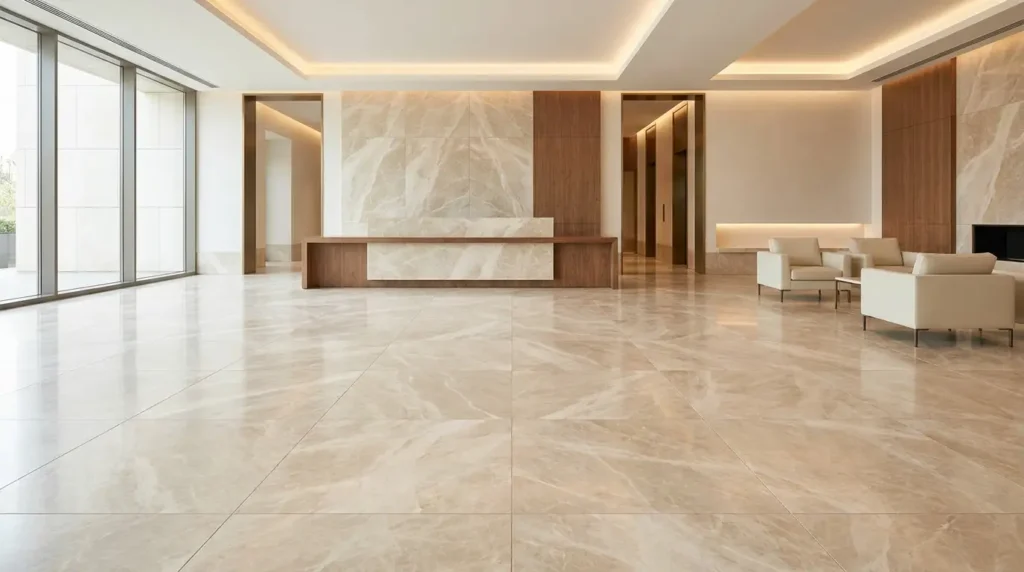
Some natural stones are designed to become the visual focal point of a space.
Others are valuable because they create a calm architectural foundation.
Diana Royal marble belongs primarily to the second category.
Its warm cream-to-beige background, soft natural movement and understated veining make it suitable for interiors where natural stone should feel refined without overwhelming the architecture.
Diana Royal is a Turkish beige marble associated with the Karamanlı area of Burdur in Türkiye. Current quarry references describe the material as a naturally beige-veined marble originating from this region.
It can be considered for:
- flooring
- wall cladding
- bathrooms
- hotel lobbies
- residential interiors
- staircases
- vanity tops
- reception areas
- restaurants
- commercial interiors
- custom stone elements
Its strength is versatility.
A carefully selected Diana Royal surface can work in a highly contemporary hotel, a warm residential interior or a more traditional architectural project.
The final result depends on much more than simply choosing the stone name.
Important factors include:
- actual slab selection
- background color
- vein intensity
- finish
- dimensions
- layout
- lighting
- surrounding materials
- installation
- maintenance
What Is Diana Royal Marble?
Diana Royal is a natural Turkish marble generally characterized by a warm beige or cream-beige background with softer white, taupe and light brown natural movement.
The material is associated particularly with the Karamanlı area of Burdur.
Depending on the individual block and slab, its appearance may range from:
- pale cream
- ivory beige
- warm light beige
- medium beige
- soft sand tones
Natural veins may appear as:
- white lines
- cream movement
- light taupe veins
- soft brown details
- subtle cloudy structures
- gently flowing linear patterns
Some slabs are extremely calm.
Others contain stronger layered movement.
This natural variation means Diana Royal should be selected from the actual material available for the project rather than from a digital image alone.
Why Is Diana Royal Popular in Architecture?
The stone works particularly well when designers want natural marble without very aggressive veining.
Highly dramatic marble immediately attracts attention.
Diana Royal can behave differently.
It can create:
- warmth
- continuity
- subtle natural texture
- visual comfort
- material depth
without forcing every other architectural element into the background.
This makes it useful for projects where large surfaces need to remain visually controlled.
Diana Royal for Flooring
Flooring is one of the most natural applications for Diana Royal.
A floor occupies a significant percentage of the visible interior.
For this reason, very dramatic stone can sometimes create too much movement across a large area.
Diana Royal offers a calmer alternative.
It can be particularly suitable for:
- hotel lobbies
- villas
- apartments
- corridors
- living rooms
- restaurants
- offices
- entrance halls
A large Diana Royal floor can create a warm mineral foundation for the entire interior.
Diana Royal for Hotel Lobby Floors
Hospitality interiors often require materials that work across substantial areas.
A lobby may include:
- reception
- seating
- circulation
- elevators
- columns
- restaurants
- connecting corridors
Using one compatible natural stone across several of these zones can create visual continuity.
A contemporary palette might combine:
Diana Royal flooring
walnut wall panels
warm white plaster
cream furniture
subtle bronze details
The stone supports the complete interior rather than competing with it.
Diana Royal for Residential Flooring
In residential interiors, Diana Royal can help connect several spaces.
For example:
- entrance
- living room
- dining area
- hallway
can share the same stone.
This is particularly effective in open-plan homes where multiple flooring changes would visually divide the architecture.
A continuous beige marble floor can make the plan feel larger and more coherent.
Diana Royal for Living Rooms
The warm beige character works especially well with natural materials.
Good combinations include:
Diana Royal + walnut
Diana Royal + light oak
Diana Royal + warm white
Diana Royal + bronze
Diana Royal + dark metal
The stone provides enough natural variation to prevent the room from feeling flat, while remaining quiet enough for furniture, art and lighting to remain important.
Diana Royal for Wall Cladding
Diana Royal is not limited to flooring.
Large-format wall panels can create a sophisticated interior with much less visual intensity than strongly veined statement marble.
Possible applications include:
- lobby walls
- corridor walls
- reception backgrounds
- living room walls
- restaurant interiors
- elevator surrounds
- office reception areas
The larger the panel, the more clearly the natural movement of the marble can be appreciated.
Full-Height Diana Royal Walls
Full-height panels can be particularly effective in tall interiors.
Instead of dividing the surface into many small tiles, large pieces create:
- fewer joints
- stronger continuity
- more natural stone visibility
- a cleaner architectural grid
Before production, panel dimensions should be coordinated with:
- ceiling height
- doors
- wall openings
- electrical points
- furniture
- lighting
Stone should be designed around the architecture rather than cut without reference to the final wall.
Diana Royal for Bathrooms
Warm beige marble is a natural fit for spa-inspired bathrooms.
Diana Royal can be considered for:
- bathroom floors
- shower walls
- vanity tops
- bathtub surrounds
- wall panels
- shelves
- niches
- custom stone elements
A contemporary bathroom might use:
Diana Royal honed marble
dark walnut vanity
warm white walls
brushed bronze fixtures
The result can feel warm and sophisticated without excessive decoration.
Diana Royal Shower Walls
Large shower panels help preserve the natural stone pattern.
Before fabrication, plan:
- wall dimensions
- panel joints
- shower controls
- niches
- shelves
- fixtures
If possible, position major cuts and openings so that they do not unnecessarily destroy the most attractive natural areas.
For wet environments, the complete installation system and surface requirements should also be designed for the specific project.
Diana Royal Vanity Tops
The subtle background of Diana Royal can work well for bathroom vanities.
It is particularly useful when the cabinetry itself has a strong material character.
For example:
Diana Royal vanity top
walnut cabinet
creates a balanced combination of mineral and wood textures.
When producing a custom vanity, plan:
- basin opening
- faucet holes
- backsplash
- visible edges
- side returns
before cutting the slab.
Diana Royal for Staircases
Staircases create repeated horizontal and vertical stone surfaces.
Diana Royal can be used for:
- treads
- risers
- landings
- side cladding
- skirting
The material sequence should be reviewed so the staircase appears consistent from bottom to top.
Randomly mixing significantly lighter and darker pieces can create an unintended striped appearance.
Vein Direction on Stairs
Even relatively calm beige marble can contain directional movement.
If several stair pieces have visible veins, consider whether they should:
- follow one direction
- flow through the staircase
- be distributed more randomly
The choice should be intentional.
For premium projects, cutting plans can help control this relationship.
Diana Royal for Reception Desks
A reception desk is another effective application.
Because the stone is relatively restrained, it can be used across a large custom desk without becoming visually excessive.
Possible stone components include:
- front face
- countertop
- side returns
- raised sections
- background wall
A carefully fabricated reception desk can make the natural stone feel substantial while maintaining a clean contemporary appearance.
Diana Royal for Restaurants
Restaurants often need materials that create warmth.
Beige marble works particularly well with controlled lighting.
Diana Royal can be used for:
- floors
- wall panels
- bar fronts
- bar tops
- host desks
- bathroom vanities
- custom tables
Warm indirect lighting can emphasize the cream and beige tones without making the stone appear yellow.
Diana Royal for Commercial Interiors
In office and commercial environments, neutral stone can help create a professional appearance without being visually cold.
Possible applications include:
- entrance floors
- reception areas
- executive floors
- wall panels
- conference areas
- circulation zones
For high-traffic flooring, material selection should consider the actual service conditions, finish and maintenance requirements rather than appearance alone.
Polished Diana Royal Marble
A polished finish increases surface reflection.
This can make Diana Royal appear:
- richer
- slightly darker
- more formal
- more luxurious
- more visually defined
Polishing also tends to make natural veins easier to see.
It may work well for:
- hotel lobbies
- residential floors
- wall panels
- vanity tops
- reception desks
- decorative surfaces
Honed Diana Royal Marble
A honed finish reduces reflection.
This usually creates:
- a softer surface
- calmer color
- less glare
- a contemporary character
- a more architectural appearance
Honed Diana Royal is particularly effective when combined with:
- walnut
- oak
- mineral plaster
- linen
- matte metal
- warm neutral fabrics
For minimalist interiors, honing can make beige marble feel much more modern.
Polished or Honed Diana Royal?
Neither is universally better.
Choose polished when the design needs:
- stronger reflection
- richer color
- formal luxury
- more visual depth
Consider honed when the goal is:
- contemporary minimalism
- reduced glare
- softer stone character
- greater material subtlety
The best method is to compare the same Diana Royal selection in both finishes under similar lighting.
Brushed Diana Royal
A brushed finish introduces additional texture.
It can create:
- a more tactile surface
- reduced formal appearance
- stronger response to side lighting
- a more natural material character
However, surface finish names alone are not sufficient for final approval.
A real production sample should be reviewed because texture intensity can vary between production methods.
How Lighting Changes Diana Royal
Beige stone is highly responsive to light temperature.
Warm Lighting
Can emphasize:
- cream
- beige
- light brown
- warm taupe
Cool Lighting
Can make the stone appear:
- lighter
- greyer
- less warm
- more neutral
This becomes especially important in hospitality projects where artificial lighting can determine the appearance of the material for most of the day.
Side Lighting
Light entering from the side can reveal more of:
- subtle veins
- surface texture
- tonal transitions
- mineral movement
This is particularly noticeable on honed or textured finishes.
Lighting should therefore be considered during stone selection rather than after installation.
Diana Royal + Walnut
This is one of the most reliable combinations.
Diana Royal provides:
- a light mineral base
- warm beige tones
- quiet natural variation
Walnut provides:
- darker brown contrast
- strong organic grain
- warmth
Together they create a balanced luxury palette.
This combination can work in:
- hotels
- villas
- apartments
- restaurants
- offices
Diana Royal + Light Oak
Light oak produces a brighter, softer interior.
This can work especially well for:
- bathrooms
- modern residences
- spa interiors
- boutique hospitality
- relaxed contemporary spaces
The result is less formal than dark walnut but remains warm.
Diana Royal + Warm White
Warm white creates a low-contrast relationship with the beige marble.
This can make the interior feel:
- brighter
- calmer
- larger
- softer
Warm white can be used on:
- plaster walls
- ceilings
- cabinetry
- furniture
- textiles
The stone then provides subtle natural depth.
Diana Royal + Black
Black details can provide graphic definition.
Good applications include:
- window frames
- lighting
- handles
- furniture frames
- thin metal profiles
Use black selectively.
Too much can overwhelm the warm character that makes Diana Royal attractive.
Diana Royal + Bronze
Brushed bronze can strengthen the warm palette.
Possible applications include:
- lighting
- handles
- bathroom fixtures
- furniture details
- decorative trims
A matte or brushed finish generally creates a more restrained result than highly reflective metallic surfaces.
Diana Royal + Rosso Levanto
A calm beige marble can create a strong background for a dark statement stone.
For example:
Diana Royal floor
Rosso Levanto reception desk
creates a clear visual hierarchy.
The beige marble covers the large area.
The darker stone becomes the focal point.
This is often more effective than using two equally dramatic materials across large surfaces.
Diana Royal + Afyon White
This combination creates a lighter material palette.
Afyon White can introduce:
- greater brightness
- stronger white contrast
while Diana Royal provides:
- warmth
- beige continuity
The two stones can be separated by application.
For example:
Diana Royal floor
Afyon White bathroom surface
or selected decorative areas.
Diana Royal + Travertine
Beige marble and ivory travertine can occupy similar color families, but their textures are different.
Travertine may display:
- natural pores
- sedimentary layers
- linear vein-cut patterns
- more visible texture
Diana Royal provides:
- a marble surface
- softer movement
- a more crystalline appearance
- different reflection when polished
Combining them can work when the difference in texture is deliberate.
Large-Format Diana Royal Flooring
Large-format flooring can make Diana Royal particularly effective.
Larger pieces provide:
- fewer joints
- greater continuity
- more visible natural pattern
- a stronger sense of material scale
They can work particularly well in:
- hotel lobbies
- villas
- commercial entrances
- large living rooms
However, dimensions should be selected according to the actual material and installation requirements.
Bigger is not automatically better.
Custom Cut-to-Size Production
Architectural projects often benefit from dimensions created specifically for the floor or wall.
Custom pieces can be coordinated with:
- wall lines
- columns
- door openings
- circulation axes
- reception desks
- stairs
This allows the stone grid to become part of the architecture.
Instead of cutting random pieces on site, the project can be planned before production.
Why Floor Grid Planning Matters
The pattern of joints is almost as important as the marble itself.
Poor joint placement can weaken the appearance of a premium stone floor.
Where possible, coordinate joints with:
- doors
- columns
- walls
- changes between spaces
- major furniture
- architectural axes
This creates a floor that feels designed rather than simply covered with stone.
Dry Layout for Diana Royal
Before installation, the stone can be arranged to evaluate the overall visual balance.
A dry layout can help control:
- lighter pieces
- darker pieces
- vein direction
- stronger natural movement
- neighboring pieces
This is especially valuable when the project uses a significant quantity.
The objective is not to eliminate natural variation.
It is to distribute it intentionally.
Why Crate-by-Crate Installation Can Cause Problems
Suppose one crate contains a slightly darker group of marble.
If that entire crate is installed in one section of the lobby, the finished floor may develop an obvious tonal zone.
A better strategy is to inspect and distribute material according to the approved visual range.
Natural marble should be considered across the entire project surface.
Slab Selection
For slab applications, inspect full-size material.
Review:
- background color
- vein structure
- darker areas
- slab dimensions
- surface quality
- relationship between several slabs
A small sample cannot represent the full appearance of a natural stone slab.
Selecting Diana Royal for a Large Project
For a large hotel or commercial interior, define the project requirements before production.
1. Background Range
Should the material be:
- pale cream
- light beige
- medium beige?
2. Vein Range
Should the stone be:
- extremely calm
- moderately veined
- naturally expressive?
3. Finish
Polished, honed or another approved texture?
4. Dimensions
Standard tiles or custom project sizes?
5. Quantity
How much material is required, including project allowance?
6. Visual Approval
How will the complete quantity be reviewed?
This process creates much clearer expectations.
Uniformity vs Natural Variation
A common mistake is assuming that higher-quality marble must look perfectly identical.
Natural stone is geological.
Variation is expected.
Quality control should focus on whether the material remains within the approved project range, not whether every piece looks artificially duplicated.
A successful Diana Royal project might intentionally include:
- slightly lighter pieces
- slightly warmer pieces
- subtle changes in veins
as long as the overall surface remains balanced.
How to Clean Diana Royal Marble
Diana Royal is marble and should be maintained using practices appropriate for calcareous natural stone.
For routine care:
- Remove dust and grit regularly.
- Clean spills promptly.
- Use clean soft cloths or suitable mops.
- Use a pH-neutral cleaner appropriate for natural stone.
- Avoid acidic cleaning products.
- Avoid unnecessary abrasive products.
- Follow an appropriate maintenance program for the finish and application.
Calcareous stones are sensitive to acidic solutions, and products containing lemon, vinegar or other acids can dull or etch the surface.
Can You Use Vinegar on Diana Royal Marble?
No.
Vinegar is acidic.
Acid can chemically react with marble and change its surface finish.
On polished marble, the result may appear as:
- a dull area
- loss of reflection
- a pale mark
- a cloudy spot
This is not always a conventional stain.
The finish itself may have been etched.
What Is Etching?
Etching occurs when acidic material reacts with the calcium-carbonate-based surface of marble.
The affected area may lose its original polish or texture.
Natural stone care guidance identifies acidic products as a cause of etching on calcareous stones.
This is why prevention is more effective than relying on cleaning afterward.
Should Diana Royal Be Sealed?
There is no universal treatment schedule for every marble installation.
Whether an impregnating treatment is beneficial depends on:
- specific stone
- finish
- location
- exposure
- intended use
An impregnating sealer can improve resistance to certain everyday liquids and staining agents, but it does not make marble completely stain-proof.
Does Sealing Prevent Acid Etching?
No.
Stain resistance and acid resistance are different.
Marble can still react with acidic substances even when an impregnating treatment has been applied.
Therefore:
sealed marble does not mean acid-proof marble.
Diana Royal in Kitchens
Diana Royal may also be considered for kitchen surfaces when the user understands the characteristics of marble.
Possible applications include:
- islands
- countertops
- backsplashes
However, marble requires care around:
- lemon
- vinegar
- wine
- acidic foods
- acidic cleaners
The natural stone industry’s technical guidance notes that calcitic marble is vulnerable to mild acids commonly encountered in kitchen and bar environments.
For some owners, this natural aging and patina is acceptable.
For others, a different material may better match their expectations.
Diana Royal for High-Traffic Areas
A private residential floor and a busy hotel lobby do not experience the same service conditions.
For high-traffic spaces, consider:
- specific stone properties
- finish
- entrance protection
- installation
- cleaning frequency
- maintenance
- spare material
Dust, sand and grit can act as abrasives on natural stone floors, making regular dust removal and entrance mats particularly important.
Keep Spare Material
For important commercial or hospitality projects, retaining spare material from the original production can be valuable.
Years later, a newly quarried selection may not match the existing installation exactly.
Replacement pieces from the original group can simplify future repairs or alterations.
Diana Royal vs Burdur Beige
Both belong to the broader warm Turkish beige marble family from a design perspective, but actual selections can have different visual identities.
Diana Royal
Often offers:
- warm cream-beige tones
- flowing natural movement
- soft veins
- architectural warmth
Burdur Beige
May offer:
- classic beige coloration
- different natural vein structures
- varying levels of uniformity
Because both names can include multiple visual selections, the best comparison is between actual slabs or tiles rather than names alone.
Diana Royal vs Afyon White
These stones create very different interiors.
Diana Royal
Provides:
- beige warmth
- lower contrast
- softer atmosphere
Afyon White
Provides:
- brighter white surfaces
- more reflected light
- stronger contrast with dark materials
Choose according to the overall palette rather than treating one stone as universally superior.
Diana Royal vs Tundra Grey
The main distinction is temperature.
Diana Royal
Feels:
- warm
- beige
- soft
- inviting
Tundra Grey
Feels:
- cooler
- grey
- restrained
- contemporary
Diana Royal naturally supports palettes containing:
- walnut
- bronze
- cream
- warm white
Tundra Grey often integrates well with:
- charcoal
- black
- concrete
- cooler neutral palettes
Diana Royal vs Ivory Travertine
Their colors can sometimes be similar, but the natural structure is different.
Diana Royal Marble
Typically shows:
- a marble structure
- smoother surfaces
- soft flowing veins
- greater reflective depth when polished
Ivory Travertine
Typically shows:
- sedimentary layering
- natural pores
- vein-cut or cross-cut patterns
- more obvious texture
For a cleaner polished interior, Diana Royal may fit naturally.
For a more textured architectural language, travertine may be preferable.
Common Mistakes with Diana Royal Marble
1. Selecting from One Small Sample
Small samples do not show the complete visual range.
2. Expecting Every Piece to Be Identical
Natural marble varies.
3. Ignoring the Complete Project Quantity
A large project requires a controlled overall selection.
4. Installing Without Tonal Planning
This can create unintended light and dark zones.
5. Choosing Tile Size Without Reviewing the Architecture
The stone grid should work with the building.
6. Using Acidic Cleaners
Acids can etch marble.
7. Assuming Sealer Makes the Stone Stain-Proof
It does not.
8. Choosing Finish Only from Photographs
Actual samples provide a better comparison.
9. Forgetting Spare Material
Future replacements may be difficult to match.
10. Using Beige Marble Without Contrast
Too many similar beige surfaces can make an interior visually flat.
Wood, plaster, darker stone or restrained metal details can create balance.
How to Plan a Diana Royal Project
A practical sequence is:
1. Define the Application
Floor, wall, bathroom, stairs or custom element?
2. Calculate the Required Quantity
Include appropriate project allowance.
3. Define the Visual Selection
Background tone and acceptable vein range.
4. Select the Finish
Polished, honed or another approved texture.
5. Determine Dimensions
Standard or custom.
6. Review the Actual Material
Especially for large quantities.
7. Prepare the Layout
Coordinate floor and wall grids with architecture.
8. Pre-Arrange Important Areas
Where tonal control is necessary.
9. Number Custom Pieces
For complex installations.
10. Perform Quality Control Before Shipment
Confirm dimensions, finish and visual selection before packing.
Is Diana Royal a Good Choice for Large Projects?
It can be particularly effective when a project requires:
- warm natural marble
- restrained movement
- large continuous surfaces
- slabs and tiles
- custom dimensions
- compatibility with wood
- hotel and residential applications
Its calm visual character is an advantage when hundreds or thousands of square meters need to remain architecturally consistent.
The key is establishing the acceptable selection before production begins.
Why Diana Royal Works in Contemporary Design
Beige marble is sometimes incorrectly treated as inherently traditional.
The material itself is not the problem.
The surrounding design determines the final character.
Consider:
honed Diana Royal flooring
walnut panels
warm mineral plaster
simple cream furniture
minimal bronze details
The result can be highly contemporary.
The same marble combined with elaborate ornamental details would produce an entirely different atmosphere.
Natural stone is flexible.
Its architectural context determines how it is perceived.
Final Thoughts
Diana Royal marble is a strong option for projects that need a warm, refined and relatively calm natural stone.
Its cream and beige tones can create an architectural foundation for:
- hotels
- villas
- apartments
- restaurants
- offices
- bathrooms
- lobbies
- staircases
It works particularly well when natural stone needs to provide material quality without dominating every visual element.
But successful results depend on more than the marble name.
They depend on:
actual material selection
finish
dimensions
layout
tonal distribution
lighting
installation
maintenance.
Review real slabs or tiles.
Define the acceptable visual range.
Coordinate joints with the architecture.
Compare polished and honed samples.
Avoid acidic cleaners.
And allow natural variation to remain part of the character of the stone.
When these decisions are made carefully, Diana Royal can create interiors that feel warm, substantial and sophisticated without relying on excessive decoration.
Frequently Asked Questions
What is Diana Royal marble?
Diana Royal is a Turkish natural marble known for its warm beige-to-cream background and soft natural veining. It is particularly associated with the Karamanlı area of Burdur, Türkiye.
What color is Diana Royal?
It generally ranges from cream and ivory beige to warmer beige tones, with white, taupe and soft brown natural movement.
Can Diana Royal be used for flooring?
Yes. It is commonly associated with flooring and wall applications, including residential and hospitality projects.
Can Diana Royal be used in bathrooms?
Yes. It can be considered for bathroom floors, walls, vanity tops and other stone elements when appropriately specified and installed.
Is polished or honed Diana Royal better?
Neither is universally better. Polished surfaces provide more reflection and color depth, while honed surfaces create a softer and more contemporary appearance.
Can Diana Royal be used for stairs?
Yes. It can be fabricated into stair treads, risers and related architectural components subject to the requirements of the project.
Can Diana Royal be produced in custom dimensions?
Yes. Natural marble can be fabricated according to architectural dimensions where the available material and project requirements allow.
How should Diana Royal marble be cleaned?
Use suitable pH-neutral products intended for natural stone and avoid acidic cleaners such as vinegar or lemon-based products.
Can vinegar damage Diana Royal marble?
Yes. Marble is calcareous, and acidic substances can dull or etch its surface.
Does sealing make Diana Royal stain-proof?
No. An appropriate impregnating treatment may improve stain resistance, but it does not make marble completely stain-proof or acid-proof.
Looking for Diana Royal Marble for Your Project?
VeraMarbles can support residential, hospitality and commercial projects requiring Diana Royal marble.
Send us your:
- required quantity
- dimensions
- thickness
- preferred finish
- application
- desired color range
- architectural drawings
- project location
We can support your project with:
- slab selection
- color and vein control
- slabs
- tiles
- custom cutting
- floor and wall layout planning
- pre-installation arrangement
- piece numbering
- packing coordination
- quality control before shipment
Request a Quote from VeraMarbles