
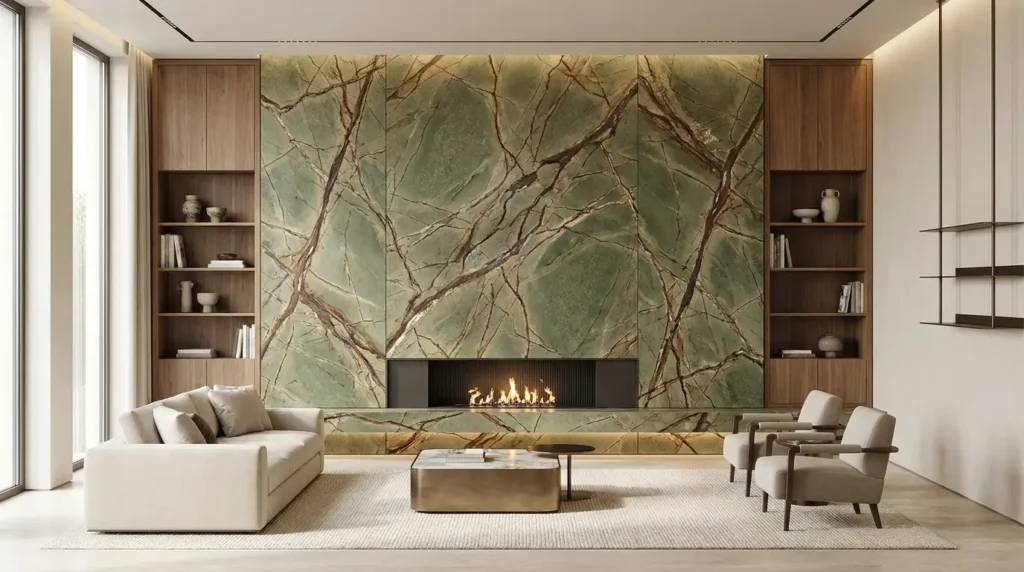
Very few natural stones resemble a landscape as strongly as Rainforest Green marble.
Its green background is crossed by irregular brown, cream, grey and occasionally darker mineral lines that branch across the surface like:
- tree roots
- river networks
- forest branches
- geological maps
This distinctive pattern makes Rainforest Green completely different from conventional white, beige or grey marble.
Instead of behaving as a quiet architectural background, it often becomes one of the dominant visual elements of the space.
It can be particularly effective for:
- feature walls
- fireplaces
- bathrooms
- vanity tops
- reception areas
- hotel interiors
- restaurants
- flooring
- staircases
- kitchen islands
- dining tables
- custom stone furniture
However, there is an important technical point to understand before specifying the material.
Although it is widely traded under the name Rainforest Green marble, the stone is not a true calcite marble in the strict geological sense.
Rainforest Green from the Bidasar area of Rajasthan, India is technically classified as serpentinite, a metamorphic rock dominated by minerals from the serpentine group. Geological research specifically identifies Rainforest Green and Bidasar Green among commercially available Indian serpentinites.
This distinction is important because geological composition influences:
- fabrication
- maintenance
- chemical behavior
- surface performance
- technical specification
For design purposes, however, the material remains widely recognized internationally under the commercial name Rainforest Green marble.
What Is Rainforest Green Marble?
Rainforest Green marble is a decorative natural stone quarried in Rajasthan, India, particularly associated with the Bidasar area.
It is also encountered commercially under names such as:
- Bidasar Green
- Forest Green
- Rajasthan Green
The material is classified geologically as serpentinite rather than true marble. Natural-stone databases identify Bidasar Green and Rainforest Green as commercial names for a Precambrian metamorphic serpentinite from Rajasthan.
Its appearance typically combines:
- light to medium green
- olive green
- forest green
- dark green
- brown
- dark brown
- cream
- pale mineral lines
- occasional grey or nearly black details
The most recognizable characteristic is the branching vein network.
Unlike the broad flowing veins of many white marbles, Rainforest Green often contains narrow lines that intersect and separate repeatedly across the slab.
This creates an almost botanical appearance.
Why Is It Called Rainforest Green?
The name comes from its visual character.
When viewed as a complete slab, the intersecting brown and cream lines can resemble:
- branches in a dense forest
- roots spreading through soil
- rivers crossing an aerial landscape
- natural vegetation patterns
This resemblance becomes much more obvious on a full slab than on a small sample.
A small 10 × 10 cm sample may look like:
green stone with one brown line.
A complete slab may reveal hundreds of interconnected natural branches.
This is why Rainforest Green should always be evaluated at slab scale for important architectural applications.
Is Rainforest Green Really Marble?
Commercially, yes.
Geologically, no.
This distinction should be understood clearly.
True marble is generally based on recrystallized carbonate minerals such as calcite or dolomite.
Serpentinite is primarily composed of silicate minerals belonging to the serpentine group.
Industry guidance specifically notes that serpentine is often commercially mistaken for or grouped with marble even though its magnesium-silicate composition is fundamentally different from calcitic marble.
Research on Rainforest Green identifies the material as a serpentinite in which serpentine-group minerals dominate and carbonates occur mainly within fractures, shears and pores.
For this reason, a technically detailed architectural specification may benefit from describing it as:
Rainforest Green commercial marble / serpentinite
rather than assuming it has exactly the same mineral behavior as a white calcitic marble.
Where Does Rainforest Green Come From?
Rainforest Green is associated with the Bidasar area of Rajasthan, India.
Natural-stone geological records identify:
- Bidasar
- Rajasthan
- India
as the source location for the stone commonly sold as Rainforest Green or Bidasar Green.
The region contains distinctive decorative serpentinite deposits whose unusual fracture and mineral networks create the visual patterns for which the stone is known.
Origin should still be confirmed for the actual material supplied to an architectural project whenever:
- certificates of origin are required
- customs documentation is important
- project specifications require a particular source
Commercial names alone should not replace documentation.
What Does Rainforest Green Look Like?
The exact color depends on the block and selection.
Possible background tones include:
- pale olive green
- medium forest green
- grey-green
- deep green
- muted moss green
Veins may appear:
- dark brown
- chocolate brown
- reddish brown
- cream
- pale beige
- grey
- nearly black
Some slabs contain a very dense branching network.
Others contain larger uninterrupted areas of green.
This difference dramatically changes how the stone behaves in an interior.
Calm vs Dramatic Rainforest Green
It can be useful to think of Rainforest Green selections in three broad visual groups.
Calm Selection
May contain:
- larger green areas
- fewer brown branches
- thinner veins
- lower visual contrast
This can be easier to use on:
- larger floors
- multiple wall surfaces
- repeated hotel applications
Medium Selection
May provide:
- balanced green background
- visible brown branches
- controlled natural movement
This is highly versatile for:
- bathrooms
- fireplaces
- reception areas
- furniture
Dramatic Selection
May contain:
- dense branch networks
- heavy brown movement
- strong cream intersections
- highly graphic natural patterns
These slabs can be extremely powerful for:
- feature walls
- statement furniture
- luxury reception areas
- large bathroom walls
More dramatic does not automatically mean better.
The correct selection depends on the application.
Why Full-Slab Selection Matters
Rainforest Green is one of the strongest examples of why natural stone should not be selected from a small sample alone.
Imagine two samples taken from the same slab.
Sample A
Comes from an uninterrupted green area.
It appears almost completely green.
Sample B
Comes from an intersection of several veins.
It appears mostly brown, cream and dark green.
Both samples represent the same slab.
Neither represents the complete composition.
For a serious project, review:
- complete slab photographs
- several slabs together
- slab dimensions
- color range
- vein density
- slab sequence
before final approval.
Rainforest Green for Feature Walls
A feature wall is arguably the strongest application for this material.
The branching pattern becomes much easier to appreciate when the stone is displayed vertically at full architectural scale.
Possible locations include:
- hotel lobby
- villa entrance
- living room
- restaurant
- reception
- executive office
- private club
- luxury retail interior
Large panels allow the pattern to become almost artwork-like.
The stone itself provides the decoration.
Large Panels Are Particularly Effective
When Rainforest Green is divided into many small tiles, the branching network is repeatedly interrupted.
Larger panels provide:
- fewer joints
- greater natural continuity
- better visibility of the geological pattern
- stronger architectural scale
For an important feature wall, the panel layout should be designed before fabrication.
Consider:
- wall dimensions
- doors
- electrical points
- lighting
- furniture
- joints
- slab dimensions
The goal is to use the stone composition intentionally.
Planning the Veins on a Wall
Suppose one slab contains a particularly interesting brown branch running diagonally through the center.
That feature can be positioned:
- through the center of the wall
- beside a fireplace
- behind a reception desk
- around another architectural focal point
Alternatively, poor cutting may place it:
- inside a door opening
- behind furniture
- at the edge of the wall
- inside a discarded offcut
The same slab can produce two completely different architectural results.
This is why cutting plans matter.
Rainforest Green for Fireplace Walls
A fireplace and Rainforest Green work naturally together.
The stone already resembles an abstract natural landscape.
A full-height fireplace wall can create a very strong composition.
For example:
Rainforest Green wall
minimal black fireplace
warm oak floor
off-white plaster
can create a highly contemporary room.
The stone becomes the primary decorative element.
Technical requirements around heat must be evaluated according to the actual fireplace system and construction.
Rainforest Green for Bathrooms
Green natural stone can create a sophisticated bathroom when balanced correctly.
Rainforest Green can be considered for:
- shower walls
- vanity tops
- vanity walls
- bathroom floors
- bathtub surrounds
- shelves
- niches
- custom basins
However, the stone is visually powerful.
Using it on every surface can easily overwhelm a small bathroom.
A more controlled approach is often stronger.
A Balanced Rainforest Green Bathroom
Consider:
Rainforest Green shower wall
warm neutral floor
walnut vanity
warm white plaster
restrained bronze fixtures
The green stone remains the focal point.
The other materials provide visual space around it.
Rainforest Green Shower Walls
Large shower panels can show the branch pattern extremely well.
Before cutting, plan:
- niche location
- shower controls
- shelves
- joints
- corners
- panel sizes
The strongest part of the natural pattern should not accidentally disappear inside a large niche.
For premium natural stone, openings should be coordinated with the slab layout.
Rainforest Green Vanity Tops
A vanity requires much less stone than a complete wall.
This allows particularly interesting parts of the slab to be selected.
Before fabrication, consider:
- basin cutout
- faucet holes
- backsplash
- visible edges
- side returns
If a distinctive brown branch runs through the selected area, position it so that it remains visible rather than being removed by the basin opening.
Rainforest Green for Flooring
Rainforest Green can also be used for interior flooring.
Natural-stone technical databases identify Bidasar Green as suitable for flooring, while noting that performance should not automatically be equated with harder stone categories.
Flooring applications may include:
- entrance halls
- residential spaces
- hotel areas
- restaurants
- selected commercial interiors
However, the selection strategy becomes different from a feature wall.
Choosing Rainforest Green for a Large Floor
A highly dramatic slab may look spectacular on a wall.
Repeating equally dramatic pieces over hundreds of square meters can create excessive visual movement.
For larger floors, consider:
- calmer selections
- controlled vein density
- consistent green background
- balanced brown areas
- tile dimensions
- joint layout
Pre-arrangement may help create a more coherent result.
Dry Layout Before Installation
For an important floor, pieces can be arranged before installation.
This allows review of:
- green tonal variation
- brown vein density
- stronger pieces
- quieter pieces
- neighboring tiles
- overall visual balance
The pieces can then be numbered.
The goal is not to remove variation.
The goal is to distribute natural variation intentionally.
Avoid Installing Crate by Crate
Suppose one crate contains significantly more brown-veined material.
If that entire crate is installed in one section of the room, the finished floor may develop a large dark area.
Instead, review material from multiple crates and distribute it according to the approved visual strategy.
This principle applies to most natural stone flooring, but it is particularly important for strongly patterned materials.
Rainforest Green for Staircases
The stone can create very distinctive staircases.
Possible components include:
- treads
- risers
- landings
- side cladding
- surrounding walls
Because the pattern is irregular, each step may look significantly different.
A premium staircase should therefore consider the complete set of components before cutting.
The strongest branches can be distributed rather than concentrated randomly.
Rainforest Green for Reception Desks
A reception desk can use Rainforest Green very effectively.
Possible surfaces include:
- front face
- countertop
- side returns
- adjacent wall
A simple rectangular reception desk can become highly distinctive simply through the natural branching pattern of the stone.
This can be especially effective in:
- hotels
- restaurants
- offices
- private clubs
The surrounding materials should usually remain quieter.
Rainforest Green for Restaurants
Restaurants provide an excellent environment for dramatic natural stone.
Controlled architectural lighting can highlight the branch network.
Possible applications include:
- host desks
- bar fronts
- bar tops
- feature walls
- bathroom vanities
- custom tables
- fireplace surrounds
Warm light can emphasize:
- brown
- cream
- olive
- warmer green areas
while preserving the natural depth of the stone.
Rainforest Green for Hotels
Hospitality projects can use the material as a signature accent.
Rather than covering thousands of square meters, Rainforest Green can be concentrated in:
- reception
- premium suites
- restaurant areas
- spa bathrooms
- lift lobbies
- fireplaces
- decorative furniture
A limited quantity can create a memorable material identity.
Rainforest Green for Kitchen Islands
A large island provides enough area to display the unusual pattern.
Possible applications include:
- island top
- vertical side panels
- perimeter countertop
- backsplash
The cutting plan becomes especially important when the stone contains large branches.
A distinctive vein can potentially continue from:
horizontal countertop
to
vertical end panel
if the slab is planned correctly.
Rainforest Green as a Countertop Material
Because Rainforest Green is geologically serpentinite rather than true calcite marble, its chemical behavior can differ from conventional marble.
Industry guidance notes that serpentine is magnesium-silicate based and can exhibit greater resistance to common kitchen acids than true calcitic marble.
However, this should not be interpreted as meaning every Rainforest Green surface is completely acid-proof.
Individual mineral components and carbonate-filled veins may react differently, and technical databases specifically caution that some mineral constituents of Bidasar Green are not permanently acid resistant.
Therefore, responsible care remains appropriate.
Rainforest Green for Dining Tables
The stone is particularly well suited visually to custom furniture because its pattern can resemble natural artwork.
Possible pieces include:
- dining tables
- coffee tables
- console tables
- side tables
- desks
- display plinths
For a dining table, a large slab allows almost the entire natural pattern to remain visible.
This can make every finished table unique.
Rainforest Green for Coffee Tables
Smaller furniture elements can use highly dramatic sections that might be too visually intense for a large floor.
For example, an offcut containing:
- dense brown branches
- cream intersections
- strong green areas
may become an excellent coffee-table top.
This can also improve material yield on custom projects.
Rainforest Green + Walnut
This is one of the strongest combinations.
Rainforest Green provides:
- green mineral color
- dark natural branches
- irregular geological movement
Walnut provides:
- warm brown color
- organic grain
- depth
Because brown already appears naturally inside the stone, walnut often feels visually connected to it.
A sophisticated palette can be:
Rainforest Green
dark walnut
warm white
bronze
Rainforest Green + Light Oak
Light oak creates a brighter and more contemporary contrast.
It can work particularly well in:
- bathrooms
- living rooms
- modern kitchens
- spa interiors
The lighter wood allows the green stone to remain visually dominant while preventing the interior from becoming too dark.
Rainforest Green + Warm White
Warm white is one of the safest supporting colors.
It provides a neutral background and allows the green and brown natural pattern to remain clearly visible.
Use warm white for:
- plaster
- cabinetry
- ceilings
- furniture
- textiles
A slightly warm white often works more naturally with the earthy brown veins than a very cold blue-white.
Rainforest Green + Cream
Cream creates an even warmer result.
This works particularly well when the stone contains:
- brown
- beige
- warm mineral veins
Possible combinations include:
Rainforest Green feature wall
cream furniture
walnut flooring
This creates an earthy, sophisticated material palette.
Rainforest Green + Black
Black works naturally with darker areas within the stone.
Use it selectively for:
- window frames
- lighting
- fireplace openings
- furniture structures
- bathroom fixtures
Too much black can make a dark green interior feel heavy.
Light plaster and warm wood can restore balance.
Rainforest Green + Bronze
Brushed bronze can connect well with the brown and warmer mineral lines.
It can be used on:
- lighting
- bathroom fixtures
- handles
- table bases
- thin architectural profiles
Keep the metallic finish restrained.
The natural stone already has significant decorative complexity.
Rainforest Green + Beige Stone
A neutral beige natural stone can act as a background material.
For example:
beige floor
Rainforest Green feature wall
creates a clear visual hierarchy.
This can work particularly well in hotels.
The beige stone provides continuity across large areas.
Rainforest Green creates the memorable focal point.
Rainforest Green + Ivory Travertine
This combination can create a highly natural palette.
Ivory Travertine provides:
- cream coloration
- subtle sedimentary texture
- architectural calm
Rainforest Green provides:
- green contrast
- branching veins
- visual drama
A lobby might use:
Ivory Travertine flooring
with
one Rainforest Green reception wall.
The materials remain naturally related without competing equally.
Rainforest Green + White Marble
White marble can create strong contrast.
But avoid combining Rainforest Green with an extremely dramatic white marble unless the project intentionally wants multiple statement materials.
A calmer white surface is generally easier to balance.
The objective should be:
one dominant stone
one supporting stone.
Rainforest Green + Dark Red Marble
Green and dark red can create a very rich color palette.
But both materials are visually strong.
If used together, one should remain clearly secondary.
For example:
- Rainforest Green as the main wall
- dark red stone only as a small table
may be more effective than placing two large dramatic stone walls next to each other.
Rainforest Green + Concrete
Concrete creates a more architectural and restrained setting.
The uniform grey surface can contrast with the highly organic green stone.
This works particularly well in:
- contemporary villas
- restaurants
- commercial interiors
The contrast is between:
controlled industrial surface
and
unpredictable geological pattern.
Polished Rainforest Green
Polishing can significantly deepen the visual character of the stone.
A polished surface may show:
- richer green
- darker brown
- stronger contrast
- greater depth
- stronger reflections
Polishability is recognized for Bidasar Green serpentinite, although exterior polish durability may be limited.
Polished Rainforest Green can work particularly well for:
- feature walls
- tabletops
- vanity tops
- reception desks
- selected floors
Honed Rainforest Green
Honing reduces surface reflection.
The same material may appear:
- softer
- slightly lighter
- less formal
- more contemporary
This can work particularly well in minimalist interiors.
The strong natural pattern remains visible without additional visual intensity from high gloss.
Brushed Rainforest Green
A brushed or textured surface can emphasize the tactile quality of the stone.
It may create:
- softer reflections
- more visible natural texture
- stronger response to side lighting
- a less formal appearance
Because finish terminology can vary between production methods, the actual surface sample should be approved before large-scale production.
Polished or Honed?
Consider polished when the project wants:
- richer green
- stronger contrast
- visual depth
- formal luxury
Consider honed when the project wants:
- lower reflection
- a contemporary aesthetic
- softer colors
- more architectural restraint
The best decision should be based on an actual sample of the selected material.
How Lighting Changes Rainforest Green
Lighting has a major effect on this stone.
Natural Daylight
Can reveal:
- olive tones
- true green coloration
- subtle grey areas
- fine mineral variation
Warm Artificial Lighting
Can emphasize:
- brown veins
- cream lines
- olive tones
- warmer greens
Cool Lighting
Can emphasize:
- grey-green
- darker green
- stronger contrast
This is why material review should ideally take place under lighting similar to the final project.
Side Lighting
Light directed across the stone can emphasize:
- branch intersections
- surface texture
- mineral transitions
- polished reflections
On a large vertical wall, carefully planned lighting can make the natural pattern much more visible after sunset.
Choosing Rainforest Green Slabs
Selection should begin with the design goal.
1. Choose the Green Tone
Do you want:
- lighter olive
- medium forest green
- deep green?
2. Choose the Vein Density
Do you want:
- calm
- balanced
- dramatic?
3. Evaluate Brown Content
Some slabs contain significantly more brown than others.
4. Review Full Slabs
Never rely only on small samples.
5. Review Several Slabs Together
Especially for large projects.
6. Confirm Dimensions
Large walls and tables require appropriate usable slab dimensions.
7. Approve the Finish
Before fabrication.
Slab-to-Slab Variation
This stone can vary significantly.
Two slabs may have:
- similar green backgrounds
- completely different branch networks
That uniqueness is one of the primary reasons to use natural stone.
However, a project requiring multiple panels should still aim for compatible overall character.
This can involve grouping slabs according to:
- background tone
- brown intensity
- vein density
- visual movement
Slab Sequence
Where neighboring panels need visual continuity, sequential slab availability can be useful.
The natural branch pattern may allow:
- partial continuation
- related movement
- symmetrical arrangements in some cases
But the material should not be expected to create mathematically perfect repeated patterns.
Natural irregularity is part of its identity.
Can Rainforest Green Be Bookmatched?
Suitable sequential slabs may sometimes allow mirrored compositions.
However, the effect can be very different from the symmetry seen in strongly flowing white marble.
Rainforest Green contains branching networks.
Mirroring these can create an extremely dense central composition.
This can be visually powerful but also very busy.
Therefore, always preview the complete arrangement before approving symmetrical matching.
Natural Flow May Be Better
For some interiors, natural slab flow is more sophisticated.
Instead of forcing perfect symmetry, neighboring slabs can be arranged according to:
- compatible branch direction
- green tone
- vein density
This often preserves the forest-like character more naturally.
Cutting Layout
A cutting layout is particularly useful for this stone.
A good workflow is:
- Finalize dimensions.
- Photograph the actual slabs.
- Position required pieces over the slab images.
- Mark openings.
- Review the strongest branches.
- Review corners.
- Review neighboring pieces.
- Approve the arrangement.
- Begin cutting.
This can significantly improve the final result.
Use Offcuts Intelligently
The irregular pattern means even smaller pieces can remain visually interesting.
Offcuts may be useful for:
- shelves
- side tables
- bathroom niches
- skirting
- small decorative surfaces
- samples
Thoughtful material planning can improve overall slab yield.
Corner Planning
Visible corners deserve attention.
Suppose a strong brown branch reaches the end of a countertop.
If the vertical return uses an unrelated area of stone, the transition may feel abrupt.
A carefully planned cutting layout can sometimes create a more natural visual relationship around corners.
The objective is not artificial perfection.
It is deliberate composition.
Piece Numbering
For custom architectural projects, finished components can be numbered according to their installation positions.
A system may connect:
drawing
→
piece number
→
crate
→
installation location
This becomes especially useful when the layout has been designed around particular branch patterns.
How to Clean Rainforest Green
The first rule of natural stone maintenance is to understand the geological composition of the stone.
Because Rainforest Green is a serpentinite rather than conventional calcite marble, its chemistry is different.
General natural-stone care guidance recommends:
- removing dust and grit
- cleaning spills promptly
- using soft cleaning materials
- using neutral cleaners suitable for natural stone
- avoiding aggressive chemicals
- avoiding abrasive cleaning where inappropriate
Even silicate-rich stones can contain mineral components that react differently to chemicals, so acidic cleaners are generally not recommended as a routine care strategy.
Can Vinegar Be Used on Rainforest Green?
It is better not to use vinegar as a routine cleaner.
Although serpentine can provide greater acid resistance than true calcitic marble, Rainforest Green may contain carbonate-filled fractures and other mineral components with different chemical sensitivities.
Technical records for Bidasar Green also caution that individual mineral constituents are not permanently acid resistant.
Therefore, use products specifically appropriate for the actual natural stone surface.
Do Not Treat Serpentinite Like Granite Automatically
Another mistake is assuming:
“It is not marble, therefore it behaves exactly like granite.”
That is not correct either.
Serpentinite has its own:
- mineralogy
- fracture structure
- abrasion characteristics
- fabrication behavior
The material should be treated according to its own technical characteristics.
Should Rainforest Green Be Sealed?
There is no universal answer for every installation.
An impregnating treatment may be appropriate depending on:
- actual stone
- finish
- application
- exposure
- fabrication
- maintenance expectations
General natural-stone guidance explains that impregnating treatments can increase stain resistance but do not make natural stone completely stain-proof.
The correct treatment should be evaluated for the specific project.
Natural Fracture Networks
The branch-like appearance of Rainforest Green is closely related to the stone’s natural fracture and mineral networks.
This means slab evaluation should consider more than visual beauty.
Fabricators and project teams should also inspect the actual slab for:
- natural fracture structure
- reinforcement requirements
- cutting orientation
- narrow components
- large openings
A highly decorative branch may also correspond to a geological feature that needs appropriate fabrication planning.
Fabrication Requires Experience
Large natural-stone panels, thin sections and highly detailed custom components should be fabricated with the behavior of the actual material in mind.
Particular attention may be required around:
- sink openings
- narrow bridges
- long thin pieces
- large cutouts
- mitred edges
Project drawings should be reviewed before fabrication begins.
Exterior Use Requires Technical Evaluation
Rainforest Green should not automatically be specified for every exterior application simply because it can take a polish or because serpentinite may offer greater acid resistance than calcitic marble.
Technical records note that polish durability may be limited in exterior conditions for Bidasar Green.
Exterior suitability should therefore depend on:
- actual stone
- finish
- climate
- exposure
- technical test data
- panel dimensions
- fixing system
- local requirements
For many projects, its strongest role remains interior architectural design.
Rainforest Green for Luxury Residential Projects
Possible residential applications include:
- master bathrooms
- fireplaces
- kitchen islands
- dining tables
- entrance walls
- powder rooms
- furniture
A limited amount can give the entire residence a strong material identity.
For example, one Rainforest Green fireplace wall may be enough to define the living room.
Rainforest Green for Hospitality Projects
Hotels and restaurants can use the material strategically.
Possible applications include:
- reception desk
- lobby wall
- restaurant bar
- premium bathrooms
- fireplace
- decorative furniture
- spa surfaces
This is particularly useful when the majority of the project uses quieter materials.
The green stone becomes easier to notice because it is not repeated everywhere.
Rainforest Green vs Rainforest Brown
These two commercially related stones share a branching, landscape-like natural character but use different dominant color palettes.
Rainforest Green
Typically emphasizes:
- green
- olive
- brown veins
- cream lines
Rainforest Brown
Typically emphasizes:
- brown
- earthy red-brown
- cream
- darker mineral networks
The choice depends on whether the project requires a green or warmer earthy focal point.
Rainforest Green vs Verde Guatemala
Green natural stones are frequently compared, but trade names and geological classifications can differ considerably.
Rather than choosing only from a green color name, compare:
- full slabs
- geological pattern
- background color
- vein density
- finish
- available dimensions
Rainforest Green is particularly recognizable for its branching brown network.
That characteristic should be visible in the actual material being approved.
Rainforest Green vs Green Marble with White Veins
Traditional green marbles may show:
- green background
- white linear veins
- smoother movement
Rainforest Green provides:
- branching brown networks
- greater visual complexity
- landscape-like patterns
If the project requires a clean and restrained green surface, another green stone may be easier to use.
If the design requires a highly organic statement, Rainforest Green can be much more distinctive.
Rainforest Green vs Rain Forest Green
These spellings generally refer to the same commercial stone family.
You may encounter:
- Rainforest Green
- Rain Forest Green
- Forest Green
- Bidasar Green
when searching internationally.
Because trade names vary, the actual slab, origin and specification should always be confirmed rather than relying only on spelling.
Common Mistakes with Rainforest Green
1. Assuming It Is Geologically a Conventional Marble
It is commercially called marble but is technically serpentinite.
2. Selecting from a Small Sample
The branch network must be viewed at full-slab scale.
3. Choosing the Most Dramatic Slab for Every Surface
Highly dense patterns may overwhelm large floors.
4. Cutting Before Reviewing the Pattern
The most interesting branches can disappear.
5. Using Too Many Competing Materials
Rainforest Green already contains strong natural movement.
6. Assuming Every Slab Is Similar
Natural variation is significant.
7. Ignoring Brown Content
Some selections contain considerably more brown than others.
8. Treating It Exactly Like Granite
Serpentinite is a different geological material.
9. Using Aggressive Cleaning Products Without Checking Compatibility
Cleaning should be appropriate for the actual stone composition.
10. Assuming Exterior Suitability from the Trade Name
Exterior use should be technically evaluated.
How to Plan a Rainforest Green Project
A practical workflow is:
1. Define the Application
Wall, bathroom, floor, table, fireplace or countertop?
2. Define the Desired Green Tone
Light, medium or dark?
3. Define the Vein Density
Calm, balanced or dramatic?
4. Review Full Slabs
Not only samples.
5. Review the Complete Required Quantity
Several slabs should work together.
6. Confirm Dimensions
Especially for large walls and furniture.
7. Select the Finish
Polished, honed or another approved texture.
8. Prepare the Cutting Layout
Position components on actual slab photographs.
9. Review the Branch Pattern
Do not hide the most valuable areas inside openings.
10. Number Complex Pieces
Especially when panel sequence matters.
11. Perform Quality Control Before Shipment
Check:
- dimensions
- finish
- piece numbers
- pattern
- visible condition
- packing
Is Rainforest Green Suitable for Large Projects?
Yes, when its role is clearly defined and the required material can be selected consistently.
Potential projects include:
- hotels
- villas
- restaurants
- residential developments
- executive interiors
- luxury commercial spaces
However, because the material has strong natural variation, large projects should define the approved visual range clearly.
The specification can include:
- preferred green tone
- acceptable brown content
- vein density
- finish
- dimensions
- reference slab photographs
This creates more objective expectations.
Why Rainforest Green Works in Contemporary Design
The material may appear extremely decorative, but that does not mean it requires a decorative interior.
In fact, it can work particularly well in minimalist architecture.
Consider:
Rainforest Green
walnut
warm white plaster
dark metal
clear glass.
The stone supplies the visual complexity.
The architecture remains simple.
This contrast allows the geological pattern to feel sophisticated rather than excessive.
The Best Approach Is Usually Restraint
Rainforest Green does not need to appear on:
- every wall
- every countertop
- every floor
- every table
to create an impact.
One carefully selected application may be stronger.
A living room may need only:
one Rainforest Green fireplace wall.
A hotel may need only:
one Rainforest Green reception desk.
A bathroom may need only:
one Rainforest Green shower wall.
With expressive natural stone, scarcity can increase visual impact.
Final Thoughts
Rainforest Green marble is one of the most distinctive decorative natural stones available for architectural design.
Commercially, it is recognized as a green marble.
Geologically, it is more accurately classified as a serpentinite associated with the Bidasar region of Rajasthan, India.
Its visual identity comes from the relationship between:
green background
branching brown veins
cream and darker mineral lines.
This creates a pattern that can resemble a natural forest, river network or aerial landscape.
Rainforest Green can be considered for:
- feature walls
- fireplaces
- bathrooms
- floors
- reception areas
- kitchen islands
- tables
- stairs
- hospitality interiors
- custom furniture
But its strongest projects begin with the full slab.
Do not select it from a small sample alone.
Review the actual green range.
Control the amount of brown movement.
Plan cutting before fabrication.
Use the strongest branches intentionally.
Balance the stone with quieter surrounding materials.
Understand that its serpentinite geology differs from conventional calcitic marble.
And select maintenance treatments according to the actual stone rather than assuming every material sold under the marble category behaves identically.
When these decisions are coordinated correctly, Rainforest Green can transform a relatively simple architectural surface into a natural composition that cannot be replicated by a repeating manufactured pattern.
Frequently Asked Questions
What is Rainforest Green marble?
Rainforest Green is a commercial natural-stone name for a distinctive green material with branching brown and cream veins. Geologically, the material associated with Bidasar, Rajasthan is classified as serpentinite rather than true calcitic marble.
Where does Rainforest Green marble come from?
It is associated with the Bidasar area of Rajasthan, India.
Is Rainforest Green real marble?
Commercially it is widely sold as marble, but geologically it is serpentinite, a metamorphic rock dominated by serpentine-group minerals.
What color is Rainforest Green?
It generally has a green, olive or forest-green background with branching brown, cream, grey and darker natural mineral lines.
Is Bidasar Green the same as Rainforest Green?
Bidasar Green and Rainforest Green are among the commercial names recorded for the same Rajasthan serpentinite family.
Can Rainforest Green be used for walls?
Yes. Large interior feature walls are among the strongest ways to display its branching natural pattern.
Can Rainforest Green be used for flooring?
It can be used for flooring subject to appropriate material selection, finish, installation and project requirements. Technical stone records identify Bidasar Green as suitable for flooring while distinguishing its abrasion behavior from harder stone categories.
Can Rainforest Green be used for countertops?
It can be considered for countertops. Its serpentinite mineralogy differs from conventional calcitic marble, but the actual material and mineral veins should still be maintained appropriately.
Is polished or honed Rainforest Green better?
Neither is universally better. Polishing generally produces richer color and stronger contrast, while honing creates lower reflection and a softer contemporary appearance.
Can Rainforest Green be symmetrically matched?
Suitable sequential slabs may allow mirrored arrangements, but its branching pattern can produce very dense compositions. The complete layout should be previewed before fabrication.
How should Rainforest Green be cleaned?
Use appropriate neutral cleaning products suitable for natural stone, remove spills promptly and avoid aggressive cleaners without first confirming compatibility with the stone.
Is Rainforest Green completely acid-resistant?
It should not be treated as completely acid-proof. Serpentinite may provide greater acid resistance than true calcitic marble, but individual mineral and carbonate components can still have chemical sensitivity.
Looking for Rainforest Green Marble for Your Project?
VeraMarbles can support residential, hospitality and commercial projects requiring Rainforest Green natural stone.
Send us your:
- required quantity
- application
- dimensions
- thickness
- preferred finish
- desired green tone
- preferred vein intensity
- architectural drawings
- project location
We can support your project with:
- slab selection
- color and pattern control
- slabs
- tiles
- custom cutting
- cutting-layout planning
- pattern arrangement
- pre-installation arrangement
- piece numbering
- packing coordination
- quality control before shipment
Request a Quote from VeraMarbles