
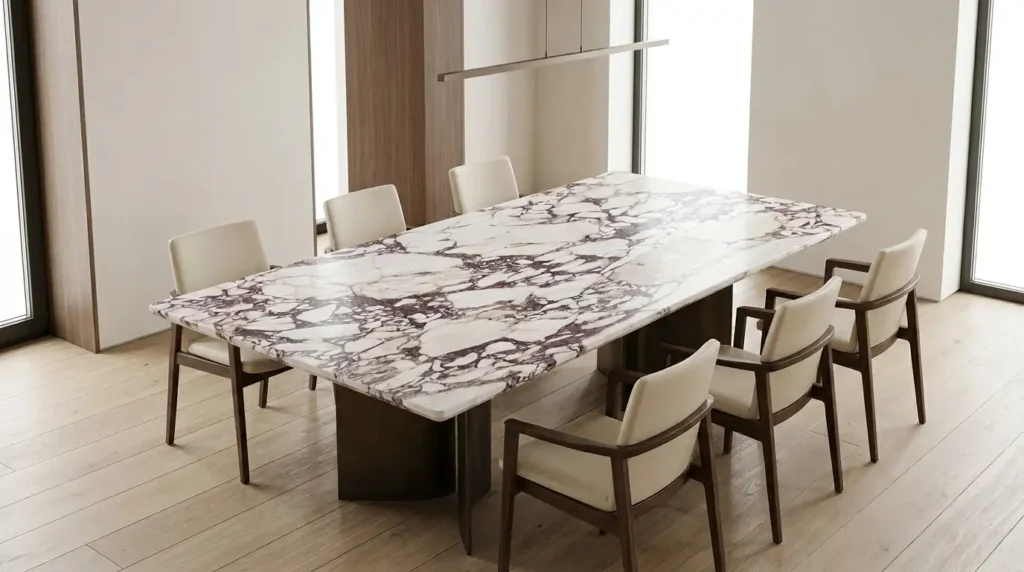
A marble dining table is more than a piece of furniture.
When natural stone is used correctly, the table becomes one of the largest uninterrupted stone surfaces inside the room.
That means every decision becomes visible:
- stone selection
- slab pattern
- table dimensions
- vein position
- edge detail
- finish
- base design
- thickness
- structural support
- fabrication quality
A beautiful marble slab can produce an ordinary table if these elements are poorly coordinated.
A carefully designed table can transform the same natural stone into a major architectural object.
This is especially important because genuine marble is naturally unique.
No two slabs contain exactly the same:
- veins
- mineral formations
- color transitions
- natural markings
A custom marble dining table should therefore be designed around the actual slab, not simply around a generic stone texture.
Why Choose a Marble Dining Table?
Natural marble offers characteristics that manufactured furniture surfaces cannot reproduce exactly.
Every table can contain a unique geological composition.
Depending on the stone, the surface may display:
- bold veins
- subtle mineral clouds
- crystalline structures
- brecciated patterns
- sedimentary movement
- dramatic color variation
This makes marble particularly suitable for furniture that is intended to function as a focal point.
A marble dining table can work in:
- contemporary residences
- luxury villas
- apartments
- hotel suites
- private dining rooms
- restaurants
- executive interiors
- hospitality spaces
The design can range from extremely minimal to highly expressive.
A Marble Table Begins with the Stone
One of the most common mistakes is choosing the furniture shape first and considering the actual stone last.
For natural stone furniture, the process should often work in the opposite direction.
The slab itself provides valuable information.
Before finalizing the table, review:
- slab dimensions
- dominant veins
- quieter areas
- natural discontinuities
- background color
- direction of movement
Then determine how the tabletop can best use those characteristics.
A dramatic slab may deserve a very simple table shape.
A quiet stone may allow the base or edge detail to become more expressive.
Best Marble Types for Dining Tables
There is no universally best marble.
The correct stone depends on the intended design.
Different stones create completely different furniture.
Calacatta Viola Dining Table
Calacatta Viola can create an extremely expressive table.
Its characteristic palette may include:
- white background
- burgundy
- violet
- deep red-purple movement
A dining table provides enough surface area for these dramatic veins to remain visible.
It works especially well when the surrounding interior is restrained.
For example:
Calacatta Viola table
dark walnut dining chairs
warm white plaster
minimal bronze lighting.
The stone becomes the dominant decorative feature.
Statuario Marble Dining Table
Statuario creates a more neutral luxury appearance.
Typical selections combine:
- white background
- grey veins
- large areas of clean white
This works particularly well in contemporary interiors where the table should appear bright and refined.
A simple combination could be:
Statuario table
walnut chairs
light oak floor
warm white architecture.
Rosso Levanto Dining Table
Rosso Levanto creates a completely different atmosphere.
The dark burgundy coloration can make the table feel almost sculptural.
Possible visual characteristics include:
- wine red
- burgundy
- white mineral veins
- darker geological areas
Because the stone is already visually powerful, the base should usually remain simple.
A dark bronze or black metal base can work particularly well.
Alexander Black Dining Table
Alexander Black is useful when the interior needs a strong dark anchor.
Its visual character can include:
- deep black
- charcoal
- white veins
- pale-grey movement
A large polished or honed black table can create strong contrast against:
- cream chairs
- light oak flooring
- warm white walls
The result can feel highly contemporary.
Rainforest Green Dining Table
Rainforest Green can produce one of the most unusual natural stone tables.
Its branching pattern may resemble:
- tree roots
- forest branches
- river systems
- geological maps
This makes every table visually unique.
A simple rectangular top allows the stone itself to remain the artwork.
Narcisse Dining Table
Narcisse works particularly well for warmer interiors.
Its layered palette can include:
- brown
- mocha
- taupe
- grey-brown
- lighter mineral clouds
This makes it especially compatible with:
- light oak
- walnut
- cream upholstery
- bronze
A Narcisse dining table can feel rich without relying on sharp contrasting veins.
Afyon White Dining Table
Afyon White is a strong option when the desired table is:
- light
- restrained
- natural
- elegant
Rather than dramatic veins, the design can rely on:
- crystalline marble texture
- subtle mineral movement
- clean proportions
This makes it especially suitable for minimalist interiors.
Travertine Dining Tables
Travertine furniture deserves its own category.
Travertine is geologically limestone rather than marble and contains characteristic natural cavities and sedimentary structures.
A travertine table can feel:
- more architectural
- more tactile
- less formal
- more earthy
Popular visual directions include:
- Ivory Travertine
- Silver Travertine
- Pink Travertine
Travertine can be:
- vein cut
- cross cut
- filled
- partially filled
- more naturally open
Each treatment changes the furniture considerably.
Marble Dining Table Shapes
The table shape influences both architecture and stone yield.
The four most common directions are:
- rectangular
- round
- oval
- organic or sculptural
Rectangular Marble Dining Table
Rectangular tables are among the most efficient ways to display natural stone.
They allow:
- long vein movement
- relatively simple fabrication
- clear seating organization
- efficient integration into large rooms
They work particularly well with strongly directional slabs.
For example, a long grey vein can travel almost the full length of a rectangular Statuario table.
Common Rectangular Dining Table Dimensions
Useful design starting points include approximately:
- 160 × 90 cm
- 180 × 90 cm
- 200 × 100 cm
- 220 × 100 cm
- 240 × 110 cm
- 260 × 110 cm
- 280 × 120 cm
- 300 × 120 cm
These are not universal standards.
The correct dimensions depend on:
- number of seats
- room size
- chair dimensions
- slab dimensions
- base position
Dining Table Space per Person
As an approximate planning rule, around 55–65 cm of table edge per person often provides practical seating.
More generous luxury dining layouts may provide:
- 65 cm
- 70 cm
- or more
per guest.
Chair width and armrests should also be considered.
Six-Person Marble Dining Table
A typical rectangular six-person table may begin around:
180–200 × 90–100 cm.
For a more generous design:
220 × 100 cm
can provide additional space.
Eight-Person Marble Dining Table
A common starting range is approximately:
220–260 × 100–110 cm.
The exact dimension depends heavily on whether chairs are also placed at both ends.
Ten-Person Marble Dining Table
A large table may begin around:
280 × 110 cm
and extend to:
300 × 120 cm or larger.
At this scale, slab dimensions and structural support become increasingly important.
Round Marble Dining Tables
Round tables create a softer spatial relationship.
They are particularly effective in:
- square dining rooms
- entrance dining areas
- smaller luxury apartments
- hospitality settings
A round stone top also allows a central base.
This can provide more freedom around the perimeter.
Common Round Table Diameters
Approximate planning ranges include:
- Ø100–110 cm → compact dining
- Ø120 cm → approximately four people
- Ø130–140 cm → four to six
- Ø150 cm → approximately six
- Ø160–180 cm → six to eight
- Ø180 cm+ → large dining configuration
The actual seating capacity depends on:
- chair width
- base geometry
- desired spacing
Round Tables Use the Slab Differently
A round top removes the slab corners.
This may create more material waste.
But the geometry can also be used strategically.
A dramatic central vein can be positioned across the diameter.
Alternatively, a more uniform slab may create a calmer circular composition.
Oval Marble Dining Tables
Oval tables combine some advantages of rectangular and round furniture.
They provide:
- longer seating capacity
- softened corners
- easier circulation
- more sculptural form
Oval tables can work particularly well with heavily veined stones because the curved perimeter creates an interesting relationship with the natural pattern.
Racetrack-Shaped Tables
A contemporary variation is the racetrack table.
It uses:
- straight long sides
- rounded ends
This geometry works particularly well for:
- modern villas
- hospitality interiors
- large open-plan dining rooms
The shape feels softer than a rectangle but remains easier to organize than a completely organic table.
Organic Marble Tables
Natural stone can also be cut into more irregular furniture forms.
Possible shapes include:
- asymmetrical ovals
- soft triangular forms
- irregular rounded rectangles
- free-form silhouettes
These can be visually powerful.
But the shape should not compete unnecessarily with a highly dramatic stone.
If the slab already contains exceptional veins, a simpler geometry may create the stronger table.
The Importance of Slab Dimensions
Table design must consider the actual usable slab.
Suppose a project requires:
300 × 120 cm.
The available stone slab may measure:
295 × 175 cm.
The table cannot simply be produced at the requested length without:
- reducing the size
- adding a joint
- finding another slab
- changing the orientation
For custom marble furniture, final dimensions should therefore be confirmed only after suitable material is identified.
One-Piece Marble Dining Tables
For premium furniture, a one-piece top is often visually preferred.
It provides:
- uninterrupted natural pattern
- no center joint
- stronger material continuity
But one-piece production depends on:
- slab dimensions
- slab integrity
- handling
- transport
- building access
- table size
A one-piece 300 cm table may be technically possible to fabricate but difficult to move through:
- elevators
- staircases
- door openings
Logistics should be considered before production.
Two-Piece Marble Tables
For very large furniture, a carefully designed joint may be more practical.
The joint can sometimes be positioned:
- at the center
- along a natural vein
- above part of the support structure
If adjacent slabs are available, pattern continuity can also be considered.
The goal is to make the joint intentional.
Marble Table Thickness
There is no single universal thickness appropriate for every natural stone dining table.
The design must consider:
- stone type
- table dimensions
- span
- base structure
- reinforcement
- slab condition
- edge detail
- transportation
Natural stone structural behavior varies significantly, so large unsupported spans should not be designed from appearance alone.
20 mm Marble Table Tops
Approximately 20 mm stone can create a refined contemporary appearance.
Advantages include:
- visually lighter furniture
- reduced stone weight
- elegant edge profile
But a thin stone panel generally places greater importance on:
- substructure
- reinforcement
- support placement
- fabrication quality
Large thin slabs should not simply be placed over widely spaced legs without engineering consideration.
30 mm Marble Table Tops
Approximately 30 mm stone creates a more substantial appearance.
It may offer:
- greater visual mass
- simpler edge treatment
- increased stiffness relative to thinner material
but still requires proper support depending on the:
- span
- stone
- table size
- base design
Thickness alone does not eliminate structural design requirements.
Thick-Looking Marble Tables
A table that appears 60, 80 or even 100 mm thick does not necessarily use a solid stone slab of that thickness.
A common architectural approach is to create a built-up or mitred edge.
The main top might use a thinner slab while edge pieces create the appearance of greater thickness.
This can:
- reduce excessive weight
- produce a monumental appearance
- create a cleaner modern profile
The fabrication quality of the mitred joints becomes critical.
Solid Thick Stone vs Built-Up Edge
Solid Thick Stone
Can provide:
- genuine material depth
- heavy sculptural appearance
But it also increases:
- weight
- transportation difficulty
- structural demands
- material use
Built-Up Edge
Can provide:
- thick visual appearance
- lower overall stone mass
- greater control over edge proportions
But requires:
- precise cutting
- careful vein matching
- high-quality mitre fabrication
Neither is universally superior.
Marble Table Edge Profiles
Edge design can completely change the furniture language.
Possible profiles include:
- straight edge
- micro-bevel
- eased edge
- rounded edge
- bullnose
- half-bullnose
- chamfer
- mitred thick edge
- sculpted edge
Straight Edge
A straight edge creates the most architectural appearance.
It works particularly well for:
- minimalist tables
- thick-looking tops
- rectangular furniture
A very small safety bevel may still be introduced to reduce sharpness and chipping risk.
Rounded Edge
A soft radius can make stone furniture feel:
- less severe
- more tactile
- more contemporary
This works particularly well with:
- oval tables
- round tables
- lighter-colored stone
- softer furniture forms
Bullnose
A fully rounded edge creates a more traditional or sculptural appearance.
It can work well for round tables but generally creates a very different language from a sharp contemporary slab table.
Chamfered Edge
A chamfer removes part of the corner at an angle.
This can create:
- shadow
- visual lightness
- finer edge perception
A substantial stone top can therefore appear thinner from normal viewing height.
Reverse Chamfer
Another contemporary approach is removing material primarily from the underside.
From above, the table retains a strong stone surface.
From the side, the edge can appear visually lighter.
This can work extremely well for modern marble furniture.
Pencil Edge
A minimal rounded edge is useful when the design needs to remain simple but the corners should not feel excessively sharp.
It works particularly well for everyday dining furniture.
Which Edge Is Best?
The answer depends on the architecture.
For a highly veined dramatic stone, a simple edge is often strongest.
For a calm monochromatic stone, a more sculptural edge can become part of the design.
Marble Table Base Design
The base is just as important as the stone.
A beautiful marble top can be visually weakened by an inappropriate base.
The base must satisfy two requirements:
structural support
and
visual proportion.
Metal Table Bases
Metal allows the stone to remain visually dominant.
Possible finishes include:
- black
- dark bronze
- brushed bronze
- stainless steel
- powder-coated metal
Metal bases can be:
- central pedestal
- twin pedestal
- rectangular frame
- cross-shaped
- sculptural
Black Metal Base
This is one of the safest choices for:
- Calacatta Viola
- Statuario
- Rosso Levanto
- Rainforest Green
- beige marble
Black creates a visually neutral support.
Bronze Base
Bronze adds warmth.
It works particularly well with:
- burgundy marble
- brown marble
- cream stone
- warm white marble
Use it carefully.
If both the marble and metal are highly decorative, the table can become visually excessive.
Stainless Steel Base
Stainless steel creates a cooler architectural character.
It works especially well with:
- white marble
- grey marble
- black marble
and interiors with contemporary metal detailing.
Stone Pedestal Bases
Another approach is creating the base from natural stone.
This can produce a more sculptural monolithic table.
Possible configurations include:
- one central pedestal
- two rectangular pedestals
- cylindrical stone bases
- oval supports
- fluted stone bases
The design can use:
the same stone
or
a contrasting stone.
Same-Stone Base
Using the same stone creates a monolithic object.
For example:
Calacatta Viola top + Calacatta Viola pedestal.
This can be extremely dramatic.
But large quantities of patterned stone may become visually overwhelming.
Contrasting Stone Base
A more controlled approach may use:
Statuario top
dark stone pedestal
or:
Rosso Levanto top
cream limestone base.
This creates hierarchy within the furniture itself.
Travertine Pedestal Bases
Travertine is particularly suited to sculptural furniture bases.
Its textured appearance works well in:
- cylindrical bases
- block forms
- fluted structures
A polished marble top combined with a honed travertine base can create contrast between:
- smooth
- textured
natural stone surfaces.
Wood Bases
Stone and timber form one of the strongest material combinations.
Possible woods include:
- walnut
- oak
- dark stained oak
Wood can visually soften a large stone top.
Walnut Base + Marble Top
Walnut works extremely well with:
- white marble
- burgundy marble
- green marble
- beige marble
- brown stone
The natural grain introduces warmth without competing directly with stone veining.
Marble Top Pattern Placement
This is one of the most important details in custom table production.
Do not cut the tabletop from whichever part of the slab provides the easiest yield.
Review the slab first.
Ask:
- Where is the strongest vein?
- Where should it begin?
- Should it cross the center?
- Should the quieter area face the seating?
- Is there one section that should be avoided?
The stone should be composed intentionally.
Centered Vein
A strong vein may be positioned through the center of the table.
This can work especially well on:
- rectangular tables
- long oval tables
The vein becomes the primary graphic feature.
Diagonal Vein
A diagonal natural vein can create more movement.
This works particularly well with:
- Statuario
- Calacatta varieties
- black-and-white marble
The table immediately feels less symmetrical.
Quiet Center
Another approach is keeping the center relatively calm and allowing stronger veins toward the perimeter.
This can create a subtler overall composition.
There is no universal correct orientation.
Dining Table Vein Direction
Direction should relate to the table geometry.
For a long rectangular table, a major vein can run:
Along the Length
This emphasizes the long proportion.
Across the Width
This creates stronger interruption and visual contrast.
Diagonally
This creates dynamic movement.
Preview all options before cutting.
Slab Photography Before Production
A custom stone table should ideally be designed using a clear photograph of the actual slab.
A strong workflow is:
- Photograph the complete slab.
- Record actual dimensions.
- Correct perspective if necessary.
- Create a scaled tabletop outline.
- Position it digitally over the slab.
- Review multiple orientations.
- Approve the selected composition.
- Begin cutting.
This can dramatically improve the furniture.
One Slab Can Produce Several Different Tables
Imagine one Calacatta Viola slab.
Layout A
Places the strongest burgundy movement in the center.
The result becomes highly dramatic.
Layout B
Uses the quieter white region.
The result becomes much more minimal.
Layout C
Rotates the same piece 90 degrees.
The vein direction changes completely.
Same slab.
Three different pieces of furniture.
Material Yield Still Matters
Visual quality is important, but furniture production must also consider yield.
A slab may potentially produce:
- one large dining table
- one coffee table
- two side tables
when the layout is coordinated properly.
A poor cutting plan might create:
- one dining table
- several unusable remnants
without improving the main piece.
The best cutting plan balances:
visual composition
and
material utilization.
Using Offcuts for Matching Furniture
One effective strategy is creating a furniture family from the same slab.
For example:
Dining table
coffee table
two side tables
can all come from related sections.
The pieces then share:
- color
- geology
- material identity
without being identical.
Matching Does Not Mean Repeating
Natural stone furniture should not look like printed furniture using the same copied texture.
Each piece should remain naturally unique.
The relationship should come from:
- same block
- similar color
- related vein character
not digital repetition.
Polished Marble Dining Tables
Polishing creates:
- more reflection
- greater color depth
- stronger veins
- a more formal appearance
A polished dining table can feel particularly luxurious when using:
- dark marble
- colorful marble
- strongly veined white marble
However, polished surfaces can make:
- scratches
- etching
- fingerprints
- water marks
more visually noticeable depending on the material.
Honed Marble Dining Tables
Honing creates:
- lower reflection
- softer color
- more contemporary appearance
- more restrained stone movement
A honed table works particularly well in minimalist architecture.
It can also make a dramatic stone easier to integrate into a calm interior.
Polished vs Honed Dining Table
Choose polished when you want:
- richer color
- strong reflection
- formal luxury
- greater visual depth
Consider honed when you want:
- reduced glare
- contemporary design
- softer stone color
- a more tactile surface
Both require appropriate care.
Marble Dining Table Weight
Natural stone furniture can be very heavy.
The final weight depends on:
- stone density
- table dimensions
- thickness
- base material
- built-up edges
A large marble dining table should therefore be considered as a heavy furniture item during:
- production
- packing
- shipping
- delivery
- installation
Why Weight Matters
The table may need to pass through:
- doorways
- elevators
- corridors
- staircases
before reaching its final location.
A table that fits perfectly in the dining room may not fit through the building access route as one assembled piece.
Design for Installation
Large custom tables are often easier to handle when:
- top and base are separate
- base components can be assembled on site
- final stone top is installed after positioning the base
The connection system should be designed before production.
Marble Table Bases Need Proper Support
Natural stone is strong in compression but brittle compared with many flexible structural materials.
A large table top should therefore have appropriate support based on:
- stone characteristics
- span
- thickness
- base configuration
- reinforcement
Do not assume a stone tabletop can safely bridge a large unsupported distance simply because the slab appears thick.
Avoid Excessive Cantilevers
Large unsupported stone overhangs increase structural risk.
A dramatic floating appearance may require:
- hidden metal framing
- internal structural reinforcement
- carefully positioned bases
The furniture should be engineered rather than designed purely from a render.
Dining Chairs and Table Base Position
Structural support should not interfere with seating.
Check:
- chair width
- knee space
- leg position
- pedestal width
- end seating
before finalizing the base.
A beautiful base positioned incorrectly can make the table uncomfortable.
Table Height
A common dining-table height is approximately:
74–76 cm.
Some custom designs may vary slightly.
The complete table height includes:
- base
- stone top
- mounting structure
This sounds obvious, but it is easy to accidentally make a custom table too tall when a thick stone top is added to a base designed independently.
Knee Clearance
Always review clearance below the tabletop.
A thick-looking 100 mm edge should not necessarily mean the entire underside extends 100 mm downward across the seating area.
Built-up edge designs can preserve a thick visual appearance while allowing greater knee clearance.
Round Table Pedestal Size
A central pedestal should provide enough stability without interfering with chairs.
Too narrow:
- visual instability
- structural issues
Too wide:
- poor knee space
The correct proportion depends on:
- tabletop diameter
- base weight
- stone thickness
- structural design
Marble Dining Table Care
Natural marble furniture requires realistic maintenance expectations.
The Natural Stone Institute recommends mild, non-acidic cleaners for calcareous natural stone and specifically warns that products containing lemon, vinegar or other acids can dull or etch these surfaces.
For routine table care:
- remove spills promptly
- use coasters
- use placemats where appropriate
- use trivets for hot items
- use soft cleaning cloths
- use suitable pH-neutral natural-stone cleaner
- avoid abrasive cleaning powders
- avoid acidic cleaners
Can Vinegar Be Used on a Marble Dining Table?
No.
Vinegar is acidic.
The Natural Stone Institute specifically advises against vinegar on calcareous stones such as marble, limestone and travertine.
Acid exposure can create:
- dull marks
- loss of polish
- cloudy areas
- locally changed texture
This is called etching.
What Is Etching?
Etching is different from staining.
Stain
A substance penetrates the stone.
Etch
An acid chemically reacts with the surface.
An etched polished marble table may show:
- matte spots
- pale rings
- loss of reflection
Acid exposure is one of the primary maintenance considerations for calcium-carbonate-based marble.
Common Dining Table Acids
Examples include:
- lemon
- lime
- vinegar
- wine
- tomato
- some fruit juices
- acidic sauces
- certain household cleaners
This does not mean marble cannot be used for dining tables.
It means buyers should understand how genuine marble behaves.
Use Coasters
Coasters are especially helpful beneath:
- citrus drinks
- wine
- cocktails
Natural-stone care guidance specifically recommends coasters under glasses, particularly those containing alcohol or citrus.
Use Trivets
Natural-stone care guidance also recommends using trivets or mats beneath hot cookware even where the stone itself may tolerate elevated temperature.
This also helps protect:
- finish
- applied treatments
- surrounding furniture components
Should a Marble Dining Table Be Sealed?
Possibly.
The requirement depends on:
- actual stone
- absorption
- finish
- intended use
- existing factory treatment
An impregnating treatment can make natural stone more resistant to staining.
It does not make the stone completely stain-proof.
Does Sealing Prevent Etching?
No.
This is one of the biggest misconceptions about marble furniture.
An impregnating treatment primarily helps reduce penetration of liquids.
It does not fundamentally remove marble’s calcium-carbonate sensitivity to acid.
Technical guidance notes that impregnating treatment may reduce but does not eliminate vulnerability to acidic attack.
Therefore:
sealed marble is not acid-proof marble.
Marble Table Patina
Some owners appreciate the way marble develops subtle signs of use over time.
This may include:
- light etching
- small scratches
- gradual surface patina
Others expect the table to remain visually perfect.
Neither expectation is wrong.
But the buyer should understand which one they have before choosing natural marble.
Is Marble Suitable for Families?
It can be.
But lifestyle matters.
A marble table may suit someone who:
- understands natural stone
- cleans spills promptly
- accepts natural patina
- uses placemats and coasters
It may be less suitable for someone expecting:
- zero maintenance
- complete acid resistance
- no visible change over years of heavy use
Material selection should match expectations.
Marble vs Travertine Dining Table
Both are natural stone, but visually they are very different.
Marble
Usually offers:
- denser surface
- stronger crystalline character
- veins
- polished or honed luxury
Travertine
Usually offers:
- pores
- sedimentary layers
- softer earthy character
- more visible texture
Travertine is geologically limestone, not marble.
Marble vs Porcelain Table
Manufactured surfaces can provide:
- more uniform appearance
- repeated patterns
- lower variation
- different maintenance characteristics
Natural marble provides:
- genuine mineral structure
- unique slabs
- non-repeating geology
- natural depth
The choice is fundamentally between:
geological uniqueness
and
manufactured consistency.
Marble vs Wood Dining Table
Wood provides:
- warmth
- grain
- lower apparent visual weight
Marble provides:
- mineral depth
- greater visual mass
- stone pattern
- stronger sculptural presence
Combining both can often create the strongest result.
For example:
marble top
walnut base.
Custom Marble Dining Table vs Ready-Made Table
A ready-made table is generally selected from an existing:
- dimension
- design
- stone pattern
A custom table allows greater control over:
- actual slab
- tabletop dimensions
- pattern placement
- edge profile
- base design
- finish
This is particularly valuable for highly patterned natural stone.
Why Custom Slab Selection Matters
Suppose two clients order a:
240 × 110 cm Calacatta Viola table.
One table may contain:
- a strong central burgundy composition
while another may be:
- predominantly white with limited purple movement.
Same stone name.
Same size.
Completely different furniture.
Custom slab approval allows the client or architect to understand what will actually be produced.
Custom Table Production Workflow
A professional natural stone furniture process can follow:
1. Define the Furniture Type
Dining table, coffee table, console or side table?
2. Define Dimensions
Based on room and seating.
3. Select the Stone
Choose the desired natural stone family.
4. Review Actual Slabs
Compare the current available material.
5. Choose the Slab
Approve the exact piece.
6. Position the Table Digitally
Determine the best area of the slab.
7. Confirm Edge Profile
Straight, rounded, chamfered or built-up?
8. Choose the Finish
Polished or honed?
9. Design the Base
Stone, timber or metal?
10. Review Structural Support
Particularly for large spans.
11. Fabricate
According to approved drawings.
12. Quality Control
Check:
- dimensions
- finish
- edges
- slab pattern
- assembly points
- visible condition
13. Pack
Furniture packing must account for stone weight and fragile edges.
14. Install
Large furniture may require professional handling.
Packing Marble Furniture
A marble dining table is not packed like ordinary flat-pack furniture.
The stone requires protection against:
- impact
- edge damage
- movement
- vibration
A shipping package may need:
- rigid crate
- cushioning
- protected corners
- controlled support points
- separate base packaging
The exact method depends on:
- table dimensions
- stone
- shipping mode
- destination
Why Edges Are Critical During Shipping
The central part of a stone top can often be relatively well protected.
Edges and corners are more vulnerable to impact.
Particular attention should be paid to:
- sharp rectangular corners
- thin edges
- mitred edges
- projecting details
during handling and packing.
Marble Furniture for Hotels
Stone furniture is particularly useful in hospitality because it can connect furniture with the architectural material palette.
Possible pieces include:
- dining tables
- coffee tables
- console tables
- side tables
- reception tables
- bar tables
A project may use the same stone across:
architectural surfaces
and
selected furniture
to create continuity.
Marble Furniture for Restaurants
Restaurants can use custom stone tables to create a distinctive identity.
But specification must consider:
- food exposure
- acids
- cleaning frequency
- table size
- edge durability
- maintenance
A polished calcitic marble tabletop will require more maintenance awareness than a decorative stone wall.
Marble Dining Table for Luxury Residences
Residential projects allow greater material expression.
A dining table can become the central stone statement instead of covering:
- floors
- walls
- fireplace
with the same dramatic material.
For example:
neutral limestone architecture
one Calacatta Viola dining table
can provide enough color and movement for the entire dining space.
Using Statement Stone Only on Furniture
This is one of the strongest contemporary design strategies.
Instead of committing to a dramatic natural stone across hundreds of square meters, use it on:
- dining table
- coffee table
- console
The furniture becomes:
- movable
- concentrated
- visually powerful
while the architecture remains restrained.
Matching Dining and Coffee Tables
There are two approaches.
Same Stone
Creates a clear furniture family.
For example:
Narcisse dining table
Narcisse coffee table.
Different but Compatible Stone
Creates greater hierarchy.
For example:
Afyon White dining table
Rosso Levanto coffee table.
The second approach provides more variety.
Avoid Stone Overload
Natural stone furniture becomes less special when every object is stone.
A room containing:
- marble floor
- marble wall
- marble dining table
- marble coffee table
- marble side tables
- marble console
can become visually heavy.
Use natural stone strategically.
One or two major furniture pieces may be enough.
The Best Marble Dining Table Is Not Always the Most Dramatic
The strongest slab in the warehouse is not automatically the best furniture stone.
A dining room with:
- dramatic art
- rich walnut panels
- statement lighting
may benefit from a calm table.
A minimal room may benefit from a spectacular slab.
Selection should respond to the whole interior.
Common Mistakes with Marble Dining Tables
1. Selecting Stone from a Small Sample
A small sample cannot show the complete table composition.
2. Choosing Dimensions Before Checking Slab Size
The desired one-piece top may not fit the available material.
3. Ignoring Vein Placement
Important parts of the slab can be wasted.
4. Designing the Base Only for Appearance
The support must also be structurally appropriate.
5. Making the Edge Too Thick Without Considering Knee Space
A dramatic edge should not make the table uncomfortable.
6. Ignoring Weight
Large stone furniture requires planning for delivery and installation.
7. Using Acidic Cleaners
Marble can be etched by acids.
8. Assuming Sealing Makes Marble Acid-Proof
It does not.
9. Using Too Many Decorative Elements
A beautiful stone often needs a simple furniture design.
10. Producing Before Approving the Actual Slab
Natural stone varies too much to rely only on the stone name.
How to Choose a Marble Dining Table
Use this sequence:
1. Measure the Room
Determine available circulation.
2. Determine Seating Capacity
Four, six, eight, ten or more?
3. Select the Shape
Rectangle, round, oval or organic?
4. Define Approximate Dimensions
Do not finalize until material is reviewed.
5. Choose the Stone Character
Do you want:
- white
- dark
- colorful
- calm
- dramatic?
6. Review Full Slabs
Select from actual material.
7. Choose Pattern Placement
Position the tabletop on the slab.
8. Select Finish
Polished or honed?
9. Select Edge Detail
Straight, rounded, chamfered or built-up?
10. Design the Base
Stone, metal or timber?
11. Verify Structural Support
Especially for large tables.
12. Check Access
Will the furniture physically reach the room?
13. Approve Production Drawings
Before cutting begins.
Final Thoughts
A marble dining table is one of the most effective ways to introduce natural stone into an interior.
Unlike a small accessory, the tabletop provides enough area to display:
- genuine slab movement
- natural veins
- mineral structures
- color variation
- geological uniqueness
But the stone itself is only the beginning.
The quality of the finished furniture depends on:
slab selection
table proportions
pattern placement
edge detailing
surface finish
base design
structural support
fabrication
packing
maintenance.
Choose the actual slab rather than relying on a small sample.
Match the table dimensions to both the room and available stone.
Plan the veins before cutting.
Keep the base visually subordinate when the stone is dramatic.
Do not use thickness alone as a substitute for proper structural support.
Design large furniture with transportation and installation in mind.
Use suitable pH-neutral care products.
Avoid lemon, vinegar and other acidic cleaners on acid-sensitive marble.
And remember that an impregnating treatment can improve stain resistance but does not make natural marble completely stain-proof or acid-proof.
The strongest marble furniture does not look like a slab simply placed on a base.
It looks as though the stone, geometry and furniture were designed together from the beginning.
Frequently Asked Questions
Is marble good for a dining table?
Yes. Marble is widely used for table tops and other furniture surfaces because of its natural appearance and unique veining. However, calcitic marble is sensitive to acids and requires appropriate care.
What is the best marble for a dining table?
There is no universally best marble. The right choice depends on the desired color, pattern, dimensions, finish and maintenance expectations. Statuario, Calacatta Viola, Rosso Levanto, Afyon White, dark marble and other natural stones can all create very different tables.
What is a good marble dining table size for six people?
Approximately 180–220 cm long and 90–100 cm wide is a useful planning range for many six-person rectangular tables. Chair width and desired spacing should determine the final dimension.
What size marble table is good for eight people?
Approximately 220–260 cm long and 100–110 cm wide is a common starting range for rectangular configurations, although seating design can change the requirement.
What height should a marble dining table be?
Approximately 74–76 cm overall height is common for dining furniture. The final height should consider the top thickness, support structure and chairs.
Is 20 mm marble thick enough for a dining table?
It can be used in properly designed furniture, but suitability depends on the stone, dimensions, span, reinforcement and supporting base. Thickness should not be selected independently of structural support.
Is 30 mm marble better for a table?
A 30 mm top provides a more substantial appearance and greater section thickness, but large tables still require appropriate support. It is not universally better than a correctly engineered thinner top.
How can a marble table look 80 mm thick?
A built-up or mitred perimeter edge can create the visual appearance of a thicker stone top without using a solid 80 mm slab across the entire table.
Is polished or honed marble better for a dining table?
Polished marble creates stronger reflection and color depth. Honed marble provides a softer, lower-reflection appearance. Both can be used depending on the design and maintenance expectations.
Can vinegar damage a marble dining table?
Yes. Vinegar is acidic and should not be used on calcareous marble.
Can lemon damage a marble table?
Yes. Acidic substances including lemon can etch calcitic marble surfaces.
Should marble dining tables be sealed?
An appropriate impregnating treatment may improve stain resistance for some stones and applications, but it does not make marble completely stain-proof.
Does sealing protect marble from acid?
No. Impregnating treatment does not eliminate marble’s vulnerability to acidic attack.
Can marble tables be made from one slab?
Yes, when the slab dimensions, structural condition, table size and logistics allow it. Large tables should also be checked against building access for delivery and installation.
Can marble table tops have custom shapes?
Yes. Natural stone can be fabricated into rectangular, round, oval, racetrack and more sculptural custom forms, subject to stone characteristics and fabrication requirements.
Looking for a Custom Marble Dining Table?
VeraMarbles can support custom natural stone furniture for residential, hospitality and commercial projects.
Send us your:
- preferred stone
- table dimensions
- table shape
- number of seats
- preferred finish
- desired edge profile
- base concept
- project location
- reference drawings or images
We can support your project with:
- stone selection
- full-slab review
- tabletop pattern positioning
- custom dimensions
- edge fabrication
- polished and honed finishes
- stone pedestal production
- matching coffee and side tables
- production drawings
- quality control
- export packing
- project coordination
Request a Custom Marble Table Quote from VeraMarbles