
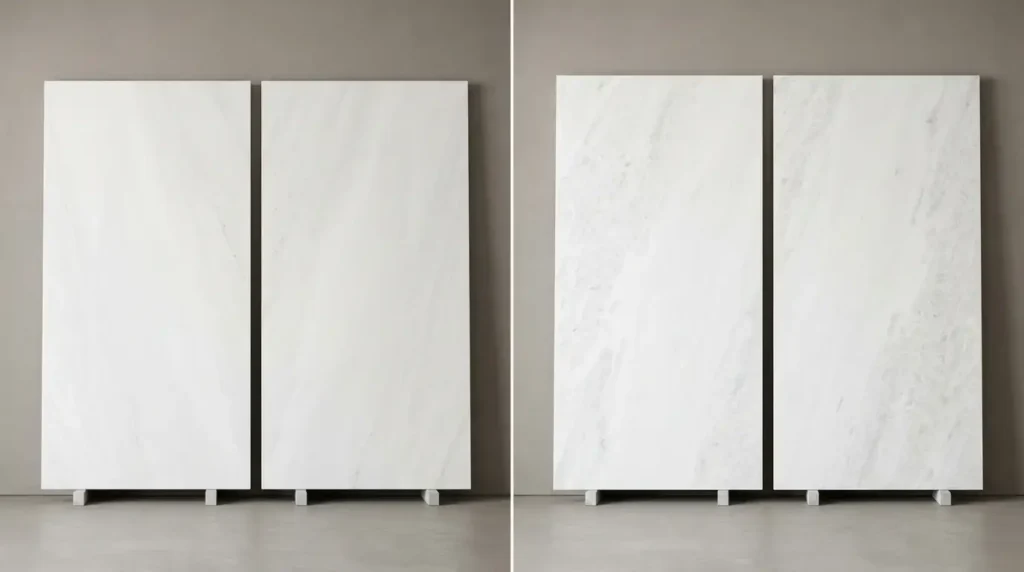
Türkiye is internationally associated with several important white natural stones.
Two names frequently encountered in architectural projects are:
Afyon White
and
Mugla White.
At first glance, the decision may seem simple.
Both are:
- Turkish
- naturally white
- genuine marble
- available for architectural projects
- suitable for polished and honed surfaces
- used in floors, walls and custom stone work
But treating them as interchangeable white stones would be a mistake.
They come from completely different marble-producing regions.
Their geological backgrounds are different.
Their crystalline appearance can differ.
Their natural variation differs from block to block.
And the correct choice depends on much more than asking:
“Which one is whiter?”
A professional comparison should consider:
- origin
- background tone
- crystalline texture
- natural markings
- slab consistency
- available dimensions
- finish
- application
- required quantity
- fabrication
- maintenance
- technical test data
This guide explains how to choose between Afyon White and Mugla White marble for an architectural project.
Quick Comparison: Afyon White vs Mugla White
| Characteristic | Afyon White | Mugla White |
|---|---|---|
| Country | Türkiye | Türkiye |
| Main region | İscehisar, Afyonkarahisar | Muğla |
| Geological setting | İscehisar calcitic marble group | Southern Menderes Massif marble deposits |
| Commercial color | White | White |
| Typical visual role | Calm architectural white | Bright crystalline architectural white |
| Natural appearance | Selection-dependent, subtle mineral variation | Selection-dependent, crystalline structure can be pronounced |
| Flooring | Strong option | Strong option |
| Bathrooms | Strong option | Strong option |
| Wall cladding | Strong option | Strong option |
| Hospitality | Strong option | Strong option |
| Polished finish | Available | Available |
| Honed finish | Available | Available |
| Large-project selection | Essential | Essential |
| Best choice decided by | Actual slabs + application | Actual slabs + application |
These are broad architectural tendencies.
Actual slabs must always take priority over simplified descriptions.
What Is Afyon White Marble?
Afyon White is a natural marble associated with the historic İscehisar marble district of Afyonkarahisar, Türkiye.
Scientific investigation of İscehisar marbles divides the deposits into several mineralogical groups.
Afyon White is included within the calcitic marble group, dominated by calcite.
The district lies approximately 25 kilometers northeast of Afyonkarahisar and has an extremely long history of marble production.
The ancient marble center associated with İscehisar supplied white and colored stone for important architectural and sculptural applications during antiquity.
Today, Afyon White remains internationally recognized as one of Türkiye’s important white marble categories.
What Does Afyon White Look Like?
Afyon White is generally selected for a predominantly white surface.
Depending on the quarry level and block, the stone may include:
- clean white
- neutral white
- warm white
- subtle ivory-white areas
- fine pale-grey movement
- crystalline variation
- occasional more visible natural markings
Some selections appear extremely calm.
Others display more obvious mineral movement.
This range matters.
The most suitable Afyon White for a large hotel floor may not be the same selection chosen for:
- a vanity
- a table
- a feature wall
Natural stone selection should always follow the application.
What Is Mugla White Marble?
Mugla White is another genuine Turkish marble, originating from Muğla in southwestern Türkiye.
The Muğla marble region lies on the southern flank of the Menderes Massif, one of Türkiye’s major metamorphic geological structures.
Academic research identifies Mugla White among the internationally traded marbles quarried from the metamorphic carbonate sequences of this region.
Mugla White also has a particularly clear official geographical definition.
The registered geographical indication for Muğla Beyaz Mermeri defines the production area as the Muğla districts of:
- Yatağan
- Milas
- Kavaklıdere.
The registration describes the material as marble produced from the numerous quarry areas extending along the Milas–Yatağan–Kavaklıdere corridor.
Mugla White Has a Registered Geographical Origin
This is an important procurement point.
Muğla White received registered geographical-indication protection as a designation of origin, with the registration dated April 19, 2020.
For architects and buyers, this reinforces that the name is connected to a defined Turkish production geography rather than being simply a generic expression meaning:
white marble from Muğla.
For a major international project, origin documentation should still be reviewed alongside:
- actual slabs
- technical data
- required dimensions
- project specifications
What Does Mugla White Look Like?
Mugla White is generally recognized for its bright white natural-marble character and crystalline texture.
A recent machining study investigating a Mugla White marble sample characterized the tested material as having a crystalline texture with relatively coarse calcite grains.
Depending on the individual quarry, block and selection, Mugla White may visually include:
- bright white
- crystalline white
- soft grey-white
- subtle grey mineral movement
- occasional more visible veins or mineral structures
Again, there is no single digital texture that represents every Mugla White slab.
Natural variation must be expected.
Are Afyon White and Mugla White Both Real Marble?
Yes.
This is an important distinction from some other commercial natural stones sold under the marble category.
Afyon White is classified mineralogically as calcitic marble within the İscehisar deposits.
Mugla White is also identified in geological and engineering literature as marble from the metamorphic carbonate sequences of the southern Menderes Massif.
Therefore, this comparison is between:
two genuine Turkish metamorphic white marbles
rather than between a marble and a commercially named limestone.
The Biggest Difference Is Origin
Afyon White
Origin:
İscehisar, Afyonkarahisar, central-western Türkiye.
Mugla White
Origin:
Muğla, southwestern Türkiye, particularly the Yatağan–Milas–Kavaklıdere production corridor defined by its geographical indication.
These areas belong to different geological settings.
For buyers, this means the names should never be treated as different marketing labels for exactly the same material.
Which One Is Whiter?
This question does not have a universal answer.
Natural marble is quarried in blocks.
One exceptionally clean Afyon White block may appear whiter than a particular Mugla White block.
Another Mugla White selection may appear brighter than the available Afyon White material.
Therefore, avoid purchasing based on statements such as:
“Stone A is always whiter than Stone B.”
A better process is to compare the actual production material under the same lighting.
How to Compare Whiteness Properly
If white background is critical, compare slabs:
- Under identical lighting.
- Using the same camera settings when reviewing photographs.
- Without aggressive image editing.
- Preferably with a neutral reference surface.
- Across several slabs, not just one.
- After considering the required finish.
White marble photography can be deceptive.
Exposure can make almost any white stone appear extremely bright.
Cool White vs Warm White
Whiteness is not only about brightness.
It is also about color temperature.
A stone may appear:
- cool white
- neutral white
- soft warm white
- slightly ivory
These differences affect the complete interior.
For example:
Cooler White Marble
Can work naturally with:
- grey
- black
- stainless steel
- cooler lighting
- contemporary monochrome palettes
Warmer White Marble
Can work naturally with:
- walnut
- bronze
- cream
- warm plaster
- beige stone
The correct white should match the architecture.
Crystalline Character
One of the visual characteristics worth comparing is crystal structure.
Mugla White is documented in recent research as having a crystalline texture, with the tested sample showing comparatively coarse mineral grains.
This can contribute to a visible crystalline quality under:
- daylight
- polished finishing
- directional lighting
Afyon White also has a natural marble crystal structure, but individual selections can appear visually different in terms of:
- grain visibility
- tonal movement
- overall calmness
The difference should be assessed on actual slabs.
Does Bigger Crystal Size Mean Better Marble?
No.
Crystal size is not a luxury ranking.
A marble is not automatically better because its crystals are:
- larger
- smaller
- more visible
Texture influences:
- appearance
- processing behavior
- reflection
- material character
but the best stone is the one appropriate for the project.
Which One Looks More Minimal?
Both can look highly minimal when a clean selection is chosen.
However, the final result depends more on:
- natural markings
- format
- finish
- joint pattern
- lighting
than the stone name alone.
A large honed Afyon White floor can feel extremely minimal.
So can a clean Mugla White slab wall.
Which One Is Better for Flooring?
Both can be strong choices.
For flooring, do not begin with:
Afyon or Mugla?
Begin with:
What does the project require?
Evaluate:
- required quantity
- desired white range
- tile dimensions
- finish
- traffic
- natural variation
- technical data
- installation method
- maintenance
Then compare actual available material.
Afyon White for Flooring
Afyon White can work particularly well where a project requires:
- light natural flooring
- restrained marble movement
- architectural continuity
- compatibility with darker accent materials
Possible applications include:
- hotels
- villas
- living rooms
- entrance halls
- corridors
- office receptions
A calm Afyon White selection can function as the architectural base rather than the focal stone.
Mugla White for Flooring
Mugla White is also widely suited visually to light natural-marble flooring.
Its crystalline character can be particularly attractive on:
- large entrance floors
- hotels
- villas
- commercial interiors
- luxury residential spaces
Official geographical-indication documentation for Mugla White also records low porosity values for the registered material and describes high hardness and durability.
However, project engineers should still request current technical test data for the actual material being supplied, especially for demanding commercial applications.
Never Compare Technical Performance Using Marketing Claims Alone
This point is particularly important.
A supplier may say:
- very strong
- extremely durable
- premium quality
- low absorption
about almost any stone.
That is not enough for technical specification.
For important projects, compare equivalent test reports for:
- water absorption
- apparent porosity
- density
- flexural strength
- compressive strength
- abrasion
- freeze-thaw performance where relevant
using the same or comparable testing standards.
Do not compare one stone’s laboratory report with another stone’s marketing description.
Which One Is Better for a Hotel Lobby?
Both.
The better question is:
What visual character should the hotel have?
Afyon White Can Work Well When:
The project wants:
- calm white flooring
- subtle natural variation
- strong contrast with dark reception elements
- a restrained luxury palette
Mugla White Can Work Well When:
The project wants:
- bright crystalline white
- strong reflected light
- a visibly mineral surface
- a clean architectural palette
But actual slab selection remains decisive.
Large Hotel Projects Need Selection Control
Imagine a 3,000 m² hotel project.
The stone name alone is insufficient.
The project should define:
- acceptable white range
- maximum grey movement
- allowed mineral markings
- finish
- piece dimensions
- acceptable variation
Representative reference pieces can then establish the project standard.
This is much more useful than simply writing:
“Premium white marble.”
Which One Is Better for Bathrooms?
Both materials can create excellent bathrooms.
They can be considered for:
- shower walls
- floors
- vanity tops
- bathtub surrounds
- niches
- wall panels
The decision should follow the intended design.
Afyon White Bathroom
A contemporary combination could use:
Afyon White
dark walnut
warm white plaster
brushed bronze.
The marble creates brightness without requiring dramatic veins.
Mugla White Bathroom
Mugla White can be especially effective when the bathroom emphasizes:
- clean white surfaces
- crystalline texture
- natural light
- restrained detailing
A palette could combine:
Mugla White
light oak
warm white
brushed stainless steel.
The result can feel bright and contemporary.
Which One Is Better for Shower Walls?
There is no universal winner.
Compare the actual slabs for:
- whiteness
- natural movement
- panel dimensions
- required openings
- finish
Large panels usually preserve the stone appearance better than many small pieces.
Before cutting, coordinate:
- niche position
- shower controls
- shelves
- joints
- corners
even when the marble pattern is relatively calm.
Which One Is Better for Vanity Tops?
Both can work visually.
Because a vanity requires relatively little material, the selection can be very precise.
Choose a section with:
- the preferred white tone
- attractive crystalline movement
- controlled natural markings
and place:
- basin
- faucet
- backsplash
around the stone rather than allowing the best part to disappear inside an opening.
Which One Is Better for Wall Cladding?
Both can be excellent.
Afyon White can create a calm white architectural wall.
Mugla White can provide a brighter crystalline expression.
But the visual result is determined by:
- slab scale
- natural markings
- joint width
- finish
- lighting
rather than the product name alone.
Large White Marble Wall Panels
White marble benefits from large formats because the architecture becomes cleaner.
Advantages can include:
- fewer joints
- stronger continuity
- more visible natural stone
- greater perceived scale
Panel dimensions should nevertheless be based on:
- slab size
- structural design
- handling
- fixing
- installation
rather than automatically choosing the largest possible piece.
Which One Is Better for Staircases?
Both can create strong white-marble stairs.
A staircase should be selected as one complete composition.
Review:
- tread tone
- riser tone
- grey movement
- finish
- edge profile
before installation.
Random mixing can make even individually beautiful marble pieces look inconsistent.
Afyon White Stairs
Afyon White can work particularly well with:
- walnut handrails
- black metal
- bronze
- warm white walls
The stone provides a light architectural mass.
Mugla White Stairs
Mugla White can create a very bright stair composition, particularly in spaces with abundant daylight.
Its crystalline structure can become more visible on:
- wide treads
- polished surfaces
- direct natural light
Again, actual material selection determines the final effect.
Which Is Better for Custom Furniture?
Both can work for:
- dining tables
- coffee tables
- console tables
- reception furniture
- display plinths
For furniture, subtle natural details become more noticeable because the user sees the stone from close range.
A table does not necessarily need the cleanest possible slab.
A slightly more expressive mineral structure may create a more interesting object.
Polished Afyon White vs Polished Mugla White
Polishing generally increases:
- reflection
- visual depth
- crystalline definition
in white marble.
Polished Afyon White
Can appear:
- bright
- clean
- crystalline
- more formal
Polished Mugla White
Can also exhibit strong brightness and crystal definition.
Research specifically investigating Mugla White confirms its ability to be processed as a crystalline marble, while the official geographical registration highlights its polishing characteristics.
The real comparison should use samples processed to the same finish.
Honed Afyon White vs Honed Mugla White
Honing reduces reflection.
Both stones can then appear:
- softer
- less formal
- more architectural
- slightly warmer or more muted
Honed white marble is particularly effective in contemporary interiors where the stone should feel natural rather than glossy.
Which Finish Is Better?
Choose polished when you want:
- stronger light reflection
- crystalline depth
- more formal luxury
- clearer mineral detail
Consider honed when you want:
- lower glare
- softer white
- contemporary minimalism
- restrained material character
Neither is inherently higher quality.
Do Not Compare Finishes on Different Slabs
A common mistake is comparing:
polished Afyon White slab A
with
honed Mugla White slab B
and concluding that all visual differences come from the stone type.
They do not.
The result is affected by:
- natural selection
- surface finish
- photography
- lighting
For a fair comparison, use representative material and similar processing.
How Lighting Changes White Marble
White marble is extremely sensitive to lighting.
Daylight
Can reveal:
- true background color
- crystal size
- grey movement
- natural differences
Warm Artificial Light
Can make both stones appear:
- creamier
- softer
- warmer
Cool Artificial Light
Can make both appear:
- brighter
- greyer
- cooler
This can change the apparent difference between Afyon White and Mugla White significantly.
Which One Is Better with Walnut?
Both.
Walnut provides strong warm contrast against white stone.
Afyon White + Walnut
Can create a calm architectural palette.
Mugla White + Walnut
Can create stronger contrast between visible crystalline white stone and dark wood.
The actual white temperature should be compared with the selected timber sample.
Which One Is Better with Light Oak?
Both can work.
Light oak creates:
- low contrast
- natural warmth
- brighter interiors
This is particularly effective in:
- bathrooms
- villas
- spa-inspired spaces
- contemporary residential interiors
Which One Is Better with Black?
White marble and black detailing naturally create strong contrast.
Black can appear through:
- window profiles
- furniture
- lighting
- stair details
- bathroom fixtures
Both Afyon White and Mugla White work well in this palette.
The difference will come from the actual marble selection.
Which One Is Better with Bronze?
Both.
Brushed bronze can soften a white-marble interior.
It works particularly well with slightly warmer white selections.
Use bronze selectively.
Large amounts of reflective metal can distract from the natural marble.
Which One Is Better with Colored Marble?
This is where calm white stones become especially useful.
A white marble can serve as the primary background while a stronger material becomes the accent.
For example:
white marble floor
Rosso Levanto reception
or:
white marble bathroom
dark statement vanity.
Both Afyon White and Mugla White can perform this supporting role.
Afyon White with Afyon Violet
Afyon White can be particularly interesting beside a more expressive violet-veined marble.
The white material provides:
- calmness
- brightness
- regional material continuity
while the violet stone becomes the focal point.
Use the expressive stone selectively.
Mugla White with Milas Lilac
Mugla White and Milas-area decorative white stones originate from the broader southwestern Turkish marble landscape, but they should not be confused.
Mugla White can provide:
- clean white background material
while a purple-veined selection can create:
- stronger decorative movement.
Again, the stones should have clearly different roles.
Afyon White vs Mugla White for Minimalist Interiors
Both are highly suitable.
For minimal interiors, prioritize:
- clean selection
- large formats
- narrow joints
- honed surface
- simple supporting materials
A minimal palette might contain only:
white marble
oak
warm plaster
dark metal.
The marble does not need dramatic veins to create material quality.
Which One Feels More Luxurious?
Neither stone wins simply because of its name.
Luxury depends heavily on:
- selection
- fabrication
- scale
- joints
- layout
- lighting
- installation quality
A poorly installed expensive white marble can look ordinary.
A carefully selected and fabricated calm white marble can look exceptional.
Is One More Expensive?
There is no reliable evergreen answer.
White marble pricing can change according to:
- current block availability
- required whiteness
- selection quality
- slab size
- thickness
- finish
- quantity
- fabrication
- packing
- shipping
- project specifications
Therefore, do not compare only:
price per square meter.
Why Selection Grade Affects Price
Suppose a project requires extremely clean white stone with almost no visible grey movement.
That may reduce the percentage of usable material from a production group.
Greater selection pressure can affect:
- availability
- yield
- cost
A project accepting reasonable natural variation may have greater sourcing flexibility.
Large Slab Requirements Affect Cost
A project requiring:
3-meter-tall wall panels
has different material requirements from one needing:
60 × 60 cm flooring.
Large uninterrupted pieces require:
- appropriate block dimensions
- suitable slabs
- fewer natural discontinuities
- greater usable area
This can influence both selection and yield.
Thickness Matters
Pricing and technical requirements also depend on:
- 2 cm
- 3 cm
- custom thickness
- laminated construction
- structural requirements
Do not compare quotations unless the specifications are equivalent.
Cut-to-Size vs Standard Tiles
A standard tile order and a custom architectural package are different products.
Custom cut-to-size may include:
- project-specific dimensions
- drawings
- piece numbering
- edge work
- openings
- layout planning
- additional quality control
A slightly higher material price can sometimes reduce site fabrication and installation complexity.
Which One Is Better for Large Quantity Projects?
Both can support large architectural projects when the required selection is available.
The critical issue is not only theoretical quarry capacity.
It is whether the supplier can provide the required quantity within the approved visual range.
Ask to review:
- current production
- representative slabs
- block availability
- multiple crates
- finish samples
before confirming a major order.
How to Specify White Range
Do not write only:
“white marble, premium quality.”
A more useful specification may describe:
- predominantly white background
- limited grey movement
- no major dark areas
- agreed crystal appearance
- approved reference photographs
- honed finish
The more objective the visual definition, the fewer misunderstandings during production.
Do Not Demand Artificial Uniformity
Natural white marble varies.
Variation may occur in:
- background whiteness
- crystal structure
- grey movement
- minor mineral markings
Demanding that every tile look digitally identical may be incompatible with genuine natural stone.
Quality control should instead determine whether the material falls within an approved range.
Dry Layout for Large Floors
For important flooring projects, pieces can be arranged before installation.
The team can review:
- very white pieces
- warmer pieces
- stronger grey areas
- crystal differences
and distribute them intentionally.
This can significantly improve the final result.
Avoid Crate-by-Crate Installation
Suppose one crate contains slightly warmer marble.
Installing the entire crate in one section can create a visible color block.
Instead, material can be reviewed across several crates and distributed according to the approved visual strategy.
This applies to both Afyon White and Mugla White.
Piece Numbering
For custom projects, a clear system can connect:
architectural drawing
→
stone piece number
→
crate
→
installation location.
This is useful for:
- floors
- walls
- staircases
- bathrooms
- reception areas
Cutting Layout
For slab-based work:
- Finalize architectural dimensions.
- Photograph the actual slabs.
- Establish correct scale.
- Position required pieces.
- Mark openings.
- Review natural markings.
- Review corners.
- Calculate yield.
- Approve.
- Fabricate.
Even calm white marble benefits from planning.
Which One Has Lower Porosity?
Be careful with this comparison.
The registered technical description for Mugla White reports a low porosity range for the geographical-indication material, with an average value stated at approximately 0.22%.
However, it would be incorrect to conclude from this alone that:
Mugla White always has lower porosity than Afyon White.
A fair technical comparison requires:
- current Afyon White data
- current Mugla White data
- equivalent test method
- actual supplied selection
from the project.
Always compare like with like.
White Marble Maintenance
Both Afyon White and Mugla White are carbonate marbles.
Natural marble should generally be maintained using products appropriate for calcareous stone.
For routine care:
- Remove loose dust and grit.
- Clean spills promptly.
- Use soft cleaning materials.
- Use an appropriate pH-neutral natural-stone cleaner.
- Avoid acidic cleaners.
- Avoid unnecessary abrasive products.
Acidic substances can etch carbonate marble surfaces.
Can You Use Vinegar on Afyon White?
No.
Afyon White is calcitic marble.
Vinegar is acidic and can chemically affect calcium-carbonate-based stone.
The surface may develop:
- dull marks
- loss of polish
- cloudy areas
- changed texture
Can You Use Vinegar on Mugla White?
The same conservative marble-care rule applies.
Mugla White is a carbonate marble and should not routinely be cleaned using vinegar or other acidic products.
Use a cleaner intended for natural marble instead.
What Is Etching?
Etching occurs when acid reacts chemically with carbonate stone.
It is different from a conventional stain.
A polished white marble surface may become:
- dull
- less reflective
- locally matte
after acid contact.
Cleaning does not necessarily remove etching because the finish itself has changed.
Should Afyon White Be Sealed?
Possibly, depending on:
- actual stone
- finish
- application
- exposure
An impregnating treatment may improve resistance to certain staining agents.
It does not make the marble completely stain-proof.
Should Mugla White Be Sealed?
The same principle applies.
Even though official technical information describes Mugla White as relatively low in porosity, treatment should still be selected according to:
- actual supplied material
- finish
- intended application
rather than applied automatically.
Does Sealing Prevent Acid Etching?
No.
This applies to both stones.
Impregnating treatments primarily address liquid penetration.
They do not remove the basic chemical sensitivity of carbonate marble.
Therefore:
sealed white marble is not acid-proof white marble.
Which One Is Better for Kitchens?
Either can be considered when the client understands genuine marble.
Kitchen surfaces can encounter:
- lemon
- vinegar
- wine
- tomato
- acidic sauces
- acidic cleaners
For clients who require a surface that remains completely unchanged after repeated acid exposure, conventional marble may not match their expectations.
For clients who accept natural patina and follow appropriate care, white marble can remain a deliberate design choice.
Exterior Use
Do not assume that either marble is universally suitable for every exterior application.
Exterior performance depends on:
- actual stone
- climate
- freeze-thaw exposure
- moisture
- panel dimensions
- anchoring
- finish
- test data
- local requirements
A stone that performs successfully as an interior lobby floor has not automatically been approved for:
- exterior facade
- exterior paving
- freeze-thaw conditions
Project-specific engineering is required.
Which One Is Better for Exterior Cladding?
There is no responsible answer based only on the names.
Request comparable current technical information for both candidate stones.
Then evaluate the required facade system.
Architecture should select the appearance.
Engineering should verify the performance.
Afyon White vs Mugla White: Origin Summary
Afyon White
- Türkiye
- Afyonkarahisar
- İscehisar
- historic marble-producing district
- calcitic marble classification
Mugla White
- Türkiye
- Muğla
- southern Menderes Massif
- Yatağan–Milas–Kavaklıdere geographical-indication region
- metamorphic marble deposits
This origin distinction should remain clear in procurement documents.
Afyon White vs Mugla White: Visual Summary
Afyon White
Consider it when the desired project character includes:
- calm white
- subtle natural variation
- restrained mineral character
- neutral architectural background
Mugla White
Consider it when the available selection provides:
- bright white appearance
- visible crystalline character
- strong mineral depth
These are not absolute geological rules.
Actual production material must be compared.
Afyon White vs Mugla White for Hotels
Consider Afyon White If:
The project wants:
- restrained white flooring
- warm luxury
- strong pairing with walnut or colored stone
- calm large surfaces
Consider Mugla White If:
The project wants:
- luminous crystalline white
- strong daylight response
- clean contemporary interiors
- a pronounced marble texture
Final selection should be based on full project quantity.
Afyon White vs Mugla White for Bathrooms
Afyon White
Can work particularly well with:
- walnut
- bronze
- warm plaster
- cream
Mugla White
Can work particularly well with:
- light oak
- stainless steel
- neutral white
- clean minimalist architecture
But neither stone is restricted to these combinations.
Afyon White vs Mugla White for Flooring
Choose according to:
- Actual selection.
- Required quantity.
- Format.
- Finish.
- technical performance.
- Price.
- Availability.
- Desired white tone.
Do not choose according to an online photograph alone.
Afyon White vs Mugla White for Wall Panels
Compare:
- slab heights
- usable widths
- natural markings
- crystal appearance
- background consistency
- finish
A marginally more expensive slab may produce better yield if it allows the wall to be completed with fewer joints.
Which One Should You Choose?
Choose Afyon White when the available selection better provides the:
- white temperature
- natural movement
- format
- finish
- quantity
your architecture requires.
Choose Mugla White when its actual production better provides those same project objectives.
This may sound obvious.
But it is the correct way to buy natural stone.
Do not choose a quarry name first and attempt to force the project around it.
Choose the actual material that best satisfies the design.
A Practical Decision Guide
You Want an Extremely Calm White Floor
Compare the cleanest current selections of both stones.
Do not decide from the name.
You Want Visible Crystalline Character
Pay particular attention to Mugla White slabs with clearly visible crystalline texture.
You Want a Warm Contemporary Hotel
Compare both stones with the actual:
- walnut
- plaster
- lighting
specified for the project.
You Want a Bright Minimalist Bathroom
Compare honed samples under the planned bathroom lighting.
You Need Very Large Wall Panels
Slab dimensions and usable yield may become more important than minor color differences.
You Need Thousands of Square Meters
Consistency of the complete production becomes more important than one exceptional slab.
You Need Custom Cut-to-Size
Compare:
- block dimensions
- slab dimensions
- yield
- fabrication
- quality-control capability
not only the raw square-meter price.
Questions to Ask Before Ordering Afyon White
Request:
- Current full-slab photographs.
- Quarry/source confirmation.
- Required quantity availability.
- Background-white range.
- Natural variation examples.
- Slab dimensions.
- Thickness.
- Finish samples.
- Current technical test reports.
- Packing information.
- Cut-to-size capabilities where needed.
Questions to Ask Before Ordering Mugla White
Request:
- Actual material source.
- Full-slab photographs.
- Required quantity.
- White and grey range.
- Crystal appearance.
- Dimensions.
- Thickness.
- Finish.
- Current technical tests.
- Geographical-origin documentation where required.
- Packing and fabrication information.
Common Mistakes When Comparing White Marble
1. Asking Only Which One Is Whiter
Whiteness varies between selections.
2. Comparing Edited Photographs
Exposure can completely change white marble.
3. Comparing Different Finishes
Polished and honed material can appear different in color.
4. Choosing from One Sample
A sample cannot represent a complete slab or project quantity.
5. Ignoring Crystal Structure
White marble is not simply a color.
Texture matters.
6. Expecting Every Piece to Be Identical
Natural marble varies.
7. Choosing the Stone Before Defining the Application
Flooring and wall panels may need different selections.
8. Comparing Price Without Dimensions
Material yield can significantly affect real project cost.
9. Comparing Technical Values from Different Standards
Use equivalent test methods.
10. Assuming Sealer Eliminates Marble Maintenance
It does not.
How to Plan the Project
A professional workflow for either stone is:
1. Define the Application
Floor, wall, bathroom, stairs or furniture?
2. Define the Desired White
Cool, neutral or warm?
3. Define Natural Variation
Extremely calm or visibly mineral?
4. Establish Quantity
Include appropriate project allowance.
5. Compare Actual Material
Review Afyon White and Mugla White under similar conditions.
6. Choose the Finish
Polished, honed or another approved treatment?
7. Confirm Dimensions
Standard or custom?
8. Review Technical Data
Especially for demanding applications.
9. Prepare Layouts
For large floors and wall panels.
10. Approve Representative Material
Before full production.
11. Number Custom Pieces
Where installation sequence matters.
12. Inspect Before Shipment
Verify:
- dimensions
- finish
- white selection
- natural variation
- numbering
- visible quality
- packing
Final Thoughts
Afyon White and Mugla White are two important Turkish white marbles, but they should not be treated as interchangeable products.
Afyon White originates from the historic İscehisar marble district of Afyonkarahisar and belongs to its calcitic marble group.
Mugla White originates from southwestern Türkiye’s Muğla marble region and is associated geologically with the metamorphic marble deposits of the southern Menderes Massif. Its protected geographical origin covers the Yatağan, Milas and Kavaklıdere districts.
Both can create:
- bright floors
- sophisticated bathrooms
- large wall panels
- staircases
- hospitality interiors
- custom architectural elements
But the best choice depends on the actual stone available for the project.
Compare:
background white
crystalline texture
natural markings
slab dimensions
finish
quantity
technical performance
fabrication yield
price
rather than relying only on the trade name.
For large projects, review several slabs or representative production groups.
For flooring, establish an acceptable tonal range.
For wall panels, check usable dimensions.
For bathrooms, compare the stones under realistic lighting.
For demanding technical applications, request current test data for the actual supplied material.
And when comparing quotations, make sure both proposals refer to the same:
- thickness
- finish
- dimensions
- selection level
- fabrication scope
- delivery conditions
The question is not whether Afyon White or Mugla White is universally better.
The real question is:
Which current selection fits your project better?
That is the decision that produces better natural-stone architecture.
Frequently Asked Questions
What is the difference between Afyon White and Mugla White marble?
The primary difference is their geological and geographical origin. Afyon White comes from the İscehisar marble district of Afyonkarahisar, while Mugla White comes from the Muğla marble region in southwestern Türkiye.
Are Afyon White and Mugla White both real marble?
Yes. Afyon White is classified within the calcitic marbles of İscehisar, while Mugla White is identified among the metamorphic marbles of the southern Menderes Massif.
Where does Afyon White come from?
Afyon White is associated with İscehisar in Afyonkarahisar, Türkiye, a historic marble-producing district approximately 25 kilometers northeast of Afyonkarahisar.
Where does Mugla White come from?
The protected origin of Muğla White covers the Yatağan, Milas and Kavaklıdere districts of Muğla, Türkiye.
Does Mugla White have a geographical indication?
Yes. Muğla White Marble is registered as a designation of origin, with registration dated April 19, 2020.
Which is whiter, Afyon White or Mugla White?
There is no universal answer because both natural marbles vary between blocks and selections. The actual project material should be compared under the same lighting and finish.
Which marble has a more crystalline appearance?
Mugla White is documented as having a crystalline texture, and a recent material study characterized the tested sample as relatively coarse-grained. Actual visual appearance still varies between production selections.
Which is better for flooring?
Both can be suitable for flooring. The final decision should depend on actual selection, technical data, finish, format, required quantity and project conditions.
Which is better for bathrooms?
Both can be used for bathrooms. Compare actual slabs, white tone, crystal character, finish and required panel dimensions.
Can Afyon White be polished?
Yes. Afyon White can be produced with polished and other architectural finishes depending on the project.
Can Mugla White be polished?
Yes. Official material documentation specifically describes its ability to accept polishing, while modern research also examines its polishing and machining behavior.
Can Afyon White and Mugla White be honed?
Yes. Honing can produce a softer, lower-reflection appearance on either material.
Can vinegar damage these white marbles?
Acidic cleaners should not be used routinely on carbonate marble. Acids can react with the stone and alter its surface finish.
Does sealing make Afyon White or Mugla White acid-proof?
No. An impregnating treatment does not remove the chemical sensitivity of carbonate marble to acids.
Should white marble be selected from a small sample?
For important architectural projects, no. Review full slabs or representative production quantities because a small sample cannot communicate the complete natural variation.
Choosing Between Afyon White and Mugla White for Your Project?
VeraMarbles can help you compare the actual materials available for your architectural project.
Send us your:
- required quantity
- application
- dimensions
- thickness
- preferred finish
- desired white range
- acceptable natural variation
- architectural drawings
- project location
We can support your project with:
- material comparison
- slab selection
- white-range control
- full-slab review
- slabs
- tiles
- custom cutting
- floor and wall layout planning
- dry layout
- piece numbering
- packing coordination
- quality control before shipment
Request a Quote from VeraMarbles