
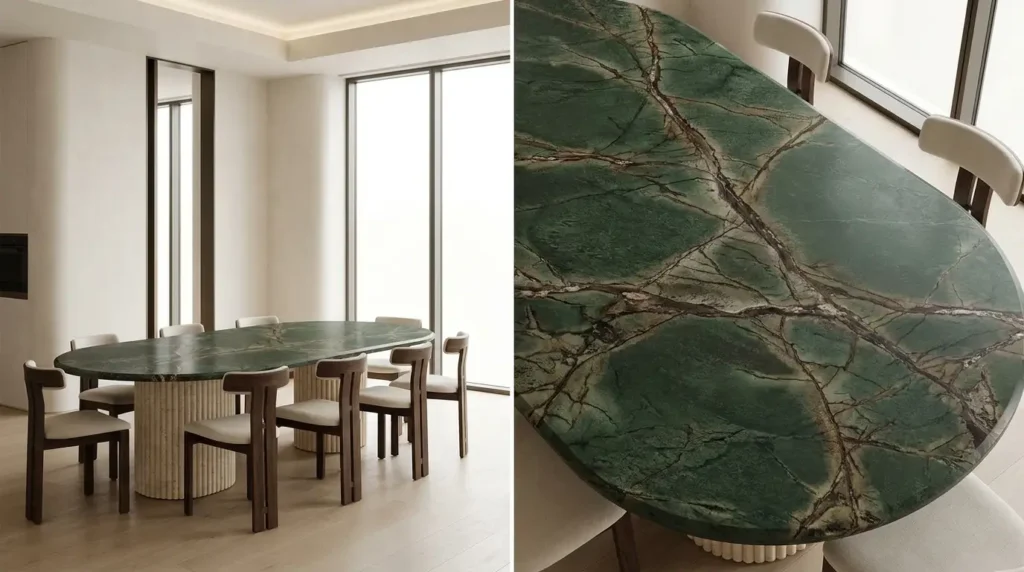
A custom marble table should not begin with a standard furniture model and end with a random piece of marble placed on top.
The strongest bespoke stone furniture is designed in the opposite direction.
It begins with four things:
the architecture
the furniture dimensions
the natural stone
the way that particular slab should be cut.
From there, every decision can be coordinated.
The result may be:
- a marble dining table
- a coffee table
- a console
- a side table
- a meeting table
- a reception table
- a restaurant table
- a sculptural stone object
but the production logic remains similar.
A successful custom marble table normally requires coordination between:
- design
- slab selection
- technical drawing
- structural support
- cutting layout
- fabrication
- finishing
- assembly
- quality control
- packing
- installation
Skipping any of these stages can turn an exceptional stone into ordinary furniture.
What Is a Custom Marble Table?
A custom marble table is produced specifically for a project rather than selected from a fixed furniture catalogue.
The client or architect can typically define:
- stone
- exact dimensions
- shape
- height
- thickness
- edge profile
- surface finish
- tabletop pattern
- base geometry
- base material
- assembly method
This provides significantly greater design control than purchasing a standard table.
But the most important difference is often the stone itself.
With bespoke furniture, the actual slab can be selected before production.
That means the table can be designed around real geology rather than a generic stone name.
Custom Marble Furniture Is Different from Mass Production
A mass-produced marble table may be designed around:
- predetermined dimensions
- standard bases
- interchangeable stone pieces
- broad color tolerances
A bespoke table can instead be developed around:
- one specific slab
- one particular vein
- one architectural interior
- one set of dimensions
The difference becomes particularly visible with expressive natural stones.
Consider Calacatta Viola.
Two tables can both be described as:
240 × 110 cm Calacatta Viola dining table
yet one may contain:
- predominantly white stone
- one controlled burgundy vein
while another may contain:
- dense purple-burgundy movement
- very little quiet white area.
Technically, they use the same stone name.
Visually, they are entirely different furniture pieces.
Why Natural Stone Furniture Should Be Designed from the Slab
Natural marble does not contain a repeating industrial pattern.
Every slab has its own:
- vein position
- color concentration
- mineral movement
- natural markings
- usable dimensions
The furniture should therefore respond to the slab.
A strong custom production process asks:
Which part of this slab should become the table?
rather than:
Which part can we cut most quickly?
That single question can transform the final result.
Step 1: Define the Furniture Type
The production process begins with function.
Is the piece a:
- dining table
- coffee table
- console table
- side table
- meeting table
- desk
- reception table?
Each requires different consideration.
Dining Table
The design must consider:
- number of seats
- knee clearance
- chair positions
- tabletop span
- base locations
- circulation
- structural support
Coffee Table
There is more freedom for:
- sculptural forms
- low pedestals
- organic shapes
- nesting configurations
- monolithic stone volumes
Console Table
The design is normally:
- narrower
- longer
- positioned against a wall
which creates different stability requirements.
Meeting Table
A large meeting table may require:
- cable management
- electrical access
- multiple structural supports
- modular construction
- site assembly
The furniture function should always be defined before the stone is fabricated.
Step 2: Determine the Dimensions
The client may begin with dimensions such as:
240 × 110 × 75 cm
for a dining table.
But those dimensions should still be reviewed against:
- seating requirements
- room size
- circulation
- slab dimensions
- transport access
- structural support
Custom does not mean arbitrary.
The furniture still needs to work physically.
Typical Dining Table Dimensions
Useful starting points may include approximately:
- 180 × 90 cm
- 200 × 100 cm
- 220 × 100 cm
- 240 × 110 cm
- 260 × 110 cm
- 280 × 120 cm
- 300 × 120 cm
Larger tables are possible.
But as dimensions increase, the importance of:
- slab availability
- support
- weight
- shipping
- building access
increases significantly.
Typical Coffee Table Dimensions
Common starting points include:
- Ø70 cm
- Ø80 cm
- Ø90 cm
- Ø100 cm
- 100 × 60 cm
- 120 × 70 cm
- 140 × 80 cm
Coffee-table height often falls somewhere around:
30–45 cm
depending on the seating arrangement.
Custom Means the Furniture Can Follow the Room
One advantage of bespoke production is avoiding arbitrary standard dimensions.
Suppose a dining room works best with a:
235 × 105 cm
table.
There is no reason the table must become:
240 × 110 cm
simply because that is a common catalogue size.
If the:
- slab
- structure
- furniture layout
support the requested geometry, custom production allows the dimensions to follow the architecture.
Step 3: Choose the Stone Character
Before choosing the exact slab, define the desired visual direction.
Does the project need:
- white
- beige
- grey
- black
- burgundy
- green
- pink
- brown?
Then determine whether the stone should be:
- calm
- moderately expressive
- highly dramatic
This is more useful than choosing based only on stone prestige.
Dramatic Stone for Custom Furniture
Examples may include:
- Calacatta Viola
- Rosso Levanto
- Rainforest Green
- Alexander Black
These materials can make the furniture itself the focal point.
They generally work best when the table geometry remains controlled.
Calm Stone for Sculptural Furniture
Examples may include:
- Afyon White
- Ivory Travertine
- selected Tundra Grey
- calm beige marble
These stones provide more freedom for:
- fluting
- curved bases
- unusual silhouettes
- thick architectural volumes
because the material pattern is quieter.
Stone Selection Should Follow the Interior
A stone should not be evaluated in isolation.
Compare it with:
- flooring
- wall finish
- timber
- furniture upholstery
- metal details
- lighting
For example:
may look exceptional against:
- cream
- oak
- warm plaster
but could compete with an already highly colorful interior.
Step 4: Review Actual Slabs
This is one of the most important stages.
For custom furniture, request or prepare:
- full-slab photographs
- slab dimensions
- available quantity
- surface condition
- sequential slabs where relevant
A small stone sample is useful for:
- color
- tactile feeling
- finish
but it cannot show the final table composition.
Why Small Samples Are Not Enough
Imagine a 10 × 10 cm sample.
It may contain:
- only white background
- only one burgundy area
- only one grey vein
while the complete slab may be far more complex.
A bespoke table should be selected from:
the whole slab
rather than from a small fragment.
Step 5: Select the Exact Slab
Once suitable slabs are identified, select the actual material that will become the furniture.
Consider:
- overall color
- pattern
- dimensions
- natural discontinuities
- location of major veins
- usable areas
- finish potential
Do not select only the most dramatic slab.
Select the slab that works best for the specific table.
A Dramatic Slab Is Not Always the Best Slab
Suppose a minimal residence contains:
- architectural artwork
- walnut wall panels
- statement lighting
The dining table may need a quieter stone.
In another project with:
- white walls
- neutral flooring
- minimal furniture
an expressive slab may be exactly what is needed.
Stone selection should respond to the room.
Step 6: Produce the Shop Drawing
Before cutting natural stone, the furniture should be translated into a technical drawing.
A shop drawing can define:
- overall dimensions
- tabletop dimensions
- table height
- edge profile
- stone thickness
- pedestal dimensions
- base locations
- support structure
- joints
- radii
- openings
- assembly details
- material specifications
This is the point where an aesthetic concept becomes something that can actually be fabricated.
Why Shop Drawings Matter
A reference image may communicate:
what the table should feel like.
It usually does not communicate:
- exact radius
- precise edge
- underside support
- mounting details
- dimensional tolerances
- hidden metal structure
A shop drawing removes ambiguity.
The client, designer and production team can all review the same information before stone is cut.
Reference Image vs Production Drawing
A client may send an image from:
- an interior render
- an architecture project
and ask:
“Can you make something similar?”
That reference can define the visual direction.
But the production drawing must reinterpret it into a physically realistic piece of furniture.
This is particularly important because digital and AI-generated furniture often contains impossible structural details.
Do Not Copy an Image Blindly
A reference image may show:
- an unsupported 3-meter marble span
- extremely thin stone legs
- an impossible cantilever
- a massive tabletop on a tiny pedestal
- stone that appears to float
These details may look attractive digitally.
They still need to work under gravity.
Bespoke fabrication should preserve the design language while correcting unrealistic construction.
Step 7: Define the Stone Thickness
There is no one universal thickness for custom marble furniture.
The choice depends on:
- stone
- furniture size
- span
- base design
- reinforcement
- desired appearance
Common slab thicknesses such as:
- approximately 20 mm
- approximately 30 mm
may be used in furniture applications when the complete support system is appropriate.
But visual thickness can be increased without using a solid stone block.
20 mm Tabletop
A thinner top can create:
- visual lightness
- contemporary proportions
- elegant edges
It typically requires careful attention to:
- support
- reinforcement
- handling
particularly for large tables.
30 mm Tabletop
A thicker slab can provide:
- stronger visual mass
- greater section depth
- more substantial edges
but it still does not eliminate the need for proper support on large spans.
Visual Thickness vs Actual Stone Thickness
A table can look:
- 60 mm
- 80 mm
- 100 mm
thick without using a solid slab of the same thickness.
This can be achieved using a built-up or mitred edge.
Mitred Edge Construction
The top surface is fabricated from one stone panel.
Narrow stone pieces are then joined around the perimeter at approximately 45-degree intersections to create the visual appearance of a thicker block.
This can produce a strong architectural table while limiting unnecessary stone mass.
Why Mitre Quality Matters
Poor fabrication may reveal:
- wide joints
- mismatched veins
- chipped corners
- inconsistent polishing
A successful mitred edge should appear intentional and precise.
On patterned marble, the relationship between the tabletop and edge should also be reviewed.
Step 8: Select the Edge Profile
The edge is one of the most visible furniture details because users see it from a seated position.
Possible profiles include:
- straight
- micro-bevel
- eased
- pencil edge
- rounded
- bullnose
- chamfered
- reverse chamfer
- thick mitred edge
Straight Edge
Works particularly well with:
- modern dining tables
- dramatic marble
- rectangular geometry
The simplicity allows the natural stone to remain dominant.
Rounded Edge
Works particularly well with:
- oval tables
- coffee tables
- softer residential interiors
- organic furniture
The radius should be carefully controlled.
A subtle 5 mm radius and a large 40 mm radius create completely different furniture.
Chamfered Edge
A chamfer can visually reduce the mass of the tabletop.
This is particularly useful when the table should appear:
- refined
- lighter
- more architectural
while still using substantial stone.
Sculptural Edge Profiles
For special furniture, the edge itself can be machined into:
- deeper curves
- grooves
- flutes
- layered profiles
However, highly complex edges should usually be paired with calmer natural stone.
Otherwise the table may contain too much visual information.
Step 9: Create the Slab Cutting Layout
Once the dimensions and edge details are approved, the furniture components should be positioned over the actual slab.
This is where bespoke natural-stone production becomes materially different from ordinary furniture manufacturing.
Digital Slab Layout
A practical workflow is:
- Photograph the complete slab.
- Record exact slab dimensions.
- Correct image perspective.
- Scale the slab digitally.
- Draw the table components at real proportions.
- Position them over the slab.
- Review different orientations.
- Approve the layout.
- Transfer the approved positions to production.
This allows the table to be composed before cutting.
Why Vein Placement Matters
One strong vein can determine the entire character of the furniture.
It may be positioned:
- through the center
- diagonally
- toward one end
- around the perimeter
- intentionally away from the center
There is no universal best position.
The important thing is that it is deliberate.
Layout Option A: Central Feature
A dramatic natural formation occupies the center of the tabletop.
This creates a strong focal composition.
Particularly useful for:
- dining tables
- large coffee tables
- meeting tables
Layout Option B: Diagonal Movement
A major vein travels diagonally across the top.
This creates:
- energy
- asymmetry
- visual movement
It works particularly well with strongly veined white or black marble.
Layout Option C: Calm Center
The center remains relatively quiet while stronger movement occurs near:
- one corner
- one side
- perimeter
This can create a more restrained furniture surface.
Same Slab, Different Furniture
One slab can create completely different tables depending on orientation.
Rotating a tabletop outline by 90 degrees can change:
- vein direction
- color balance
- focal point
- material yield
This is why layout should be approved before fabrication.
Step 10: Balance Pattern and Yield
Stone is a finite natural material.
The visually perfect table position may not produce the most efficient cutting plan.
A premium project needs to balance:
design quality
with
material yield.
Maximum Yield Layout
A layout optimized exclusively for yield may:
- reduce waste
- produce more components
but may not use the stone’s pattern effectively.
Maximum Visual Layout
A layout optimized exclusively for appearance may:
- create spectacular furniture
- leave significant remnants
Neither approach is always correct.
Decide Based on Furniture Importance
For the main dining table in a luxury residence, greater material waste may be acceptable to achieve an exceptional pattern.
For a project containing:
- 40 restaurant tables
material yield may become significantly more important.
Different applications require different optimization.
Step 11: Plan Other Furniture from the Same Slab
Remnants should be considered before cutting begins.
A large slab may potentially produce:
- dining table
- coffee table
- side table
- console shelf
depending on its dimensions.
This can improve both:
- material utilization
- interior consistency
Furniture Families
A coordinated set may include:
Dining table
Coffee table
Side tables.
The pieces can use the same stone block or slab family.
They will share:
- color
- geology
- material character
while each remains naturally unique.
Do Not Force Exact Pattern Matching
Natural-stone furniture does not need digitally repeated patterns.
Matching should mean:
- compatible material
- compatible color
- related geological character
not:
- identical copied texture.
Natural variation is part of the value.
Step 12: Cutting the Stone
After approval, the slab can be cut into the required components.
Depending on the geometry and available production equipment, fabrication may involve processes such as:
- bridge cutting
- CNC cutting
- waterjet cutting
- manual stone fabrication
Different geometries require different methods.
Straight Components
Simple rectangular table tops can often be produced efficiently with conventional precision cutting.
Round and Oval Components
Curved furniture requires controlled digital geometry.
CNC or appropriate waterjet-based fabrication can be particularly useful for:
- circles
- ovals
- racetrack shapes
- complex curves
depending on the workshop and material.
Organic Shapes
Free-form furniture should be produced from:
- approved CAD geometry
- full-scale templates
- digitally controlled cutting
rather than manually approximating a reference photograph.
This ensures symmetry and repeatability where required.
Step 13: CNC Edge Processing
Computer-controlled fabrication can also be used for repeatable edge profiles.
Possible operations include:
- rounding
- chamfering
- profiling
- recesses
- grooves
- certain fluted details
Final surface finishing may still require skilled manual work.
Digital equipment provides precision.
Craftsmanship determines the final quality.
CNC Does Not Replace Stone Knowledge
A machine can follow coordinates precisely.
It does not understand whether:
- a natural vein is fragile
- a corner needs reinforcement
- an edge contains an undesirable natural feature
- a visible face requires additional hand finishing
Stone fabrication still requires experienced judgment.
Step 14: Review Natural Discontinuities
Natural stone can contain:
- veins
- fissures
- mineral boundaries
- healed fractures
- cavities
- natural structural features
These should be reviewed before and during fabrication.
The position of a natural feature may influence whether a component should be:
- reinforced
- repositioned
- redesigned
- rejected
depending on the stone and application.
Decorative Vein vs Structural Concern
A dramatic vein may be visually beautiful.
That does not automatically mean it should pass through the most mechanically sensitive part of a furniture component.
Visual layout and structural evaluation should happen together.
Step 15: Reinforcement Where Required
Some table designs may require structural reinforcement.
This may include a hidden:
- metal frame
- metal plate
- structural substrate
- other engineered supporting system
depending on the furniture.
The reinforcement should not simply be added after fabrication problems appear.
It should be integrated into the design.
Hidden Metal Support
Large dining tables often benefit from an appropriately designed hidden metal structure beneath the stone.
This can help:
- control unsupported spans
- distribute loads
- connect pedestals
- improve overall stability
The exact system depends on:
- table length
- width
- stone
- thickness
- base configuration
Support Should Remain Visually Controlled
The structural system should do its job without dominating the furniture.
A well-designed support may be almost invisible from normal viewing angles.
This allows the marble to remain visually primary.
Step 16: Design the Base
The base determines both:
- appearance
- stability.
Possible materials include:
- natural stone
- metal
- wood
- combinations of these
Stone Pedestal Base
A stone pedestal creates a more monolithic furniture object.
Possible forms include:
- rectangular blocks
- cylindrical bases
- oval pedestals
- twin pedestals
- fluted columns
- curved volumes
Same-Stone Pedestal
Using the same marble for both top and base can create a highly sculptural object.
This works particularly well for:
- monochromatic stone
- restrained patterns
- furniture intended as a focal point
Contrasting Stone Pedestal
Another approach uses a different natural stone.
For example:
Calacatta Viola top
Ivory Travertine pedestal.
The quieter base supports the more expressive tabletop.
Metal Base
Metal creates a lighter visual structure.
Possible finishes include:
- black
- charcoal
- dark bronze
- brushed bronze
- stainless steel
Metal bases work especially well with highly expressive stone because they do not introduce another natural pattern.
Wood Base
Wood can soften the visual weight of marble.
Strong combinations include:
- Statuario + walnut
- Afyon White + walnut
- Alexander Black + light oak
- Rainforest Green + walnut
- beige marble + dark oak
The timber grain and stone geology create two different natural textures.
Step 17: Check Knee Clearance
For dining and meeting tables, base design cannot be evaluated only from the front.
The user needs space for:
- legs
- knees
- chairs
- armchairs where relevant
A beautiful pedestal that blocks seating is unsuccessful furniture.
Check the Table from Every Seat
Review:
- end seats
- corner seats
- long-side seats
before approving the base.
A two-pedestal dining table should not place the pedestals directly where users need knee space.
Step 18: Check Stability
The table must remain stable under realistic use.
The design should consider:
- tabletop weight
- base footprint
- center of gravity
- overhang
- connection between top and base
This is especially important with:
- round pedestal tables
- large coffee tables
- narrow console tables
Avoid Tiny Pedestals Under Massive Tops
A render may show a:
280 cm marble tabletop
on:
one extremely narrow stone cylinder.
Visually interesting does not automatically mean physically appropriate.
The pedestal must be sized according to real structural and stability requirements.
Step 19: Fabricate the Base
Stone bases may require:
- straight cutting
- curved fabrication
- lamination
- mitred assembly
- CNC shaping
- fluting
- hand finishing
depending on the design.
Hollow Stone Pedestal Construction
A large stone pedestal does not necessarily need to be carved from one solid block.
It may be fabricated from multiple stone panels around an internal structure.
This can reduce:
- unnecessary weight
- material usage
while maintaining a monolithic appearance.
The seams and corners must be executed carefully.
Solid Stone Bases
Some designs may genuinely use:
- solid stone
- thick stone sections
- block material
where the geometry and logistics support it.
This creates significant weight.
Delivery and floor loading should be considered.
Step 20: Fluted Marble Bases
Fluting is popular in contemporary stone furniture because it introduces:
- rhythm
- shadows
- craftsmanship
- tactile depth
It works particularly well on:
- cylindrical bases
- curved pedestals
- console fronts
Best Stones for Fluting
Calmer materials can display the geometry especially clearly.
Examples include:
- Afyon White
- Ivory Travertine
- beige marble
- selected grey stones
Highly dramatic veins may become visually fragmented when cut into deep flutes.
Step 21: Surface Finishing
The selected finish affects:
- color
- reflection
- tactile quality
- maintenance appearance
Common furniture finishes include:
- polished
- honed
- brushed
- textured treatments where appropriate
Polished Custom Marble Table
Polishing can create:
- deeper color
- stronger vein contrast
- greater reflection
- more formal luxury
It can be especially effective with:
- black
- burgundy
- green
- strongly veined white marble
Honed Custom Marble Table
Honing can create:
- reduced glare
- softer color
- more tactile appearance
- more contemporary furniture
This is particularly effective for minimalist interiors.
Finish the Edges Properly
The tabletop surface and exposed edges should read as one finished object.
An otherwise beautiful table can look unfinished if the:
- top
- edge
- underside visible areas
have obviously inconsistent levels of finishing.
Step 22: Dry Assembly
Before final packing, the table should ideally be assembled or test-fitted where practical.
This allows verification of:
- top-to-base relationship
- connection points
- level
- stability
- proportions
- overall appearance
This is one of the most valuable quality-control stages for bespoke furniture.
Why Dry Assembly Matters
A tabletop and pedestal may each be dimensionally correct individually.
But the complete furniture may reveal:
- incorrect support position
- visual imbalance
- assembly interference
- misaligned fixing points
Test-fitting exposes these issues before shipping.
Step 23: Quality Control
Custom furniture should undergo final inspection before packing.
A useful quality-control checklist includes:
- overall dimensions
- table height
- tabletop dimensions
- stone selection
- approved pattern
- edge profile
- corner quality
- surface finish
- pedestal dimensions
- base finish
- connection points
- visible repairs where applicable
- assembly
- stability
- cleanliness
Compare Finished Furniture with the Approved Drawing
The finished piece should be compared against:
- shop drawing
- slab layout
- finish sample
- client approval
This creates a clear reference for quality control.
Check the Pattern
For bespoke slab-selected furniture, verify that the actual tabletop corresponds to the approved slab section.
This is especially important for dramatic stones.
The client approved not simply:
Calacatta Viola
but potentially a very specific part of a Calacatta Viola slab.
Check the Edge
Inspect:
- straightness
- radius
- polishing
- mitres
- chips
- corner consistency
The user will interact closely with this part of the furniture.
Check the Underside
Premium furniture should not be evaluated only from above.
Inspect visible underside areas and confirm that:
- structural components
- fixings
- unfinished edges
are appropriately resolved.
Step 24: Photograph the Completed Table
Before export packing, document the finished product.
Useful photographs include:
- complete table
- top view
- three-quarter view
- stone close-up
- edge close-up
- base
- underside connection
- dry assembly
This creates a record of the furniture before shipping.
Why Production Photography Matters
The client can verify:
- shape
- pattern
- finish
- proportions
before the crate leaves production.
It also documents the condition prior to transport.
Step 25: Plan the Packing
Natural stone furniture should not be packed like lightweight household furniture.
Important risks include:
- edge impact
- vibration
- surface scratching
- component movement
- pressure at incorrect support points
Packing should respond to the actual geometry.
Separate Top and Base Packing
For many tables, it is safer and more practical to pack:
tabletop
and
base
as separate components.
Benefits can include:
- easier handling
- better protection
- reduced pressure on connection points
- easier site installation
Edge Protection
Particular attention should be given to:
- table corners
- thin profiles
- polished edges
- mitred edges
These areas can be more vulnerable to impact.
Crate Design
Depending on the table and shipping method, the packaging may include:
- rigid timber crate
- internal cushioning
- protected supports
- controlled fixing
- moisture protection where relevant
The table should not be able to move freely inside the crate.
Step 26: Shipping
Export furniture logistics should consider:
- total packed weight
- crate dimensions
- loading orientation
- container space
- delivery access
A single large marble table may occupy significantly more logistical capacity than its furniture footprint suggests.
Furniture Weight Should Be Calculated Early
Do not wait until packing to discover that the table is exceptionally heavy.
Approximate weight should be considered during:
- design
- base selection
- installation planning
- shipping quotation
Step 27: Site Access
Before producing a large table, confirm how it will reach the room.
Review:
- building entrance
- door dimensions
- elevator
- staircases
- corridor turns
- final room access
This is especially important for:
- large one-piece dining tops
- massive stone pedestals
- monolithic coffee tables
A Table Can Fit the Room but Not the Door
This is one of the most avoidable custom-furniture mistakes.
A 300 cm dining table may fit beautifully in the dining room.
But if the one-piece top cannot pass through:
- entrance door
- elevator
- staircase
the design needs modification before fabrication.
Modular Furniture Design
Large furniture can sometimes be designed in modules.
Examples include:
- separate tabletop and pedestals
- two-part meeting table
- pedestal components assembled on site
The visual concept can remain monolithic while the actual construction becomes manageable.
Step 28: Installation
At the project site, components can be:
- unpacked
- inspected
- moved into position
- assembled
- leveled
- secured according to the design
- cleaned
- inspected again
Large stone furniture may require professional handling equipment and experienced installers.
Custom Dining Tables
Among bespoke marble furniture categories, dining tables provide one of the greatest opportunities for slab selection.
The tabletop is large enough to show:
- full veins
- mineral transitions
- broad geological patterns
Popular forms include:
- rectangular
- oval
- racetrack
- round
Custom Coffee Tables
Coffee tables provide more design freedom.
They may use:
- organic shapes
- solid pedestals
- nesting compositions
- sculptural edges
- strong statement stone
They are also excellent for using premium slab remnants.
Custom Console Tables
Console tables typically combine:
- long proportions
- narrow depth
- strong wall relationship
They can work well in:
- entrance halls
- hotel corridors
- living rooms
- behind sofas
Because they are relatively narrow, stability should be considered carefully.
Custom Side Tables
Side tables require small amounts of stone.
This makes them ideal for:
- rare marble
- expensive slabs
- dramatic remnants
- coordinated furniture sets
A side table can use an exceptionally expressive section that would not be large enough for another product.
Custom Meeting Tables
Large natural-stone meeting tables can become significant architectural furniture.
The design may require:
- cable openings
- integrated power
- multiple supports
- modular tops
- hidden metal structure
At this scale, technical planning becomes especially important.
Using One Slab for Multiple Products
A well-planned slab can potentially produce:
- one coffee table
- two side tables
- one console top
or another combination.
The exact possibilities depend on:
- slab dimensions
- furniture dimensions
- pattern
- stone characteristics
Planning all products together can improve yield.
Using Remnants Intelligently
A leftover piece does not necessarily mean low-value material.
An offcut may contain:
- spectacular vein
- rare color concentration
- exceptional geological pattern
If the dimensions fit a coffee or side table, it may become one of the strongest pieces in the collection.
Marble Furniture for Residential Projects
Custom stone furniture works especially well in residences where a client wants:
- a unique centerpiece
- material continuity
- a specific size
- stone coordinated with the architecture
Possible applications include:
- dining rooms
- living rooms
- entrances
- bedrooms
- home offices
Marble Furniture for Hotels
Hotels can use bespoke natural-stone furniture for:
- lobby tables
- coffee tables
- consoles
- suite dining tables
- side tables
- reception furniture
Furniture can reinforce the architecture without repeating exactly the same stone everywhere.
Marble Furniture for Restaurants
Possible products include:
- dining tables
- bar tables
- host desks
- console tables
Restaurant furniture must also consider:
- repeated use
- cleaning
- food and drink exposure
- edge durability
- maintenance
The most beautiful stone is not automatically the most practical choice for every restaurant concept.
Marble Furniture for Retail
Natural stone can also be fabricated into:
- display tables
- plinths
- counters
- presentation pedestals
The combination of furniture and architecture can help create a coherent material identity.
Marble Furniture for Offices
Possible pieces include:
- executive desks
- meeting tables
- reception tables
- console tables
A large natural-stone meeting table can become the central object of a boardroom.
Custom Marble Table Care
Care should follow the actual natural stone.
For conventional calcitic marble, a conservative maintenance approach includes:
- removing spills promptly
- using soft cloths
- using a suitable pH-neutral natural-stone cleaner
- avoiding abrasive powders
- using coasters
- avoiding acidic cleaning products
Acid Sensitivity
Many conventional marbles are calcium-carbonate based.
Acidic substances such as:
- lemon
- vinegar
- some wines
- certain cleaners
can chemically alter the surface.
This can create etching.
What Is Etching?
Etching is different from staining.
A stain involves material penetrating the stone.
Etching involves the surface being chemically changed.
On polished marble, it may appear as:
- a dull ring
- matte spot
- loss of reflection
The stone can be clean and still be etched.
Does Sealing Prevent Etching?
No.
This is important when selling custom marble furniture.
An appropriate impregnating treatment may improve resistance to certain stains.
It does not convert conventional calcitic marble into an acid-proof material.
Customers should receive realistic maintenance expectations.
Should Every Marble Table Be Sealed?
Not necessarily.
Treatment depends on:
- actual stone
- porosity
- finish
- application
- factory processing
Some stones may benefit from an appropriate impregnating treatment.
Others may not require the same approach.
Stone-specific evaluation is preferable to a universal rule.
Polished Tables and Everyday Use
Polished marble offers:
- greater reflection
- deeper color
- strong visual impact
but surface changes such as:
- etching
- fine scratches
- fingerprints
can sometimes be more noticeable.
Honed Tables and Everyday Use
Honed surfaces generally provide:
- lower reflection
- softer appearance
- more contemporary character
They may visually disguise some types of minor surface variation better than high-gloss finishes.
However, honed marble still requires appropriate care.
Natural Patina
Natural stone furniture may gradually develop signs of use.
Some clients appreciate this.
Others expect the table to remain visually unchanged.
This expectation should be discussed before the stone is selected.
A customer who wants absolute uniformity and zero visual aging may prefer a different material category.
Custom Marble Table vs Ready-Made Table
Ready-Made
Provides:
- predetermined dimensions
- predefined slab pattern
- standard base
- limited customization
Custom
Provides control over:
- dimensions
- exact slab
- exact pattern position
- finish
- edge
- base
- height
- structural concept
The extra value lies in coordination.
Why Custom Marble Furniture Costs Differ
The cost of bespoke stone furniture is influenced by more than the square-meter price of the marble.
Major factors include:
- stone selection
- slab size
- material yield
- table dimensions
- thickness
- edge complexity
- curved cutting
- CNC work
- reinforcement
- pedestal design
- metal structure
- finish
- dry assembly
- packing
- shipping
This is why two tables using the same stone can have very different production costs.
Stone Cost Is Only One Part
Imagine two tables both using approximately 3 m² of stone.
Table A
- simple rectangle
- straight edge
- metal base
Table B
- organic shape
- thick mitred edge
- two fluted stone pedestals
- hidden metal reinforcement
The stone quantity may be similar.
The fabrication scope is completely different.
Why Slab Yield Affects Price
A 240 × 110 cm tabletop requires approximately:
2.64 m²
of visible top surface.
But the project may need a much larger slab because:
- dimensions must fit
- veins must be positioned
- natural features may need to be avoided
- remnants may be unavoidable
The table should not be priced by multiplying 2.64 m² by slab price alone.
Custom Marble Furniture Quality Checklist
Before approving a supplier, evaluate whether the process includes:
Material
- actual slab selection
- clear photographs
- dimensions
Design
- shop drawing
- exact dimensions
- edge detail
- base detail
Slab Layout
- actual table position
- vein orientation
Fabrication
- accurate cutting
- suitable reinforcement
- edge processing
Assembly
- fit
- stability
Quality Control
- dimension check
- finish check
- pattern check
Packing
- proper protection
- secure crate
This process is more important than simply asking whether the workshop has CNC equipment.
Machines Matter, but Process Matters More
Modern equipment can improve:
- precision
- repeatability
- complex geometry
but premium furniture still depends heavily on:
- stone selection
- drawing accuracy
- craftsmanship
- finishing
- quality control
A highly advanced machine cannot correct a poorly planned slab layout.
What to Send When Requesting a Custom Marble Table Quote
To receive a more useful quotation, send:
1. Furniture Type
Dining, coffee, console, side or meeting table.
2. Dimensions
Length × width × overall height.
3. Stone Preference
If known.
4. Shape
Rectangle, round, oval, organic or another form.
5. Edge Preference
If known.
6. Finish
Polished or honed.
7. Base Concept
Stone, metal, timber or open to proposal.
8. Reference Images
Very useful.
9. Quantity
One table or a hotel/restaurant project?
10. Destination
Important for packing and logistics.
If You Only Have a Reference Image
That is still enough to begin.
A custom furniture project can start from:
- one photograph
- one sketch
- one render
- one inspiration image
The next step is translating it into:
- realistic dimensions
- workable stone geometry
- production drawings
- a suitable support structure
The reference does not need to be technically complete.
From Image to Finished Marble Table
A simplified workflow can be:
reference image
→
dimensions
→
stone selection
→
shop drawing
→
slab selection
→
slab layout
→
fabrication
→
base production
→
dry assembly
→
quality control
→
packing
→
delivery.
This is the core of bespoke stone furniture production.
Common Mistakes in Custom Marble Furniture
1. Producing Before Approving the Actual Slab
Natural stone varies too much.
2. Treating a Reference Render as a Technical Drawing
The furniture may not be structurally realistic.
3. Ignoring Stone Weight
Logistics and support can become problematic.
4. Cutting Before Approving Pattern Placement
The most attractive part of the slab may be lost.
5. Using a Tiny Base Under a Massive Top
Visual elegance cannot replace stability.
6. Ignoring Knee Clearance
A dining table must function while people are seated.
7. Choosing Thickness Only for Appearance
Structural support should be evaluated separately.
8. Ignoring Building Access
A one-piece table may not reach the final room.
9. Producing Every Component from Solid Stone
Some furniture can achieve the same visual effect with more efficient engineered construction.
10. Ignoring Remnants
Smaller furniture can often be produced from valuable remaining stone.
11. Skipping Dry Assembly
Component problems may only become visible when the complete table is assembled.
12. Inadequate Packing
Premium fabrication can be damaged during poor transportation.
13. Using Acidic Cleaning Products on Conventional Marble
Appropriate stone care remains necessary.
14. Promising That Sealer Makes Marble Maintenance-Free
It does not.
How to Design Better Custom Marble Furniture
The most successful approach is not:
choose marble → choose table.
It is:
interior
→
furniture function
→
dimensions
→
stone character
→
actual slab
→
pattern placement
→
technical design
→
fabrication.
This creates a much more coherent object.
Let Dramatic Stone Do the Work
When the marble contains:
- burgundy veins
- branching green patterns
- strong black-and-white contrast
keep the furniture geometry relatively simple.
A complicated base is often unnecessary.
Let Calm Stone Support Sculpture
When the stone is relatively quiet, the design can introduce more:
- fluting
- curves
- pedestal geometry
- thick volumes
The furniture itself becomes the pattern.
Design the Whole Furniture Family Together
If a project requires:
- dining table
- coffee table
- side tables
- consoles
plan them together.
This improves:
- slab utilization
- material coordination
- visual consistency
and can reduce unnecessary waste.
Final Thoughts
A custom marble table is not simply a marble top manufactured to a requested size.
True bespoke stone furniture requires coordination between:
design
actual natural stone
technical drawings
slab layout
fabrication
structure
finishing
quality control
packing.
The process should begin with the intended furniture and the architecture around it.
Then select the stone character.
Review real slabs.
Approve the exact slab.
Create a technical shop drawing.
Position the table digitally over the natural stone before cutting.
Consider both pattern and material yield.
Select the correct edge profile.
Design a physically realistic support system.
Use CNC and precision machinery where they improve accuracy, but do not treat machinery as a substitute for craftsmanship.
Dry assemble important furniture before packing.
Inspect the finished product against the approved drawings and slab layout.
Protect the stone properly for transport.
And provide realistic care instructions for the actual material.
The strongest bespoke marble table has one defining characteristic:
its design looks inseparable from the slab from which it was produced.
It does not look like a generic table covered with marble.
It looks like that particular piece of natural stone was selected specifically to become that particular piece of furniture.
Frequently Asked Questions
What is a custom marble table?
A custom marble table is produced specifically according to selected dimensions, stone, shape, finish, edge profile, slab pattern and base design rather than being purchased in a predefined catalogue configuration.
Can I choose the exact marble slab for my table?
Yes. Exact slab selection is one of the major advantages of bespoke stone furniture. The slab can be photographed and approved before fabrication.
Can I choose where the marble veins appear?
Yes. For custom slab-based production, the table outline can be positioned digitally over the actual slab photograph before cutting so the vein arrangement can be reviewed.
Can you make a marble table from a reference photo?
A reference photograph or render can be used as the starting design direction. It should then be translated into realistic dimensions, structural details and production drawings before fabrication.
Do custom marble tables need shop drawings?
Detailed production drawings are highly useful because they communicate dimensions, edges, finishes, bases, connections and other fabrication details before the stone is cut.
Can marble tables be cut with CNC machines?
Computer-controlled fabrication can be used for precise shapes, curves, profiles and repeatable furniture components depending on the design and workshop equipment.
Can marble be cut into an organic table shape?
Yes. Free-form and organic tabletops can be fabricated from approved digital geometry, subject to stone characteristics and structural requirements.
Can marble table bases be fluted?
Yes. Stone pedestals can be produced with fluted or ribbed surfaces when the selected material and pedestal design are appropriate.
Can the tabletop and base use the same marble?
Yes. Using the same stone can produce a monolithic furniture appearance. A contrasting stone, metal or timber base can also be used.
Can a marble table have a metal frame underneath?
Yes. Large or demanding table designs may use a hidden structural metal system to support the natural stone and control spans.
Is a 20 mm marble top enough?
It can be used in appropriately designed furniture, but the required support depends on table size, stone characteristics, span and base configuration.
Is 30 mm marble better for a custom table?
It creates a thicker section and may offer greater stiffness, but it does not eliminate the need for appropriate structural design.
How do marble tables look 80 or 100 mm thick?
A built-up or mitred edge can create the visual appearance of a much thicker stone tabletop while the primary slab itself remains thinner.
Can one marble slab produce several furniture pieces?
Yes. Depending on slab and furniture dimensions, one slab may produce a combination of dining tables, coffee tables, side tables or console components.
Can marble remnants be used for furniture?
Yes. High-quality slab remnants can be particularly useful for coffee tables, side tables, consoles and smaller furniture components.
Is polished or honed marble better for furniture?
Polished marble provides stronger reflection and color depth. Honed marble creates a softer, lower-reflection appearance. The best finish depends on the stone and design.
Can vinegar be used to clean a marble table?
Conventional calcium-carbonate marble should not be cleaned with vinegar because acidic substances can etch the surface.
Does sealing make a marble table stain-proof?
No. An appropriate impregnating treatment may improve stain resistance, but it does not make natural stone completely stain-proof.
Does sealing prevent marble from etching?
No. An impregnating treatment does not remove the acid sensitivity of conventional calcitic marble.
How are custom marble tables packed for export?
Packing depends on the design, but stone tabletops and bases are often protected as separate components inside rigid packaging with controlled support, cushioning and edge protection.
What information is needed for a custom marble table quotation?
Ideally provide the furniture type, dimensions, quantity, stone preference, shape, finish, base concept, reference images and project destination.
Looking for a Custom Marble Table?
VeraMarbles can support bespoke natural stone furniture from initial reference image to finished production.
Send us your:
- reference image or concept
- furniture type
- dimensions
- preferred stone
- preferred finish
- edge preference
- base concept
- quantity
- project destination
We can support your project with:
- stone recommendations
- full-slab selection
- exact slab approval
- tabletop pattern positioning
- shop drawings
- custom dimensions
- round, oval and organic fabrication
- CNC stone processing
- polished and honed finishes
- custom edge profiles
- stone pedestal production
- fluted stone elements
- structural coordination
- matching furniture sets
- dry assembly
- quality control
- export packing
- project coordination
Request a Custom Marble Furniture Quote from VeraMarbles