
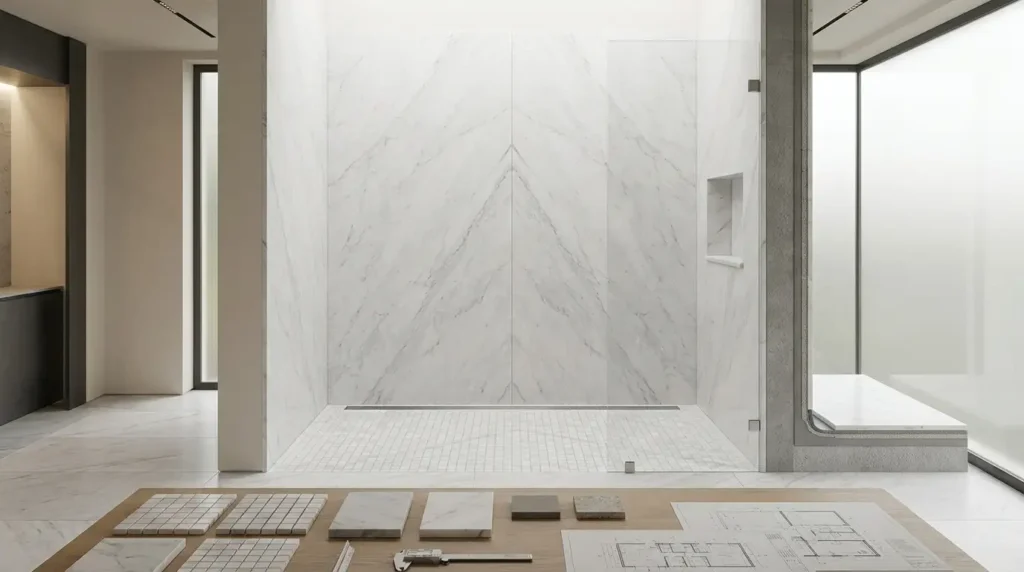
Marble can create some of the most refined bathrooms, showers and spa interiors in architecture.
But a wet area should never be specified as:
“Marble throughout.”
A shower wall, shower floor and vanity wall may all be located inside the same bathroom.
Technically, they are different applications.
Each surface experiences a different combination of:
- water
- drainage
- foot traffic
- cleaning
- soap
- joints
- penetrations
- substrate conditions
- maintenance
The correct question is therefore not simply:
“Can marble be used in a bathroom?”
It is:
“Is this exact marble, finish, format and installation system appropriate for this exact wet-area condition?”
That distinction matters.
Many natural marbles can perform successfully in wet-area applications when:
- the stone is suitable
- the assembly is properly designed
- water is controlled
- the correct installation system is used
- maintenance expectations are realistic
A successful wet-area specification connects:
stone
surface finish
format
waterproofing
drainage
substrate
setting materials
joints
maintenance.
The marble is only one part of the system.
Divide the Bathroom into Performance Zones
Do not treat the complete bathroom as one environmental condition.
A useful design approach is to divide it into zones.
Zone 1 — Shower Floor
Usually experiences:
- direct water
- bare feet
- soap
- shampoo
- continuous drainage
- frequent cleaning
This is typically one of the most demanding locations.
Zone 2 — Shower Walls
Experience:
- repeated direct water
- soap residue
- penetrations
- waterproofing interfaces
but no foot traffic.
This allows different choices from the floor.
Zone 3 — Main Bathroom Floor
May experience:
- occasional water
- wet feet
- traffic
- cleaning
- water around the shower or bathtub
but normally less continuous water than the shower floor.
Zone 4 — Bathtub Surround
May receive:
- splash water
- cleaning products
- occasional standing water at horizontal surfaces
depending on detailing.
Zone 5 — Vanity Area
May experience:
- cosmetics
- toothpaste
- water splashes
- cleaning products
but is generally less demanding from a drainage perspective.
Zone 6 — Decorative or Dry Wall
May be inside a bathroom but receive very little direct water.
This can provide much more freedom in:
- finish
- slab layout
- bookmatching
than a shower floor.
The same marble does not necessarily need the same specification across every zone.
Start with the Actual Stone
Do not approve wet-area marble only by commercial name.
Natural stones sold under one market name can vary between:
- quarry areas
- blocks
- production lots
- selections
The architect should review the actual proposed material.
Important characteristics may include:
- absorption
- pore structure
- mineral composition
- soundness
- veins
- fissures
- resin treatment
- reinforcement
- fabrication behavior
The final decision should relate to:
the actual supplied stone
rather than only a photograph of the stone family.
Not Every Marble Behaves Identically in Water
Marble is a broad natural-stone category.
Different marbles can vary substantially in:
- absorption
- crystalline structure
- natural fissures
- mineral inclusions
- reinforcement requirements
Some materials can tolerate demanding wet conditions more comfortably than others.
Avoid universal statements such as:
“all marble is suitable for showers.”
Likewise, avoid the opposite claim:
“marble cannot be used in showers.”
The correct answer is material- and system-specific.
Review Water Absorption and Porosity
Wet-area applications place greater importance on how water interacts with the stone.
Relevant technical information may include:
- water absorption
- density
- stone structure
- soundness
depending on the project.
Lower absorption may be desirable for certain demanding applications, but one generic absorption number should not replace a complete material assessment.
Do Not Use One Universal Absorption Limit for Every Project
Different:
- jurisdictions
- stone types
- applications
- installation systems
may use different performance criteria.
The architect should rely on:
- current applicable requirements
- actual test data
- project-specific technical review
rather than copying a number from an unrelated project.
Inspect Natural Veins and Fissures
Some veins are:
- fully mineralized
- visually dramatic
- structurally integrated
while other natural features may require:
- filling
- resin treatment
- reinforcement
during stone processing.
Wet-area selection should consider whether the actual slab contains natural features that may:
- retain moisture
- require repair
- influence fabrication
particularly around:
- cut-outs
- corners
- thin pieces.
Mesh-Backed or Resin-Backed Stone Needs Additional Review
Some marble slabs are reinforced on the back with:
- mesh
- resin
- other factory-applied treatments
to improve handling or fabrication.
Do not automatically assume these surfaces can be bonded directly in every wet-area installation.
The project team should confirm compatibility between:
- stone backing
- setting material
- waterproofing system
- intended application
before fabrication.
Shower Floor and Shower Wall Should Not Share One Generic Specification
This is one of the most important principles.
A marble that works beautifully as:
large polished shower wall panels
may require a completely different:
- format
- finish
- installation detail
on the floor.
Specify each surface independently.
Shower Floor Specification
A shower floor must coordinate:
- water drainage
- walking surface
- slope
- drain
- joints
- waterproofing
- setting material
- stone format
- finish.
The architecture should be developed as a complete assembly.
Positive Drainage Is Essential
Water should move toward the intended drain rather than remaining in depressions.
The floor geometry must provide appropriate drainage according to:
- approved system
- local requirements
- drain type
- shower design.
Do not rely on the installer to invent the floor slope after the marble has already been ordered.
Coordinate Slope Before Selecting Format
Different floor geometries suit different stone formats.
A shower with water falling toward:
one central point drain
may require the surface to change plane in several directions.
A shower with:
one linear drain
may permit a simpler directional slope.
This influences mosaic selection.
Why Mosaic Is Common on Shower Floors
Small mosaic pieces can generally follow changes in slope more easily than large rigid stone panels.
They also introduce more joints into the walking surface.
But neither of these factors automatically proves:
- slip safety
- technical suitability.
The actual combination of:
- stone
- finish
- mosaic format
- grout
- contaminants
- testing
still matters.
Mosaic Does Not Automatically Mean Non-Slip
A common oversimplification is:
“mosaic is safe because it has more grout.”
Additional joints may affect surface behavior.
But the complete surface still needs to satisfy the appropriate project requirements.
Never make a safety specification based on pattern alone.
Slip Performance Must Be Verified
Finish names such as:
- honed
- brushed
- textured
do not automatically establish wet slip performance.
Where slip resistance is a project requirement, review:
- the actual stone
- actual finish
- applicable test method
- intended use
rather than relying on generic terminology.
Polished Marble on Shower Floors
A polished surface may become more challenging under wet conditions.
Do not specify polished shower flooring simply because:
- the same finish is used on the wall.
Wet-floor suitability requires separate evaluation.
Honed Marble on Shower Floors
Honed surfaces often provide:
- lower reflection
- softer appearance
than polished marble.
But:
honed does not automatically mean slip-safe.
The actual tested surface and project condition remain important.
Textured Marble
Certain stones can be supplied with more textured finishes.
These may alter:
- friction
- appearance
- cleaning characteristics.
Before specifying a textured shower floor, evaluate both:
performance
and
maintenance.
A very rough surface may provide different cleaning challenges.
Shower Floor Mosaic Size
Possible choices may include:
- fine square mosaic
- 20–25 mm square
- small hexagon
- penny round
- other small formats
depending on the design and system.
The correct format should respond to:
- slope geometry
- drain
- stone
- finish
- desired pattern.
Point Drain
With a central drain, the floor may slope from multiple directions.
Small-format mosaics can make these plane changes easier to accommodate.
Still, coordinate the drain with the actual pattern.
Linear Drain
A linear drain can simplify the floor geometry in some shower designs.
This may allow:
- more directional layouts
- somewhat larger formats
depending on the approved floor assembly.
Do Not Cut a Strong Pattern Randomly Around a Drain
Patterns such as:
- hexagon
- herringbone
- chevron
may create awkward fragments around a drain if the drain location is not coordinated.
Model both:
drain
and
pattern
before final approval.
Shower Wall Specification
Shower walls do not have:
- pedestrian traffic
- floor slope
so the design has more freedom.
Possible formats include:
- natural-stone tile
- large-format panels
- full-height slab panels
- mosaic
- bookmatched panels.
But waterproofing and penetrations remain critical.
Large Marble Shower Panels
Large panels can reduce the number of visible joints.
They can also preserve:
- vein movement
- slab-scale geology
more effectively than small tiles.
This makes them particularly attractive for:
- luxury residences
- hotel bathrooms
- spa projects.
Large Panels Do Not Remove Waterproofing Requirements
A nearly full-height marble slab is still:
a finish material.
It is not the complete water-management system.
The wall behind it still requires an appropriate assembly.
Waterproofing Belongs Behind the Stone System
The shower should be designed so water is controlled through an approved wet-area assembly.
The specification should coordinate:
- substrate
- waterproofing
- penetrations
- drain connection
- setting materials
- stone
- joints
- sealants.
Do not rely on:
- stone
- grout
- impregnating treatment
as the primary waterproofing layer.
Grout Is Not Waterproofing
Another common misconception:
grout does not replace the waterproofing system.
Even high-performance grout should be treated as part of the finish assembly rather than the fundamental moisture barrier.
Sealant Is Not a Substitute for Waterproofing Either
Flexible sealants may be used at appropriate:
- changes of plane
- movement conditions
- interfaces
according to the installation design.
They should not become the only moisture-control strategy.
Substrate Selection
The substrate must be compatible with:
- wet conditions
- stone weight
- waterproofing
- setting system
- panel dimensions.
Do not use a generic wall substrate because:
“it is only tile.”
Large natural-stone panels can create significantly different loads and installation demands.
Substrate Flatness
Large marble panels require a well-prepared wall.
Poor flatness can lead to:
- uneven panel alignment
- varying joints
- lippage
- difficult installation.
The larger the stone, the more visible these conditions can become.
Do Not Use Adhesive Thickness to Fix a Bad Wall
The setting layer should work within the requirements of the approved installation system.
It should not become an uncontrolled method for correcting major wall irregularities.
Prepare the substrate correctly first.
Setting Material Compatibility
The selected setting material needs to be compatible with:
- natural stone
- backing
- substrate
- waterproofing
- wet-area conditions.
This is particularly important for:
- light marble
- translucent stone
- moisture-sensitive materials
- resin-backed materials.
Light-Colored Marble
Light marble can reveal undesirable changes more readily than dark stone.
Depending on the material and system, issues may include:
- visible backing color
- moisture-related darkening
- uneven appearance.
Use compatible materials and test the proposed assembly where appearance is critical.
Avoid Unnecessary Dark Setting Materials Behind Light Stone
For pale or slightly translucent natural stone, the material behind the stone can sometimes influence appearance.
The installation specification should take this into account rather than treating all mortars or adhesives as visually equivalent.
Moisture-Sensitive Natural Stone
Certain natural stones may exhibit moisture-related dimensional or visual behavior.
Depending on the material, exposure to moisture can contribute to:
- curling
- warping
- temporary darkening
- permanent appearance changes.
Where sensitivity is suspected, obtain project-specific guidance and consider installation testing.
Test Unfamiliar Stone Systems
For demanding wet areas, a sample installation or mock-up can be valuable.
Test the actual combination of:
- stone
- backing
- waterproofing
- adhesive
- grout
- finish
rather than evaluating each independently.
Marble Shower Wall Panel Layout
Large slab walls should be planned like other architectural cladding.
The elevation should include:
- panel joints
- niche
- controls
- shower head
- glass channels
- benches
- bathtub
- lighting
before slab mapping.
Do Not Choose the Best Slab Pattern Before Showing the Fixtures
A beautiful vein may later be removed by:
- mixer control
- niche
- shower outlet
- access opening.
Overlay all important penetrations before approving the stone layout.
Bookmatched Shower Walls
Bookmatching can create a strong bathroom focal point.
But the primary mirror axis should respond to:
- shower geometry
- bathtub
- vanity
- architectural centerline
rather than simply the center of the slab.
Joint Placement in Shower Walls
Consider both:
- stone composition
- water-management detailing.
Do not move technical joints solely to improve the marble picture without checking the assembly.
Horizontal Joints
Where possible, coordinate horizontal stone joints with:
- niche
- fixture line
- shower glass
- architectural datum
to make them intentional.
Vertical Joints
Vertical joints can align with:
- shower centerline
- panel grid
- niche edge
- fixture axis
depending on the design.
Inside Corners
Inside shower corners require appropriate:
- waterproofing continuity
- movement accommodation
- finish detailing.
Do not simply force two rigid stone panels together with no movement strategy.
External Corners
Possible marble details include:
- mitred corner
- butt joint
- solid return
- trim profile
depending on:
- stone
- fabrication
- durability
- design.
Resolve this before cutting.
Niche Design
A shower niche is one of the most detail-sensitive areas.
Coordinate:
- back panel
- jambs
- head
- sill
- waterproofing
- slope
- stone joints.
Do not leave niche fabrication until the installer is already on site.
Niche Sill
Horizontal stone surfaces inside wet areas should be detailed to prevent unintended water retention.
The sill geometry should work with:
- drainage
- waterproofing
- jointing
rather than acting like a small shelf that collects water.
Shower Bench
A bench introduces another horizontal wet surface.
Coordinate:
- slope
- support
- edge
- joints
- waterproofing.
A slab that looks monolithic still needs to function as part of the wet-area system.
Main Bathroom Floor
Outside the shower, marble flooring may experience less direct water but still sees:
- wet feet
- splashes
- cleaning
- cosmetics.
Specify it separately from the dry areas of the building.
Entrance to Shower
The area immediately outside the shower may experience more water than the rest of the bathroom.
This can affect:
- finish selection
- mat strategy
- layout.
Think in zones rather than assuming one risk level across the room.
Curbless Showers
Curbless design can create clean architecture.
But it requires especially careful coordination of:
- floor levels
- waterproofing
- drainage
- slope
- glass
- transition geometry.
The stone layout should be developed alongside these technical conditions.
Floor Transition into Curbless Shower
Decide whether the same material:
- continues
- changes format
- changes finish
at the shower boundary.
For example:
large-format marble bathroom floor
may transition into:
matching marble mosaic shower floor.
This retains material continuity while responding to drainage geometry.
Bathtub Surrounds
Bathtub details can include:
- vertical cladding
- deck
- ledge
- apron
- slab surround.
Horizontal surfaces need particular attention to:
- water
- joints
- penetrations
- maintenance.
Freestanding Bathtub Walls
The wall behind a freestanding bath can become one of the strongest opportunities for:
- bookmatched marble
- large slab panels
- feature stone.
Because it may receive less direct water than a shower wall, design flexibility may increase.
Still define the actual wet exposure.
Vanity Tops
Vanity tops face a different risk profile.
Typical exposures include:
- water
- soap
- cosmetics
- toothpaste
- personal-care products.
Marble can create a highly refined surface, but clients should understand its maintenance behavior.
Acid-Sensitive Marble
Many conventional marbles are calcium-carbonate based.
Acidic substances can react with the surface.
Potential sources in bathrooms include:
- certain cleaners
- cosmetics
- personal-care products.
The result may be:
- dulling
- etching
- loss of polish.
This is a chemical reaction, not necessarily a stain.
Etching vs Staining
These should not be confused.
Staining
A substance penetrates the stone.
Etching
Acid chemically alters the surface.
A marble surface may be:
- perfectly clean
but still have:
- a dull etched mark.
Sealing Does Not Prevent Etching
An impregnating treatment may improve resistance to some staining.
It does not change the basic acid sensitivity of conventional calcitic marble.
Do not tell clients:
“Once sealed, marble cannot be damaged by acids.”
That is incorrect.
Is Sealing Required?
Not every natural stone needs the same treatment.
The decision depends on:
- actual stone
- absorption
- finish
- intended exposure
- treatment product.
An appropriate impregnating treatment may be useful for some marble installations.
But it should be specified based on the actual material.
Sealer Is Not Waterproofing
This distinction is essential in bathrooms.
An impregnator may reduce liquid penetration into the stone.
It does not replace the waterproofing membrane or wet-area assembly behind the finish.
Water Darkening
Some natural stones can appear darker when wet.
This may be:
- temporary
- variable by piece.
Architects should understand this before specifying highly absorbent or visually sensitive material in constantly wet conditions.
Stone Selection and Soap Residue
Water and soap can leave visible deposits on:
- dark stone
- polished surfaces
- textured surfaces
in different ways.
Maintenance appearance should be part of finish selection.
Polished Shower Walls
Polished marble may be used successfully on suitable vertical wet surfaces.
Benefits include:
- strong color depth
- pronounced veins
- relatively smooth cleaning surface.
Potential concerns include:
- visible water spots
- etching from inappropriate cleaners
- reflections.
The decision should follow the actual stone and project.
Honed Shower Walls
Honed marble creates:
- lower reflection
- softer visual character.
It can work particularly well in contemporary bathrooms.
However, the more matte appearance does not make the stone immune to:
- staining
- etching
- moisture.
Brushed and Textured Walls
More tactile finishes can provide:
- stronger material expression
- lower reflection.
But deeper texture may retain:
- soap residue
- minerals
- dirt
more readily.
Maintenance needs to be considered.
Marble Mosaic Walls
Mosaic can be useful where:
- the wall is curved
- pattern is desired
- small-scale detail is appropriate.
The architect should still specify:
- chip size
- sheet geometry
- backing
- grout
- mounting
- stone finish.
Steam Rooms and High-Moisture Spa Areas
Steam environments create more demanding conditions than ordinary residential bathrooms.
Projects may require additional consideration of:
- vapor management
- waterproofing
- temperature
- substrate
- setting materials
- stone suitability.
Do not assume that a material working in a standard shower will automatically suit a steam room.
Spa Floors
Spa environments may combine:
- continuous moisture
- bare feet
- cleaning chemicals
- higher traffic.
Stone selection and finish should therefore be reviewed against actual operational requirements.
Hotel Bathrooms
Hospitality introduces another level of complexity.
A hotel bathroom is not used like a private residential bathroom.
Consider:
- multiple users
- frequent cleaning
- standardized housekeeping products
- repeated rooms
- operational maintenance
- replacement strategy.
Housekeeping Chemistry Matters
A beautiful marble specification can fail operationally if housekeeping uses:
- acidic bathroom cleaners
- abrasive products
that are incompatible with the stone.
Maintenance requirements should be communicated to the operator before handover.
Mock Up a Typical Hotel Bathroom
For repeated hotel rooms, one full bathroom mock-up can help validate:
- slab layout
- mosaic
- grout
- drain
- niche
- lighting
- sealant
- transitions
- cleaning appearance.
Resolve issues before multiplying them across hundreds of rooms.
Repeated Hotel Bathrooms Need Production Logic
If 100 bathrooms use the same marble design, determine whether the objective is:
- identical panel geometry
- similar visual range
- unique natural vein layouts in every room.
Natural marble should not be expected to create 100 identical geological compositions.
Specify a Visual Range
For repeated projects, define:
- base color
- acceptable vein intensity
- natural features
- finish.
This allows variation while preserving design consistency.
Waterproofing Penetrations
Potential penetrations include:
- shower mixers
- shower heads
- handheld outlets
- body sprays
- niches
- drains
- fixing brackets.
Every penetration should be coordinated with the wet-area assembly.
The stone cut-out is only the visible part of the detail.
Shower Glass Fixings
Glass channels or brackets may penetrate:
- floor
- walls
- curb.
Coordinate these with:
- waterproofing
- stone
- joint layout.
Do not drill through completed wet-area systems without a coordinated detail.
Plumbing Compounds and Natural Stone
Certain plumbing compounds or oily products can potentially stain some natural stones.
Products touching the stone should be checked for compatibility.
Avoid assuming that every standard plumbing material is harmless to pale marble.
Drainage Before Decoration
For wet floors, the priority sequence should be:
drainage
then
waterproofing
then
stone composition.
Do not compromise water management to maintain one perfect decorative pattern.
Drain Placement
Drain location affects:
- slopes
- tile cuts
- pattern
- shower glass
- user experience.
Coordinate it during design development.
Marble Shower Floor Layout
For a square shower, possible strategies include:
- centered drain
- linear drain at wall
- linear drain at entrance
- other engineered configurations.
Each changes the stone layout.
Large Single-Piece Shower Trays
Custom natural-stone shower trays can create a highly monolithic appearance.
They may incorporate:
- machined slope
- drain opening
- edge details.
This is a custom engineered/fabricated product and should not be treated like a flat stone tile.
Machined Stone Shower Bases
If using a custom stone base, verify:
- material suitability
- structural support
- slope
- drain integration
- surface finish
- transport
- installation.
The visual simplicity may hide substantial technical complexity.
Movement Joints
Wet-area stone does not eliminate the need for movement accommodation.
Changes in plane and required joints should be treated according to the approved system.
Do not simply fill every interface with rigid grout.
Changes of Plane
Typical examples include:
- floor to wall
- wall to wall
- niche returns
- bench interfaces.
These locations should be detailed intentionally.
Grout Selection
Grout influences:
- appearance
- joint behavior
- maintenance.
For natural stone, consider:
- stone sensitivity
- joint width
- grout aggregate
- color
- compatibility.
Test on the actual stone where required.
Dark Grout with Light Marble
Strong grout pigment can dramatically change the appearance of pale marble mosaic.
Before specifying, check:
- potential staining
- cleanup
- visual contrast.
Do not rely only on a digital render.
Grout Does Not Need to Match the Stone Exactly
The designer can choose:
- close match
- subtle contrast
- strong contrast
according to the pattern.
But wet-area performance remains part of the decision.
Sealant Color
At movement conditions, sealant may remain visible.
Coordinate its color with:
- stone
- grout
- adjacent materials.
A technically correct but visually unrelated sealant line can weaken an otherwise refined bathroom.
Efflorescence and Moisture
Moisture moving through assemblies can carry soluble salts that later appear on surfaces.
If efflorescence appears, the underlying moisture source should be understood rather than repeatedly washing only the visible deposit.
Water management is fundamental.
Ventilation
Bathroom performance is not controlled only at the stone surface.
Ventilation can help manage:
- humidity
- drying
- condensation
- long-term maintenance.
Coordinate wet-area design with the overall building system.
Cleaning Marble in Wet Areas
For many conventional marbles, conservative routine care includes:
- mild pH-neutral stone cleaner
- soft cloths
- non-abrasive cleaning
- clean water rinsing
- regular drying.
In showers, removing excess water after use can reduce:
- soap film
- water spotting
- mineral buildup.
Avoid Acidic Bathroom Cleaners
Products containing:
- vinegar
- lemon
- other acids
can etch calcium-carbonate marble.
Do not allow generic bathroom-cleaning specifications to override the requirements of natural stone.
Avoid Abrasive Cleaning
Abrasive powders or aggressive pads may scratch certain finishes.
The operation and maintenance manual should define suitable products.
Maintenance Must Reach the Operator
Specification is not complete when construction ends.
For hotels and commercial spaces, provide cleaning information to:
- facilities team
- housekeeping
- maintenance contractor.
Otherwise incompatible products may be introduced later.
Wet-Area Mock-Up
A mock-up is particularly useful when the design includes:
- unfamiliar marble
- light-colored marble
- resin-backed stone
- custom slab shower walls
- complex niches
- unusual grout
- strong lighting
- new installation system.
What the Mock-Up Should Test
Depending on project risk, review:
- stone appearance
- finish
- grout
- joint
- setting materials
- waterproofing interfaces
- niche
- drain
- sealant
- lighting.
The mock-up should answer real project questions.
Do Not Mock Up Only the Pretty Part
A perfectly clean 1 m² wall sample may prove very little.
For a shower, a useful mock-up may need to include:
- corner
- floor
- wall
- joint
- drain
- penetration.
Test the complex interfaces.
Marble Wet-Area Shop Drawings
Important wet-area stone packages may include:
- floor plan
- wall elevations
- panel numbers
- niche details
- bench details
- drain
- slopes
- joint locations
- stone thickness
- finish
- openings
- edge profiles
- slab layout.
This reduces interpretation during installation.
Slab Mapping
For large-format marble bathrooms, digital slab mapping can control:
- shower wall veins
- vanity backsplash
- tub wall
- niche.
Use the actual approved slabs.
Do not simply mirror generic textures in the rendering.
Coordinate the Complete Bathroom
One stone block or slab sequence may potentially supply:
- vanity
- shower wall
- tub surround
- niche.
Planning these elements together can improve:
- visual continuity
- yield.
Do Not Force Vein Continuity Everywhere
Trying to connect every vein across:
- vanity
- floor
- walls
- niche
can create:
- excessive waste
- impractical fabrication.
Choose the most important visual surfaces.
Prioritize the Focal Surface
For example:
may have highest priority.
Secondary shower or vanity elements can use compatible but less controlled stone.
This creates hierarchy.
Quality Control
Before shipment, inspect:
Material
- stone selection
- visual range
- finish.
Fabrication
- dimensions
- cut-outs
- corners
- edges
- niche components.
Special Conditions
- resin/mesh backing
- reinforcement
- panel identification.
Layout
- panel sequence
- vein orientation
- bookmatch
- mosaic pattern.
Inspect Wet-Area Cut-Outs Carefully
Cut-outs for:
- mixers
- drains
- fixtures
can create fragile stone geometries.
Their position should be checked against:
- veins
- natural fissures
- panel edges.
Packing
Bathroom packages contain many unique pieces.
Crates can be organized by:
- room
- floor
- wall
- shower
- vanity.
This reduces installation errors.
Hotel Room Kits
For repeated hotel projects, one useful logistics approach is grouping material into identifiable room packages.
The exact system depends on:
- project
- quantities
- installation sequence.
The principle is to connect fabrication with site execution.
Spare Material
Consider spare material for:
- floor mosaic
- tile
- large slabs
where replacement may be difficult.
Later quarry production may not match the original visual range.
Architect’s Wet-Area Marble Checklist
Before issuing the specification, confirm:
Application
- shower floor
- shower wall
- bathroom floor
- vanity
- bathtub
- niche
- spa
- steam area.
Stone
- exact material
- full-size representative material
- absorption information
- structural/soundness characteristics
- natural fissures
- backing or resin treatment
- visual range.
Finish
- polished
- honed
- textured
- actual wet-floor performance where relevant.
Format
- slab
- tile
- mosaic
- custom shower base
- thickness
- chip or panel dimensions.
Water Management
- slope
- drain
- waterproofing
- curb or curbless condition
- penetrations.
Substrate
- material
- flatness
- wet-area compatibility
- structural support.
Installation
- setting material
- backing compatibility
- grout
- movement joints
- sealant.
Detailing
- niche
- bench
- corners
- thresholds
- glass fixings
- plumbing openings
- transitions.
Visual Control
- sample
- full slab
- slab mapping
- bookmatch
- mosaic orientation.
Testing
- relevant stone performance
- wet-floor slip requirements
- assembly compatibility where needed.
Approval
- mock-up
- shop drawings
- finish sample
- grout sample.
Maintenance
- cleaning method
- acid restrictions
- impregnating treatment where appropriate
- operator instructions.
Logistics
- piece numbering
- room identification
- packing
- spare material.
Not every project requires every item.
But wet areas deserve more specification detail than a dry decorative wall.
Questions Architects Should Ask Before Specifying Marble in a Wet Area
- Is this exact stone appropriate for the proposed wet exposure?
- What water-absorption information is available?
- Does the stone contain significant natural fissures?
- Is the stone resin or mesh backed?
- Is the backing compatible with the proposed setting system?
- What finish is proposed for the floor?
- What wet-slip information is required?
- What shower-floor format works with the proposed slope?
- How will the drain coordinate with the mosaic?
- What waterproofing system is proposed?
- What substrate does the system require?
- What setting material is compatible with this marble?
- Could the stone be moisture sensitive?
- Should a test installation be prepared?
- How will changes of plane be detailed?
- What grout is proposed?
- What sealant is proposed?
- Can the shower-wall slabs be mapped before cutting?
- Are all plumbing penetrations finalized?
- Is a bathroom mock-up required?
- What cleaning products will the operator use?
- Should an impregnating treatment be considered?
- How will spare material be retained?
These questions transform:
“marble bathroom design”
into:
a coordinated wet-area specification.
Common Marble Wet-Area Specification Mistakes
Treating the Entire Bathroom as One Zone
Shower floors and decorative walls have very different requirements.
Selecting the Stone Only from Appearance
Wet-area performance needs additional review.
Assuming Every Marble Works the Same Way
Natural materials vary.
Assuming Honed Automatically Means Non-Slip
Actual surface performance must be considered.
Using Polished Wall Specification on the Shower Floor
The two applications should be evaluated separately.
Assuming Mosaic Automatically Guarantees Slip Safety
Pattern alone is not a performance test.
Using Marble as the Waterproofing Strategy
Stone is a finish material.
Treating Grout as Waterproofing
The waterproofing assembly belongs behind or beneath the finish.
Treating Sealer as Waterproofing
Impregnation is not a shower membrane.
Ignoring Resin or Mesh Backing
Some backing systems require special compatibility review.
Selecting Adhesive Without Considering Stone Color
Light natural stone can be visually sensitive to installation materials.
Ignoring Moisture-Sensitive Stone Behavior
Some stones require specialized installation approaches.
Finalizing Shower Walls Before Plumbing Coordination
Penetrations can destroy slab compositions.
Designing the Niche on Site
Niche joints and slopes should be coordinated earlier.
Cutting a Strong Mosaic Pattern Randomly Around the Drain
Drain and pattern belong in the same drawing.
Using Rigid Grout at Every Change of Plane
Movement conditions require appropriate detailing.
Cleaning Marble with Generic Acidic Bathroom Products
Calcareous marble can etch.
Promising That Sealing Prevents Etching
It does not.
Failing to Inform Hotel Housekeeping
Incorrect cleaning can damage an otherwise successful installation.
Skipping the Mock-Up on Repeated Hotel Bathrooms
One unresolved detail can then multiply across the project.
A Practical Marble Wet-Area Workflow
1. Divide the Bathroom into Zones
Identify actual water exposure.
2. Select Suitable Stone Candidates
Based on design and expected performance.
3. Review Technical Information
For the actual materials.
4. Select Finish by Application
Walls and floors may differ.
5. Choose Format
Slab, tile or mosaic.
6. Design Drainage
Before finalizing shower-floor pattern.
7. Select the Wet-Area Assembly
Waterproofing, substrate and setting system.
8. Check Stone-System Compatibility
Including backing and moisture sensitivity.
9. Coordinate Plumbing
Before slab layout.
10. Resolve Niches, Benches and Corners
As technical details.
11. Prepare Wall and Floor Layouts
At actual scale.
12. Review Full Slabs
For large-format work.
13. Map Important Panels
Bookmatch or directional layout.
14. Approve Mosaic Geometry
Including the drain.
15. Test Grout and Sealant
Where visually or technically important.
16. Build a Mock-Up
When project risk justifies it.
17. Produce Shop Drawings
For custom stone packages.
18. Fabricate and Inspect
Before shipment.
19. Pack by Room or Zone
Where beneficial.
20. Issue Maintenance Guidance
Before handover.
The goal is to connect:
design
to
water management
to
stone production.
Final Thoughts
Marble can be an exceptional material for bathrooms, showers and spa environments.
But wet areas reveal the weakness of vague specifications very quickly.
The correct approach is not:
“Use honed marble in the bathroom.”
It is:
which marble?
where?
which finish?
which format?
over which assembly?
with which drainage strategy?
with which maintenance plan?
A shower floor is different from a shower wall.
A vanity is different from a steam room.
A mosaic is different from a full-height slab.
A sealer is different from waterproofing.
A grout joint is different from a movement joint.
A finish name is different from verified wet-floor performance.
Begin by dividing the wet area into real performance zones.
Evaluate the actual stone.
Coordinate drainage and waterproofing before decorative layout.
Select floor formats that work with the slope.
Map large wall panels around the plumbing.
Resolve niches and changes of plane.
Check backing and setting-material compatibility.
Test unfamiliar systems.
Communicate realistic maintenance expectations.
And make sure the operator understands how the marble should be cleaned.
When these decisions are coordinated correctly, wet-area marble does not need to be treated as a risky decorative exception.
It becomes what it should be:
a deliberately engineered natural-stone finish within a complete architectural water-management system.
Frequently Asked Questions
Can marble be used in wet areas?
Many marbles can be used successfully in wet areas when the actual stone, finish, format and installation system are appropriate. Suitability should be assessed for the specific material and application.
Can marble be used in a shower?
Yes, certain marbles can be used on shower walls and floors, but the two surfaces should be specified separately according to water exposure, slip requirements, drainage and installation method.
Is marble waterproof?
No. Marble should not be treated as the waterproofing system. Wet areas require an appropriate waterproofing assembly behind or beneath the stone finish.
Does grout waterproof a marble shower?
No. Grout is part of the finish system and does not replace the required waterproofing assembly.
Does sealing make marble waterproof?
No. An impregnating treatment can improve stain resistance for some stones but does not create the primary waterproofing layer.
Is honed marble safe for shower floors?
The term “honed” alone does not establish wet slip performance. The actual stone, finish and relevant test requirements should be evaluated.
Is polished marble suitable for shower walls?
Polished marble may be appropriate for suitable shower-wall applications. The actual stone, setting system, maintenance and project conditions should still be evaluated.
Is polished marble suitable for shower floors?
A polished floor may present greater wet-slip concerns. Suitability should be determined from the actual tested surface and applicable project requirements rather than appearance alone.
Why are mosaics often used on shower floors?
Small mosaic pieces can conform more readily to sloped shower-floor geometry and create more joints than large tiles. This does not automatically establish slip suitability.
What mosaic size should be used on a marble shower floor?
There is no universal size. The choice depends on drain type, slope, stone, finish, joint configuration and design intent.
Can large marble slabs be used on shower walls?
Yes, large slab or panel systems can create fewer visible joints and preserve natural stone movement, provided the substrate, installation system, waterproofing and handling are properly coordinated.
Can marble shower walls be bookmatched?
Yes. Sequential slabs can be mapped around fixtures, niches and joints to create a bookmatched composition when suitable material is available.
Does a marble shower need a sealer?
Some stones may benefit from an appropriate impregnating treatment, while others may not require the same treatment. The decision should be based on the actual stone and exposure.
Does sealer stop marble from etching?
No. Impregnators do not remove the chemical sensitivity of conventional calcium-carbonate marble to acids.
Can vinegar be used to clean a marble shower?
Acid-sensitive marble should not be cleaned with vinegar or other acidic cleaners because they can etch the surface.
What cleaner should be used on marble in bathrooms?
A mild, non-acidic, stone-compatible cleaner is generally appropriate for many calcareous stones. Maintenance instructions should follow the actual material and treatment.
Why does marble sometimes look darker when wet?
Some natural stones absorb moisture and can temporarily darken. The degree depends on the particular material and installation condition.
Can resin-backed marble be used in showers?
It may be possible in an appropriately designed system, but backing, setting-material and wet-area compatibility must be checked rather than assumed.
Should architects build a marble bathroom mock-up?
For large hospitality projects, unfamiliar materials, complex details or high-risk assemblies, a mock-up can be extremely valuable.
What should architects specify for marble wet areas?
The specification should coordinate the actual stone, finish, format, technical suitability, waterproofing, substrate, setting system, joints, drainage, penetrations, mock-ups and maintenance requirements.
Specifying Marble for a Wet-Area Project?
VeraMarbles supports architects, interior designers and project teams developing natural-stone bathrooms, showers and spa applications.
Send us your:
- bathroom drawings
- shower plans and elevations
- project dimensions
- preferred marble
- finish direction
- required formats
- mosaic concept
- slab-wall concept
- estimated quantity
- project location
- schedule
We can support your project with:
- marble selection
- full-slab review
- bathroom wall panels
- shower-wall layouts
- marble mosaics
- shower-floor mosaic development
- slab mapping
- bookmatch planning
- vanity production
- bathtub surrounds
- niche components
- cut-to-size fabrication
- finish samples
- mosaic samples
- shop-drawing coordination
- panel and piece numbering
- quality control
- room-based packing
- spare-material coordination