
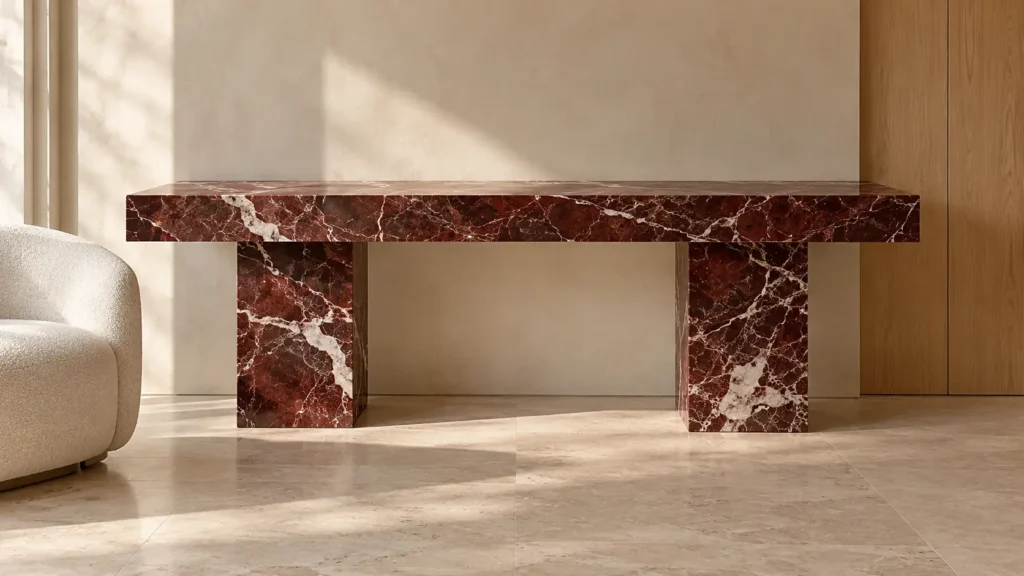
Aegean Red and Rosso Levanto both offer burgundy colour and white veining for architectural interiors. Use their published descriptions to build a shortlist, then choose between the actual proposed slabs in the finish and dimensions required by the project.
The useful comparison is the composition that will remain after cutting: the balance of red and white, the scale of the veins, and how adjoining pieces will read together.
This guide explains how to evaluate the two selections for feature walls, reception counters and bespoke furniture.
What the Current Material Pages Tell You
| Material | Published appearance | Published production options | Main visual question |
|---|---|---|---|
| Aegean Red | Rich burgundy background with fine white veining and mineral detailing | Honed or polished; slabs, cut-to-size, massive pieces and block | Does the available selection provide the intended balance of red field and finer movement? |
| Rosso Levanto | Deep burgundy background with striking white veining and expressive movement | Honed or polished; slabs, cut-to-size, massive pieces and block | How will the white-vein pattern appear across the finished element and its joints? |
The Aegean Red material page provides one starting point for a burgundy interior palette.
The Rosso Levanto material page presents another selection within a similar colour direction.
These descriptions are broad. Review actual material together before deciding that one selection is consistently quieter, darker or more dramatic. Confirm current quantity, dimensions, thickness and production suitability for the intended element.
Write the Visual Brief Before Choosing the Name
A clear visual brief makes the comparison more useful than two disconnected sample photographs.
For example, a reception desk brief might ask for:
- A predominantly burgundy front with visible white movement.
- A balanced distribution of veins across the principal elevation.
- A quieter top around equipment and accessories.
- Side returns that relate to the front without requiring perfect continuity.
- A finish approved beside the surrounding joinery and lighting.
A tabletop brief might instead prioritize one central formation, a calmer perimeter and an edge that preserves the slab’s visual character.
Use the same brief when reviewing both materials. This gives the supplier a practical basis for proposing suitable pieces.
Compare Full Slabs Under Similar Conditions
Request identifiable photographs of the proposed slabs, including dimensions and orientation. Keep the finish and photography conditions as comparable as practical.
A close crop of one stone and a distant warehouse photograph of another can exaggerate their apparent differences. Reflections can also obscure veins and background colour.
Review:
Red field: How much of the surface reads as burgundy, and how evenly is it distributed?
White movement: Are the veins fine, broad, branching, clustered or concentrated in one area?
Quiet zones: Where can openings, accessories or secondary pieces be placed?
Adjoining pieces: Does the proposed group provide the intended visual range?
Follow the photographic review with physical samples for colour and finish approval. Keep the sample and full-slab references together so each communicates its proper role.
Test the Selection at the Finished Scale
Place the actual element outline over the proposed slab image.
For a wall, include panel boundaries, openings and orientation. For a counter, show the top, front and returns. For a table, show the perimeter and how its position relates to the base.
A fine vein network can read as texture from a distance. A concentrated white formation may become the dominant feature of a small piece. Review both the principal viewing distance and close inspection.
Rotate the cutting outline where production allows. A change in orientation may improve the composition without changing the stone selection.
A Reception Desk Example
Consider a desk with a long public-facing front and a smaller working top.
For each candidate, prepare the same two views: the finished front elevation and the top layout with equipment openings shown. Then compare the visible result.
One proposed Aegean Red slab may provide the more balanced front; another Rosso Levanto selection may provide it instead. The decision belongs to the actual material layout rather than an assumed rule attached to either name.
Choose How Much Red the Room Needs
Decide whether the stone is a concentrated feature or part of a broader material composition.
A burgundy console against a light wall can establish a clear focal point. A stone-lined alcove creates a more enveloping effect. A repeated stone detail can connect separate spaces without covering every surface.
Review these options in the room elevations. Include furniture, art and lighting so the stone is evaluated as part of the interior.
Useful palette studies include burgundy stone with pale oak and cream textiles, or with walnut and restrained metal accents. Treat these as combinations to test using physical samples.
The relevant question is whether the complete palette supports the intended atmosphere.
Compare Honed and Polished Finishes Separately
Both material pages list honed and polished options. Approve the finish using representative samples under the proposed lighting.
Polishing introduces stronger reflection. A honed surface offers a more subdued sheen. The preferred result depends on the room, viewing angles and intended use.
For a wall, check reflections from windows and fittings. For a counter or table, review the surface at the height and angle from which people will normally see it.
Record the approved finish clearly. Photos of different slabs in different finishes are a weak basis for deciding which stone has the preferred colour.
Resolve Edges, Seams and Returns During Selection
Red marble often exposes the relationship between neighbouring pieces through contrasting veins.
Approve where joints fall and how the pattern meets at corners. Specify whether the design aims for aligned movement, a mirrored composition or a compatible tonal relationship.
For a mitred apron, show the proposed top and return together on the cutting layout. A deep-looking edge should also be drawn in section so its construction is clear.
For large elements, coordinate panel dimensions with support, handling and access. Confirm the proposed stone’s condition, repairs and backing information with the fabricator.
A successful visual composition should also be practical to produce and install.
Evaluate the Intended Application
A visual shortlist is the beginning of specification.
For a feature wall, review panel weight, support, substrate, joints and fixing requirements.
For a reception counter, coordinate equipment openings, accessible service points and the interfaces between top, front and supporting construction.
For furniture, agree the actual stone section, base arrangement, support and handling method.
For floors or wet areas, obtain the information and approvals relevant to that exposure and finish. A material name or colour does not establish slip performance, moisture behaviour or compatibility with a setting system.
If the element surrounds a working fireplace, coordinate it with the appliance manufacturer’s requirements and the complete assembly design.
Compare Quotes Against One Approved Scope
Ask suppliers to price the same drawings and requirements.
Include the selected material range, finish, piece dimensions, edge details, seams, quantities and approval process. Identify packing, delivery and installation responsibilities.
Request clarity about material allocation and how long the proposed selection can be held. Agree when changes would require a new approval.
A price comparison is useful only when the inclusions and material selections are understood. Avoid assuming a universal price ranking between Aegean Red and Rosso Levanto.
Confirm Maintenance Expectations
Agree the care routine for the actual stone and finish before approval.
The Natural Stone Institute recommends appropriate neutral cleaning products and explains that acidic substances can affect calcareous stone. Its guidance also describes impregnating treatments as repellents rather than products that make stone impervious. Natural Stone Institute care guidance
For a hospitality counter or tabletop, involve the operator in the material review. Confirm compatible cleaning products, treatment requirements and the owner’s expectations for surface change.
A finish or sealer should not be presented as eliminating all maintenance.
Your Approval Record Should Identify
- The actual slabs or blocks and their reference photographs.
- The acceptable colour and vein range.
- The approved finish sample.
- The cutting layout, orientation and visible joints.
- The stone section, support and installation requirements.
- The production scope, quality checks and care information.
For repeated pieces, approve the range across the whole proposed quantity. One attractive sample cannot represent every finished item.
Frequently Asked Questions
Is Aegean Red always lighter than Rosso Levanto?
Their current descriptions both place them within burgundy tones. Compare the actual proposed material under similar conditions rather than assuming a fixed light-to-dark ranking.
Which is better for a reception desk?
Choose the selection that satisfies the desk’s visual brief, layout and technical requirements. Review the front, top and returns together before approving either material.
Can the same red marble be used for walls and furniture?
Potentially, subject to material availability and application-specific approval. Resolve the thickness, support, finish and production requirements for each element.
Can a supplier match an inspiration photograph exactly?
An inspiration image can guide the desired colour and pattern. Approval should identify the actual material and acceptable variation rather than promise an identical natural formation.
Discuss Your Red Marble Selection
VeraMarbles’ natural-stone project services include material selection, sampling, shop-drawing coordination and quality follow-up.
Share the application drawings, quantities and preferred visual direction. Ask to review proposed Aegean Red and Rosso Levanto selections against the same brief so the material decision can move into an approved cutting and production plan.