
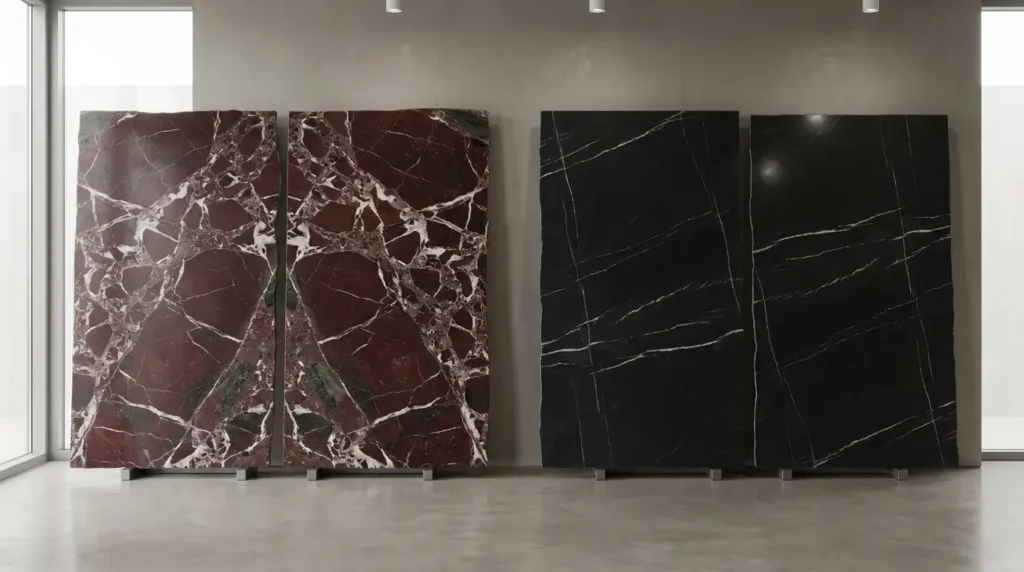
Choosing between Rosso Levanto and Alexander Black is not simply a choice between two dark natural stones.
It is a choice between two completely different architectural moods.
Rosso Levanto introduces:
- burgundy
- deep wine red
- white calcite movement
- occasional darker or green mineral areas
- warmth
- visual richness
Alexander Black introduces:
- deep black
- charcoal
- white and pale-grey veins
- strong graphic contrast
- neutrality
- visual depth
Both can become statement materials.
Both can work in:
- hotels
- villas
- bathrooms
- restaurants
- reception areas
- fireplaces
- custom furniture
But they do not communicate the same design language.
A project that works beautifully with Rosso Levanto may feel completely different if the stone is replaced with Alexander Black.
The correct decision depends on:
- desired color temperature
- surrounding materials
- amount of natural pattern
- lighting
- application
- slab selection
- finish
- project scale
- maintenance expectations
This guide compares the two materials from an architectural rather than purely decorative perspective.
Quick Comparison: Rosso Levanto vs Alexander Black
| Characteristic | Rosso Levanto | Alexander Black |
|---|---|---|
| Dominant color | Burgundy to wine red | Deep black to charcoal |
| Typical vein color | White, cream, occasional green/dark mineral areas | White to pale grey |
| Overall feeling | Warm, expressive, rich | Neutral, graphic, dramatic |
| Visual intensity | High | Medium to high |
| Best role | Statement material | Statement or strong neutral |
| Works especially well with | Walnut, cream, bronze, warm beige | Oak, walnut, white, beige, bronze |
| Feature walls | Excellent | Excellent |
| Bathrooms | Excellent when balanced with lighter materials | Excellent when balanced with lighter materials |
| Floors | Best with controlled selection | Best with calmer vein selection |
| Kitchen islands | Visually dramatic | Graphic and contemporary |
| Hospitality | Warm luxury | Contemporary luxury |
| Slab review | Essential | Essential |
| Polished finish | Richer red and stronger contrast | Deeper black and stronger contrast |
| Honed finish | Softer burgundy | Softer charcoal |
These are design tendencies.
Actual slabs always take priority over generalized descriptions.
What Is Rosso Levanto?
Historically, Rosso Levanto refers to the distinctive red ornamental stone from the Levanto and Bonassola area of Liguria, Italy.
Geologically, the traditional material is not a conventional calcitic metamorphic marble.
It is an ophicalcite, a brecciated serpentinite-related rock containing contrasting calcite veins.
Research on the historic architecture of Levanto specifically identifies Rosso di Levanto as locally quarried ophicalcite, while Liguria’s geological records document the historic Rosso Levanto quarry area at Bonassola.
Its classic visual appearance can include:
- deep burgundy
- wine red
- reddish brown
- white calcite veins
- occasional dark green serpentinite areas
- irregular fractured patterns
The red coloration in the historical material is associated with iron oxidation and hematite.
A Note About the Rosso Levanto Trade Name
This point is important when sourcing material internationally.
The historic name refers to the Ligurian stone.
However, similar red decorative stones from other regions, including Türkiye, can appear in international trade under names related to Rosso Levanto.
Historic stone documentation even notes the later commercial presence of Turkish material with similar visual characteristics.
Therefore, do not assume that every slab labelled:
Rosso Levanto
has exactly the same:
- geological origin
- quarry
- mineralogy
- technical performance
For an architectural order, confirm:
- country of origin
- quarry or source where required
- current slab photographs
- physical sample
- technical test data
The trade name identifies a visual market category.
The supplied stone defines the real project.
What Is Alexander Black?
Alexander Black is a Turkish dark natural stone associated commercially with the İskenderun and Amanos region.
Current material references identify its origin as Türkiye and describe its characteristic appearance as a deep black background crossed by white natural veins.
Its typical visual palette includes:
- deep black
- charcoal black
- white veins
- pale-grey lines
- occasional fine branching movement
Some slabs can be relatively calm.
Others contain much denser white vein networks.
This makes Alexander Black highly flexible.
A calm slab can work as a dark architectural background.
A dramatic slab can become a feature surface.
The Biggest Difference Is Color Temperature
The easiest way to understand these materials is through color temperature.
Rosso Levanto Is Warm
Its red-burgundy background naturally connects with:
- walnut
- bronze
- warm beige
- cream
- brown
- muted brass
- warm lighting
It creates a rich, warm atmosphere.
Alexander Black Is More Neutral
Its black-and-white composition connects easily with:
- white
- grey
- oak
- walnut
- concrete
- stainless steel
- black metal
- beige
This makes it easier to integrate into both warm and cool contemporary palettes.
Rosso Levanto Creates Color
Rosso Levanto is not simply a dark neutral.
It introduces a recognizable color into the interior.
A large Rosso Levanto surface may immediately make the room feel:
- warmer
- richer
- more dramatic
- more expressive
This is useful when the natural stone itself should contribute significantly to the color palette.
Alexander Black Creates Contrast
Alexander Black works differently.
Instead of introducing a strong hue, it introduces:
darkness + white contrast.
This makes it particularly effective when the architecture already contains color through:
- wood
- furniture
- artwork
- textiles
- another natural stone
Alexander Black can anchor these elements without adding another strong color.
Which Is More Dramatic?
That depends on the slab.
But generally:
Rosso Levanto
Is dramatic because of:
- unusual burgundy color
- white veining
- complex fractured geology
Alexander Black
Is dramatic because of:
- deep black background
- high black-and-white contrast
- graphic vein structure
Rosso Levanto tends to feel more expressive and luxurious.
Alexander Black tends to feel more graphic and architectural.
Which Is More Minimal?
Alexander Black is usually easier to integrate into a minimalist palette.
For example:
Alexander Black
warm white
light oak
black metal
creates a highly controlled contemporary interior.
Rosso Levanto can also work in minimalist architecture, but its color makes the stone itself more dominant.
A minimalist Rosso Levanto project requires restraint around it.
Rosso Levanto in Minimal Architecture
A successful contemporary palette might use:
one Rosso Levanto feature wall
warm white plaster
light oak floor
minimal cream furniture.
The architecture remains simple.
The stone provides the color.
Alexander Black in Minimal Architecture
Alexander Black can use an equally restrained palette:
one Alexander Black wall
warm white plaster
oak
clear glass.
The stone provides contrast rather than color.
This usually produces a more monochromatic result.
Which Is Better for a Feature Wall?
Both are excellent.
The question is what role the wall should play.
Choose Rosso Levanto When:
You want the wall to introduce:
- burgundy
- warmth
- rich material identity
- dramatic color
Choose Alexander Black When:
You want:
- black depth
- graphic white veins
- neutral drama
- stronger monochromatic architecture
There is no universal winner.
Full-Slab Walls
Both materials benefit enormously from large-format panels.
Small tiles interrupt the natural pattern.
Large slabs allow:
- stronger geological expression
- fewer joints
- more natural continuity
- greater material scale
For important walls, the slab layout should be prepared before cutting.
Which Is Better for Bookmatching?
Both can potentially create impressive mirrored compositions when suitable sequential slabs are available.
However, the visual effect differs.
Rosso Levanto Bookmatch
Can produce:
- complex burgundy shapes
- white calcite intersections
- highly expressive symmetry
- almost abstract-art compositions
Alexander Black Bookmatch
Can produce:
- strong black-and-white geometry
- clear central symmetry
- sharper graphic forms
Alexander Black usually creates the more monochromatic composition.
Rosso Levanto generally creates the richer color composition.
Do Not Automatically Bookmatch Either Stone
A mirrored composition is not always better.
Some slabs have a natural directional movement that is more attractive when allowed to continue normally.
Always preview:
natural flow
and
mirrored layout
before making the decision.
Which Is Better for a Fireplace?
Both are extremely effective.
Rosso Levanto Fireplace
Creates:
- warmth
- burgundy color
- rich focal point
It works particularly well with:
- light oak
- cream
- warm beige
- walnut
Alexander Black Fireplace
Creates:
- strong black focal point
- graphic contrast
- contemporary depth
It works particularly well with:
- warm white
- light oak
- concrete
- glass
Fireplace Example: Rosso Levanto
Consider:
Rosso Levanto full-height fireplace wall
cream sofa
light natural floor
warm white plaster.
The marble becomes the main color element.
Fireplace Example: Alexander Black
Consider:
Alexander Black fireplace wall
light oak floor
off-white walls
minimal furniture.
The result becomes more graphic and restrained.
Which Is Better for Bathrooms?
Again, the desired atmosphere matters.
Rosso Levanto Bathroom
Can feel:
- warm
- intimate
- sophisticated
- jewel-like
Alexander Black Bathroom
Can feel:
- graphic
- minimalist
- contemporary
- monochromatic
Both should generally be balanced with lighter materials in smaller spaces.
Rosso Levanto Bathroom Combination
A strong palette can be:
Rosso Levanto shower wall
cream floor
walnut vanity
warm white plaster
brushed bronze fixtures.
The burgundy stone becomes the focal point.
Alexander Black Bathroom Combination
A strong alternative can be:
Alexander Black shower wall
warm neutral floor
light oak vanity
warm white plaster
dark metal or restrained bronze fixtures.
The result is cleaner and more monochromatic.
Which One Makes a Small Bathroom Feel Darker?
Both can reduce perceived brightness if overused.
Alexander Black absorbs more visual light because the background is almost black.
Rosso Levanto is also dark but introduces warmer reflected color.
For a small bathroom, consider using either stone on:
one main wall
rather than:
- every wall
- floor
- vanity
- bathtub
all at once.
Which Is Better for Vanity Tops?
Both can work visually.
Rosso Levanto Vanity
Works particularly well when you want:
- color
- decorative identity
- warm contrast
Alexander Black Vanity
Works particularly well when you want:
- clean dark contrast
- graphic veining
- easier pairing with different cabinet colors
A small vanity also allows a particularly attractive part of the slab to be selected.
Which Is Better for Hotel Lobbies?
The answer depends on whether the stone is the background or the accent.
Neither material is usually necessary across the entire lobby.
A stronger strategy can be:
neutral floor
statement dark stone.
Rosso Levanto in Hotels
Possible applications include:
- reception wall
- reception desk
- fireplace
- bar
- premium bathroom
- decorative table
Its burgundy color can create a highly memorable hospitality identity.
Alexander Black in Hotels
Possible applications include:
- reception desk
- lobby wall
- elevator surrounds
- fireplace
- restaurant bar
- stairs
Its neutral dark appearance makes it easier to coordinate with multiple hospitality areas.
Which Is Better for a Reception Desk?
Rosso Levanto
Creates a reception desk that immediately introduces color.
Alexander Black
Creates a reception desk that immediately introduces contrast.
For a light beige or white hotel lobby:
either material can work extremely well.
The choice depends on whether the project needs:
warm burgundy
or
neutral black.
Rosso Levanto + Beige Flooring
This is one of the most reliable hospitality combinations.
The beige floor provides:
- continuity
- brightness
- calm
Rosso Levanto provides:
- burgundy contrast
- a memorable focal point
A reception desk or wall can become the identity of the lobby.
Alexander Black + Beige Flooring
The strategy is similar.
The beige surface provides the large neutral area.
Alexander Black provides:
- stronger contrast
- black depth
- graphic white veins
This generally creates a more neutral and contemporary atmosphere than Rosso Levanto.
Which Is Better for Flooring?
Both can be used for interior flooring where the actual stone and project specification are appropriate.
But selection becomes particularly important.
Rosso Levanto Flooring
Can become visually intense because of:
- red color
- complex veins
- natural brecciated movement
For large floors, a relatively calm selection can be preferable.
Alexander Black Flooring
Can also become busy if every piece contains strong white veins.
For large areas, consider:
- greater black background
- lower vein density
- controlled distribution
Large Floors Need Different Slab Selection
Do not automatically use the same selection criteria for:
feature wall
and
500 m² floor.
A dramatic slab can look spectacular vertically.
Hundreds of dramatic pieces across a floor may create too much movement.
Application should determine selection.
Which Is Better for Staircases?
Both create powerful stairs.
Rosso Levanto Stairs
Provide:
- warm dramatic color
- strong connection with walnut and cream architecture
Alexander Black Stairs
Provide:
- graphic definition
- strong contrast against light walls
- a more monochromatic appearance
For both stones, piece sequencing matters.
Random tonal distribution can make the staircase appear fragmented.
Which Is Better for Kitchen Islands?
Both can produce spectacular islands.
But their design language differs greatly.
Rosso Levanto Island
Becomes a strong color object.
It works particularly well with:
- cream cabinetry
- walnut
- warm white
- restrained bronze
Alexander Black Island
Becomes a graphic architectural object.
It works with:
- light oak
- walnut
- white cabinetry
- beige cabinetry
- grey cabinetry
Alexander Black is usually easier to integrate with a wider range of kitchen colors.
Planning the Island Before Cutting
For either stone, prepare the layout before fabrication.
Review:
- sink
- cooktop
- faucet
- overhang
- vertical ends
- edge details
Then position these components over photographs of the real slabs.
Do not allow the most important natural vein to disappear inside a sink opening simply because the cutting layout was optimized only for yield.
Which Is Easier to Pair with Wood?
Both work extremely well with wood.
Rosso Levanto + Walnut
Creates a warm and rich palette.
The burgundy stone and dark brown timber naturally support each other.
Alexander Black + Walnut
Creates greater tonal contrast.
Black stone makes the warmth of walnut more noticeable.
Which Is Better with Light Oak?
Alexander Black generally creates the strongest contrast with light oak.
The combination feels:
- contemporary
- bright
- graphic
Rosso Levanto + light oak can also work extremely well, but the result becomes more colorful and expressive.
Which Is Better with Bronze?
Both.
But bronze behaves differently with each.
Rosso Levanto + Bronze
Creates a very warm palette.
Use the bronze carefully to avoid excessive richness.
Alexander Black + Bronze
Bronze introduces warmth into an otherwise neutral black-and-white material scheme.
This can create useful balance.
Which Is Better with Stainless Steel?
Alexander Black.
The combination of:
- black
- white
- brushed stainless steel
creates a cool, highly contemporary palette.
Rosso Levanto generally feels more natural with warmer metals and timber, although stainless steel can still be used intentionally.
Which Is Better with Warm White?
Both.
Warm white gives either stone visual breathing room.
With Rosso Levanto
It makes the burgundy appear richer.
With Alexander Black
It strengthens black-and-white contrast without the harshness of a cold pure-white environment.
Which Is Better with Concrete?
Alexander Black usually integrates more naturally.
A palette of:
Alexander Black
concrete
oak
glass
can feel very architectural.
Rosso Levanto can also be combined with concrete, but the contrast becomes more expressive because the burgundy stone introduces a strong warm color.
Which Stone Looks More Luxurious?
Luxury is not a geological property.
It comes from:
- selection
- fabrication
- proportion
- layout
- installation
- lighting
- surrounding architecture
Poorly selected Rosso Levanto can look chaotic.
Poorly planned Alexander Black can look fragmented.
A carefully selected slab of either material can look exceptional.
The better question is:
Which luxury language fits the project?
Rosso Levanto
Warm, expressive luxury.
Alexander Black
Graphic, contemporary luxury.
Polished Rosso Levanto
Polishing can emphasize:
- deeper wine-red tones
- greater contrast
- brighter calcite veins
- more mineral depth
Historical Rosso Levanto is known for its ability to take a decorative polish.
A polished surface may be particularly effective for:
- feature walls
- reception desks
- tables
- fireplaces
Honed Rosso Levanto
Honing can make the material feel:
- softer
- more burgundy than glossy red
- more architectural
- less formal
It can be especially effective in contemporary residential projects.
Polished Alexander Black
Polishing generally emphasizes:
- black depth
- white-vein contrast
- surface reflection
This can create a highly dramatic result.
Honed Alexander Black
Honing generally produces:
- softer charcoal-black
- reduced reflection
- more restrained white veins
- contemporary appearance
The visual difference can be substantial.
Which Stone Benefits More from Polishing?
Both benefit visually, but in different ways.
Polishing Rosso Levanto intensifies the richness of the color.
Polishing Alexander Black intensifies black-to-white contrast.
For minimalist interiors, honed surfaces may make either stone easier to integrate.
Compare Actual Finish Samples
Do not decide finish from internet photographs alone.
Photography can change:
- black depth
- red saturation
- vein contrast
- reflection
Whenever possible, compare:
polished
and
honed
versions of the actual selected material.
Lighting Rosso Levanto
Warm-neutral lighting can emphasize:
- burgundy
- wine red
- warmer mineral areas
Excessively warm yellow lighting may make the material appear too brown or red.
Balanced lighting is preferable.
Lighting Alexander Black
Alexander Black responds strongly to directional light.
Grazing light can emphasize:
- white veins
- panel joints
- surface finish
Warm light can soften the black-and-white contrast.
Cool light can make the veins appear sharper.
Which Performs Better in Low Light?
Alexander Black can become almost visually black in low-light areas, leaving the white veins as the main visible feature.
Rosso Levanto may retain more recognizable color under warm lighting.
For a dark restaurant or bar, both can work beautifully.
But their resulting atmospheres will be different.
Rosso Levanto in a Restaurant
Consider:
Rosso Levanto bar
walnut
cream plaster
warm indirect lighting.
The space feels rich and intimate.
Alexander Black in a Restaurant
Consider:
Alexander Black bar
light oak or walnut
warm-white plaster
dark bronze.
The atmosphere becomes more graphic and controlled.
Slab Selection: Rosso Levanto
Review:
- burgundy intensity
- amount of white calcite
- darker areas
- potential green mineral areas
- fracture network
- slab dimensions
- reinforcement where relevant
- pattern density
Historic Rosso Levanto is naturally brecciated and fractured in appearance because of its ophicalcite geology.
The apparent fracture network is therefore an important part of both visual and fabrication review.
Slab Selection: Alexander Black
Review:
- depth of black
- amount of charcoal
- white-vein density
- vein thickness
- vein direction
- slab dimensions
- natural discontinuities
- finish
Some Alexander Black slabs can be nearly calm.
Others can contain very dense white movement.
Specify what the project actually needs.
Which Stone Has More Variation?
Both can vary substantially.
Rosso Levanto may vary through:
- burgundy intensity
- red-brown areas
- calcite density
- green serpentinite zones
- brecciated structure
Alexander Black may vary through:
- black depth
- charcoal content
- white-vein density
- vein thickness
- pattern direction
Do not assume one sample defines the entire material.
Full-Slab Photography Is Essential
For either stone, obtain full-slab photographs before approving important applications.
Full images help evaluate:
- pattern
- usable dimensions
- major veins
- natural discontinuities
- potential cutting positions
This is particularly important for:
- kitchen islands
- walls
- fireplaces
- reception desks
- large vanities
Cutting Layout
A good custom project can follow this process:
- Finalize project dimensions.
- Photograph the selected slabs.
- Add dimensional scale.
- Position each required component.
- Add sink, niche and fixture openings.
- Review the principal veins.
- Review corners.
- Check material yield.
- Approve the arrangement.
- Begin fabrication.
This process applies equally to Rosso Levanto and Alexander Black.
Which Is Easier to Cut Efficiently?
This cannot be answered from the commercial name alone.
Efficiency depends on:
- slab dimensions
- required pieces
- natural discontinuities
- reinforcement
- pattern requirements
One individual Alexander Black slab may yield a project more efficiently than another.
The same applies to Rosso Levanto.
Cost should therefore consider more than square-meter price.
Visual Quality vs Material Yield
Imagine a hotel reception requiring three large panels.
Layout A produces:
- exceptional vein positioning
- greater waste
Layout B produces:
- better yield
- less attractive panel composition
Which is correct?
For a secondary corridor wall, Layout B may be sensible.
For the main hotel reception, Layout A may justify the additional stone.
The application determines the priority.
Corner Planning
Both stones require attention at visible corners.
Relevant applications include:
- reception desks
- islands
- fireplaces
- vanity returns
A major vein reaching an edge should not meet a completely unrelated adjacent surface without consideration.
The goal is not artificial perfection.
It is intentional fabrication.
Dry Layout
For complex walls and floors, a dry layout can help review:
- overall color
- vein distribution
- panel relationships
- darker pieces
- quieter pieces
Approved pieces can then be numbered.
Piece Numbering
A strong project organization system can connect:
architectural drawing
→
stone piece
→
crate
→
installation position.
This prevents carefully selected pieces from being randomly installed on site.
Rosso Levanto Care
Care instructions should follow the mineralogy of the actual supplied stone.
Historic Italian Rosso Levanto is serpentinite-related ophicalcite rather than conventional calcitic marble.
Serpentine-based stones can exhibit different acid behavior from true calcitic marble; natural-stone technical guidance notes that serpentine is magnesium-silicate based and generally more acid-resistant than true marble.
However, Rosso Levanto also contains significant calcite veining.
For this reason, avoid assuming that the complete surface is universally acid-proof.
Use a cleaning system appropriate for the actual stone.
Alexander Black Care
The most conservative approach is to use:
- pH-neutral natural-stone cleaner
- soft cleaning materials
- prompt spill removal
- regular dust removal
unless current technical documentation for the actual supplied material establishes another appropriate system.
Natural Stone Institute guidance recommends mild non-acidic products for calcium-carbonate stone and warns that acidic products can cause etching.
Do Not Use One Care Rule for Every “Marble”
This comparison demonstrates why commercial names can be misleading.
Rosso Levanto may be sold commercially as marble while historically being serpentinite-related ophicalcite.
Alexander Black is also marketed commercially as marble, while the exact supplied material should be verified through current technical documentation.
The correct maintenance system follows:
mineralogy + finish + application
rather than simply:
commercial category.
Should Either Stone Be Sealed?
Possibly, depending on the actual material and application.
Natural Stone Institute guidance explains that impregnating treatments can make certain natural stones more stain-resistant but do not make them completely stain-proof.
Whether treatment is appropriate should depend on:
- actual stone
- absorption
- finish
- location
- exposure
- intended use
Sealing Is Not Universal Acid Protection
This is especially important for mixed-mineral natural stones.
An impregnating treatment primarily reduces liquid penetration.
It does not necessarily stop a chemical reaction between an acid and an acid-sensitive mineral.
Therefore:
sealed stone does not automatically mean acid-proof stone.
Which Is Better for High-Traffic Areas?
Do not decide this comparison visually.
For a high-traffic hotel floor, evaluate:
- current technical test data
- abrasion
- flexural strength
- finish
- maintenance program
- entrance protection
- installation
The specific selected stone must meet the service requirements.
A feature-wall specification cannot automatically be transferred to busy flooring.
Exterior Use
Exterior suitability should also be evaluated separately.
Historic Rosso Levanto has been used in architectural applications, and geological research documents its historic use as both internal decoration and, in certain periods, external cladding and paving.
That historical precedent does not mean every modern slab or every similarly named stone is suitable for every exterior climate.
Alexander Black exterior use should likewise rely on current technical data for the actual material.
Consider:
- climate
- freeze-thaw exposure
- moisture
- sunlight
- finish
- anchoring
- panel dimensions
- local requirements
Rosso Levanto vs Alexander Black for Luxury Villas
Choose Rosso Levanto When the Villa Needs:
- strong material color
- warm statement surfaces
- visual connection with walnut
- dramatic dining or living areas
- a richer atmosphere
Choose Alexander Black When the Villa Needs:
- neutral dark contrast
- minimalist black-and-white detailing
- strong relationship with oak and glass
- graphic bathrooms
- contemporary fireplaces
Rosso Levanto vs Alexander Black for Hotels
Rosso Levanto Works Especially Well for:
- memorable reception desks
- bar areas
- restaurants
- selected luxury suites
- fireplace walls
Alexander Black Works Especially Well for:
- receptions
- lift lobbies
- bathrooms
- stairs
- restaurant features
- graphic wall cladding
Either can be used strategically rather than covering the entire hotel.
Rosso Levanto vs Alexander Black for Restaurants
Choose Rosso Levanto when the desired mood is:
- warm
- intimate
- rich
- expressive
Choose Alexander Black when the desired mood is:
- graphic
- sophisticated
- neutral
- contemporary
Lighting should be planned together with the stone.
Rosso Levanto vs Alexander Black for Bathrooms
Choose Rosso Levanto for:
- warmer spa-like luxury
- burgundy statement walls
- cream and walnut palettes
Choose Alexander Black for:
- monochromatic bathrooms
- black-and-white contrast
- contemporary minimalism
- light oak and warm-white palettes
Rosso Levanto vs Alexander Black for Kitchens
Choose Rosso Levanto when the island should function as a:
color statement.
Choose Alexander Black when it should function as a:
graphic dark anchor.
For either material, verify the technical behavior of the actual supplied stone before specifying demanding countertop use.
Which One Is More Timeless?
Both can be timeless when used correctly.
Dark natural stone has existed in architecture far longer than contemporary interior trends.
The more important issue is whether the application is dependent on temporary decoration.
A simple:
- slab wall
- fireplace
- staircase
- table
can age more successfully than an overly themed interior.
Which One Is More Versatile?
Alexander Black is generally more neutral.
Its black-and-white palette can integrate with a wider variety of colors.
Rosso Levanto is more specific.
Its burgundy color immediately becomes part of the overall design scheme.
Therefore:
Alexander Black is usually easier to combine.
Rosso Levanto usually creates a stronger color identity.
Which One Should You Choose?
Choose Rosso Levanto if you want:
- burgundy
- warmth
- richness
- color
- expressive geology
- a statement surface
Choose Alexander Black if you want:
- deep black
- white veins
- neutrality
- graphic contrast
- contemporary architecture
- easier material pairing
Choose neither purely from a small sample.
The final decision should be made from actual slabs.
A Simple Decision Guide
Your Interior Uses Walnut and Cream
Both work.
Choose Rosso Levanto for a warmer result.
Choose Alexander Black for stronger contrast.
Your Interior Uses Light Oak and White
Alexander Black is usually easier.
Your Interior Uses Warm Beige Stone
Both work extremely well as accents.
You Want the Stone to Add Color
Choose Rosso Levanto.
You Want the Stone to Stay Neutral
Choose Alexander Black.
You Want a Strong Black-and-White Graphic
Choose Alexander Black.
You Want an Unusual Red Natural Stone
Choose Rosso Levanto.
You Want a Dramatic Restaurant or Bar
Both work.
Rosso Levanto is warmer.
Alexander Black is more monochromatic.
Questions to Ask Before Ordering Rosso Levanto
Ask for:
- Country of origin.
- Quarry or production source where relevant.
- Current full-slab photographs.
- Slab dimensions.
- Available quantity.
- Finish.
- Current technical data.
- Information about reinforcement where relevant.
- Sequential slabs if pattern matching is required.
- Packing details.
Because the trade name is used broadly, origin confirmation is particularly important.
Questions to Ask Before Ordering Alexander Black
Ask for:
- Quarry/source confirmation.
- Full-slab photographs.
- Desired black selection.
- Desired vein density.
- Available dimensions.
- Quantity.
- Finish.
- Current technical test data.
- Sequential availability.
- Packing details.
Do not specify simply:
“black marble.”
The desired visual range should be clear.
Common Mistakes When Choosing Between Them
1. Comparing Small Samples
Neither material can be understood properly at sample scale.
2. Treating Them as Interchangeable Dark Marbles
Their color languages are completely different.
3. Ignoring Rosso Levanto Origin
The historic name and modern trade usage can overlap.
4. Choosing the Most Dramatic Slabs for Every Application
A floor and feature wall need different selection strategies.
5. Ignoring Finish
Polished and honed surfaces can substantially alter both stones.
6. Ignoring Lighting
Dark stone changes dramatically under different lighting.
7. Cutting Before Preparing the Layout
Important veins can disappear into openings.
8. Using Too Many Statement Materials Together
Allow one stone to dominate.
9. Assuming Commercial “Marble” Means Identical Geology
Commercial and geological classifications can differ.
10. Assuming Sealing Makes Natural Stone Maintenance-Free
It does not.
How to Plan the Project
A practical process for either stone is:
1. Define the Role
Is it:
- the primary stone
- or the accent stone?
2. Define the Application
Wall, floor, bathroom, fireplace, island or furniture?
3. Define the Desired Visual Range
Color and vein density.
4. Confirm Origin
Especially when trade names may be used broadly.
5. Review Full Slabs
Not only samples.
6. Choose the Finish
Polished, honed or another approved treatment?
7. Prepare the Cutting Layout
Use actual slab photographs.
8. Review Important Veins
Protect the strongest natural features.
9. Dry Lay Critical Areas
Where necessary.
10. Number Custom Pieces
Preserve the approved layout.
11. Verify Technical Requirements
Use current data for the actual material.
12. Inspect Before Shipment
Check:
- selection
- dimensions
- finish
- numbering
- visible condition
- packing
Final Thoughts
The choice between Rosso Levanto and Alexander Black is ultimately a choice between two different forms of dark natural-stone architecture.
Rosso Levanto is defined by:
burgundy + white mineral movement + warm geological richness.
Alexander Black is defined by:
black + white veins + graphic contrast.
Historic Rosso Levanto originates from the Ligurian Levanto–Bonassola area and is geologically associated with ophicalcite and serpentinite formations rather than conventional calcitic marble.
Alexander Black is commercially associated with the İskenderun–Amanos area of Türkiye and is recognized for its deep black background and contrasting white veining.
Choose Rosso Levanto when you want the stone to introduce:
- color
- warmth
- richness
- expressive identity
Choose Alexander Black when you want:
- neutrality
- contrast
- graphic depth
- contemporary flexibility
But do not make the final choice from the stone name alone.
Review the actual slabs.
Confirm origin.
Compare polished and honed finishes.
Study the material under realistic lighting.
Prepare the cutting layout.
Determine whether dramatic veins belong on a feature wall or calmer material belongs on the floor.
And define the stone’s role within the complete architecture.
The best natural stone is not simply the rarest or most dramatic option.
It is the material whose:
color
pattern
scale
finish
technical characteristics
work most successfully with the project.
Frequently Asked Questions
What is the main difference between Rosso Levanto and Alexander Black?
Rosso Levanto has a burgundy-to-wine-red background with contrasting calcite movement, while Alexander Black has a deep black-to-charcoal background with white or pale-grey veins.
Is Rosso Levanto Italian or Turkish?
The historic Rosso Levanto name refers to the ornamental ophicalcite quarried around Levanto and Bonassola in Liguria, Italy. However, visually similar Turkish stones can also appear under related commercial names, so the origin of the actual supplied slabs should always be confirmed.
Where does Alexander Black come from?
Alexander Black is commercially associated with Türkiye, particularly the İskenderun and Amanos region.
Is Rosso Levanto a true geological marble?
The historic Italian Rosso Levanto is more accurately described geologically as ophicalcite, a serpentinite-related brecciated ornamental stone with calcite veins.
Which is better for a modern interior?
Alexander Black is generally easier to integrate into neutral minimalist interiors, while Rosso Levanto works particularly well when the design needs a warm burgundy statement.
Which is better for a feature wall?
Both. Rosso Levanto creates a warm colored feature; Alexander Black creates a more neutral black-and-white graphic feature.
Which is better for bathrooms?
Both can work. Rosso Levanto creates a warmer, richer bathroom, while Alexander Black generally produces a more monochromatic and contemporary result.
Which is better for a kitchen island?
Choose Rosso Levanto when you want the island to introduce color. Choose Alexander Black when you want a dark graphic anchor. Technical suitability should be confirmed for the actual supplied material.
Can Rosso Levanto and Alexander Black be polished?
Both are commercially used with polished surfaces, although the exact finish behavior depends on the actual stone. Polishing generally increases color depth and vein contrast.
Can they be honed?
Honed surfaces can create a softer, lower-reflection interpretation and are especially useful in contemporary design.
Can either stone be bookmatched?
Suitable sequential slabs can potentially create mirrored arrangements. The complete composition should be digitally previewed before fabrication.
Which stone works better with walnut?
Both. Rosso Levanto creates a warm tonal palette with walnut, while Alexander Black provides stronger black-to-brown contrast.
Which stone works better with light oak?
Alexander Black generally creates the stronger contemporary contrast, although Rosso Levanto can also work extremely well when the burgundy stone is intended as the primary color feature.
Should dark natural stone be sealed?
Treatment depends on the actual stone, mineralogy, finish and application. An impregnating treatment can improve stain resistance in appropriate cases, but does not make natural stone completely stain-proof.
Choosing Between Rosso Levanto and Alexander Black?
VeraMarbles can help you evaluate the actual natural stone rather than choosing only from a product name.
Send us your:
- project application
- required quantity
- dimensions
- thickness
- preferred finish
- architectural drawings
- desired visual character
- project location
We can support your project with:
- slab selection
- material comparison
- color and vein control
- full-slab review
- slabs
- tiles
- custom cutting
- cutting-layout planning
- symmetrical slab matching
- dry layout
- piece numbering
- packing coordination
- quality control before shipment
Request a Quote from VeraMarbles