
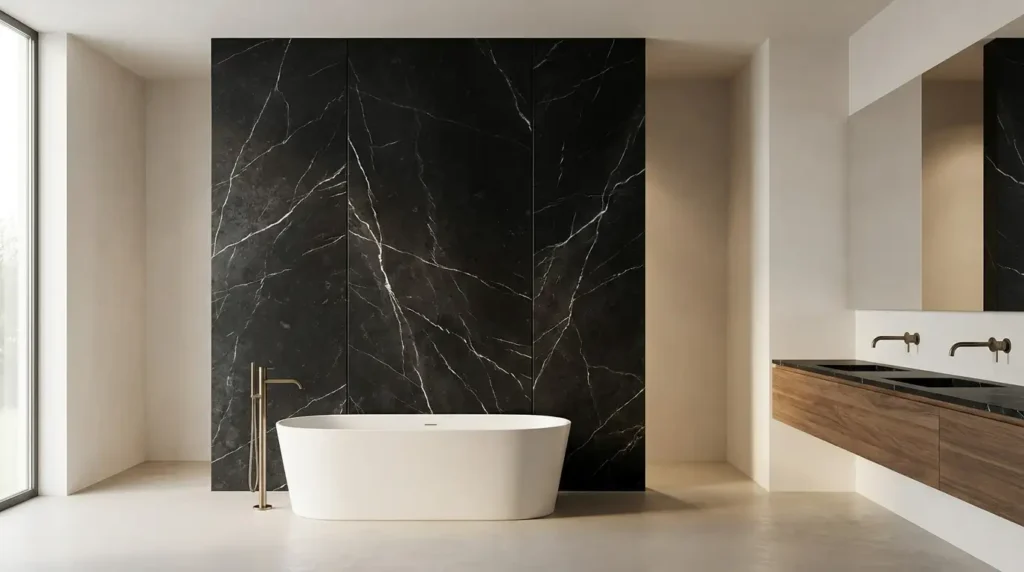
Black natural stone has a very different role in architecture from white, beige or grey materials.
It does not simply provide a neutral background.
A well-selected black stone can create:
- depth
- contrast
- visual structure
- architectural drama
- a strong focal point
Alexander Black marble is particularly effective because it combines a deep black to charcoal-black background with irregular white and pale grey natural veins.
The result can feel:
- graphic
- contemporary
- sophisticated
- monumental
- restrained
depending on the slab selection and how the stone is used.
Alexander Black is commercially associated with the Hatay and İskenderun region of Türkiye, particularly the Amanos area. Current stone references consistently describe the material as Turkish black stone from this region.
Possible architectural applications include:
- feature walls
- bathrooms
- fireplaces
- flooring
- staircases
- reception desks
- vanity tops
- kitchen islands
- bar surfaces
- dining tables
- custom furniture
- hospitality interiors
- luxury residential projects
However, black natural stone requires careful planning.
Its dark background makes:
- veins
- joints
- scratches
- reflections
- water marks
- fabrication details
more visually noticeable.
For this reason, the strongest Alexander Black projects begin with the actual slabs rather than simply selecting the material name.
What Is Alexander Black Marble?
Alexander Black is a commercial black natural stone associated with southern Türkiye.
Published material references identify its origin as:
Hatay / İskenderun / Amanos region, Türkiye.
The stone is typically recognized by:
- deep black background
- charcoal-black areas
- irregular white veins
- pale grey veins
- occasional finer spider-like mineral lines
- naturally varying vein density
Some slabs may appear nearly solid black from a distance.
Others can contain significantly stronger white movement.
This variation makes slab selection particularly important.
Is Alexander Black a True Geological Marble?
Alexander Black is widely marketed internationally within the commercial marble category.
However, commercial natural-stone classification and geological classification do not always mean the same thing.
Geological research on black ornamental stones from the İskenderun–Payas section of the Amanos region describes very dark to black, fine-grained micritic carbonate rock with white calcite veins, associated with Mesozoic platform-carbonate formations.
This is important for specification.
Rather than assuming every material sold as Alexander Black has identical mineralogical characteristics, a serious project should rely on:
- actual supplier documentation
- quarry information
- current technical test reports
- approved slabs
- project-specific performance data
when engineering performance matters.
Commercially, however, the name Alexander Black marble remains the standard and recognizable market terminology.
Where Does Alexander Black Come From?
Alexander Black is associated with the İskenderun and Hatay region of southern Türkiye.
Commercial material references place the quarry area around the Amanos Mountains near İskenderun.
The wider region has a complex geological history.
Official geographic documentation for Hatay notes that the Amanos Mountains contain extensive Paleozoic and Mesozoic units, including major limestone formations.
For architectural buyers, the practical takeaway is straightforward:
Alexander Black is a Turkish black natural stone, and the actual supplied material should be confirmed by:
- quarry source
- origin documents where required
- slab photographs
- physical samples
- technical reports
rather than relying only on visual similarity to other international black stones.
What Does Alexander Black Look Like?
Its main visual relationship is:
black
white.
But natural stone is more complex than that simplified description.
The background may range from:
- deep jet black
- charcoal black
- slightly warm black
- dark anthracite
while the veins may appear:
- bright white
- off-white
- pale grey
- silver-grey
The strongest selections usually maintain enough uninterrupted black surface for the white veins to remain visually clear.
Quiet Alexander Black
A calm selection may contain:
- predominantly black background
- very few white lines
- wide uninterrupted dark areas
- restrained mineral movement
This can work particularly well for:
- large flooring areas
- countertops
- furniture
- minimalist walls
because the surface remains relatively controlled.
Medium-Veined Alexander Black
A balanced selection may contain:
- substantial black background
- several clearly visible white veins
- occasional branching
- moderate natural movement
This is highly versatile.
It can work for:
- bathrooms
- feature walls
- fireplaces
- reception desks
- tables
Dramatic Alexander Black
A stronger selection may contain:
- dense white veins
- branching mineral structures
- intersecting lines
- higher black-to-white contrast
These slabs can become natural artwork.
They can be particularly effective for:
- full-height feature walls
- bookmatched compositions
- large fireplace walls
- reception areas
But more veins do not automatically mean better quality.
The best slab is the one that fits the application.
Why Full-Slab Selection Matters
A small black marble sample can be extremely misleading.
Imagine a 10 × 10 cm sample cut from a quiet area.
It may look almost completely black.
Another sample taken from the same slab may contain several white veins and appear heavily patterned.
Both represent the same natural stone.
Neither represents the complete composition.
For important projects, review:
- full-size slab photographs
- several slabs together
- slab dimensions
- vein density
- vein direction
- natural discontinuities
- finish
before final approval.
Alexander Black for Feature Walls
A large feature wall is one of the strongest applications.
The black background creates architectural depth while the white veins introduce natural movement.
Possible locations include:
- hotel lobbies
- villa entrances
- living rooms
- restaurants
- reception spaces
- executive offices
- private clubs
- luxury retail
Large panels preserve more of the geological pattern.
Small tiles repeatedly interrupt it.
Full-Height Alexander Black Walls
Full-height panels can create a monumental effect.
Instead of seeing individual stone tiles, the observer reads one large dark architectural surface.
Benefits can include:
- fewer joints
- greater stone scale
- stronger vein visibility
- cleaner architectural proportions
The wall should be planned before fabrication.
Coordinate:
- panel dimensions
- ceiling height
- doors
- furniture
- electrical outlets
- lighting
- joints
with the actual slabs.
Planning the Main Veins
Strong white veins should be considered almost like architectural lines.
Suppose a slab contains one major diagonal white vein.
That vein might be positioned:
- behind the reception desk
- through the central part of a fireplace wall
- beside an architectural opening
or, without planning, it could disappear:
- behind furniture
- inside a door opening
- in a discarded offcut
Both approaches use the same stone.
Only one uses its visual value effectively.
Can Alexander Black Be Bookmatched?
Suitable sequential slabs can sometimes be arranged as mirrored compositions.
This can create:
- strong symmetry
- central graphic forms
- dramatic white vein patterns
- a highly decorative architectural focal point
Possible applications include:
- lobby walls
- bathrooms
- reception backgrounds
- fireplaces
- dining-room walls
However, bookmatching should never be selected simply because it is technically possible.
The actual slabs should first be previewed.
Bookmatch vs Natural Vein Flow
Bookmatched Arrangement
Creates:
- clear symmetry
- a defined central axis
- more decorative impact
- greater formality
Natural Vein Flow
Creates:
- less symmetry
- more organic movement
- greater architectural restraint
- natural geological continuity
Some Alexander Black slabs may look much more sophisticated when allowed to flow naturally rather than being mirrored.
The correct choice depends on the stone.
Alexander Black for Bathrooms
Black natural stone can create an exceptionally sophisticated bathroom when used with restraint.
Alexander Black can be considered for:
- shower walls
- vanity tops
- vanity walls
- bathroom floors
- bathtub surrounds
- shelves
- niches
- custom basins
A contemporary palette might combine:
Alexander Black
dark or medium walnut
warm white plaster
brushed bronze
light neutral flooring.
This prevents the room from becoming completely dark.
Alexander Black Shower Walls
Large shower panels can be especially powerful.
The white veins remain visible against the black field and create a natural graphic composition.
Before fabrication, plan:
- shower controls
- niches
- shelves
- panel joints
- corners
- glass fixing points
A large niche should not accidentally remove the strongest part of the slab.
One Black Wall Can Be Enough
A bathroom does not need black marble everywhere.
For example:
Alexander Black shower wall
warm neutral floor
off-white walls
may create more impact than using black stone across every surface.
Dark material becomes more visually powerful when surrounded by lighter architectural surfaces.
Alexander Black Vanity Tops
A vanity requires relatively little material.
This allows a particularly attractive slab section to be selected.
Before cutting, consider:
- basin opening
- faucet holes
- backsplash
- front edge
- side returns
A strong white vein can be positioned along the vanity rather than removed by the basin opening.
Alexander Black for Flooring
Alexander Black can also be used for interior flooring.
Commercial references list floors and stairs among its common architectural applications.
Possible spaces include:
- entrance halls
- selected hotel areas
- restaurants
- luxury residential interiors
- office reception spaces
- powder rooms
But a dark floor creates a very different visual atmosphere from white or beige stone.
It can make the room feel:
- deeper
- more intimate
- more dramatic
- more formal
Large Black Floors Need Careful Selection
For a large floor, highly veined material may become visually excessive.
Consider using a calmer selection with:
- more black background
- lower white-vein density
- controlled tonal variation
and reserve the most dramatic slabs for vertical features.
This creates hierarchy.
Tile Format Matters
The same Alexander Black can look completely different depending on format.
Smaller tiles create:
- more joints
- more frequent pattern interruption
- stronger grid
Large formats create:
- fewer joints
- greater continuity
- more visible natural movement
The correct size should respond to:
- room dimensions
- slab availability
- installation
- structural requirements
- desired visual scale
Pre-Installation Arrangement
Before installing an important natural stone floor, pieces can be laid out and reviewed.
This allows the project team to control:
- vein distribution
- quieter pieces
- heavily veined pieces
- tonal variation
- direction
Pieces can then be numbered.
This is particularly useful with black stone because bright veins make random distribution more obvious.
Alexander Black for Fireplaces
A fireplace is one of the most natural applications for dramatic black stone.
Possible approaches include:
- full-height fireplace wall
- simple stone surround
- large central panel
- mantel
- side returns
A minimalist composition might combine:
Alexander Black fireplace
light oak floor
warm white wall
cream furniture.
The fireplace becomes the main focal point.
Technical suitability around heat should always be coordinated with the actual fireplace system.
Alexander Black for Reception Desks
A reception desk provides an excellent opportunity to use the stone strategically.
Possible surfaces include:
- front face
- countertop
- side panels
- background wall
A simple rectangular reception can become highly distinctive when the white veins are carefully positioned.
For hotel and commercial projects, this often creates more impact than using black marble across the entire lobby.
Vein Continuity Around Corners
A custom reception desk may have several visible faces.
If the main white vein ends exactly at a corner and the side panel has a completely unrelated pattern, the result can feel fragmented.
For high-end fabrication, the relationship between:
- top
- front
- side
should be planned before cutting.
Perfect continuity is not always possible.
But the transition should feel intentional.
Alexander Black for Kitchen Islands
A black marble island creates an immediate focal point.
Possible applications include:
- island top
- vertical side panels
- backsplash
- perimeter worktops
- bar area
A large slab allows the natural white veins to remain clearly visible.
The stone can work especially well with:
- walnut
- light oak
- off-white cabinetry
- muted beige cabinetry
- bronze
- dark metal
Planning a Black Marble Island
Before cutting, review:
- sink
- cooktop
- faucet
- seating overhang
- side panels
- visible edges
The position of major veins should be considered before openings are cut.
A beautiful white branch disappearing inside a sink cutout is usually a missed design opportunity.
Countertop Use Requires Stone-Specific Understanding
If the supplied Alexander Black is a calcium-carbonate-rich stone, acidic substances can affect the finish.
Natural-stone care guidance notes that calcium-carbonate stones are sensitive to acids and should generally be cleaned with mild, non-acidic products.
Kitchen exposure may include:
- lemon
- vinegar
- wine
- tomatoes
- acidic sauces
- acidic cleaning products
For countertops, technical behavior should therefore be confirmed for the actual supplied Alexander Black rather than inferred only from its commercial name.
Alexander Black for Bar Counters
Dark natural stone is particularly effective under controlled hospitality lighting.
A bar can use Alexander Black on:
- countertop
- front panels
- side returns
- background wall
Warm directional lighting can emphasize the white veins while maintaining the black depth.
However, bar environments may also expose stone to:
- citrus
- wine
- food acids
- cleaning chemicals
Care expectations should be considered during specification.
Alexander Black for Restaurants
Restaurants can use black stone strategically because evening lighting naturally supports darker materials.
Possible applications include:
- host desks
- bar fronts
- fireplaces
- feature walls
- bathroom vanities
- custom tables
A sophisticated palette could include:
Alexander Black
walnut
warm cream plaster
dark bronze
soft lighting.
The stone provides enough graphic movement without additional decorative patterns.
Alexander Black for Staircases
Alexander Black can create a dramatic staircase.
Possible components include:
- treads
- risers
- landings
- side cladding
- adjacent walls
The vein distribution should be considered across the complete staircase.
Randomly placing heavily veined pieces next to nearly solid-black pieces may create unnecessary visual fragmentation.
Black Staircase + Light Architecture
One effective design strategy is:
Alexander Black stairs
warm white walls
glass balustrade
natural oak or walnut details.
The dark stone defines the staircase while the surrounding architecture remains bright.
Alexander Black for Custom Furniture
Possible furniture applications include:
- dining tables
- coffee tables
- console tables
- side tables
- display plinths
- benches
- reception furniture
Black natural stone works particularly well for furniture because even a relatively small piece can create strong contrast.
Alexander Black Dining Tables
A dining table gives the user a close view of the stone.
This makes slab selection important.
A table may use:
Calm Selection
For a minimalist appearance.
Dramatic Selection
For a table that functions almost like natural artwork.
Before fabrication, consider:
- support structure
- slab dimensions
- thickness
- edge design
- vein placement
- weight
Alexander Black Coffee Tables
Smaller offcuts can often become attractive furniture surfaces.
This can improve material yield while creating unique pieces.
A small area containing one strong white vein may be perfect for:
- coffee table
- side table
- console top
even if it was not ideal for a large wall.
Polished Alexander Black
Polishing usually creates the most dramatic interpretation.
A polished surface can make the stone appear:
- deeper black
- more contrasted
- richer
- more reflective
White veins become more visible.
Commercial material references commonly list polished surfaces for Alexander Black.
Polished material can work especially well for:
- feature walls
- reception desks
- countertops
- vanities
- furniture
- selected interior floors
Honed Alexander Black
Honing lowers reflection.
The background may then appear:
- softer
- slightly charcoal
- more matte
- more contemporary
White veins remain visible but the overall composition becomes less formal.
Honed Alexander Black can work particularly well with:
- walnut
- warm plaster
- light oak
- linen
- brushed metal
Polished vs Honed Alexander Black
Choose Polished When You Want:
- maximum black depth
- stronger reflections
- sharp vein contrast
- formal luxury
Consider Honed When You Want:
- lower reflection
- contemporary minimalism
- softer black tone
- more architectural surfaces
Neither finish is universally better.
The finish should support the design.
Why You Should Compare the Same Slab
Do not compare:
one polished slab
with
a completely different honed slab
and assume all visual differences come from the finish.
Natural variation can influence:
- black depth
- vein density
- white-vein brightness
The best comparison uses the same or closely matched material.
Brushed or Textured Alexander Black
Additional finishes may be technically possible depending on the actual stone and fabrication method.
A textured surface can:
- reduce reflection
- make black appear lighter
- emphasize tactile character
- react strongly to side lighting
However, always approve a physical finish sample before major production.
The word “brushed” alone does not define exactly how the final surface will look.
How Finish Changes Black Stone
Surface finish has an especially strong effect on dark stone.
Polished
Can appear:
- jet black
- richer
- strongly contrasted
Honed
Can appear:
- charcoal black
- softer
- less reflective
Textured
Can appear:
- lighter grey-black
- more mineral
- more tactile
This is why finish selection cannot be separated from color approval.
How Lighting Changes Alexander Black
Lighting can completely transform the material.
Natural Daylight
May reveal:
- charcoal undertones
- subtle mineral areas
- differences between slabs
Warm Artificial Light
Can soften:
- white veins
- black contrast
and create a warmer overall interior.
Cool Artificial Light
Can emphasize:
- white veins
- silver-grey details
- sharper black-and-white contrast
For important projects, review a representative sample under realistic lighting.
Grazing Light
Side lighting across a black stone wall can emphasize:
- white veins
- surface texture
- joints
- finish
This can create a beautiful result.
It can also expose:
- uneven panels
- poor polishing
- inconsistent joints
Stone installation and lighting should therefore be coordinated.
Alexander Black + Walnut
This is one of the strongest combinations.
Alexander Black provides:
- black mineral depth
- white graphic veins
Walnut provides:
- warm brown
- organic grain
- natural warmth
Together, they create a sophisticated balance.
Possible spaces include:
- bathrooms
- hotels
- restaurants
- living rooms
- kitchens
Alexander Black + Light Oak
Light oak creates much stronger contrast.
This combination makes the black stone feel:
- contemporary
- graphic
- lighter in context
A strong residential palette could use:
Alexander Black fireplace
light oak floor
warm white plaster.
Alexander Black + Warm White
Warm white provides visual breathing room.
This is especially important around dark materials.
Use warm white for:
- walls
- ceilings
- cabinetry
- upholstery
One Alexander Black surface can then become much more noticeable.
Alexander Black + Cream
Cream creates softer contrast than pure white.
This can work particularly well in hospitality interiors.
For example:
Alexander Black reception
cream-beige floor
walnut wall
creates a sophisticated warm-neutral palette.
Alexander Black + Bronze
Brushed bronze can introduce warmth.
Use it selectively for:
- lighting
- bathroom fixtures
- handles
- thin profiles
- furniture details
Unlike Sahara Noir, Alexander Black generally does not need warm gold-colored veins.
The bronze should come from the architecture rather than being artificially introduced into the stone pattern.
Alexander Black + Stainless Steel
For a cooler and more contemporary palette, stainless steel can work well.
Possible applications include:
- kitchen details
- furniture
- lighting
- bathroom fixtures
The result becomes more minimal and graphic.
Alexander Black + Afyon White
This combination creates strong Turkish black-and-white contrast.
Afyon White contributes:
- brightness
- calm white mineral surface
Alexander Black contributes:
- black depth
- white veins
- visual drama
A hotel might use:
Afyon White floor
Alexander Black reception desk.
The dark stone becomes immediately visible.
Alexander Black + Burdur Beige
A warm beige floor can make Alexander Black appear even more dramatic.
For example:
Burdur Beige flooring
Alexander Black fireplace
creates a clear hierarchy.
The beige stone covers the larger surface.
The black stone acts as the focal material.
Alexander Black + Silver Travertine
This creates a more monochromatic natural-stone palette.
Silver Travertine provides:
- layered grey
- pores
- sedimentary texture
Alexander Black provides:
- dark black
- sharper white veins
The contrast comes from texture as much as color.
Alexander Black + Pink Travertine
This can create a more unusual contemporary palette.
Muted Pink Travertine provides:
- dusty rose
- cream
- warm mineral tones
Alexander Black provides:
- graphic contrast
- dark depth
If used carefully, the combination can work especially well in hospitality interiors.
Alexander Black vs Nero Marquina
This is one of the most important comparisons.
Both materials are commercially associated with:
- black background
- white veins
- polished surfaces
- luxury interiors
But they should not be treated as the same origin stone.
Alexander Black
Is associated with:
Türkiye, particularly Hatay / İskenderun / Amanos.
Nero Marquina
Is associated with:
Spain.
Commercial references explicitly distinguish Spanish Nero Marquina from Turkish black alternatives such as Alexander Black.
Because trade names are sometimes used loosely, buyers should verify:
- origin
- slab appearance
- supplier documentation
rather than assuming similar black-and-white stones are interchangeable.
Visual Difference: Alexander Black vs Nero Marquina
There is no absolute visual rule because both natural stones vary.
However, a project should compare:
- background darkness
- white vein density
- vein thickness
- vein direction
- slab dimensions
- finish
directly.
The most reliable decision is always made with the actual slabs.
Do Not Use the Names as Synonyms
Some commercial listings may group related black stones under overlapping names.
That does not mean their geological origin is identical.
For project specifications, write the required stone clearly and approve:
- country of origin
- actual slabs
- required visual range
before fabrication.
Alexander Black vs Sahara Noir
Both are dramatic dark natural stones, but their visual identities can be very different.
Alexander Black
Typically emphasizes:
- black background
- white or grey-white veins
- cleaner black-and-white contrast
Sahara Noir
Often emphasizes:
- black background
- white veins
- warm gold or ochre-colored mineral lines
- more angular or intersecting graphic movement
Choose Alexander Black when you want a more neutral:
black + white
palette.
Choose Sahara Noir when warmer mineral coloration is part of the intended design.
Alexander Black vs Rosso Levanto
These materials create different emotional effects.
Alexander Black
Feels:
- neutral dark
- graphic
- contemporary
- monochromatic
Rosso Levanto
Feels:
- burgundy
- warm
- dramatic
- richly colored
A minimalist black-and-white project may favor Alexander Black.
A warmer, more expressive interior may favor Rosso Levanto.
Alexander Black vs Tundra Grey
The main difference is intensity.
Alexander Black
Provides:
- much darker background
- higher contrast
- stronger focal character
Tundra Grey
Provides:
- medium grey
- softer veins
- greater suitability as a neutral background
A project might even use:
Tundra Grey floor
Alexander Black reception
to create depth without introducing unrelated colors.
Alexander Black vs Mugla Black
Türkiye produces several commercial black stone selections.
Alexander Black and Mugla Black should not be assumed to be identical.
Alexander Black is associated commercially with Hatay and İskenderun, while Mugla Black refers to a different Turkish source region.
Actual comparison should focus on:
- origin
- background
- vein pattern
- technical data
- slab availability
rather than simply choosing “Turkish black marble.”
How to Select Alexander Black Slabs
Start with the design.
1. Define the Desired Black
Do you want:
- deep jet black
- slightly charcoal black?
2. Define Vein Density
Do you want:
- almost solid black
- medium white veins
- dramatic white networks?
3. Define Vein Thickness
Fine veins create a different aesthetic from broad white lines.
4. Review Full Slabs
Never approve a major wall from a small sample.
5. Review Multiple Slabs Together
They should work as one project group.
6. Check Slab Dimensions
Especially for large panels and furniture.
7. Select the Finish
Polished or honed?
8. Prepare the Cutting Layout
Before fabrication begins.
Selecting for a Feature Wall
For a feature wall, you may intentionally select:
- dramatic veins
- interesting intersections
- larger white branches
The stone should provide visual character.
Selecting for Flooring
For a large floor, consider:
- calmer veins
- stronger black continuity
- controlled variation
This prevents the floor from becoming excessively busy.
Selecting for Furniture
Furniture can use highly distinctive areas.
A dining table may benefit from:
- one major diagonal vein
- strong central white movement
that might have been too dramatic for a large floor.
Selection should follow application.
Full-Slab Photography
A full-slab photograph helps determine:
- overall black percentage
- vein distribution
- slab shape
- dimensions
- usable areas
- sequence
This is essential for custom fabrication.
Photograph the Slab at Correct Scale
For cutting layouts, photographs should be:
- as straight as practical
- complete
- high resolution
- dimensionally referenced
Otherwise, digital positioning of project pieces may be inaccurate.
Cutting Layout
A strong workflow is:
- Finalize dimensions.
- Photograph actual slabs.
- Add correct scale.
- Position project pieces.
- Mark openings.
- Review major white veins.
- Review edges.
- Review corners.
- Approve.
- Fabricate.
This process can dramatically improve a premium black-stone project.
Material Yield vs Pattern Quality
Sometimes the most visually impressive layout produces more waste.
For example, rotating a countertop may preserve a major white vein but reduce material yield.
The project needs to balance:
visual quality
and
cost efficiency.
For a standard bathroom vanity, yield may be more important.
For the main reception desk of a luxury hotel, pattern quality may justify greater waste.
Planning Openings
Pay particular attention to:
- sinks
- cooktops
- niches
- sockets
- faucet holes
Do not finalize the cutting layout without them.
A major natural vein cannot be restored once the opening has been cut.
Corner Planning
Corners are especially visible on black-and-white stone.
Possible architectural elements include:
- waterfall island ends
- reception desks
- fireplace returns
- vanity sides
Try to create a compatible transition around the corner.
The goal is not to fake perfect geological continuity.
It is to prevent obviously unrelated surfaces from meeting accidentally.
Dry Layout
For wall panels, staircases or floors, pieces can be arranged before packing.
The complete composition can then be reviewed.
Check:
- vein density
- direction
- slab transitions
- quieter zones
- heavily veined zones
After approval, number the pieces.
Piece Numbering
A clear system can connect:
architectural drawing
→
piece number
→
crate number
→
installation position.
This is particularly important when the arrangement has been carefully designed.
Without numbering, installation can unintentionally destroy the planned composition.
How to Clean Alexander Black
Care recommendations should ultimately follow the geological composition of the actual supplied material.
General natural-stone guidance recommends understanding whether the stone is primarily calcareous or siliceous before selecting cleaning chemicals.
For routine care, a conservative approach is:
- Remove dust and grit regularly.
- Blot spills promptly.
- Use soft cleaning materials.
- Use a suitable pH-neutral natural-stone cleaner.
- Avoid aggressive abrasive cleaners.
- Avoid acidic products unless the stone’s compatibility has been specifically established.
This approach minimizes unnecessary chemical risk.
Can You Use Vinegar on Alexander Black?
Do not use vinegar as a routine cleaner unless the exact geological composition and surface treatment have been confirmed as compatible.
The Natural Stone Institute explicitly warns that vinegar should never be used on calcareous stones such as marble or limestone.
Given the carbonate geology documented for black ornamental stone from the İskenderun–Amanos area, a non-acidic cleaner is the safer specification.
What Is Etching?
Etching occurs when an acid chemically alters an acid-sensitive mineral surface.
It may appear as:
- dull spots
- grey marks
- loss of polish
- locally changed texture
Natural-stone care guidance identifies acids as a common cause of etch marks.
On polished black stone, loss of reflection can be particularly visible.
Why Etching Is More Visible on Black Stone
A small dull area may be relatively difficult to notice on some light, honed materials.
On highly polished black stone, the contrast between:
reflective surface
and
etched matte mark
can be much stronger.
For this reason, care expectations are especially important for:
- bar tops
- vanity tops
- dining tables
- kitchen islands
Fingerprints on Black Stone
Dark polished surfaces can also make everyday marks more visible.
These may include:
- fingerprints
- water spots
- dust
- cleaning residue
This does not necessarily mean the stone is damaged.
It means the surface has high visual contrast.
A honed finish may reduce some reflective visibility, although matte black surfaces have their own maintenance characteristics.
Should Alexander Black Be Sealed?
There is no universal rule that every natural stone requires exactly the same treatment.
Whether an impregnating product is appropriate depends on:
- actual mineralogy
- absorption
- finish
- application
- exposure
Natural-stone guidance notes that many marble countertops can receive additional benefit from an appropriate penetrating treatment, but sealing requirements remain stone-specific.
A project should test the actual supplied material rather than automatically applying one treatment to every black stone.
Does Sealing Make the Stone Acid-Proof?
No.
An impregnating treatment is primarily intended to reduce liquid penetration.
It does not necessarily prevent chemical reaction between acid-sensitive minerals and acidic substances.
Natural-stone countertop guidance specifically notes that sealers may reduce but do not eliminate vulnerability to acidic attack on calcium-carbonate-based stones.
Therefore:
sealed does not mean acid-proof.
Dust and Grit on Black Floors
Sand and grit can act as abrasives.
Natural-stone care guidance recommends:
- frequent dust removal
- entrance mats
- appropriate cleaning tools
to reduce scratching and surface wear.
This is especially important on dark polished floors because fine wear can become visible under strong lighting.
Alexander Black for High-Traffic Interiors
For hotels, restaurants and commercial projects, consider:
- actual test data
- finish
- traffic
- entrance protection
- maintenance
- installation
- spare material
Do not specify the stone for a high-traffic floor solely because it looks good in a slab photograph.
The complete performance requirement matters.
Exterior Use Should Be Evaluated Separately
Some commercial listings include exterior uses for Alexander Black and related black stones.
However, exterior suitability should never be treated as universal.
A project should evaluate:
- actual stone mineralogy
- absorption
- freeze-thaw exposure
- climate
- sunlight
- panel dimensions
- anchoring
- finish
- technical test reports
Dark stone can also experience significant solar heating on exposed facades.
For this reason, exterior application should be treated as an engineering decision rather than only a design decision.
Keep Spare Material
For important projects, retain some approved material when practical.
A future production batch may differ in:
- black tone
- white-vein density
- vein pattern
- finish
Original spare pieces can simplify:
- repairs
- architectural modifications
- replacements
This is particularly valuable for:
- hotels
- retail
- restaurants
- offices
Common Mistakes with Alexander Black
1. Selecting from a Small Sample
The complete vein structure cannot be understood.
2. Assuming Every Black Slab Has the Same Pattern
Natural variation is significant.
3. Confusing Alexander Black with Nero Marquina
They are associated with different origins.
4. Cutting Before Planning Major Veins
The strongest natural features may be lost.
5. Using Highly Veined Slabs Everywhere
The interior can become visually excessive.
6. Ignoring Lighting
Polished black stone reacts strongly to architectural lighting.
7. Choosing Finish Only from Photographs
Physical samples provide much better information.
8. Using Acidic Cleaners Without Understanding Mineralogy
Calcareous stones can be etched by acids.
9. Assuming Sealer Makes the Stone Acid-Proof
It does not.
10. Specifying Exterior Use Without Current Technical Data
Exterior suitability must follow the actual stone and project conditions.
How to Plan an Alexander Black Project
A useful workflow is:
1. Define the Application
Wall, floor, bathroom, fireplace, countertop or furniture?
2. Define the Desired Black Tone
Deep black or slightly charcoal?
3. Define Vein Density
Quiet, medium or dramatic?
4. Review Full Slabs
Not just samples.
5. Review the Complete Required Quantity
The selected slabs must work together.
6. Confirm Dimensions
Especially for large architectural panels.
7. Select the Finish
Polished, honed or another approved treatment?
8. Prepare the Cutting Layout
Position project pieces over actual slab photographs.
9. Review Major Veins
Check sinks, niches and other openings.
10. Arrange Important Panels
Natural flow or mirrored composition?
11. Number Custom Pieces
Preserve the approved layout.
12. Perform Quality Control
Before packing, verify:
- dimensions
- finish
- slab selection
- piece numbers
- visible condition
- packing
Is Alexander Black Good for Large Projects?
It can be highly effective when its role is clearly defined.
Potential projects include:
- luxury hotels
- restaurants
- villas
- private residences
- office interiors
- retail spaces
- hospitality developments
For very large projects, consider using Alexander Black as an accent material rather than covering every surface.
For example:
light neutral lobby floor
Alexander Black reception desk
Alexander Black fireplace
can create stronger visual identity than a completely black lobby.
Use Black Stone Strategically
Black is visually heavy.
That can be an advantage.
One relatively small area can attract significant attention.
Possible strategies include:
- one feature wall
- one reception desk
- one fireplace
- one kitchen island
- one dining table
rather than repeating black marble throughout the entire architecture.
Why Alexander Black Works in Contemporary Design
The stone naturally supports minimalist architecture.
Its fundamental palette is simple:
black
white.
This allows it to combine easily with:
- wood
- plaster
- metal
- glass
- neutral textiles
A contemporary interior might need only:
Alexander Black
walnut
warm white plaster
dark bronze
clear glass.
The stone itself provides the graphic pattern.
Black Marble Does Not Need a Dark Interior
One of the strongest design strategies is contrast.
Alexander Black can work especially well in a bright space.
For example:
white walls
large windows
light oak flooring
one Alexander Black wall.
The stone becomes far more visible than it would in an entirely dark room.
Alexander Black Can Be Minimal
Black marble is sometimes associated with highly luxurious or decorative interiors.
But the material can be extremely minimal.
Use:
- simple geometry
- large slabs
- narrow joints
- restrained lighting
- limited material palette
and Alexander Black becomes architectural rather than ornamental.
Final Thoughts
Alexander Black marble is a distinctive Turkish black natural stone commercially associated with the Hatay, İskenderun and Amanos region.
Its visual identity is based on a powerful relationship:
deep black background
natural white and pale-grey veining.
Commercial stone references consistently identify Alexander Black with the İskenderun/Amanos area, while geological research on black ornamental stone from the same regional carbonate belt documents dark micritic carbonate material with white calcite veins.
It can be considered for:
- feature walls
- bathrooms
- flooring
- fireplaces
- staircases
- reception areas
- kitchen islands
- bar counters
- tables
- custom furniture
- hospitality interiors
But the best results require more than selecting a black marble name.
A successful project considers:
actual slabs
black tone
vein density
finish
cutting layout
panel sequence
lighting
installation
maintenance.
Review full slabs.
Do not confuse visual similarity with identical origin.
Plan major veins before cutting.
Use dramatic material strategically.
Compare polished and honed samples under realistic lighting.
Confirm technical properties for the actual material when performance matters.
Use suitable non-acidic care products unless stone-specific testing proves otherwise.
And remember that an impregnating treatment does not automatically make calcium-carbonate-based natural stone acid-proof.
When these decisions are coordinated properly, Alexander Black can create one of the strongest forms of architectural contrast using an extremely simple natural palette: black stone and white geological lines.
Frequently Asked Questions
What is Alexander Black marble?
Alexander Black is a commercial Turkish black natural stone characterized by a deep black background and contrasting white or pale-grey veins.
Where does Alexander Black come from?
Commercial references associate Alexander Black with the Hatay and İskenderun region of Türkiye, particularly around the Amanos Mountains.
What color is Alexander Black?
It generally has a deep black to charcoal-black background with white and pale-grey natural veining.
Is Alexander Black the same as Nero Marquina?
No. Alexander Black is associated with Türkiye, while authentic Nero Marquina is associated with Spain. Similar black-and-white appearances can cause trade-name confusion, so origin and actual slabs should be verified.
Is Alexander Black the same as Sahara Noir?
No. Both are dark natural stones, but Sahara Noir commonly includes warmer gold or ochre-colored veining, while Alexander Black is usually selected for a more neutral black-and-white appearance.
Can Alexander Black be used for feature walls?
Yes. Full-size wall panels are one of the strongest ways to display its natural white veins against the dark background.
Can Alexander Black be used for flooring?
Commercial references include interior floors and stairs among its applications. The actual stone, finish and project performance requirements should still be evaluated.
Can Alexander Black be used in bathrooms?
Yes. It can be considered for walls, vanity tops, floors, shower walls and custom stone elements with appropriate specification and installation.
Can Alexander Black be used for kitchen countertops?
It can be considered, but users should understand the mineralogy and chemical sensitivity of the actual supplied material. Acid-sensitive carbonate stone can be affected by lemon, vinegar and similar substances.
Is polished or honed Alexander Black better?
Neither is universally better. Polished Alexander Black provides greater black depth and reflection, while honed material creates a softer and more contemporary appearance.
Can Alexander Black be bookmatched?
Suitable sequential slabs can sometimes be arranged as mirrored compositions when the natural vein pattern supports the design.
Can vinegar damage Alexander Black?
Vinegar should not be used routinely on calcium-carbonate-based stone. Natural-stone care guidance specifically advises against vinegar on marble and limestone.
Does sealing make Alexander Black acid-proof?
No. An impregnating treatment may reduce liquid penetration but does not necessarily eliminate chemical sensitivity to acids.
Should I select Alexander Black from a small sample?
For important projects, no. Full-slab photographs and multiple slabs should be reviewed because a small sample cannot represent the complete vein structure.
Looking for Alexander Black Marble for Your Project?
VeraMarbles can support residential, hospitality and commercial projects requiring Alexander Black marble.
Send us your:
- required quantity
- application
- dimensions
- thickness
- preferred finish
- desired black selection
- preferred vein density
- architectural drawings
- project location
We can support your project with:
- slab selection
- background and vein control
- slabs
- tiles
- custom cutting
- cutting-layout planning
- vein arrangement
- symmetrical slab matching
- pre-installation arrangement
- piece numbering
- packing coordination
- quality control before shipment
Request a Quote from VeraMarbles