
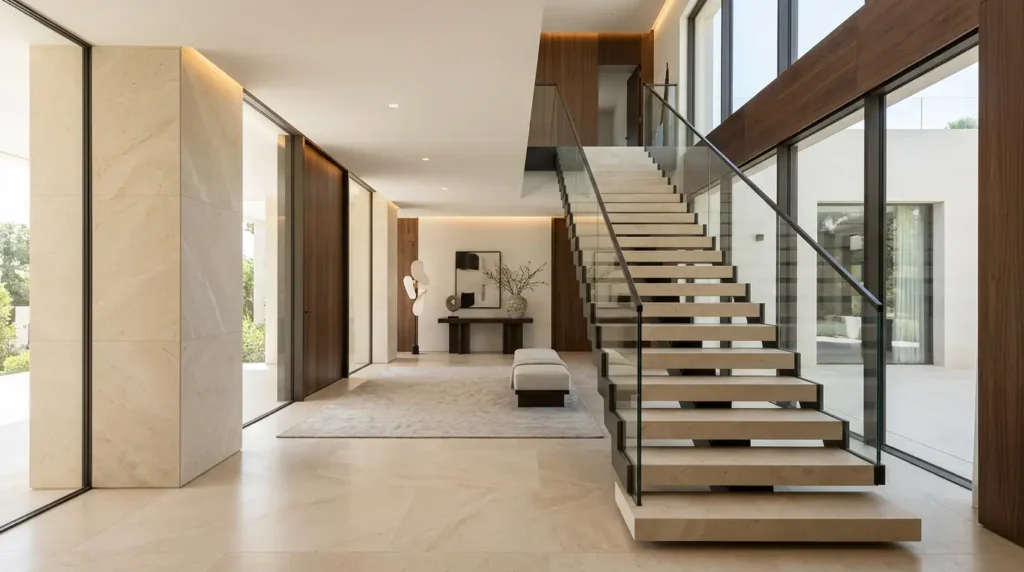
Few beige natural stones have achieved the international recognition of Crema Marfil marble.
For decades, its warm cream-to-beige coloration has made it a familiar material in:
- hotels
- villas
- luxury residences
- commercial interiors
- bathrooms
- entrance halls
- staircases
- large flooring projects
Its appeal comes from restraint.
Crema Marfil does not usually depend on dramatic black, violet or gold veining to create an impression.
Instead, the stone can offer:
- warm cream coloration
- relatively consistent natural backgrounds
- subtle mineral movement
- occasional calcite veins
- natural fossil and sedimentary details
- architectural continuity
This makes it particularly useful when natural stone must cover a significant surface without becoming the dominant pattern in the room.
There is also an important geological distinction.
Although internationally traded as Crema Marfil marble, the material is geologically a limestone rather than a metamorphic marble.
Geological documentation from southeastern Spain describes Crema Marfil as an Eocene ornamental limestone from the Alicante region, while scientific studies identify it more specifically as a well-cemented bioclastic limestone.
This does not make the commercial name incorrect within the natural stone industry.
It simply means architects and buyers should understand the difference between:
commercial stone classification
and
geological classification.
What Is Crema Marfil Marble?
Crema Marfil is a premium beige natural stone traditionally associated with southeastern Spain.
The principal geological deposits occur in Alicante Province around areas including:
- Pinoso
- Algueña
- La Romana
- Monóvar
with the Monte Coto area being particularly associated with major extraction. Spanish geological records identify the Eocene limestone formations of this region as the source of the ornamental material commercially known as Crema Marfil.
Geologically, it is generally described as:
- fine-grained
- calcite-rich
- compact
- bioclastic
- cream-colored limestone
rather than a metamorphic marble.
The material can nevertheless accept a polished finish and has historically been grouped commercially with marble.
Why Is It Called Crema Marfil?
The name reflects its visual character.
Crema refers to the cream coloration.
Marfil means ivory in Spanish.
A typical selection therefore falls somewhere within a palette of:
- cream
- ivory
- pale beige
- warm beige
- light honey-beige
However, genuine natural stone is not a standardized paint color.
Actual pieces may vary in:
- background tone
- vein intensity
- fossil content
- calcite markings
- darker mineral features
- stylolitic lines
This variation is important when selecting material for large projects.
What Does Crema Marfil Look Like?
Crema Marfil is generally known for a relatively calm background.
Possible characteristics include:
- uniform cream field
- ivory-beige background
- fine pale veins
- subtle darker beige lines
- irregular calcite veins
- small fossil structures
- occasional stylolites
- light mineral clouds
Some selections are exceptionally clean.
Others display significantly more natural movement.
This means two slabs sold under the same commercial name can create quite different interiors.
Calm vs Expressive Crema Marfil
For project planning, it is useful to think of the material as a visual range.
Cleaner Selection
May offer:
- uniform cream background
- minimal veins
- limited tonal variation
- fewer visible natural markings
This can be particularly suitable for:
- large hotel floors
- minimalist interiors
- luxury retail
- large wall panels
Balanced Selection
May include:
- cream background
- occasional pale veins
- subtle fossils
- controlled natural variation
This can work very well for:
- residential flooring
- bathrooms
- stairs
- hospitality interiors
More Expressive Selection
May show:
- stronger calcite veins
- visible stylolites
- more fossil detail
- greater tonal variation
This material may suit designs that want the stone to appear more obviously geological.
No category is automatically superior.
The correct selection depends on the intended architecture.
Crema Marfil Is Geologically Limestone
This point is important for accurate natural stone specification.
Official Spanish geological documentation identifies Crema Marfil as Eocene limestone from the Alicante region.
Scientific literature describes it as a well-cemented bioclastic limestone even though it is commercially sold as marble.
This distinction helps explain some of the natural features commonly visible in the stone, including:
- fossil fragments
- sedimentary structures
- stylolites
- calcite veins
It also reinforces the importance of evaluating the actual material rather than making assumptions based only on the word “marble.”
Stylolites in Crema Marfil
One geological feature deserves particular attention.
Crema Marfil may contain stylolites.
These are irregular natural seams formed within limestone under pressure during geological development.
They may appear as:
- dark fine lines
- serrated seams
- brownish markings
- irregular linear structures
Stylolites can be visually attractive, but some may also behave as natural discontinuities.
Research on Crema Marfil specifically identifies several types of stylolitic and calcitic discontinuities and notes their importance during stone processing.
For architects, this means a visually interesting line should not automatically be treated simply as decoration.
For fabrication, important components should be evaluated according to the actual slab.
Crema Marfil for Flooring
Flooring is one of the most established uses of Crema Marfil.
Its warm, restrained appearance makes it particularly effective over large areas.
Possible applications include:
- hotel lobbies
- villa floors
- residential living rooms
- entrance halls
- commercial interiors
- corridors
- restaurants
- executive offices
The stone provides enough variation to remain natural while generally being calm enough for large continuous surfaces.
Why Crema Marfil Works on Large Floors
Imagine a hotel lobby covering 1,000 square meters.
A highly veined marble repeated over the complete floor might create a large amount of visual movement.
Crema Marfil can provide a quieter alternative.
A carefully selected floor can appear:
- warm
- continuous
- sophisticated
- substantial
without competing with:
- furniture
- artwork
- reception desks
- lighting
- decorative wall stone
This ability to act as an architectural background is one of its greatest strengths.
Crema Marfil for Hotel Lobbies
A contemporary lobby could combine:
Crema Marfil flooring
walnut wall panels
warm white plaster
cream furniture
dark bronze metal.
The beige floor becomes the connecting material.
A darker or more dramatic natural stone can then be reserved for:
- reception desk
- fireplace
- bar
- feature wall
This creates a clear hierarchy of materials.
Large-Format Crema Marfil Flooring
Large-format stone pieces can make the material feel more architectural.
Benefits may include:
- fewer joints
- stronger continuity
- greater material scale
- cleaner visual rhythm
Large formats can work particularly well in:
- hotels
- villas
- large residential spaces
- entrance halls
- commercial interiors
However, dimensions should be coordinated with:
- available slab or block dimensions
- material structure
- floor geometry
- handling
- installation
- substrate requirements
Bigger is not automatically better.
Standard Tiles vs Cut-to-Size
Crema Marfil can be supplied in different project formats.
Standard Tiles
Can simplify projects where:
- dimensions repeat
- rooms are relatively regular
- large custom panels are unnecessary
Cut-to-Size
Can provide greater architectural control.
Custom dimensions can align with:
- columns
- doors
- corridors
- wall lines
- staircases
- reception desks
For large projects, custom cutting can make the floor grid feel like part of the architecture rather than an independent tile pattern.
Why the Floor Grid Matters
Stone quality and layout quality are separate issues.
An expensive stone installed with poorly positioned joints can still look unrefined.
Where practical, consider coordinating joints with:
- column centers
- door axes
- major wall lines
- room transitions
- reception geometry
- circulation directions
The objective is visual order.
Avoid Narrow Cut Pieces
A poorly planned floor may finish with a very narrow stone strip along one wall.
This usually indicates that the layout was not considered across the entire room before installation.
Instead, calculate:
- complete room width
- tile dimensions
- joint width
- perimeter cuts
before finalizing the grid.
Balanced edge pieces generally create a cleaner result.
Crema Marfil for Living Rooms
The material can work particularly well in warm contemporary residential interiors.
A restrained palette might use:
Crema Marfil floor
walnut cabinetry
cream upholstery
warm white plaster
black metal details.
The stone supports the rest of the design rather than demanding attention.
Crema Marfil for Villas
Large villas often contain several connected spaces.
Using one natural stone across:
- entrance
- living room
- dining room
- circulation
- stair landings
can create greater continuity.
Crema Marfil is particularly useful for this because its warm neutral coloration can transition comfortably between different furniture and material palettes.
Crema Marfil for Bathrooms
Crema Marfil can create very warm bathroom interiors.
Possible applications include:
- flooring
- wall cladding
- shower walls
- vanity tops
- bathtub surrounds
- shelves
- niches
The material works especially well when the desired atmosphere is:
- warm
- calm
- Mediterranean-inspired
- spa-like
- understated
Contemporary Crema Marfil Bathroom
Crema Marfil does not need a traditional bathroom design.
A contemporary combination might be:
honed Crema Marfil
dark walnut vanity
warm-white plaster
brushed bronze fixtures
minimal lighting.
The warm stone provides depth while the architecture remains clean.
Crema Marfil Shower Walls
Large shower panels reduce joint frequency and allow more of the natural stone surface to remain uninterrupted.
Before cutting, coordinate:
- panel dimensions
- shower controls
- niches
- shelves
- joints
- corners
For natural stone with visible veins or stylolites, these features should also be considered during fabrication planning.
Crema Marfil Vanity Tops
A vanity top can use a particularly clean or interesting area of the slab.
Before cutting, plan:
- basin opening
- faucet holes
- backsplash
- side returns
- front edge
Avoid positioning an important natural feature exactly inside the area that will be removed for the basin.
Crema Marfil for Wall Cladding
Large cream stone panels can make commercial and residential interiors feel substantial without becoming overly decorative.
Potential applications include:
- hotel lobbies
- elevator surrounds
- reception walls
- corridors
- villa entrances
- office receptions
- restaurant interiors
The warm neutral tone allows the material to cover a relatively large area.
Full-Height Wall Panels
Larger panels can create:
- fewer joints
- stronger stone presence
- more natural continuity
- cleaner proportions
Before fabrication, coordinate the wall grid with:
- ceiling heights
- doors
- furniture
- lighting
- sockets
- architectural joints
The panel design should follow the building.
Crema Marfil for Staircases
Crema Marfil is also well suited visually to staircases.
Possible components include:
- treads
- risers
- landings
- skirting
- side cladding
A complete staircase should be reviewed as one composition.
If one group of pieces is considerably darker than another, random installation can create an unintended striped effect.
Stair Selection
When preparing the staircase, consider:
- background tone
- vein density
- stylolites
- tread dimensions
- edge profiles
- finish
The natural stone should be distributed intentionally from the first step to the final landing.
Crema Marfil for Reception Desks
Crema Marfil can also be used for custom reception furniture.
It is particularly effective when the concept requires a quiet light stone rather than a dramatic statement marble.
Possible components include:
- countertop
- front panels
- side panels
- surrounding floor
- background wall
A simple reception desk can combine:
Crema Marfil
dark walnut
bronze.
The result can remain sophisticated without appearing overly ornate.
Crema Marfil for Restaurants
Warm cream stone works naturally under hospitality lighting.
Applications can include:
- flooring
- bar fronts
- bathroom vanities
- host desks
- wall panels
- selected tabletops
Warm artificial lighting can deepen beige tones.
For this reason, stone samples should be reviewed under the intended lighting whenever possible.
Crema Marfil for Custom Furniture
Possible custom elements include:
- dining tables
- coffee tables
- consoles
- benches
- side tables
- display plinths
Because the material is relatively neutral, a stone table can appear substantial without dominating the room.
Polished Crema Marfil
Polishing is one of the finishes most traditionally associated with Crema Marfil.
A polished surface can appear:
- richer
- warmer
- deeper
- more reflective
- more formal
Natural fossil and vein details may also become more visible.
Polished Crema Marfil can work particularly well for:
- lobby floors
- wall panels
- vanity tops
- entrance halls
- furniture
Honed Crema Marfil
Honing reduces surface reflection.
This can make the material appear:
- softer
- slightly lighter
- more contemporary
- less formal
- more architectural
Honed Crema Marfil works particularly well with:
- walnut
- oak
- warm plaster
- linen
- matte metal
This finish can make a stone historically associated with traditional luxury feel much more contemporary.
Polished or Honed?
The choice depends on the design.
Polished
Consider when you want:
- higher reflection
- deeper cream coloration
- formal luxury
- stronger mineral definition
Honed
Consider when you want:
- lower reflection
- contemporary interiors
- quieter stone character
- softer lighting
Compare the same selection in both finishes if possible.
Two different slabs are not a reliable finish comparison.
Brushed Crema Marfil
A brushed surface introduces additional texture.
It can make the stone feel:
- more tactile
- less formal
- more natural
- more responsive to side lighting
This can work in contemporary or rustic-modern interiors.
Actual finish samples should be approved because the intensity of brushing can vary.
Polished Crema Marfil and Lighting
Polished cream stone can reflect a significant amount of artificial lighting.
In large commercial interiors, this can create:
- stronger brightness
- reflections of ceiling lights
- greater visual depth
But excessive reflection can also produce glare.
Lighting design should therefore be coordinated with the finish.
How Lighting Changes Crema Marfil
Warm beige stone reacts strongly to color temperature.
Natural Daylight
Can reveal:
- actual cream background
- pale calcite lines
- subtle fossils
- natural tonal variation
Warm Artificial Light
May emphasize:
- cream
- honey
- warm beige
- light caramel
Cool Artificial Light
May make the stone appear:
- paler
- greyer
- less warm
For large hospitality projects, sample review under final lighting conditions can prevent unexpected color changes.
Avoid Excessively Yellow Lighting
Crema Marfil already contains natural warmth.
Very yellow artificial lighting can make the material look:
- yellow
- orange
- dated
A balanced warm-neutral lighting temperature can preserve the cream coloration without exaggerating it.
Crema Marfil + Walnut
One of the most reliable combinations.
Crema Marfil provides:
- cream
- warm mineral texture
- natural continuity
Walnut provides:
- darker brown contrast
- wood grain
- additional warmth
This pairing works in:
- hotels
- villas
- restaurants
- bathrooms
- offices
Crema Marfil + Light Oak
Light oak creates a softer palette.
The combination works particularly well in:
- spa interiors
- contemporary residences
- bedrooms
- bathrooms
- boutique hospitality
The result can feel light without becoming visually cold.
Crema Marfil + Warm White
Warm white provides a subtle transition from beige stone.
Use it on:
- plaster walls
- ceilings
- cabinetry
- furniture
This creates a low-contrast interior where material texture becomes more important than color contrast.
Crema Marfil + Black
Black details can modernize the stone considerably.
Possible applications include:
- window profiles
- lighting
- furniture frames
- handles
- bathroom fixtures
A relatively small amount of black can create enough definition.
Crema Marfil + Bronze
Brushed bronze complements the warm palette naturally.
Use it for:
- lighting
- bathroom fixtures
- furniture details
- handles
- decorative profiles
Avoid excessive bright gold.
The stone already provides natural warmth.
Crema Marfil + Dark Brown Marble
A calm cream floor can form an excellent background for a dark brown or black statement stone.
For example:
Crema Marfil floor
dark stone reception desk
creates immediate hierarchy.
This can be very effective in hotels.
Crema Marfil + Rosso Levanto
Cream and burgundy create a strong warm contrast.
A design might use:
Crema Marfil flooring
Rosso Levanto feature wall
or:
Crema Marfil bathroom surfaces
small Rosso Levanto vanity detail.
Because both materials are warm, neutral plaster or dark wood can help balance the palette.
Crema Marfil + Sahara Noir
The contrast between cream and black can create a highly architectural result.
For example:
Crema Marfil floor
Sahara Noir reception counter
can make the black stone appear much more dramatic.
This is often more effective than using dark stone throughout the entire interior.
Crema Marfil + Afyon White
The combination creates subtle tonal layering.
Afyon White provides:
- more brightness
- cleaner white contrast
Crema Marfil provides:
- warmth
- cream coloration
The stones should usually occupy different architectural roles so their distinction remains intentional.
Crema Marfil + Travertine
Cream travertine can sit within a similar color palette, but its texture is different.
Travertine generally provides:
- natural pores
- sedimentary layering
- vein-cut or cross-cut patterns
Crema Marfil generally provides:
- denser surface
- finer structure
- fossil and stylolitic details
- stronger polish potential
Using both materials can work when texture clearly differentiates them.
Crema Marfil vs Burdur Beige
Both can provide warm beige architectural surfaces.
However, they are different natural stones from different geological regions.
Crema Marfil
Is associated with:
- Alicante, Spain
- Eocene limestone
- cream-to-ivory coloration
- fossil and stylolitic structures
Burdur Beige
Is associated with:
- Türkiye
- Turkish beige natural stone tradition
- its own distinct color and vein range
Actual slabs should be compared rather than assuming all beige stones are visually interchangeable.
Crema Marfil vs Diana Royal
Both can occupy a similar warm architectural palette.
The important comparison should include:
- background shade
- vein structure
- stone availability
- dimensions
- finish
- project quantity
Diana Royal can present its own Turkish beige character, while Crema Marfil is tied to the Alicante limestone formations of Spain.
Neither is universally better.
Crema Marfil vs Ivory Travertine
This is a useful comparison because the color can sometimes be similar.
Crema Marfil
Typically provides:
- compact cream surface
- finer natural movement
- fossil details
- calcite veins
Ivory Travertine
Typically provides:
- pores
- sedimentary layering
- stronger directional appearance when vein cut
Choose according to whether the project needs:
a compact cream stone
or
a more textured layered stone.
Crema Marfil vs Beige Porcelain
A manufactured beige surface may imitate the color of natural stone.
But the material experience is different.
Real Crema Marfil may contain:
- unique fossil details
- natural calcite veins
- stylolites
- tonal changes
- non-repeating geological structures
A manufactured surface may provide greater repetition and consistency.
The project must decide whether it values:
geological authenticity
or
manufactured uniformity.
How to Select Crema Marfil
Large-project selection should be systematic.
1. Define the Background Tone
Do you want:
- pale ivory
- light cream
- medium cream-beige?
2. Define Acceptable Veining
Should it be:
- very clean
- lightly veined
- naturally expressive?
3. Define Stylolite Tolerance
Some projects may accept visible natural seams.
Others require a cleaner appearance.
4. Define Fossil Content
Visible fossils may be desirable or undesirable depending on the design.
5. Select the Finish
Polished, honed or textured?
6. Define Dimensions
Standard tiles or project-specific sizes?
7. Review Actual Material
Never approve a major quantity based only on one small sample.
Full-Slab Photography
For slab projects, full photographs provide much more useful information than small samples.
They show:
- overall color
- vein location
- stylolites
- fossils
- dimensions
- usable areas
A small sample may accidentally appear completely uniform even when the complete slab contains stronger natural markings.
Small Samples Can Be Misleading
Imagine a 10 × 10 cm sample cut from the cleanest area.
The client may expect the complete project to have no visible natural lines.
That expectation may be unrealistic.
Another small sample may contain one stylolite and make the stone look much more marked than the overall selection.
Representative approval requires a broader visual reference.
Large Project Selection
For a project requiring 2,000 m², the specification should not simply say:
Crema Marfil marble.
A more useful visual specification may include:
- light cream background
- controlled tonal variation
- limited dark stylolites
- moderate pale calcite veins
- honed finish
- defined dimensions
This provides a much clearer production target.
Natural Variation Is Normal
Natural limestone is geological.
Variation can occur in:
- cream tone
- fossil concentration
- vein intensity
- stylolite visibility
- mineral structure
The objective is not to make every piece identical.
The objective is to keep the final installation within an approved range.
Dry Layout for Flooring
For significant flooring projects, pieces can be reviewed before final installation.
This allows the team to distribute:
- lighter pieces
- darker pieces
- vein-heavy pieces
- cleaner pieces
across the floor more intentionally.
The objective is visual balance.
Do Not Install One Crate at a Time Without Review
A single crate may contain material with a slightly different tone.
Installing it all in one area can create a visible patch.
For important projects, material from different crates can be reviewed and distributed according to the agreed layout.
Piece Numbering
Custom stone components can be numbered according to architectural drawings.
A useful system links:
drawing
→
piece number
→
crate
→
installation position.
This is particularly useful for:
- stairs
- wall panels
- custom flooring
- bathroom panels
- reception desks
Cutting Layout
For slab-based fabrication, prepare a cutting layout.
The process can include:
- Finalize dimensions.
- Photograph actual slabs.
- Position components over slab images.
- Review veins and stylolites.
- Mark openings.
- Review corners.
- Confirm material yield.
- Approve.
- Fabricate.
This prevents avoidable surprises.
Material Yield
Material price per square meter does not tell the complete story.
A slab may have:
- beautiful color
- difficult natural discontinuities
- inefficient dimensions
while another slab may provide better usable yield.
The real project cost depends partly on how many required pieces can actually be produced.
Natural Discontinuities and Fabrication
Scientific research on Crema Marfil highlights the importance of stylolites and other discontinuities during fabrication.
Studies have identified open, partially open and cemented stylolites as well as calcitic veins within the material.
This does not mean Crema Marfil is unsuitable for architectural fabrication.
It means:
the actual slab must be evaluated.
Particularly sensitive designs may include:
- long thin strips
- narrow bridges
- large openings
- very thin panels
Fabrication methods should respond to the stone being processed.
How to Clean Crema Marfil
Crema Marfil is calcium-carbonate based.
This means acidic cleaning products should be avoided.
Natural stone care guidance distinguishes calcareous stones from siliceous stones specifically because calcareous materials are much more sensitive to acidic cleaners.
For routine care:
- Remove loose dust and grit.
- Clean spills promptly.
- Use soft cloths or appropriate mops.
- Use a pH-neutral product suitable for natural stone.
- Avoid acidic cleaners.
- Avoid aggressive abrasives.
- Follow the maintenance requirements of the selected finish.
Can You Use Vinegar on Crema Marfil?
No.
Vinegar is acidic.
Crema Marfil is a calcite-rich limestone.
Acid can react with calcium carbonate and alter the stone surface.
Possible effects include:
- dull marks
- loss of polish
- lighter areas
- changed texture
This reaction is known as etching.
Can Lemon Damage Crema Marfil?
Yes.
Lemon contains acid.
For the same reason as vinegar, it can react with calcium-carbonate stone.
Particular care is therefore necessary around:
- vanity tops
- bars
- dining tables
- kitchen surfaces
Spills should be removed promptly.
What Is Etching?
Etching is a chemical change to the surface.
It is not simply dirt sitting on top of the stone.
Acid reacts with calcium carbonate and changes the finish.
On a polished Crema Marfil surface, an etched area can appear:
- matte
- cloudy
- lighter
- less reflective
Ordinary cleaning may not restore the original finish.
Crema Marfil for Kitchen Countertops
Crema Marfil can visually work in kitchens, but the user should understand the behavior of calcium-carbonate stone.
Kitchen surfaces are exposed to:
- lemon
- vinegar
- wine
- tomato-based foods
- acidic cleaning products
For clients expecting a surface that remains visually unchanged despite acid exposure, a calcium-carbonate natural stone may not match those expectations.
For clients who understand natural patina and appropriate care, it may remain a viable design option.
Should Crema Marfil Be Sealed?
There is no universal treatment schedule that applies to every installation.
An appropriate impregnating product may reduce the penetration of certain liquids.
However, impregnating treatments do not create a completely impermeable surface.
Natural stone guidance explains that impregnators act within microscopic spaces in the material and function more accurately as repellents rather than absolute seals.
The treatment should be selected according to:
- actual material
- finish
- application
- exposure
- maintenance requirements
Does Sealing Make Crema Marfil Acid-Proof?
No.
This distinction is critical.
Improving resistance to liquid penetration does not remove the chemical sensitivity of calcium carbonate.
Even treated Crema Marfil can still react with:
- vinegar
- lemon
- acidic drinks
- acidic cleaners
An impregnating treatment should never be presented as acid protection.
Dust and Grit on Floors
Sand and grit can mechanically abrade stone flooring over time.
For large commercial installations, maintenance planning should include:
- effective entrance mats
- regular dust removal
- appropriate cleaning tools
- suitable stone cleaners
The maintenance plan should begin before the floor opens to traffic.
High-Traffic Applications
A luxury residential bathroom and an international hotel lobby experience completely different service conditions.
For busy floors, consider:
- material selection
- finish
- expected traffic
- entrance protection
- cleaning schedule
- maintenance
- spare material
- installation
A successful commercial stone floor is a system.
The stone is only one component.
Keep Spare Material
For large projects, retain some material from the original supply if practical.
Several years later, new material may differ in:
- cream tone
- fossil content
- vein structure
- stylolites
- finish
Having original replacement pieces can be valuable for:
- maintenance
- repairs
- later architectural changes
Crema Marfil and Underfloor Heating
Natural stone can be incorporated into heated floor systems when the complete assembly is properly engineered.
Consider:
- substrate
- stone thickness
- piece dimensions
- adhesive
- movement joints
- heating system
- installation procedures
Do not evaluate the complete assembly solely according to the commercial stone name.
Exterior Applications
Crema Marfil is historically associated primarily with architectural interior and ornamental use, although project applications can vary.
Exterior suitability should never be assumed only because the material is natural stone.
An exterior specification should consider:
- actual stone
- climate
- moisture exposure
- temperature cycles
- panel dimensions
- finish
- fixing method
- test data
- local requirements
The specific technical project should determine suitability.
Common Mistakes with Crema Marfil
1. Assuming It Is Geologically a Metamorphic Marble
Commercially it is called marble, but geologically it is an Eocene limestone.
2. Expecting Every Piece to Have the Same Beige Tone
Natural variation exists.
3. Approving a Large Quantity from One Small Sample
One sample cannot represent thousands of square meters.
4. Ignoring Stylolites
They can influence both appearance and fabrication.
5. Installing Crate by Crate Without Reviewing Shade
This can create visible tonal zones.
6. Choosing Finish Only from Photographs
Real polished and honed samples provide a better comparison.
7. Using Acidic Cleaners
Calcareous stone is sensitive to acids.
8. Assuming Sealing Makes the Stone Acid-Proof
It does not.
9. Using Beige Stone Without Material Contrast
An entirely cream room can become visually flat.
10. Comparing Only Price per Square Meter
Selection, dimensions, fabrication yield and project organization also matter.
How to Plan a Crema Marfil Project
A practical workflow is:
1. Define the Application
Floor, bathroom, staircase, wall or furniture?
2. Determine Quantity
Include appropriate allowance for cutting and project requirements.
3. Define the Cream Range
Light ivory, classic cream or warmer beige?
4. Define Natural Marking Tolerance
How many veins, fossils and stylolites are acceptable?
5. Choose the Finish
Polished, honed or textured?
6. Determine Dimensions
Standard tiles or custom project sizes?
7. Review Representative Material
Use larger references for large orders.
8. Develop the Layout
Coordinate joints with the architecture.
9. Pre-Arrange Important Areas
Especially large floors and wall installations.
10. Number Custom Pieces
Where necessary.
11. Inspect Before Packing
Verify:
- dimensions
- finish
- selection
- piece numbers
- visible condition
- packing
Is Crema Marfil Good for Large Projects?
Its restrained visual character can make it particularly effective for substantial architectural projects.
Potential applications include:
- hotels
- villas
- residential developments
- restaurants
- corporate interiors
- luxury apartments
- public interiors
For large quantities, define an approved range rather than expecting every piece to be identical.
A project specification may define:
- cream tone
- permitted vein density
- stylolite tolerance
- fossil tolerance
- finish
- dimensions
This creates much clearer expectations.
Why Crema Marfil Still Works in Contemporary Architecture
Crema Marfil is sometimes associated with highly polished traditional beige interiors.
That is only one way to use it.
Consider instead:
large-format honed Crema Marfil
dark walnut
warm mineral plaster
charcoal metal
minimal furniture.
The result can feel completely contemporary.
The architectural language determines whether the material feels traditional or modern.
Beige Does Not Have to Look Dated
The problem is rarely beige itself.
The problem is usually the complete combination.
For example:
polished beige stone
yellow lighting
ornamental gold
heavy furniture
creates one visual language.
But:
honed cream stone
walnut
warm-white plaster
black details
clean geometry
creates another.
The same color family can produce very different architecture.
Use Crema Marfil as the Supporting Stone
One of its strongest roles is as an architectural base.
Imagine:
Crema Marfil floor
dramatic green marble fireplace
or:
Crema Marfil lobby
black marble reception desk.
The cream stone provides enough warmth and natural material quality without competing with the feature stone.
This allows the more dramatic material to have greater impact.
Final Thoughts
Crema Marfil marble remains one of the best-known cream natural stones in international architecture.
Its principal deposits are associated with Alicante Province in southeastern Spain, particularly the Pinoso–Monte Coto region.
Despite its commercial marble name, geological research identifies Crema Marfil as a fine-grained, calcite-rich Eocene limestone with bioclastic characteristics, calcite veins and naturally occurring discontinuities such as stylolites.
Its architectural strength comes from restraint.
Crema Marfil can provide:
- warm cream coloration
- subtle mineral movement
- continuity across large surfaces
- natural geological variation
- compatibility with many other materials
It can be considered for:
- flooring
- bathrooms
- wall cladding
- hotel lobbies
- villas
- staircases
- reception areas
- restaurants
- custom furniture
But a successful project requires more than specifying the name.
The design should consider:
actual material selection
cream color range
natural veins and stylolites
finish
dimensions
layout
fabrication
installation
maintenance.
Review representative material.
Define the acceptable visual range.
Coordinate stone joints with the architecture.
Select polished or honed finishes under realistic lighting.
Understand natural discontinuities before fabrication.
Avoid acidic cleaning products.
And do not expect an impregnating treatment to make calcium-carbonate stone completely stain-proof or acid-proof.
When Crema Marfil is used with disciplined detailing and a contemporary supporting palette, its warm neutral character can remain highly relevant without relying on temporary design trends.
Frequently Asked Questions
What is Crema Marfil marble?
Crema Marfil is a cream-colored Spanish natural stone commercially classified as marble. Geologically, it is an Eocene calcite-rich limestone.
Where does Crema Marfil come from?
Its principal deposits are associated with Alicante Province in southeastern Spain, including the Pinoso, Algueña, La Romana and Monóvar areas.
Is Crema Marfil real marble?
Commercially, it belongs to the marble category. Geologically, it is more accurately classified as limestone rather than metamorphic marble.
What color is Crema Marfil?
It typically ranges from ivory cream to warm beige, with possible pale calcite veins, fossil structures and darker natural seams.
What are the dark lines in Crema Marfil?
Some dark or irregular lines may be natural stylolites formed during geological development. Crema Marfil research identifies several types of stylolitic discontinuities in the stone.
Can Crema Marfil be used for flooring?
Yes. Flooring is one of its established architectural applications, particularly where a warm and relatively restrained natural stone is desired.
Can Crema Marfil be used in bathrooms?
Yes. It can be considered for floors, walls, vanities and other bathroom components with suitable installation and care.
Is polished or honed Crema Marfil better?
Neither is universally better. Polished material provides stronger reflection and deeper color, while honed Crema Marfil creates a softer and generally more contemporary appearance.
Can Crema Marfil be used for kitchen countertops?
It can be used, but users should understand that it is calcium-carbonate based and can react with acidic foods and cleaners.
Can vinegar damage Crema Marfil?
Yes. Calcareous stones are sensitive to acidic cleaners, and vinegar can etch the surface.
Does sealing make Crema Marfil acid-proof?
No. Impregnating treatments can reduce the penetration of certain liquids but do not remove the stone’s chemical sensitivity to acids.
Should Crema Marfil be selected from a small sample?
For significant projects, larger representative samples, slab photographs or project-range approvals are preferable because a small sample cannot represent the full natural variation.
Looking for Crema Marfil Marble for Your Project?
VeraMarbles can support residential, hospitality and commercial projects requiring Crema Marfil natural stone.
Send us your:
- required quantity
- application
- dimensions
- thickness
- preferred finish
- desired cream selection
- acceptable natural variation
- architectural drawings
- project location
We can support your project with:
- material selection
- color-range control
- slabs
- tiles
- custom cutting
- floor and wall layout planning
- pre-installation arrangement
- piece numbering
- packing coordination
- quality control before shipment
Request a Quote from VeraMarbles