
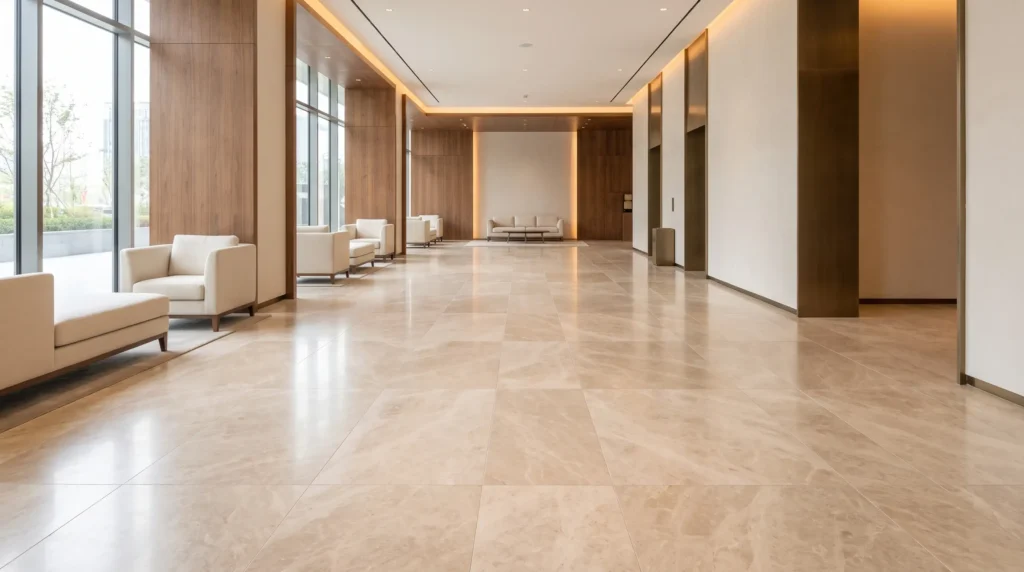
Beige marble has a very different role in architecture from highly veined statement stones.
It is usually not selected because the floor should dominate the entire room.
Instead, it is selected because it can create a warm, continuous natural surface that allows the rest of the architecture to work around it.
Burdur Beige marble flooring is a strong example of this approach.
Its characteristic cream-to-beige coloration, relatively restrained natural movement and warm overall appearance make it particularly suitable for interiors where the floor needs to feel refined without becoming visually overwhelming.
Burdur Beige is a natural marble associated with Burdur Province in Türkiye, including quarrying areas around Bucak.
It can be considered for projects such as:
- hotel lobbies
- luxury residences
- villas
- living rooms
- entrance halls
- corridors
- restaurants
- offices
- bathrooms
- retail interiors
- large commercial spaces
The final result, however, depends on much more than simply choosing a beige marble.
For a successful floor, the project should also consider:
- material selection
- background color
- tonal variation
- vein density
- tile dimensions
- slab dimensions
- polished or honed finish
- joint layout
- cutting plan
- dry layout
- installation
- lighting
- maintenance
What Is Burdur Beige Marble?
Burdur Beige is a Turkish natural marble known for its warm beige and cream coloration.
Commercial selections can vary from:
- pale cream
- light ivory beige
- warm beige
- medium beige
- slightly caramel-toned beige
Natural movement may include:
- fine cream veins
- light beige clouds
- subtle white lines
- slightly darker mineral movement
- occasional fossil-like or mineral details depending on the selection
The overall impression is generally much quieter than highly veined white marbles.
This is precisely why Burdur Beige can work effectively across large floor areas.
Instead of creating a strong graphic pattern, it can create a continuous mineral background.
Why Is Burdur Beige Popular for Flooring?
A successful flooring stone needs to work at architectural scale.
A small sample may look attractive on a desk, but the real question is:
How will the material look across 100, 500 or 2,000 square meters?
Burdur Beige can be particularly suitable for large floors because its warm neutral palette can create visual continuity without excessive contrast.
A well-selected installation can provide:
- warmth
- natural variation
- architectural consistency
- a premium material character
- a calm foundation for furniture and lighting
This is useful in projects where the stone needs to support the design rather than compete with it.
Burdur Beige for Hotel Lobby Flooring
Hotel lobbies are one of the strongest applications for beige marble.
The floor often occupies one of the largest visible surfaces in the entire interior.
A successful lobby floor must work with:
- reception desks
- seating areas
- columns
- lighting
- elevators
- circulation routes
- wall finishes
- decorative elements
Using an extremely dramatic floor can make all these elements compete visually.
Burdur Beige offers another strategy.
The floor can remain warm and luxurious while allowing stronger materials to be used selectively elsewhere.
For example:
Burdur Beige flooring
walnut reception desk
warm white plaster
brushed bronze details
can create a sophisticated hospitality interior without requiring excessive decoration.
Burdur Beige for Large Commercial Floors
Large commercial projects require more than attractive marble.
Consistency becomes critical.
Imagine a project requiring 3,000 m² of flooring.
One beautiful slab or tile does not prove that the complete quantity will create a coherent floor.
The project should evaluate:
- overall background range
- lighter pieces
- darker pieces
- vein density
- block-to-block variation
- finish consistency
- dimensional accuracy
For large projects, an approved visual range is more useful than simply requesting:
“Burdur Beige.”
The commercial stone name identifies the general material.
It does not completely define the final selection.
Burdur Beige for Living Room Floors
A warm beige marble floor can work particularly well in large living rooms and open-plan residential spaces.
It can form a continuous base across:
- living area
- dining area
- entrance
- circulation zones
without requiring a different flooring material in every space.
A contemporary combination could include:
Burdur Beige floor
natural walnut
cream upholstery
warm white walls
soft architectural lighting
The result can feel warm and substantial without becoming excessively decorative.
Burdur Beige for Villas
Large villas often contain several connected spaces.
A continuous natural stone floor can visually connect:
- entrance hall
- living room
- dining room
- corridors
- staircase zones
Using the same material across these spaces can create a stronger architectural identity.
Burdur Beige is particularly useful when the project already includes other strong elements such as:
- dark wood
- decorative marble
- large artworks
- custom furniture
- statement lighting
The beige floor can provide a quieter foundation beneath them.
Burdur Beige for Entrance Halls
Entrance areas establish the first material impression of a building.
Beige marble can make the space feel:
- warm
- substantial
- bright
- refined
For larger entrances, large-format pieces can reduce the visual frequency of joints.
For smaller entrance halls, medium formats may make installation easier around:
- doors
- columns
- corners
- stairs
The format should follow the architecture rather than being selected independently.
Burdur Beige for Corridors
Long corridors reveal poor stone distribution very quickly.
If the material is installed without tonal planning, the floor may show:
- a group of very light tiles
- followed by darker tiles
- followed by another light group
This creates visual bands that may not have been intended.
For corridors, the stone should be distributed so that natural variation appears controlled across the full length of the space.
Pre-arranging the material before installation can help achieve this.
Burdur Beige in Bathrooms
Burdur Beige can also work well in warm contemporary bathrooms.
Possible applications include:
- flooring
- wall cladding
- vanity tops
- shower walls
- bathtub surrounds
- shelves
- custom stone details
A bathroom can combine:
Burdur Beige
walnut cabinetry
warm white surfaces
brushed metal details
to create a calm spa-like atmosphere.
For wet floor areas, the finish and slip requirements must be evaluated according to the specific application.
Appearance should never be the only factor.
Polished Burdur Beige
Polishing increases surface reflection.
A polished Burdur Beige floor can appear:
- richer in color
- more reflective
- more formal
- more luxurious
- visually deeper
Polishing can also increase the visibility of subtle natural movement.
It may be appropriate for spaces such as:
- formal hotel lobbies
- reception areas
- residential entrance halls
- luxury living rooms
- selected commercial interiors
However, the required surface performance must be considered for the specific application.
Honed Burdur Beige
A honed finish has lower reflection.
It generally creates:
- a softer appearance
- more contemporary character
- reduced glare
- quieter color
- greater emphasis on the natural material rather than shine
Honed Burdur Beige can work especially well with:
- natural wood
- mineral plaster
- linen
- matte metal
- contemporary furniture
For minimalist interiors, a honed surface can make beige marble feel much more architectural.
Polished or Honed Burdur Beige?
Neither finish is automatically better.
The choice depends on the atmosphere and technical requirements of the project.
Consider Polished When You Want:
- stronger reflection
- a formal appearance
- deeper visual color
- more traditional luxury
Consider Honed When You Want:
- lower reflection
- a softer surface
- contemporary architecture
- a quieter material palette
Ideally, compare the same material in both finishes.
Photographs of two different slabs are not a reliable finish comparison because natural variation may affect the result.
How Lighting Changes Burdur Beige
Beige marble reacts strongly to lighting temperature.
Warm Lighting
Can emphasize:
- cream
- honey-beige
- warm taupe
- subtle caramel tones
Cool Lighting
Can make the same material appear:
- lighter
- greyer
- less warm
- more neutral
This matters especially in hotels, restaurants and retail spaces where artificial lighting may be used throughout most of the day.
A stone sample should ideally be reviewed under lighting similar to the planned interior.
Natural Daylight
Natural daylight changes throughout the day.
Morning light, strong midday light and late-afternoon light can create very different impressions.
Large windows can make Burdur Beige appear:
- lighter during the day
- warmer in direct sunlight
- deeper under side lighting
For a large architectural project, sample review should not happen only under showroom lighting.
Choosing the Right Tile Size
Tile format has a major impact on the final appearance of a marble floor.
The same stone can look completely different in small tiles and large-format pieces.
Small and Medium Formats
These may be useful for:
- smaller rooms
- bathrooms
- irregular floor plans
- spaces with many corners
They also create more joints.
If the stone is very calm and consistent, the joint pattern may become the dominant visual grid.
Large Formats
Larger pieces can:
- reduce the number of joints
- create greater continuity
- make the material feel more substantial
- better display natural variation
They can be particularly appropriate for:
- hotel lobbies
- large living rooms
- entrance halls
- commercial spaces
But larger dimensions also require careful evaluation of:
- material properties
- handling
- substrate
- fabrication
- installation
Custom Cut-to-Size Flooring
For architectural projects, custom dimensions can be developed around the actual geometry of the building.
This allows the floor grid to align with:
- doors
- columns
- wall lines
- reception desks
- staircases
- circulation axes
- changes in material
This often produces a much more intentional result than selecting a standard tile size first and forcing the architecture to adapt to it.
Why Joint Layout Matters
A premium marble does not automatically create a premium floor.
Poorly positioned joints can make even excellent stone look unplanned.
Consider aligning floor joints with:
- door centers
- column axes
- major wall lines
- transitions between spaces
- large furniture elements
- architectural grids
The floor should become part of the building geometry.
Avoid Narrow Edge Pieces
A common flooring mistake is creating very narrow stone strips along one side of a room.
This usually happens when the layout starts from a wall without considering the complete floor dimensions.
Instead, calculate the grid before installation.
The objective may be to distribute cut pieces more evenly around the perimeter.
This creates a cleaner visual result.
Dry Layout Before Installation
Dry layout is particularly useful for natural marble flooring.
The pieces are reviewed and arranged before final installation.
This allows the project team to evaluate:
- background color
- tonal variation
- vein distribution
- neighboring pieces
- stronger and quieter areas
- overall visual balance
Natural stone should not necessarily look completely uniform.
The objective is to prevent accidental visual concentration.
Why Random Installation Can Be Risky
Suppose 100 tiles arrive in several crates.
One crate contains slightly darker material.
If the installer finishes the first crate before opening the second, the finished floor may contain a visible darker zone.
Every individual piece may be acceptable.
The overall floor may not be.
For important projects, material from several crates should be reviewed and mixed according to an approved layout strategy.
Piece Numbering
For more complex projects, individual stone pieces can be numbered.
The number can correspond to:
- architectural drawings
- floor zones
- installation sequence
- packing crates
This creates a controlled chain from production to installation.
For custom cut-to-size projects, numbering can significantly reduce confusion on site.
Burdur Beige + Walnut
This is one of the strongest material combinations.
Burdur Beige provides a light warm mineral base.
Walnut adds:
- dark brown depth
- strong organic grain
- warmth
- contrast
The combination works particularly well in:
- hotel lobbies
- villas
- restaurants
- luxury apartments
- offices
A simple palette can be:
Burdur Beige floor
walnut wall panels
warm white walls
cream furniture
Burdur Beige + Light Oak
For a lighter contemporary interior, light oak can be an excellent partner.
This combination creates a softer atmosphere.
It can work particularly well in:
- modern residences
- spa interiors
- bathrooms
- boutique hotels
- relaxed hospitality spaces
The result is less formal than dark walnut but still warm.
Burdur Beige + Warm White
Warm white walls create a subtle transition from the beige floor.
This produces:
- lower contrast
- greater visual continuity
- brighter spaces
- softer interiors
It is particularly effective when the architecture needs to feel calm rather than graphic.
Burdur Beige + Black Details
Black can create contrast against warm beige.
Use it selectively for:
- lighting
- window profiles
- furniture frames
- door handles
- decorative metal elements
Too much black may make the space visually heavier.
A small amount can create enough definition.
Burdur Beige + Bronze
Brushed bronze and similar warm metals can work naturally with beige marble.
Possible uses include:
- lighting
- furniture legs
- handles
- wall profiles
- reception details
A restrained amount of warm metal can make the interior feel refined without becoming overly decorative.
Burdur Beige + Dark Marble
A neutral beige floor can act as the background for a much stronger marble accent.
For example:
Burdur Beige floor
Rosso Levanto reception desk
creates a clear hierarchy.
Or:
Burdur Beige flooring
dramatic white marble feature wall
allows the wall to remain the visual focus.
This is one of the main advantages of a neutral flooring stone.
It gives the designer freedom to use stronger materials elsewhere.
Burdur Beige + Travertine
Beige marble and light travertine can work together, but the combination needs enough visual differentiation.
If both materials have nearly identical colors, the transition may feel accidental.
Differences can be created through:
- texture
- cut direction
- finish
- panel dimensions
For example, a smooth beige marble interior floor can transition to a more textured travertine surface in another architectural zone.
Burdur Beige for Staircases
The material can also be considered for:
- stair treads
- risers
- landings
- skirting
- side cladding
A staircase should be treated as one complete composition.
Important considerations include:
- vein direction
- tonal sequence
- tread dimensions
- edge details
- finish
- joints
Randomly mixing very light and dark pieces can create an inconsistent staircase.
Burdur Beige for Wall and Floor Continuity
Some projects use the same stone on both floors and walls.
This can create a monolithic appearance.
For example, in a hotel entrance:
Burdur Beige floor
can continue onto:
selected Burdur Beige wall panels.
However, it is often better not to cover every surface.
Using stone selectively prevents the architecture from becoming visually flat.
A combination of:
- stone
- plaster
- wood
- glass
usually creates greater material depth.
How to Select Burdur Beige for a Large Floor
A structured selection process is essential.
1. Define the Desired Background
Do you want:
- pale cream
- light beige
- medium beige?
2. Define the Allowed Variation
Should the floor be extremely consistent or naturally varied?
3. Define the Vein Range
Some projects want almost no visible veins.
Others accept more natural movement.
4. Review Representative Material
Do not approve a 1,000 m² project from one small sample.
5. Review Multiple Production Lots When Necessary
Large quantities may require material from multiple blocks.
6. Approve the Finish
The finish changes the apparent color and contrast.
7. Define the Tile or Panel Dimensions
Do this before production.
8. Plan the Layout
Especially for large public spaces.
Selection Categories
Commercial marble can be separated visually into different selection groups.
For Burdur Beige, one selection might prioritize:
- very uniform background
- minimal veining
- minimal tonal variation
Another may allow:
- more visible veins
- natural mineral movement
- broader shade range
Neither is automatically inferior.
They represent different aesthetic requirements.
A natural-looking residential project may even benefit from more variation than a highly controlled commercial interior.
Why Uniformity Is Not the Same as Quality
This distinction is important.
Natural stone quality should not be defined only as:
“Every tile looks identical.”
If perfect repetition is the objective, a manufactured surface may be more suitable.
Natural marble has geological variation.
The goal in a well-managed project is to create a controlled and appropriate visual range.
Floor Layout and Vein Direction
Even a quiet beige marble may contain directional movement.
When several pieces have visible lines, their orientation can affect the entire floor.
Possible strategies include:
Consistent Direction
All stronger veins follow the same general axis.
Controlled Rotation
Pieces are intentionally rotated to reduce directional emphasis.
Architectural Flow
Veins follow the main movement of the room or corridor.
The right approach depends on the actual material.
Choosing Skirting
Skirting can be produced from the same Burdur Beige marble to create a continuous appearance.
Possible approaches include:
- simple straight skirting
- flush stone skirting
- recessed shadow detail
- taller traditional skirting
In contemporary interiors, a simple and precisely detailed solution is often more effective than an overly decorative profile.
Burdur Beige in High-Traffic Areas
Hotels, retail interiors and office lobbies experience significantly more traffic than residential living rooms.
For such projects, specification should consider:
- actual stone characteristics
- finish
- installation system
- entrance mats
- maintenance procedures
- replacement material
- expected traffic
Marble is widely used for floors and foyers, but performance and finish expectations should always be matched to the actual application.
Entrance Mats Matter
Sand, dirt and grit can act as abrasives on stone floors.
Regular dust removal and suitable entrance mats can help reduce this wear.
This is particularly important for:
- hotels
- commercial buildings
- entrances directly connected to exterior areas
A good maintenance strategy begins before the floor is cleaned.
It begins with reducing the amount of abrasive material that reaches the floor.
How to Clean Burdur Beige Marble Flooring
Burdur Beige is marble and should be maintained accordingly.
For routine care:
- Remove dust and grit regularly.
- Clean spills promptly.
- Use a clean, soft mop.
- Use a pH-neutral cleaner suitable for natural stone.
- Rinse appropriately when required.
- Avoid excessive detergent residue.
- Avoid abrasive powders and aggressive cleaning tools.
Calcareous natural stones are sensitive to acidic solutions, and acidic cleaners can dull or etch the surface.
Can You Clean Burdur Beige with Vinegar?
No.
Vinegar is acidic.
Acids can react with marble and alter the surface finish.
The result may appear as:
- dull areas
- loss of polish
- lighter marks
- hazy patches
This is not necessarily a conventional stain.
The finish itself may have been chemically affected.
Avoid Lemon-Based Cleaners
Products containing lemon or other acids should also be avoided on marble.
A product being described as:
natural
does not automatically mean it is suitable for natural stone.
The chemistry of the cleaner matters more than the marketing description.
What Is Etching?
Etching occurs when acid reacts with calcareous stone.
On polished marble, it can appear as a loss of reflection.
An etched area may look like:
- a dull circle
- a pale mark
- a cloudy zone
- a matte spot
Cleaning may not remove it because the problem is not dirt sitting on the surface.
The finish has changed.
Should Burdur Beige Be Sealed?
There is no universal rule saying every marble floor requires the same treatment schedule.
Whether an impregnating treatment is appropriate depends on:
- the specific stone
- finish
- installation
- exposure
- maintenance requirements
An impregnating sealer may improve resistance to certain staining agents, but it does not make natural stone completely stain-proof.
Does Sealer Prevent Acid Etching?
No.
Sealing and acid resistance are different issues.
Even a treated marble can still react with acidic substances.
A sealer should therefore never be treated as permission to use vinegar or acidic cleaning chemicals.
Routine Maintenance for Hotels
A hotel marble floor needs a structured maintenance plan.
That may include:
- frequent dust removal
- entrance mats
- rapid spill response
- suitable cleaning products
- periodic inspection
- professional refinishing when necessary
The goal should not be to wait until the floor looks damaged.
Preventive maintenance generally produces a more consistent appearance over time.
Natural Patina
Real marble changes with use.
A heavily used floor may gradually develop a different surface character from a rarely used wall.
This should be considered during material selection.
Natural stone is not necessarily intended to remain visually frozen in the exact condition it had on installation day.
A properly maintained natural patina can become part of the material’s character.
Burdur Beige for Underfloor Heating
Natural stone is commonly incorporated into heated floor systems, but the complete system must be properly designed.
Important considerations may include:
- substrate
- stone thickness
- adhesive
- movement joints
- heating system
- installation method
Do not specify the floor solely according to the stone name.
The entire assembly must be considered.
Ordering Extra Material
Large flooring projects should normally account for more than the exact net floor area.
Additional material may be required because of:
- cutting
- edge pieces
- breakage
- selection
- future replacement
The correct allowance depends on the project geometry and installation plan.
For major commercial projects, keeping spare material from the original production lot can be particularly valuable.
Natural stone sourced several years later may not match the original floor exactly.
Why Spare Stone Matters
Imagine a hotel lobby after five years.
A service modification requires several floor pieces to be replaced.
If no original material remains, a newly sourced Burdur Beige may differ slightly in:
- background color
- vein density
- finish
- shade
Keeping a documented reserve can make future repairs much easier.
Packing and Site Organization
For custom flooring projects, the stone should be packed systematically.
Crates can be organized by:
- floor
- room
- installation zone
- sequence
Each piece can be labeled according to the approved drawing.
This reduces the need for installers to search through hundreds of unrelated pieces on site.
Burdur Beige vs Diana Royal for Flooring
Both can create warm beige interiors, but their visual character may differ.
Burdur Beige
Can offer:
- classic cream-beige coloration
- relatively calm natural movement
- strong suitability for large neutral surfaces
Diana Royal
May show:
- warmer tonal movement
- more visible vein character in some selections
- a slightly different beige identity
The correct choice should be based on actual material rather than stone name alone.
Compare:
- full slabs
- tiles
- background color
- vein structure
- available quantity
- finish
Burdur Beige vs Tundra Grey
These materials create very different atmospheres.
Burdur Beige
Feels:
- warm
- cream
- welcoming
- softer
Tundra Grey
Feels:
- cooler
- grey
- more restrained
- contemporary
For a project using:
- walnut
- bronze
- cream furniture
- warm lighting
Burdur Beige can fit naturally.
For a project using:
- black metal
- charcoal
- concrete
- cooler palettes
Tundra Grey may integrate more easily.
Burdur Beige vs Afyon White
The main difference is visual brightness and warmth.
Burdur Beige
Offers:
- more beige
- greater warmth
- softer contrast
- stronger connection with warm wood
Afyon White
Offers:
- brighter white
- more visual lightness
- stronger contrast with dark materials
A hotel aiming for a warm hospitality atmosphere may prefer beige.
A highly bright and white interior may prefer Afyon White.
Burdur Beige vs Travertine
Beige marble and ivory travertine may occupy similar color palettes, but they have different geological and visual characters.
Travertine typically shows:
- natural pores
- sedimentary layering
- distinctive vein-cut or cross-cut patterns
Burdur Beige marble generally creates:
- a more crystalline marble surface
- smoother visual continuity
- different natural veining
- a different polished appearance
The choice should depend on the desired architectural language.
Common Mistakes with Burdur Beige Flooring
1. Selecting Only from a Small Sample
A small sample does not show the complete range of the project quantity.
2. Expecting Every Tile to Be Identical
Natural marble contains variation.
3. Installing Crate by Crate Without Mixing
This can create visible tonal zones.
4. Ignoring Joint Layout
Poor joints can weaken an otherwise premium floor.
5. Choosing Format Without Considering the Room
Tile dimensions should respond to architectural geometry.
6. Using Acidic Cleaners
Acids can etch marble.
7. Assuming Sealer Makes Marble Stain-Proof
It does not.
8. Ordering Only the Exact Net Quantity
Projects may require cutting allowance and future replacement material.
9. Choosing Finish Only for Appearance
Functional requirements also matter.
10. Failing to Review the Full Quantity
A large project should establish an acceptable visual range before installation.
How to Plan a Burdur Beige Flooring Project
A practical sequence is:
1. Calculate the Area
Determine the net flooring quantity.
2. Review the Floor Plan
Identify:
- rooms
- corridors
- columns
- stairs
- transitions
3. Select the Desired Visual Range
Define the acceptable beige tone and vein intensity.
4. Choose the Finish
Polished or honed.
5. Determine the Format
Standard tiles or custom dimensions.
6. Develop the Floor Grid
Coordinate it with the architecture.
7. Review Representative Material
For larger projects, review more than one piece.
8. Prepare the Material Distribution
Control tonal variation.
9. Number Custom Pieces
Where necessary.
10. Plan Maintenance Before Opening
Especially for hospitality and commercial spaces.
Is Burdur Beige a Good Choice for Large Projects?
It can be a very effective option when the project requires:
- warm natural marble
- relatively restrained patterning
- a neutral architectural base
- large flooring areas
- custom dimensions
- compatibility with wood
- both modern and classic design potential
Typical projects may include:
- hotels
- villas
- luxury residences
- offices
- restaurants
- shopping environments
- public interiors
The most important factor is not simply the name of the stone.
It is whether the available selection matches the project’s required appearance and performance criteria.
Why Beige Marble Still Works in Contemporary Design
Beige interiors are sometimes associated with traditional architecture.
But beige marble itself is not inherently traditional.
The final character depends on how it is designed.
Compare these two approaches.
Traditional Approach
high-gloss beige floor
ornamental furniture
heavy gold decoration
Contemporary Approach
honed Burdur Beige floor
walnut
warm plaster
minimal furniture
subtle bronze details
The stone is similar.
The architectural language is completely different.
This makes beige marble highly adaptable.
The Key Is Restraint
Burdur Beige works best when its calm character is used intentionally.
It does not need to compete with:
- another highly veined floor
- multiple decorative wall patterns
- excessive metallic finishes
- complicated furniture
Its strength is its ability to create a natural architectural foundation.
That foundation can then support more expressive materials in selected locations.
Final Thoughts
Burdur Beige marble flooring can be an excellent choice for projects that require a warm, natural and refined floor without excessive visual movement.
Its cream-to-beige coloration can work across:
- hotels
- villas
- residences
- lobbies
- corridors
- bathrooms
- restaurants
- commercial spaces
But a good marble floor is not created simply by buying an attractive stone.
The final result depends on:
material selection
format
finish
joint layout
tonal distribution
installation
maintenance.
Review more than one piece.
Define the acceptable color range.
Coordinate the tile grid with the architecture.
Pre-arrange the material when necessary.
Use suitable cleaning products.
Avoid acids.
Keep spare material for important large projects.
And remember that natural variation is part of the reason for choosing real marble in the first place.
When these details are coordinated correctly, Burdur Beige can create a warm and timeless flooring surface that supports the complete architectural concept rather than overwhelming it.
Frequently Asked Questions
What is Burdur Beige marble?
Burdur Beige is a natural Turkish marble associated with Burdur Province, including quarrying areas around Bucak, and is known for its beige coloration.
Is Burdur Beige suitable for flooring?
Marble is commonly used for interior flooring and foyers. The specific material, finish and installation system should be selected according to the requirements of the project.
What color is Burdur Beige?
It typically ranges from light cream and ivory beige to warmer beige tones, with natural variations in background and veining.
Is polished or honed Burdur Beige better?
Neither is universally better. Polished surfaces provide greater reflection and visual depth, while honed finishes provide a softer and more contemporary appearance.
Can Burdur Beige be used in a hotel lobby?
Yes, beige marble can be particularly effective for large hospitality floors when the selection, finish, installation and maintenance plan are appropriate for the project.
Can Burdur Beige be used in bathrooms?
It can be used in bathroom applications, subject to appropriate finish selection, installation and technical requirements for the specific wet area.
How should Burdur Beige marble be cleaned?
Use suitable pH-neutral natural stone cleaners, remove grit regularly and avoid acidic products such as vinegar or lemon-based cleaners.
Can vinegar damage Burdur Beige marble?
Yes. Marble is a calcareous stone, and acidic products can dull or etch its surface.
Does sealing make Burdur Beige stain-proof?
No. An impregnating treatment may improve stain resistance, but it does not make natural stone completely stain-proof.
Should Burdur Beige tiles be mixed before installation?
For larger projects, reviewing and distributing pieces from different crates can help create a more balanced natural variation across the floor.
Can Burdur Beige be produced in custom dimensions?
Project flooring can be planned using dimensions developed around architectural drawings, subject to available material and fabrication requirements.
Looking for Burdur Beige Marble for Your Project?
VeraMarbles can support residential, hospitality and commercial projects requiring Burdur Beige marble.
Send us your:
- required quantity
- tile or panel dimensions
- thickness
- preferred finish
- application
- desired color range
- architectural drawings
- project location
We can support your project with:
- material selection
- color-range control
- slabs
- tiles
- custom cutting
- floor-layout planning
- dry layout
- piece numbering
- packing coordination
- quality control before shipment
Request a Quote from VeraMarbles