
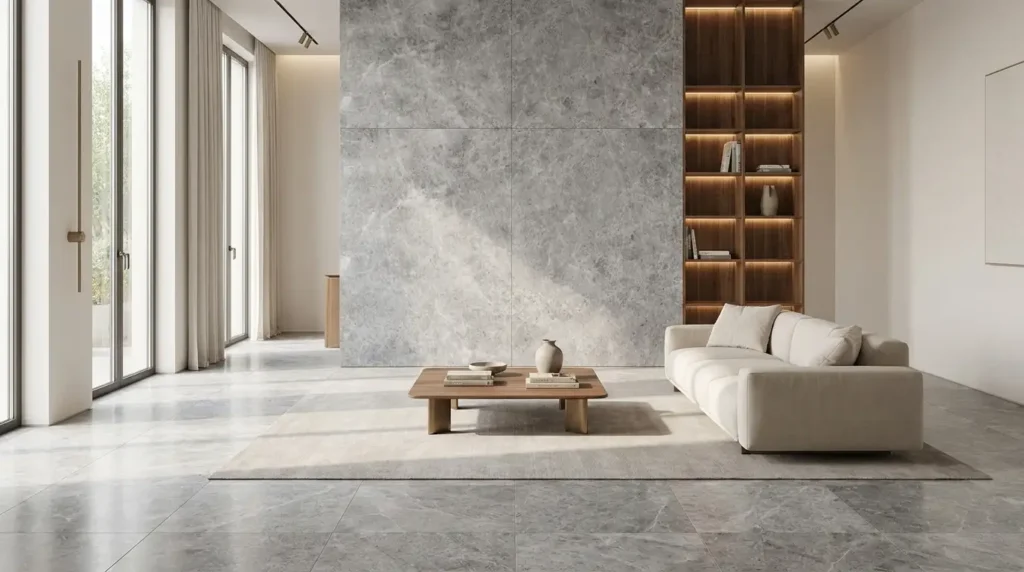
Tundra Grey marble is one of those natural stones that can quietly transform an interior without demanding all of the attention.
Its soft grey background, subtle white and light-grey veining, and occasional warmer undertones give it a balanced character that works particularly well in contemporary architecture. Tundra Grey is a Turkish marble and is commercially used for applications including flooring, wall cladding and worktops.
Unlike heavily patterned statement marbles, Tundra Grey usually creates its impact through consistency and restraint. That makes it particularly useful for large architectural surfaces where a dramatic material could become visually overwhelming.
In this guide, we look at the most important Tundra Grey marble applications, available finishes, design combinations and practical maintenance considerations.
What Is Tundra Grey Marble?
Tundra Grey is a natural grey marble quarried in Türkiye. It is recognized for a muted grey background crossed by relatively delicate veins in white, light grey and, in some selections, warmer beige or taupe tones.
Because it is natural stone, every slab is different. The density, direction and contrast of the veining can vary from one block or slab to another.
This variation is important.
When Tundra Grey is being specified for a large project, slabs should ideally be evaluated as a group rather than selected from a small sample alone. The visual consistency required for a bathroom floor may be very different from the movement desired for a feature wall.
Why Is Tundra Grey Marble Popular in Interior Design?
The main advantage of Tundra Grey is versatility.
Its neutral colour allows it to sit between warmer beige stones and cooler architectural greys. This makes it easier to combine with timber, metal, glass, white stone and neutral interior finishes.
It can work in:
- minimalist residential interiors
- luxury bathrooms
- hotel projects
- commercial interiors
- contemporary kitchens
- reception areas
- wall features
- large-format flooring
The material can be expressive enough to provide natural variation while remaining restrained enough to cover larger surfaces.
That balance is one of its strongest characteristics.
Tundra Grey Marble Applications
1. Tundra Grey Marble Flooring
Flooring is one of the most recognizable uses of Tundra Grey.
Large-format grey marble flooring can create visual continuity across an interior, particularly in open-plan spaces where too many different materials could make the architecture feel fragmented.
Tundra Grey is commercially offered for flooring applications, although the appropriate finish and expected level of wear need to be considered for each project. Brachot, for example, notes that polished Tundra Grey flooring is better suited to lower-wear areas such as bathrooms.
This distinction matters.
Choosing natural stone flooring is not simply a question of choosing a colour. You also need to consider:
- pedestrian traffic
- finish
- slip requirements
- tile dimensions
- joint layout
- maintenance
- wet or dry conditions
- indoor or outdoor use
For residential spaces with the right specification, Tundra Grey flooring can create a sophisticated and continuous architectural surface.
Where can it work?
Potential interior applications include:
- living rooms
- entrance areas
- bathrooms
- bedrooms
- corridors
- residential common areas
- selected hotel interiors
For commercial or high-traffic areas, the technical suitability of the exact finish and installation system should be evaluated for the project.
2. Tundra Grey Marble Bathrooms
Tundra Grey is particularly well suited to bathrooms because the colour palette naturally complements the restrained atmosphere often desired in spa-style interiors.
It can be used for:
- bathroom floors
- shower walls
- vanity surrounds
- feature walls
- bath surrounds
- wall tiles
- custom cut-to-size elements
Using the same marble across the floor and walls can create a monolithic appearance.
Alternatively, designers can use Tundra Grey on the floor and introduce a lighter stone on the walls to create contrast.
Because bathrooms are wet environments, surface finish, sealing requirements, installation and slip characteristics should always be determined according to the actual application rather than appearance alone.
3. Tundra Grey Wall Cladding
Wall cladding allows Tundra Grey to be used on large surfaces without exposing the material to the same wear conditions as flooring.
Brachot specifically lists wall cladding among the typical uses for the stone.
This can be particularly effective for:
- reception walls
- hotel lobbies
- bathroom feature walls
- fireplace walls
- elevator surrounds
- retail interiors
- residential feature walls
A polished finish can make the veining more pronounced, while a honed finish produces a quieter architectural appearance.
For large walls, slab selection and layout become especially important. Random installation can create abrupt changes in tone or vein direction.
A planned layout usually provides a more refined result.
4. Tundra Grey Kitchen Countertops and Worktops
Tundra Grey is also commercially supplied for worktop applications.
Its grey palette works especially well in kitchens where the designer wants natural stone without the strong visual movement of highly veined white or coloured marbles.
It can pair effectively with:
- white cabinetry
- warm oak
- walnut
- black cabinetry
- brushed metal
- cream finishes
- darker natural stone accents
However, it is still marble.
Kitchen users should therefore understand that acidic substances and inappropriate cleaning products can affect marble surfaces. Natural Stone Institute guidance recommends avoiding acidic products such as cleaners containing lemon or vinegar on marble.
For a heavily used kitchen, material expectations should be discussed before specification.
5. Vanity Tops
Tundra Grey is a strong candidate for bathroom vanity tops because its subdued grey palette works naturally with mirrors, timber cabinetry, metal fixtures and white sanitary ware.
A vanity also allows the marble to be repeated elsewhere in the room.
For example:
Tundra Grey vanity + Tundra Grey shower wall + neutral flooring
can establish continuity without covering every surface with the same material.
6. Staircases
Grey marble can work particularly well on staircases because the material visually connects different levels of an interior.
Tundra Grey is commercially used for stairs as well as flooring and larger interior surfaces.
Depending on the design, it may be used for:
- stair treads
- risers
- landings
- wall skirting
- adjacent cladding
Edge design and finish should be selected according to the project’s technical and aesthetic requirements.
7. Hotel and Commercial Interiors
The relatively neutral appearance of Tundra Grey makes it useful for larger hospitality and commercial applications.
Suppliers list applications including hotel bars, lobby areas and large interior surfaces.
Potential project areas include:
- hotel bathrooms
- reception counters
- lobby floors
- corridors
- restaurant walls
- bar fronts
- retail spaces
- office reception areas
For larger projects, material selection becomes particularly important because multiple slabs or batches may need to create one consistent architectural composition.
Tundra Grey Marble Finishes
The same marble can look surprisingly different depending on its finish.
Polished Tundra Grey
Polishing creates a smoother and more reflective surface.
It generally makes:
- grey tones appear deeper
- veins more noticeable
- the surface more reflective
- the stone feel more formal
A polished finish can work particularly well on walls, vanity surfaces and decorative applications.
For flooring, however, use conditions should be carefully considered. As noted above, Brachot recommends polished Tundra Grey flooring primarily for areas with lower wear demands.
Honed Tundra Grey
A honed finish has a softer, more matte appearance.
For contemporary interiors, this is often one of the most interesting options because it emphasizes the natural character of the material without adding strong reflections.
Honed Tundra Grey can pair particularly well with:
- oak
- walnut
- matte cabinetry
- brushed metal
- textured fabrics
- cream limestone
- warm white interiors
It often creates a quieter and more architectural appearance than polished marble.
Brushed Tundra Grey
Some suppliers also offer Tundra Grey with brushed processing in addition to polished and honed finishes.
A brushed finish introduces more tactile character and can be useful when the designer wants the material to feel less formal.
The exact appearance can vary considerably depending on the processing method, so an actual finished sample should always be reviewed.
What Colors Work with Tundra Grey Marble?
One advantage of Tundra Grey is that it can move in several design directions.
Tundra Grey + Warm White
Probably the safest combination.
Warm white prevents the interior from becoming too cool while allowing the marble’s grey structure to remain visible.
Tundra Grey + Oak
Light or medium oak introduces natural warmth.
This works particularly well in contemporary bathrooms and kitchens.
Tundra Grey + Walnut
Walnut creates a richer and more luxurious contrast.
This combination is especially effective for:
- vanity units
- kitchen cabinetry
- custom furniture
- hotel interiors
Tundra Grey + Black
Black details can make the marble feel more architectural.
Examples include:
- black-framed shower screens
- dark cabinetry
- black lighting
- metal trims
- black taps
Use dark elements strategically rather than covering every surrounding surface in black.
Tundra Grey + Cream-Coloured Stone
Brachot specifically notes that Tundra Grey pairs effectively with cream-toned marbles.
This can create an interesting balance between cool grey and warmer natural stone.
How to Select Tundra Grey Slabs for a Project
For larger projects, do not evaluate the material from one close-up photograph.
Look at the complete slabs.
Pay attention to:
Background Colour
Is the grey:
- warm?
- cool?
- light?
- medium?
- consistent between slabs?
Vein Density
Some slabs may be relatively calm.
Others may contain more visible white movement.
Vein Direction
For flooring or long wall elevations, directional veining can become part of the architecture.
Slab Compatibility
If several slabs will be installed together, view them together before fabrication whenever possible.
Final Finish
A polished slab and honed slab can appear significantly different even when they come from the same material.
The sample should therefore represent the final finish whenever possible.
How to Clean Tundra Grey Marble
Tundra Grey should be maintained according to normal natural-marble care principles.
For routine cleaning, the Natural Stone Institute recommends a neutral cleaner, stone soap or mild liquid dishwashing detergent with warm water. It also recommends using a soft cloth on surfaces, rinsing after cleaning and drying with a soft cloth.
A practical routine is:
- Remove loose dirt and dust.
- Use a soft cloth or suitable mop.
- Apply a pH-neutral natural-stone cleaner.
- Avoid excessive quantities of cleaner.
- Rinse where necessary.
- Dry the surface.
This is usually far better than trying to achieve aggressive cleaning with strong household chemicals.
What Should You Avoid on Tundra Grey Marble?
Avoid acidic cleaners.
Products containing substances such as:
- vinegar
- lemon
- acidic bathroom cleaners
- inappropriate descaling products
can damage calcareous natural stone.
The Natural Stone Institute specifically advises against using products containing lemon, vinegar or other acids on marble.
A product being labelled as a powerful household cleaner does not mean it is suitable for natural stone.
Always check compatibility first.
Does Tundra Grey Marble Need Sealing?
Whether a specific Tundra Grey installation should be sealed depends on the material, finish and application.
Natural Stone Institute guidance explains that sealers can improve stain resistance but do not make stone stain-proof, and that the need for sealing should be evaluated based on the actual stone and application.
For areas such as:
- kitchen worktops
- vanity tops
- bathroom installations
- other surfaces exposed to liquids
discuss the appropriate treatment with the stone supplier, fabricator or installer.
Avoid applying random sealers without confirming their suitability for the stone and finish.
Is Tundra Grey Marble Suitable for Exterior Use?
This question needs to be handled carefully.
Some suppliers market Tundra Grey for both interior and exterior applications, while individual installations can be affected by finish, climate, freeze-thaw exposure, installation system and the specific stone selection.
For this reason, exterior suitability should be confirmed technically for the specific project rather than assumed from a product photograph or generic description.
For facades, exterior paving or exposed architectural elements, consult the stone supplier and project engineer before specification.
Tundra Grey vs Dramatic Marble
Tundra Grey serves a very different design purpose from highly expressive stones such as Calacatta Viola or Rosso Levanto.
A dramatic marble says:
Look at the stone.
Tundra Grey often says:
Look at the architecture.
That makes it particularly useful when the natural stone should support the overall interior rather than dominate it.
Its muted grey appearance provides texture and geological character without requiring every other design element to be restrained around it.
Where Does Tundra Grey Work Best?
Tundra Grey is particularly compelling for projects that need:
- neutral natural stone
- contemporary grey tones
- large continuous surfaces
- understated veining
- compatibility with timber and metal
- residential and hospitality applications
- a material that does not visually overpower the architecture
Its commercial applications include flooring, wall cladding and worktops, with other suppliers also listing bathroom surfaces, stairs, hotel bars and lobby areas.
Final Thoughts
The appeal of Tundra Grey marble is not based on dramatic colour or oversized veins.
Its strength is restraint.
The soft grey background and subtle natural movement make it adaptable to bathrooms, floors, walls, kitchens, vanity tops, stairs and larger architectural projects.
Finish selection can completely change its character. Polished Tundra Grey can feel more refined and reflective, while honed finishes create a softer architectural look.
The most important step is to treat it as natural stone rather than a standardized manufactured surface.
Review the actual slabs. Choose the finish according to the application. Plan the layout. Use suitable cleaning products. And confirm technical suitability for demanding environments.
When these decisions are made correctly, Tundra Grey can provide a calm and timeless natural-stone foundation for both residential and commercial interiors.
Frequently Asked Questions
What is Tundra Grey marble?
Tundra Grey is a Turkish natural marble characterized by a muted grey background with delicate white and light-grey veining, sometimes accompanied by warmer beige or taupe nuances.
Where can Tundra Grey marble be used?
Typical applications include flooring, wall cladding and worktops, while suppliers also offer it for bathrooms, stairs, vanity surfaces, hotel bars and lobby areas.
Is Tundra Grey suitable for bathrooms?
Yes, it is commercially used for bathroom applications. The correct finish, installation method, waterproofing and maintenance requirements should be chosen according to the specific project.
How should Tundra Grey marble be cleaned?
Use a neutral stone cleaner, stone soap or suitable mild cleaner with warm water and a soft cloth. Avoid acidic cleaning products.
Is polished or honed Tundra Grey better?
It depends on the application. Polishing creates greater reflection and emphasizes colour and veining, while honing creates a softer matte appearance. For flooring, wear and slip requirements should also be considered.