
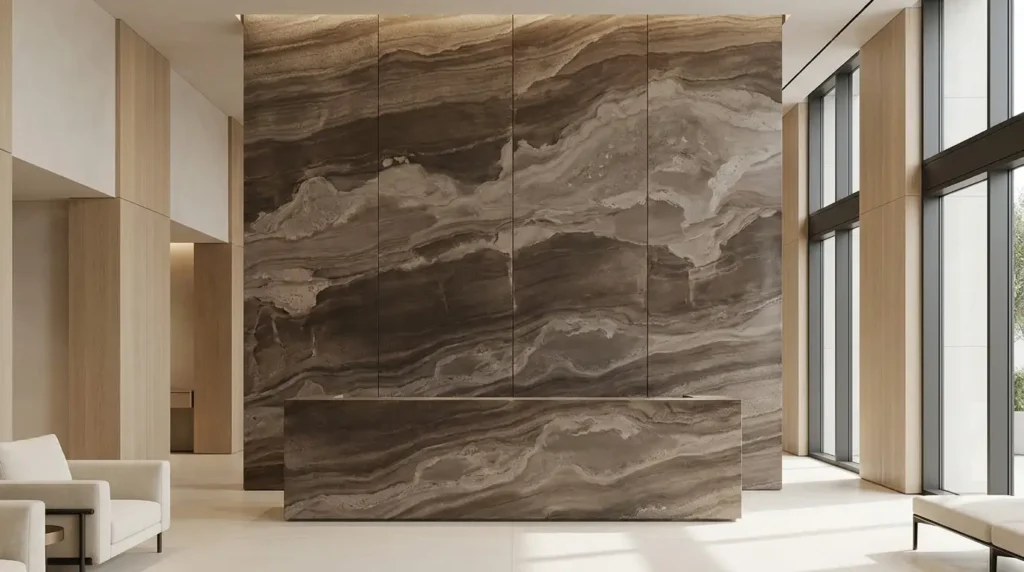
Brown natural stone can create an architectural atmosphere that is difficult to achieve with white, beige or grey marble.
It introduces:
- warmth
- visual depth
- earth tones
- natural layering
- material richness
without automatically requiring bright color.
Narcisse marble is a particularly distinctive example.
Its surface can combine deep cedar brown, mocha, taupe, muted grey and lighter beige mineral movement in a layered, cloudy composition.
Unlike stones dominated by sharp linear veins, Narcisse often feels softer and more atmospheric.
The pattern may resemble:
- flowing earth layers
- smoke
- mineral clouds
- timber-like movement
- geological sediment
- abstract landscape formations
Narcisse is a Turkish natural stone associated with Afyonkarahisar and is commercially supplied in block, slab, tile and other architectural formats. Quarry documentation also uses the term Narcisse trabej for the material.
It can work particularly well in:
- hotel interiors
- feature walls
- flooring
- bathrooms
- reception areas
- staircases
- fireplaces
- restaurants
- vanity tops
- custom furniture
- luxury residences
The strongest projects, however, begin with understanding the actual slab.
Narcisse has enough natural movement that slab selection, cutting layout and tonal control can significantly change the finished architecture.
What Is Narcisse Marble?
Narcisse is a Turkish decorative natural stone known for its warm brown and layered visual structure.
Commercial descriptions typically show a palette containing:
- cedar brown
- mocha
- dark brown
- taupe
- soft grey
- beige
- occasionally almost black details
with gradual transitions between these colors.
The stone is widely marketed within the marble category.
However, quarry documentation also describes the material as trabej, while some international trade listings have used travertine-related terminology.
For this reason, architects should avoid making technical assumptions based exclusively on the commercial category.
When structural or performance requirements matter, refer to:
- the actual supplied stone
- quarry documentation
- current technical test reports
- approved samples
- specified finish
rather than assuming that every stone marketed under the Narcisse name has identical characteristics.
Narcisse or Narcis Marble?
International searches may show several spelling variations.
These can include:
- Narcisse Marble
- Narcis Marble
- Narcisse Brown Marble
- Narcisse Mocha Marble
The most established commercial spelling found in quarry and product documentation is Narcisse.
For SEO and project documentation, using:
Narcisse Marble
as the primary name is the clearest approach.
Alternative spellings can remain useful as search terms.
Where Does Narcisse Marble Come From?
Narcisse is associated with Türkiye, and current material references specifically connect it with the Afyonkarahisar region.
Quarry documentation records dedicated Narcisse production dating back to 2007 and describes its use in major architectural and hospitality projects.
For international architectural procurement, the commercial name should still be accompanied by the appropriate project documentation where necessary.
This may include:
- country of origin
- production source
- approved slab photographs
- sample approval
- technical test data
The name identifies the stone family.
The actual project material defines the finished result.
What Does Narcisse Marble Look Like?
Narcisse is visually very different from conventional beige marble.
Its background is generally much deeper and more complex.
Common visual tones may include:
- medium brown
- deep brown
- mocha
- coffee
- muted taupe
- grey-brown
- pale beige movement
The pattern is often layered rather than sharply veined.
This produces a sense of depth.
A slab may contain areas that transition gradually from:
dark mocha
to
taupe grey
to
lighter brown
without an obvious hard boundary.
This characteristic makes the material particularly useful in sophisticated interiors where the stone should feel rich but not excessively graphic.
Calm vs Dramatic Narcisse Selections
Not every slab has the same amount of movement.
Calm Selection
May contain:
- relatively consistent brown background
- softer transitions
- limited strong contrast
- larger quiet areas
This can work well for:
- flooring
- staircases
- large commercial areas
- repeated hotel applications
Balanced Selection
May contain:
- brown and mocha background
- visible taupe movement
- lighter cloudy bands
- moderate natural contrast
This is highly versatile for:
- bathrooms
- reception areas
- wall panels
- custom furniture
Dramatic Selection
May show:
- deeper dark-brown areas
- larger grey or beige movement
- stronger cloudy structures
- more pronounced layering
These slabs may be especially effective for:
- feature walls
- fireplaces
- reception desks
- dining tables
The most dramatic slab is not automatically the best selection.
The application should determine the stone.
Why Full-Slab Selection Matters
A small sample cannot communicate the full character of Narcisse.
Imagine a sample cut from a dark section.
The stone might appear almost uniformly chocolate brown.
Another sample taken from a lighter mineral band could appear:
- taupe
- grey-brown
- beige
Both samples may come from the same slab.
For important applications, review:
- full-slab photographs
- several slabs together
- overall brown tone
- dark areas
- lighter bands
- pattern direction
- slab dimensions
- available quantity
This creates a much more realistic expectation.
Narcisse for Feature Walls
Large wall panels are one of the strongest applications for Narcisse.
The reason is scale.
The layered pattern becomes much more impressive when it is allowed to flow across a large surface.
Possible applications include:
- hotel lobby walls
- reception backgrounds
- living rooms
- restaurants
- executive offices
- entrance halls
- luxury retail interiors
Large panels allow the stone to display:
- color transitions
- cloudy structures
- deeper brown areas
- natural direction
without being interrupted repeatedly by joints.
Large Panels vs Small Tiles
Small pieces can work for some applications.
But highly expressive slabs often benefit from larger formats.
Larger panels provide:
- fewer joints
- stronger pattern continuity
- greater material scale
- more visible geological character
For a major statement wall, the panel dimensions should be coordinated with:
- slab dimensions
- ceiling height
- openings
- furniture
- lighting
- installation requirements
The stone wall should be designed, not simply covered.
Planning a Narcisse Feature Wall
A useful workflow is:
- Finalize the wall dimensions.
- Identify doors and openings.
- Determine panel dimensions.
- Photograph the actual slabs.
- Position wall panels digitally.
- Review darker and lighter areas.
- Adjust the layout.
- Approve.
- Begin fabrication.
This makes it possible to decide whether the strongest natural movement should appear:
- in the center
- around a fireplace
- behind a reception desk
- toward one side
rather than allowing it to happen randomly.
Can Narcisse Be Bookmatched?
Depending on slab sequence and natural pattern, mirrored arrangements may be possible.
Narcisse can create an unusual type of symmetrical composition because its movement is generally:
- cloudy
- layered
- flowing
rather than defined only by sharp veins.
A mirrored arrangement may create large abstract shapes.
Possible applications include:
- reception walls
- fireplaces
- hotel lobbies
- bathrooms
- private dining rooms
However, bookmatching should not be automatic.
Some slabs may look more natural when arranged according to directional flow.
Bookmatch vs Natural Flow
Bookmatch
Can create:
- strong symmetry
- larger abstract forms
- decorative focal points
- greater visual drama
Natural Flow
Can create:
- softer transitions
- less formal composition
- architectural continuity
- greater natural movement
Always preview both options before fabrication.
Narcisse for Hotel Interiors
Hospitality architecture is particularly compatible with Narcisse.
The stone’s warm brown palette can create a luxurious atmosphere without relying on bright metallic finishes or highly decorative materials.
Possible hotel applications include:
- lobby flooring
- reception walls
- reception desks
- elevator surrounds
- premium bathrooms
- restaurant interiors
- fireplaces
- staircases
- custom furniture
Quarry documentation records Narcisse as a material used in hospitality, commercial and luxury residential projects.
Narcisse for Hotel Lobbies
A contemporary lobby might combine:
Narcisse marble
warm cream limestone
dark walnut
warm white plaster
dark bronze metal.
Narcisse can be used strategically rather than everywhere.
For example:
light neutral floor
Narcisse reception wall
can make the brown stone far more noticeable.
Narcisse Reception Desk
A custom reception desk is another strong application.
Possible components include:
- front cladding
- countertop
- side returns
- background wall
The layered brown pattern works particularly well on large simple geometric volumes.
The desk itself does not need elaborate shapes.
The stone provides the character.
Pattern Continuity on Reception Furniture
If several visible faces meet, plan the stone relationships before cutting.
Important faces may include:
- top
- front
- side
A dark band can sometimes be continued visually around a corner.
Perfect geological continuity is not always possible.
The objective is to avoid obviously unrelated pieces meeting accidentally.
Narcisse for Flooring
Narcisse can create a sophisticated brown natural-stone floor.
Commercial documentation lists tiles and project-format production alongside slabs and blocks.
Possible applications include:
- hotel lobbies
- villas
- living rooms
- entrance halls
- offices
- restaurants
- corridors
For large floors, a more balanced selection is usually easier to manage than the most dramatic slab group.
Why Brown Flooring Works
Brown is naturally compatible with many architectural materials.
It can connect visually with:
- walnut
- oak
- bronze
- beige stone
- cream fabric
- warm plaster
Unlike a dark black floor, brown can provide depth while maintaining warmth.
Unlike a pale beige floor, it can create greater contrast.
Large Narcisse Floors
For large flooring areas, control:
- dark-brown distribution
- grey-taupe pieces
- lighter areas
- direction
- tile dimensions
- joint layout
Random installation may create one unusually dark corner and another much lighter area.
The complete floor should be considered as one visual composition.
Dry Layout
For major projects, pre-arrange pieces before installation.
Review:
- darker pieces
- lighter pieces
- major patterns
- neighboring pieces
- overall tonal balance
After approval, pieces can be numbered.
This is especially useful when a large quantity contains substantial natural variation.
Narcisse for Living Rooms
Brown natural stone fits particularly well in contemporary living spaces.
A simple composition may use:
Narcisse fireplace or wall
warm white plaster
cream upholstery
light oak flooring.
The stone introduces visual depth without making the room completely dark.
Narcisse for Fireplaces
A full-height fireplace wall can display the material particularly effectively.
The cloudy brown movement gives the surface enough interest even if the fireplace itself is extremely minimal.
A possible palette:
Narcisse
black fireplace opening
light oak
warm white
creates strong contrast.
Technical requirements around heat should always follow the actual fireplace construction system.
Narcisse for Bathrooms
Brown stone can create very sophisticated bathrooms.
Possible applications include:
- shower walls
- vanity tops
- vanity walls
- flooring
- bathtub surrounds
- niches
- shelves
A luxury bathroom could combine:
Narcisse wall
light oak vanity
cream plaster
brushed bronze fixtures
light stone floor.
The lighter materials prevent the brown stone from making the room feel too heavy.
Narcisse Shower Walls
Large-format panels allow the pattern to remain visible.
Before fabrication, coordinate:
- shower controls
- niches
- shelving
- panel joints
- glass fixing points
- corners
Do not allow the most interesting natural transition to disappear accidentally behind an opening.
Narcisse Vanity Tops
A vanity may use a particularly attractive portion of a slab.
Plan:
- sink opening
- faucet position
- backsplash
- edge profile
- side returns
before the slab is cut.
The strongest natural movement should remain visible wherever practical.
Narcisse for Staircases
Narcisse can produce highly architectural staircases.
Possible components include:
- treads
- risers
- landings
- side cladding
- skirting
Brown stone works especially well when the staircase is surrounded by lighter architecture.
For example:
Narcisse stairs
warm white walls
glass balustrade
walnut handrail
can create a strong contemporary composition.
Planning Stair Selection
Review all pieces together.
Avoid placing:
- several very dark treads together
- then several pale pieces
unless the contrast is intentional.
A controlled sequence produces a more coherent result.
Narcisse for Restaurants
Restaurants can use deeper stone colors very effectively because lighting is often warmer and more controlled.
Possible applications include:
- bar fronts
- host desks
- wall panels
- fireplace walls
- bathroom vanities
- dining tables
- selected floors
Narcisse works particularly well when combined with:
- walnut
- bronze
- warm cream
- black metal
Narcisse for Bar Areas
A bar can use the material on:
- front panels
- countertop
- side faces
- background wall
Warm grazing light can reveal the layered brown and taupe movement.
However, countertop use should always consider the actual material’s:
- absorption
- chemical sensitivity
- finish
- maintenance requirements
rather than relying only on its commercial stone category.
Narcisse for Custom Furniture
Narcisse can be especially effective for furniture.
Possible elements include:
- dining tables
- coffee tables
- side tables
- consoles
- display plinths
- stone benches
Its brown coloration integrates naturally with timber interiors.
This makes it easier to introduce large stone furniture without creating excessive contrast.
Narcisse Dining Tables
A dining table can display a particularly expressive slab.
Depending on selection, the table may appear:
- relatively calm
- deeply layered
- almost timber-like
- dramatically cloudy
Before fabrication, consider:
- slab dimensions
- support system
- thickness
- edge profile
- pattern position
- weight
Narcisse Coffee Tables
Smaller remnants from slab fabrication can be especially useful for:
- coffee tables
- side tables
- consoles
A smaller piece containing strong natural movement may create more visual impact on furniture than it would as part of a large floor.
This can also improve overall material yield.
Polished Narcisse
Polished surfaces are commercially available for Narcisse.
Polishing can emphasize:
- darker mocha tones
- stronger contrast
- deeper color
- greater reflections
The result can feel:
- formal
- luxurious
- richer
Polished Narcisse may work particularly well for:
- feature walls
- reception desks
- furniture
- vanity tops
- selected floors
Honed Narcisse
Honed surfaces are also documented for the material.
Honing generally reduces reflection.
The stone may then appear:
- softer
- more matte
- slightly lighter
- more contemporary
This finish works particularly well with:
- oak
- walnut
- mineral plaster
- matte metal
- linen
Polished vs Honed Narcisse
Choose Polished When You Want:
- stronger brown depth
- more reflection
- richer color
- formal interiors
Consider Honed When You Want:
- reduced glare
- contemporary architecture
- softer mineral movement
- more restrained surfaces
Ideally, compare the same material selection in both finishes.
Brushed and Textured Finishes
Quarry documentation also lists additional treatments such as:
- brushed
- sandblasted
- bush-hammered
- line-textured
among available surface options.
However, this does not mean every finish is equally suitable for every application.
Finish selection should consider:
- location
- traffic
- slip requirements
- desired texture
- maintenance
- actual production sample
For a premium project, approve the real surface rather than relying only on the finish name.
Filled vs Unfilled Treatments
Historic product documentation for Narcisse also lists both filled and unfilled honed surfaces.
This is important because surface treatment can substantially alter the appearance.
More Filled Surface
May appear:
- smoother
- more controlled
- easier to visually integrate into refined interiors
More Open Natural Surface
May emphasize:
- natural cavities
- geological texture
- stronger tactile character
The correct approach depends on the actual stone and intended application.
How Finish Changes Narcisse
A polished slab may appear significantly darker than a honed or textured version.
Polished
May emphasize:
- dark coffee
- chocolate brown
- charcoal-taupe
- deeper mineral movement
Honed
May emphasize:
- muted mocha
- taupe
- softer grey-brown
Textured
May make the stone appear:
- lighter
- drier
- more tactile
- more architectural
This means finish should be part of color approval.
How Lighting Changes Narcisse
Lighting has a major influence on brown stone.
Natural Daylight
May reveal:
- grey undertones
- true brown coloration
- subtle mineral variation
Warm Artificial Light
May emphasize:
- chocolate
- mocha
- warm taupe
- beige
Cool Artificial Light
May emphasize:
- grey-brown
- charcoal
- cooler taupe
The same slab can look surprisingly different under different lighting conditions.
Avoid Excessively Warm Lighting
Brown stone already contains warmth.
If it is combined with:
- very yellow lighting
- dark red wood
- bright gold
- beige everywhere
the interior may become overly warm.
A balanced palette can include:
- warm neutral lighting
- cream
- light oak
- dark metal
to preserve contrast.
Narcisse + Light Oak
This is one of the strongest contemporary combinations.
Light oak provides:
- brightness
- warm natural texture
- softer contrast
Narcisse provides:
- darker mineral depth
- brown and taupe movement
The result can feel luxurious without becoming formal.
Narcisse + Walnut
Walnut creates a more tonal composition.
Both materials contain brown, but their structures are different.
Narcisse provides:
- mineral clouds
- stone depth
Walnut provides:
- linear organic grain
- warmer timber coloration
The combination works especially well in:
- hotels
- restaurants
- living rooms
- executive interiors
Narcisse + Warm White
Warm white creates essential visual space around the dark brown stone.
Use it on:
- walls
- ceilings
- cabinetry
- furniture
One large Narcisse surface can then remain the focal element.
Narcisse + Cream
Cream creates a sophisticated low-contrast palette.
A hotel interior might use:
cream limestone floor
Narcisse reception desk
cream furniture
walnut wall panels.
The brown stone becomes the deepest color in the composition.
Narcisse + Black Metal
Black or charcoal metal can make the brown stone feel more contemporary.
Use it for:
- window frames
- lighting
- furniture bases
- fireplace openings
- thin profiles
The darker metal creates definition without introducing another competing natural pattern.
Narcisse + Bronze
Brushed bronze complements the brown palette naturally.
Possible applications include:
- bathroom fixtures
- lighting
- furniture legs
- handles
- architectural trims
Keep the metal restrained.
The stone already provides enough visual richness.
Narcisse + Beige Stone
A lighter beige natural stone can provide a neutral foundation.
For example:
beige flooring
Narcisse feature wall
creates a clear architectural hierarchy.
This is particularly useful in large hospitality projects where using Narcisse across every surface could become too dark.
Narcisse + Afyon White
White marble can create strong contrast.
Afyon White can provide:
- brightness
- calmer mineral movement
while Narcisse provides:
- brown depth
- layered movement
Possible strategy:
Afyon White floor
Narcisse reception desk.
The darker material immediately becomes the focal point.
Narcisse + Silver Travertine
This creates a sophisticated earthy-grey palette.
Silver Travertine contributes:
- grey
- sedimentary layering
- visible texture
Narcisse contributes:
- deeper brown
- mocha
- cloudy movement
The relationship is more subtle than a white-and-black combination.
Narcisse + Alexander Black
Both are dark stones, but their visual characters differ.
Alexander Black provides:
- black background
- strong white veins
- graphic contrast
Narcisse provides:
- brown
- taupe
- layered clouds
- softer transitions
If both are used, one should remain clearly secondary.
Otherwise the interior may become too dark.
Narcisse vs Dark Emperador
These stones can occupy similar brown interior palettes, but should not be treated as interchangeable names.
Actual materials can differ in:
- origin
- brown tone
- vein structure
- cloudy movement
- background consistency
Narcisse is particularly recognizable for its layered brown, mocha and taupe structure.
For a project, compare full slabs rather than assuming every brown marble behaves visually the same.
Narcisse vs Brown Travertine
This comparison is particularly relevant because Narcisse’s trade descriptions can reference layered or trabej characteristics.
Traditional brown travertine may display:
- clear sedimentary bedding
- natural pores
- strong vein-cut direction
Narcisse may show:
- denser-looking cloudy movement
- broad brown and taupe transitions
- a more marble-like commercial presentation
Because trade terminology around Narcisse is not entirely uniform, technical specification should always follow the actual supplied material and its test documentation.
Narcisse vs Burdur Beige
These stones create completely different levels of visual depth.
Burdur Beige
Provides:
- light beige
- neutral background
- bright warm interiors
Narcisse
Provides:
- dark brown
- mocha
- taupe
- stronger visual depth
Burdur Beige works naturally as a primary floor.
Narcisse can work especially well as a feature stone.
Narcisse vs Crema Marfil
Crema Marfil provides:
- cream
- ivory
- pale beige
Narcisse provides:
- deeper brown
- grey-brown
- mocha
They can actually work very well together.
For example:
cream floor
Narcisse fireplace
creates a warm but clearly contrasted palette.
How to Select Narcisse Slabs
Start with the architectural goal.
1. Define the Brown Range
Do you want:
- lighter mocha
- medium brown
- deep chocolate?
2. Define Grey Content
Some slabs may contain more visible grey or taupe movement.
3. Define Pattern Intensity
Do you want:
- calm
- balanced
- dramatic?
4. Review Full Slabs
Small samples are insufficient.
5. Review Several Slabs Together
Especially for large walls.
6. Confirm Usable Dimensions
Large architectural pieces require suitable slabs.
7. Select the Finish
Polished, honed or textured?
8. Prepare the Cutting Layout
Before fabrication.
Selecting Narcisse for Flooring
For large flooring projects, prioritize:
- compatible brown tones
- controlled variation
- relatively balanced movement
Highly dramatic slabs may be better reserved for vertical applications.
Selecting Narcisse for Walls
Feature walls can accommodate stronger natural movement.
Look for:
- interesting dark-light transitions
- broad cloudy structures
- compatible neighboring slabs
The strongest slab may deserve the most visible architectural position.
Selecting Narcisse for Furniture
Furniture can use particularly expressive areas.
A dining table or coffee table can become almost an individual stone artwork.
This also allows smaller slab sections to be used intelligently.
Cutting Layout
For slab-based custom work:
- Finalize dimensions.
- Photograph the real slabs.
- Add accurate scale.
- Place the components.
- Mark openings.
- Review the main patterns.
- Check corners.
- Calculate yield.
- Approve.
- Fabricate.
This process improves both aesthetics and material efficiency.
Material Yield
The visually strongest slab is not always the most efficient.
Suppose a feature wall requires three tall panels.
One dramatic slab may create beautiful movement but produce significant waste.
Another slab may allow:
- larger panels
- fewer joints
- better yield
The correct decision depends on:
- budget
- visual importance
- available quantity
Premium stone planning requires balancing both.
Natural Variation Is Part of the Material
Expect differences in:
- brown depth
- taupe content
- grey movement
- lighter areas
- pattern density
This should not automatically be treated as a defect.
The objective is to define an acceptable visual range.
Natural stone should look natural.
Piece Numbering
For complex projects, connect:
drawing
→
stone piece
→
crate
→
installation position.
This becomes particularly important when the slab arrangement has already been approved.
Random installation can destroy carefully planned transitions.
How to Clean Narcisse
Care should begin with the actual geological and mineral classification of the supplied material.
Natural-stone guidance recommends determining whether a stone is primarily calcareous or siliceous before selecting cleaning chemicals.
For routine maintenance, a conservative approach is:
- Remove dust and grit.
- Clean spills promptly.
- Use a soft cloth or suitable mop.
- Use a pH-neutral cleaner intended for natural stone.
- Avoid aggressive abrasives.
- Avoid acidic products unless compatibility has been specifically confirmed.
- Rinse and dry appropriately.
This avoids unnecessary chemical risk.
Can Vinegar Be Used on Narcisse?
Vinegar should not be treated as a standard natural-stone cleaner.
Natural-stone guidance states that acidic products can dull or etch calcium-carbonate-based stones and recommends mild non-acidic cleaners for calcareous materials.
Because commercial terminology around Narcisse includes marble and trabej-related descriptions, the safest project practice is to avoid vinegar unless specific testing of the actual supplied stone proves compatibility.
Why Stone Classification Matters for Maintenance
Two stones that look visually similar may have different chemistry.
Their reactions to:
- acid
- cleaning products
- impregnating treatments
- surface restoration
may therefore differ.
This is why technical stone care should follow the actual material rather than the color.
Etching vs Staining
These are different problems.
Staining
Occurs when a substance penetrates the stone.
Etching
Occurs when a chemical reaction changes the stone surface.
An etched area may appear:
- dull
- lighter
- less reflective
- locally different in texture
This distinction matters because cleaning a stain and restoring an etched surface require different approaches.
Should Narcisse Be Sealed?
There is no universal treatment requirement for every natural stone application.
An impregnating treatment may improve stain resistance where appropriate.
However, natural-stone guidance emphasizes that impregnators do not make stone completely stain-proof.
The decision should consider:
- actual material
- absorption
- finish
- application
- exposure
- maintenance expectations
Does Sealing Make Stone Acid-Proof?
No.
Even where an impregnating treatment is appropriate, it should not be presented as universal protection from acidic attack.
For calcium-carbonate-based materials, technical guidance notes that a sealer can reduce but does not eliminate vulnerability to acids.
Stone-specific testing should guide the final recommendation.
Dust and Grit on Narcisse Floors
Sand and grit can abrade natural stone flooring.
Routine maintenance should include:
- effective entrance mats
- regular dust removal
- suitable cleaning equipment
Natural-stone care guidance specifically identifies sand, dirt and grit as abrasive materials that can damage stone floors.
This is especially relevant for:
- hotels
- restaurants
- commercial entrances
Narcisse in High-Traffic Areas
For high-traffic flooring, consider:
- actual test data
- finish
- expected traffic
- cleaning program
- entrance protection
- installation system
- spare material
The same stone used successfully on a hotel wall may require a different specification when used on a busy floor.
Exterior Applications Require Verification
Some commercial references describe Narcisse for exterior use, while quarry documentation also lists more heavily textured finishes.
However, this should not be interpreted as universal approval for every exterior condition.
Exterior specification should consider:
- current technical test data
- climate
- freeze-thaw exposure
- water absorption
- finish
- panel dimensions
- fixing system
- local codes
The actual project conditions must determine suitability.
Keep Spare Material
For significant projects, retaining material from the approved production can be valuable.
Future material may differ in:
- brown tone
- pattern
- grey content
- finish
Original spare pieces can simplify later:
- repairs
- replacements
- alterations
This is particularly useful in hospitality and commercial projects.
Common Mistakes with Narcisse Marble
1. Selecting from a Small Sample
The complete cloudy movement cannot be understood.
2. Assuming Every Slab Is the Same Brown
Natural tonal variation is significant.
3. Ignoring Grey and Taupe Content
Some selections are warmer; others are more grey-brown.
4. Using the Most Dramatic Slabs Across a Large Floor
The result can become visually busy.
5. Cutting Before Preparing a Layout
Important patterns may be lost.
6. Ignoring Finish
Polished and honed Narcisse can look substantially different.
7. Assuming the Commercial Category Defines All Technical Properties
Project specifications should rely on actual material documentation.
8. Using Acidic Cleaning Products Without Confirming Compatibility
Maintenance should follow actual mineral composition.
9. Assuming Sealing Makes Natural Stone Stain-Proof
It does not.
10. Making the Entire Interior Brown
Use lighter supporting materials to create contrast.
How to Plan a Narcisse Project
A practical workflow is:
1. Define the Application
Wall, floor, bathroom, stairs, reception or furniture?
2. Define the Desired Brown Range
Light mocha, medium brown or deep brown?
3. Define Pattern Intensity
Calm, balanced or dramatic?
4. Select the Finish
Polished, honed or textured?
5. Review Full Slabs
Not only samples.
6. Review the Complete Quantity
Make sure several slabs work together.
7. Confirm Dimensions
Especially for large panels.
8. Prepare the Cutting Layout
Before fabrication.
9. Review Major Pattern Areas
Protect the strongest natural transitions.
10. Dry Lay Important Pieces
Where necessary.
11. Number Custom Components
Preserve the approved arrangement.
12. Perform Quality Control
Before packing, confirm:
- dimensions
- finish
- selection
- numbering
- visible condition
- packing
Is Narcisse Suitable for Large Projects?
It can be very effective when the visual range is controlled.
Historic quarry documentation specifically records use in large hospitality, commercial and luxury residential projects.
Potential project types include:
- hotels
- villas
- restaurants
- offices
- luxury residences
- shopping environments
- hospitality developments
For very large quantities, define:
- brown range
- acceptable grey content
- pattern density
- finish
- dimensions
before major production begins.
Why Narcisse Works in Contemporary Architecture
Brown stone is sometimes associated with traditional luxury.
Narcisse does not have to feel traditional.
Consider:
honed Narcisse wall
light oak
warm white plaster
black metal
cream furniture.
The result can be highly contemporary.
The stone supplies:
- depth
- color
- natural pattern
while the architecture remains restrained.
Brown Does Not Have to Mean Dark Architecture
A strong approach is contrast.
Instead of creating an entirely dark room, use Narcisse against:
- large windows
- pale flooring
- cream furniture
- warm-white walls
One dark brown surface will then become much more powerful.
Use Narcisse Strategically
Because the material contains substantial visual depth, it often works best as a selected feature.
A hotel might use:
one Narcisse reception wall.
A living room might use:
one Narcisse fireplace.
A bathroom might use:
one Narcisse shower wall.
A dining room might use:
one Narcisse table.
The stone does not need to appear everywhere to define the interior.
Final Thoughts
Narcisse marble, also searched as Narcis marble, is a distinctive Turkish brown natural stone characterized by a rich combination of:
- mocha
- cedar brown
- deep brown
- taupe
- soft grey
- lighter mineral movement.
Commercial and quarry documentation associates the material with Türkiye and records Narcisse in block, slab, tile and architectural project formats. Quarry descriptions also use the term Narcisse trabej, which makes stone-specific technical documentation particularly important for engineering specifications.
Its visual strength comes from depth rather than sharp graphic veining.
Narcisse can be considered for:
- feature walls
- flooring
- bathrooms
- fireplaces
- reception areas
- staircases
- restaurants
- custom furniture
- hospitality interiors
- residential projects
But successful use depends on more than selecting a brown stone name.
The project should consider:
actual slab selection
brown and taupe range
pattern intensity
finish
dimensions
cutting layout
tonal distribution
installation
maintenance.
Review full slabs.
Select calm material for large surfaces when appropriate.
Reserve expressive areas for focal applications.
Compare polished and honed finishes under realistic lighting.
Plan important pieces before cutting.
Verify technical performance using current documentation for the actual supplied material.
Use appropriate neutral natural-stone cleaners.
And do not assume that an impregnating treatment makes natural stone completely stain-proof or acid-proof.
When these decisions are coordinated correctly, Narcisse can create a warm, sophisticated and contemporary architectural identity without requiring excessive decoration.
Frequently Asked Questions
What is Narcisse marble?
Narcisse is a Turkish decorative natural stone commercially supplied within the marble category and recognized for its layered brown, mocha, taupe and grey natural movement.
Is Narcis marble the same as Narcisse marble?
Narcis Marble is used as an alternative spelling in some international stone listings, while Narcisse is the spelling used in established quarry documentation.
Where does Narcisse marble come from?
The stone is associated with Türkiye, with current material references connecting Narcisse to the Afyonkarahisar region.
What color is Narcisse?
It generally combines medium-to-dark brown, mocha, taupe and soft grey tones with layered or cloudy natural movement.
Is Narcisse marble or travertine?
Commercial terminology is not completely uniform. Quarry documentation describes the source as Narcisse trabej while product catalogs market the stone within the marble category, and some trade listings use travertine terminology. For technical specification, the actual supplied material and current test documentation should take priority.
Can Narcisse be used for flooring?
Yes. The material is commercially supplied in tile and slab formats and has been used in architectural projects. The actual selection, finish and performance requirements should match the intended floor.
Can Narcisse be used in bathrooms?
Yes. It can be considered for walls, vanity surfaces and suitable flooring applications with appropriate specification, fabrication and maintenance.
Can Narcisse be polished?
Yes. Polished and honed surfaces are documented among available Narcisse finishes.
Is polished or honed Narcisse better?
Neither is universally better. Polishing generally deepens the brown tones and increases reflection, while honing creates a softer, lower-reflection contemporary surface.
Can Narcisse be bookmatched?
Suitable slab sequences may allow mirrored arrangements, but the actual cloudy and layered pattern should be digitally previewed before fabrication.
How should Narcisse be cleaned?
Use a suitable pH-neutral natural-stone cleaner and avoid aggressive abrasives or unverified acidic cleaning products. Stone-care recommendations should follow the mineral composition of the actual supplied material.
Should Narcisse be sealed?
Treatment requirements depend on the actual stone, finish and application. An appropriate impregnating treatment may improve stain resistance but does not make natural stone completely stain-proof.
Can Narcisse be used outdoors?
Exterior use should be evaluated according to the actual material, technical test data, climate, finish and installation system rather than assumed from the commercial stone name.
Looking for Narcisse Marble for Your Project?
VeraMarbles can support residential, hospitality and commercial projects requiring Narcisse marble.
Send us your:
- required quantity
- application
- dimensions
- thickness
- preferred finish
- desired brown range
- preferred pattern intensity
- architectural drawings
- project location
We can support your project with:
- slab selection
- color and pattern control
- slabs
- tiles
- custom cutting
- cutting-layout planning
- pattern arrangement
- pre-installation layout
- piece numbering
- packing coordination
- quality control before shipment
Request a Quote from VeraMarbles