
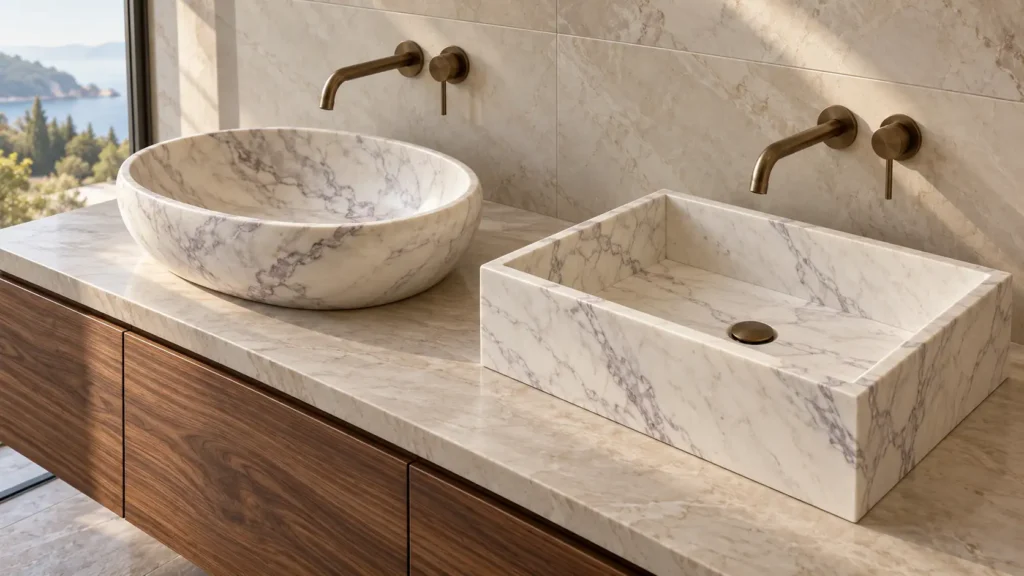
A marble sink can be carved from a stone block or assembled from cut stone components. Choose between them by reviewing the bowl geometry, material selection, joints, support and drainage detail together.
Neither description is a quality guarantee. A carved basin still needs an approved stone selection and workable internal shape. A fabricated basin needs clearly designed components and joints, alongside the same attention to daily use.
This guide focuses on natural marble bathroom basins. Kitchen sinks, laboratory fixtures and other specialist uses require a separate assessment of their exposure and performance requirements.
Carved and Fabricated Marble Sinks: The Difference
A carved basin is formed by removing material from a block. Production may combine machining and hand finishing; “carved” should not automatically be interpreted as entirely handmade.
A fabricated basin is assembled from separate pieces of stone. Its sides, base, apron and adjoining counter can be designed as a coordinated composition.
| Decision | Carved basin | Fabricated basin |
|---|---|---|
| Construction | Bowl formed within a stone block | Bowl assembled from separate components |
| Geometry to review | Internal curves, rim, base and remaining stone sections | Base falls, corner details, component thicknesses and joints |
| Visual approval | Actual block selection and proposed orientation | Piece selection, orientation and composition across joints |
| Main specification question | How is the complete form made and supported? | How are the components joined, supported and maintained? |
A deep front edge can belong to either construction. Confirm the assembly from a section drawing rather than judging it from a product photograph.
Start with the Bathroom Use
Define where the basin will be used and how it will be maintained.
A guest powder room, a primary bathroom and a hotel washroom can have different patterns of use. Discuss cleaning responsibilities, the intended toiletries and the owner’s expectations for surface change.
Agree the usable bowl size before choosing the external proportions. A substantial-looking basin can still have a small interior, while a broad shallow trough may need careful tap and drainage coordination.
Review the completed rim height with the vanity or stand beneath it. The basin’s external height is only one part of the user-facing dimension.
Approve the Internal Geometry, Not Just the Outline
An external plan and a front elevation do not fully describe a basin.
Provide sections through the bowl and waste outlet. Show the internal depth, changes of plane, corner treatment and the relationship between the rim and base.
For a carved basin, review how internal curves are formed and finished. For a fabricated bowl, identify every component and show how the base meets the sides.
Keep the cleaning routine in mind. Ask whether the proposed corners, joints and recesses can be reached using the approved cleaning method.
A visually sharp interior and an easy-to-maintain interior are different design decisions; resolve them using a representative sample where necessary.
Coordinate the Tap and Basin as One Arrangement
Confirm the exact tap before finalizing the bowl.
Review spout projection, outlet height, water landing position and handle access. Include the finished wall face and any backsplash in the section.
Do not assume that a tap selected for a ceramic basin will work equally well with a different stone bowl. Check the actual combination.
For a custom design, agree a practical review using the proposed tap or a representative arrangement. Assess handwashing space, splash behavior and drainage at the intended operating conditions before approving repeated production.
For double basins, check how two users occupy the vanity and where their storage and controls sit. Symmetrical stonework does not automatically provide a comfortable arrangement.
Specify the Waste Fitting Before Fabrication
The waste outlet is a component to coordinate, not a generic hole to add later.
Identify the proposed fitting and obtain its current dimensions and installation requirements. Confirm compatibility with the basin’s overflow arrangement, stone thickness at the outlet, sealing surfaces and access below.
The fabrication drawing should show:
- Outlet position and opening dimensions.
- Any required recess or seating surface.
- The stone section around the fitting.
- Space for the fixing nut and connections.
- Access for installation and future replacement.
If a stone cover conceals the waste, show how it is removed, supported and cleaned. A hidden outlet should remain serviceable.
Avoid approving the bowl while leaving the waste selection unresolved.
Make Drainage an Acceptance Item
Draw how the internal base directs water toward the outlet.
For a fabricated basin, show the intended changes of plane and their relationship to the joints. For a carved basin, define the required internal form rather than relying on the external shape to imply it.
Agree how drainage will be checked and what constitutes acceptance. Review the bowl with the selected waste fitting in place.
Look for unintended low points, water held at joints and obstructions created by the fitting or removable cover. Resolve the detail before releasing a production batch.
Do not describe a basin as tested unless the agreed checks have actually been performed and recorded.
Select the Stone Around the Finished Form
A slab or block photograph is a starting point. The finished basin exposes the stone across several planes and, in a carved design, through changing depths.
Review the proposed material and cutting orientation with the fabricator. Identify significant natural features, treatments or repairs that need assessment for the intended component.
For a fabricated sink, mark the base, sides and visible apron pieces on the material layout. Decide whether the veins should align, contrast or remain loosely coordinated.
For a carved basin, ask for representative views of the selected material and approval photographs at the agreed production stages.
The Afyon Violet marble guide can support the visual selection discussion for expressive white-and-violet stone. Material appearance alone does not establish suitability for a particular basin design.
Define Joints and Support Explicitly
For an assembled basin, specify the proposed joint arrangement, bonding materials and finishing approach with the fabricator. Confirm their suitability for the stone and intended exposure.
Identify visible joints and agree their appearance using a sample. Also establish what maintenance or repair process applies if a joint needs attention later.
For either construction, obtain the finished weight and agree how the basin is supported. Coordinate the cabinet, stand, brackets or wall construction as part of the installation design.
A thick-looking apron does not prove that the basin supports itself, and a countertop mounting position does not establish how the load reaches the supporting structure.
Include delivery access, lifting and installation clearances in the review.
Compare Complete Quotations
Carved and fabricated basins should be priced against the same functional brief.
Ask each supplier to identify the material, construction, finished dimensions, internal geometry, finish, waste fitting allowance, support scope, delivery and approval requirements.
A lower quote may exclude the waste, brackets, installation or a matching backsplash. A more expensive quote may describe a different stone selection or manufacturing scope.
Compare the inclusions before attributing the price difference to carving or fabrication alone. There is no universal cost ranking that applies to every basin.
VeraMarbles’ sinks and basins collection provides a starting point for discussing the proposed stone form and project requirements.
Set Realistic Care Expectations
The basin should suit the cleaning routine that will actually be used.
The Natural Stone Institute recommends suitable neutral cleaners for natural stone and explains the acid sensitivity of calcareous materials. It also describes impregnating treatments as repellents rather than products that make stone impervious. Natural Stone Institute care guidance
Agree the products and methods for the specific marble, finish and any joints. Distinguish surface etching from absorbed staining when setting the owner’s expectations.
A honed finish changes the appearance; it does not remove the need for compatible care. Neither should a sealer be presented as making a marble bowl maintenance-free.
Before You Approve Production
The approval package should bring together:
- Intended use, external dimensions and finished rim height.
- Construction method and component sections.
- Approved material, finish and visual range.
- Tap, waste and overflow coordination.
- Internal geometry and drainage acceptance checks.
- Joint details, finished weight and support arrangement.
- Delivery, installation, service access and care instructions.
For hospitality projects, approve a representative basin and its fitting arrangement before repeating the detail across multiple rooms.
Frequently Asked Questions
Is a carved marble sink always better than a fabricated sink?
No. Assess the actual material, design, workmanship, installation and maintenance requirements. The manufacturing description alone does not establish overall quality.
Can a fabricated sink look like one solid piece?
It can be designed with a continuous visual composition, but it still has an assembly of components. Confirm its construction and joint details rather than relying on the appearance.
Are all marble sinks supplied with an overflow?
No universal arrangement should be assumed. Confirm the basin design and specify a compatible waste and overflow configuration before fabrication.
Can the basin match the marble vanity top?
Potentially, subject to available material and the approved selection. Review the actual pieces together; matching commercial stone names do not guarantee identical tone or veining.
Discuss Your Marble Basin Design
VeraMarbles’ natural-stone project services include material selection, shop-drawing coordination, quality checks and production follow-up.
Share the basin plan and sections, preferred marble, tap and waste information, quantities and project location. State whether you are considering a carved form or an assembled basin so the proposed stone scope can be reviewed on a clear basis.